Kakejiku Restoration in Kobe, Japan | Our Swiss Clients’ 2nd Visit
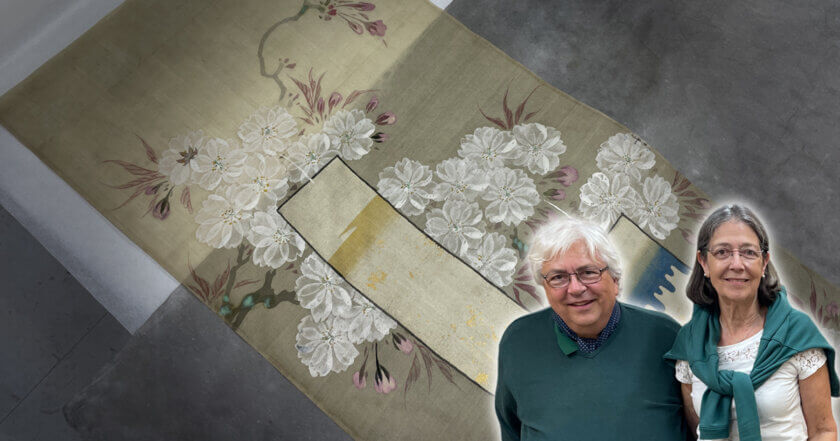
More than 10 years have passed since we began our international business, and during that time, we have had the pleasure of meeting many wonderful clients from around the world.
Some of these clients even travel all the way to our workshop in Japan, returning regularly to entrust us with the restoration of their precious kakejiku (Japanese hanging scrolls).
This time, we would like to share the story of a Swiss couple who visited our workshop for the 2nd time, having previously entrusted us with the restoration of several hanging scrolls.
You can read about their previous visit here:
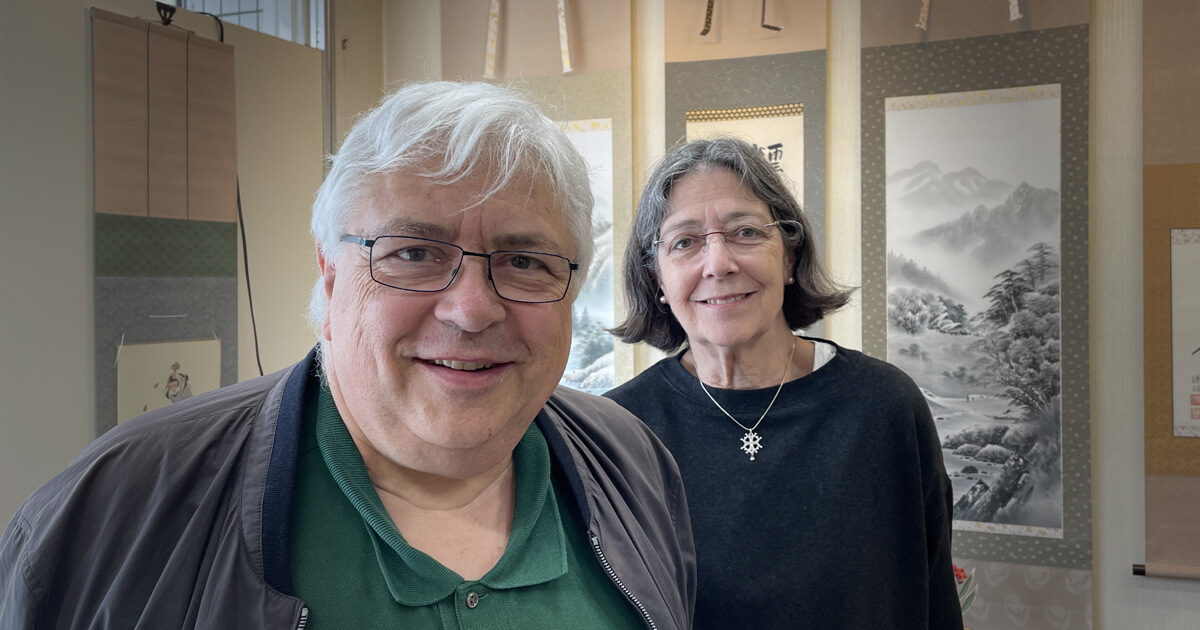
Their 2nd Visit to Our Workshop
Our visitors were a lovely couple from Switzerland.
On their previous visit, they had traveled from Kyoto by train. However, carrying numerous hanging scrolls and walking approximately 15 minutes from Tarumi Station to our workshop had proved rather exhausting.
This time, they decided to rent a car instead.
After our meeting, they planned to spend the night in Kobe before heading to Kansai International Airport for their return flight to Switzerland.
One of the great pleasures of their visits to Japan is searching for Japanese antiques and works of art. This time, too, they brought along a wonderful selection of paintings.
Handing Over the 8 Restored Kakejiku from Their Previous Visit
We began by handing over the 8 hanging scrolls they had entrusted to us for restoration during their previous visit.
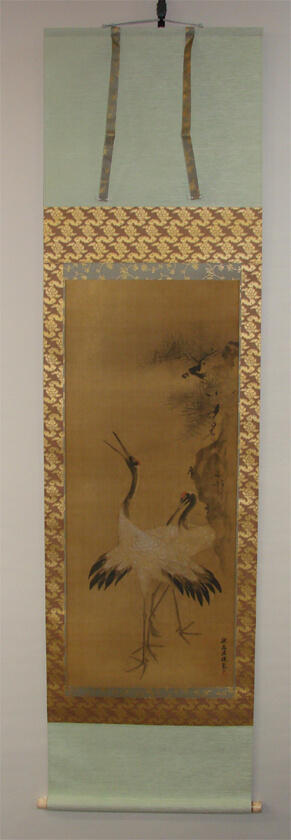
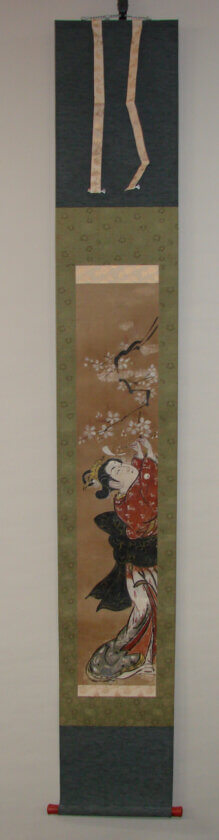
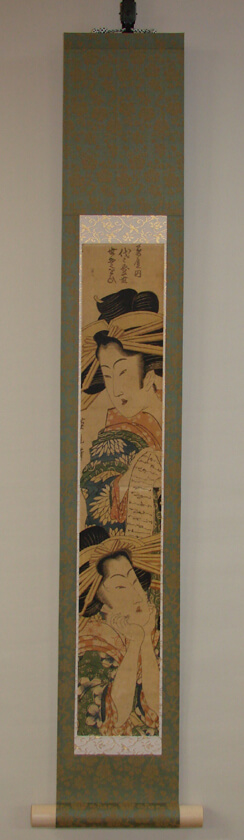
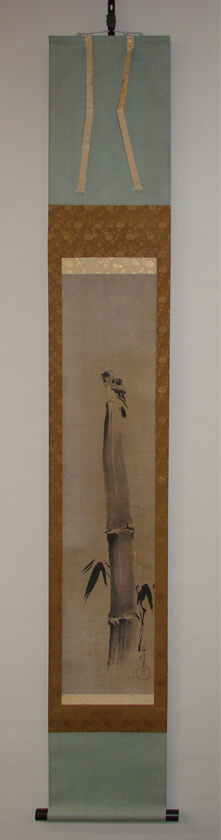
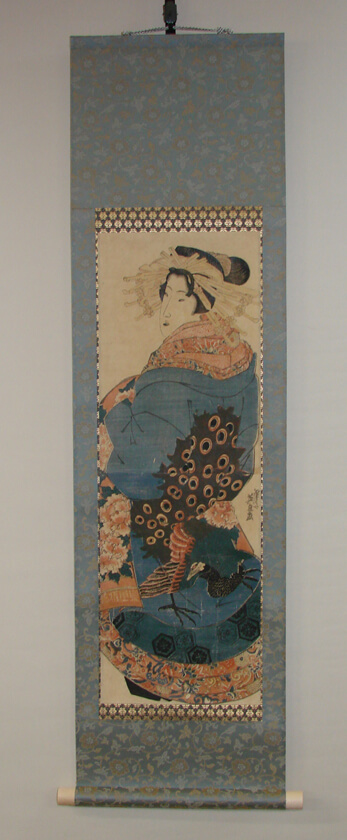
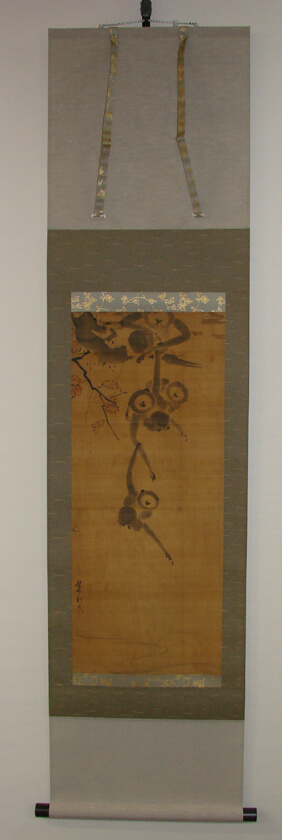
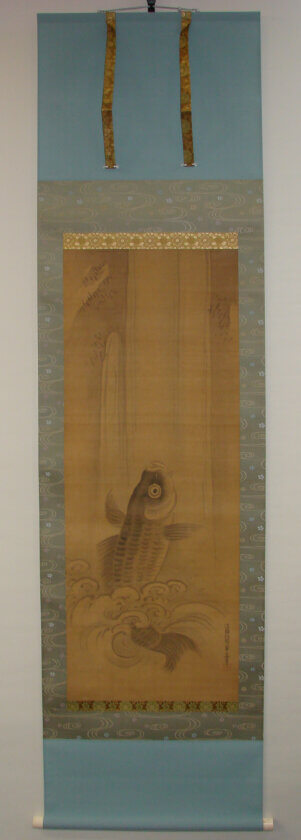
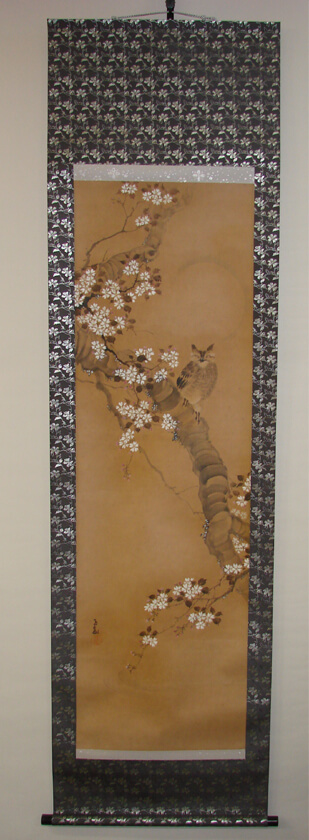
They were absolutely delighted with the results, repeatedly expressing their appreciation with comments such as “Perfect!”, “Superb!”, and “Good job!”
For a professional mounting and restoration craftsman, there is hardly a more rewarding moment.
Among the 8 scrolls, one in particular brought them tremendous joy.
As it turned out, this was a very special hanging scroll: the 1st hanging scroll they had purchased together.
The scroll had suffered such severe deterioration that the mounting specialist they had previously worked with had declined to restore it.
During their previous visit, they had brought the scroll to us, hoping that perhaps something could still be done.
To be fair, its condition was among the worst we had ever encountered. The scroll was extremely fragile and badly damaged, making its restoration a particularly challenging undertaking.
Nevertheless, since they had placed their trust in us, we were determined to do everything possible to make the scroll suitable for display once again.
With that goal in mind, we carefully assessed its condition and proceeded with the restoration, applying the techniques we considered most appropriate.
Eventually, we succeeded in restoring and remounting the artwork so that it could once again be displayed as a hanging scroll.
The couple were deeply moved to see their treasured scroll brought back to life.
It was one of those moments that made all the hard work truly worthwhile.
8 New Kakejiku Restoration Requests
Now, as if exchanging the 8 completed scrolls for another set, our clients had brought 8 new hanging scrolls for restoration.
We began by carefully unrolling each piece and examining its condition.
After assessing the damage and determining the necessary restoration work, we proposed suitable mounting fabrics, known as kireji, which are the decorative textiles used around the main artwork of a hanging scroll.
From there, we discussed their preferences and selected the colors, patterns, and overall mounting designs together.
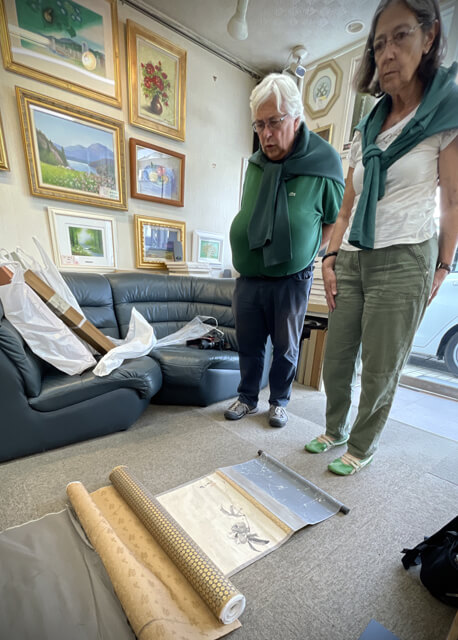
However, the couple did not seem to mind in the slightest.
As we talked, we learned that they were very familiar with custom-made furniture and curtains, and that they genuinely enjoyed selecting and combining different fabrics.
Well, that certainly explained it!
They approached the selection of mounting fabrics almost as though they were choosing materials for a new interior design project, thoroughly enjoying every moment.
Of course, both have a deep knowledge and appreciation of Japanese art, and they understand the individual characteristics of each painting remarkably well.
Perhaps that is why they were also surprisingly quick and decisive when choosing fabrics.
We began our meeting at 10:00 a.m. and continued until 5:00 p.m., with a lunch break in between.
Despite spending almost the entire day discussing the 8 scrolls, they showed no signs of fatigue whatsoever.
Quite remarkable, really!
We were once again thoroughly impressed by their enthusiasm and passion for Japanese art.
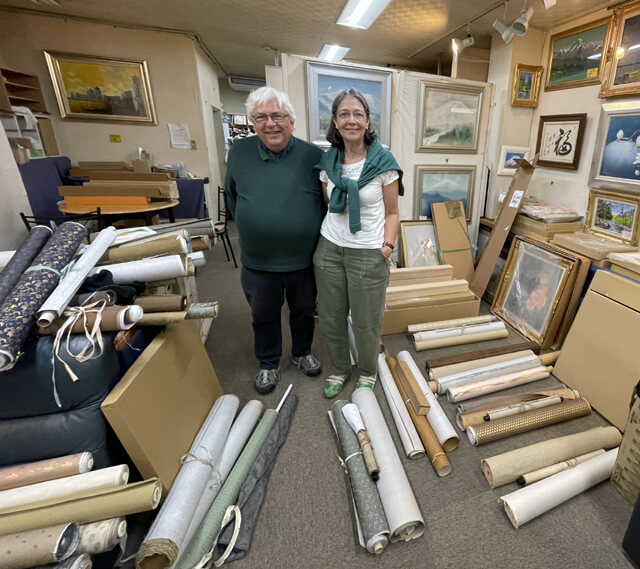
Here are the 8 hanging scrolls they entrusted to us for restoration. As you can see, all of them had suffered considerable deterioration.
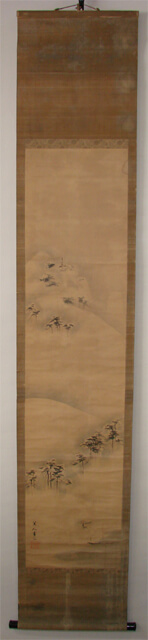
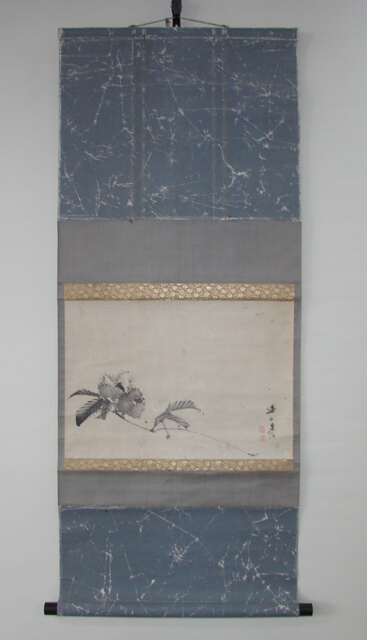
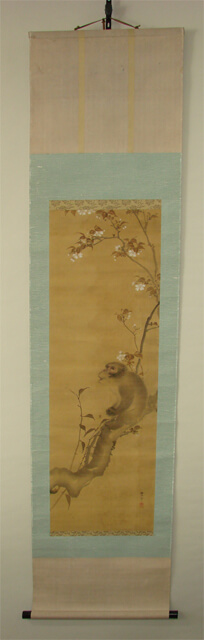
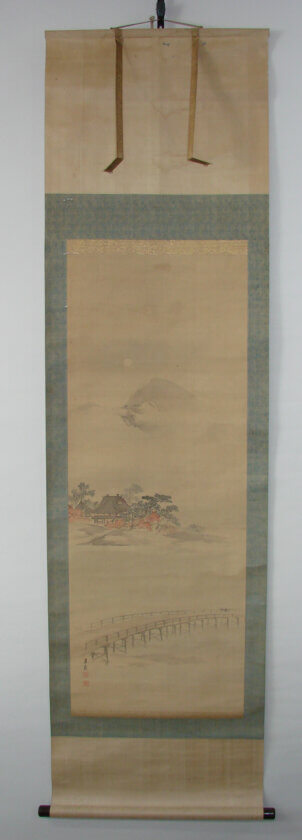
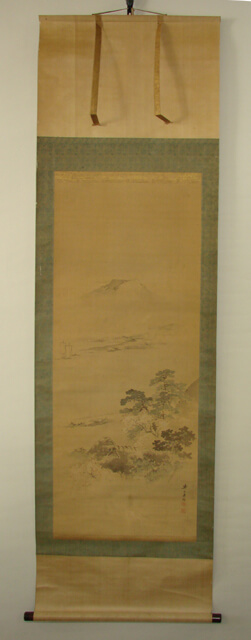
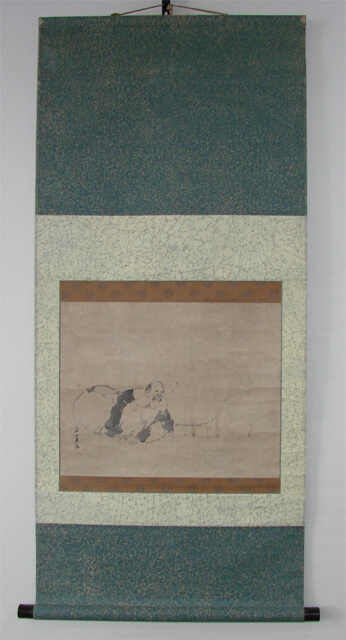
When restoring hanging scrolls that have deteriorated through age and long-term use, simply replacing the old mounting fabrics is not enough.
It is essential to assess the condition of the artwork itself, carry out any necessary reinforcement and restoration, and then remount it so that it can once again be safely displayed.
For this project, too, we would need to determine the most appropriate restoration approach for each individual work.
A Particularly Memorable Kakejiku Restoration
Although all 8 hanging scrolls were severely deteriorated, one piece was particularly memorable.
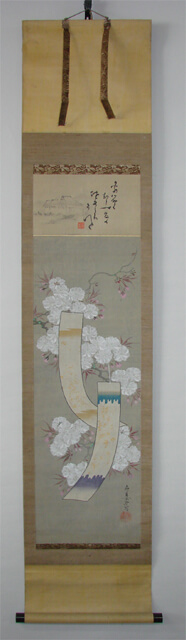
This hanging scroll consisted of 2 separate artworks mounted together, one above the other.
During the restoration process, however, we made an unexpected discovery.
When we began removing the old backing paper from the lower artwork, which depicts decorative poetry slips among cherry blossoms, we discovered that the paper had been specially colored gray.
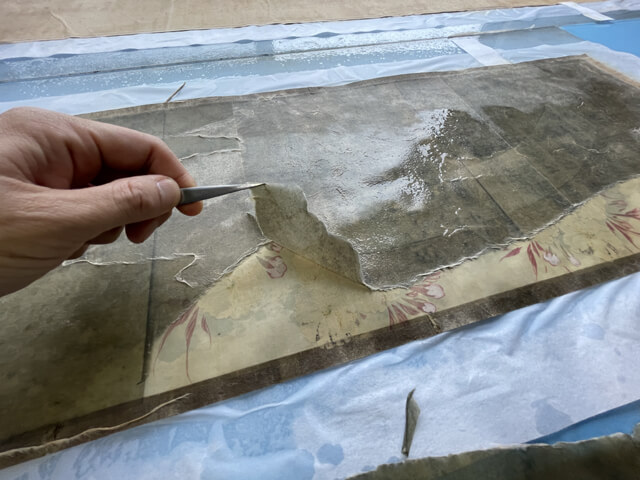
Backing paper is a layer of traditional Japanese paper, or washi, attached to the reverse of a painting or calligraphy work to provide support and reinforcement.
White or naturally colored washi is commonly used for this purpose. However, the color of the backing paper can sometimes have a significant effect on the appearance of the artwork.
For example, in paintings executed on silk, the color of the backing may be faintly visible through the woven fibers.
By using gray backing paper, the overall background of a painting can take on a more subdued tone, allowing white pigments such as gofun, a traditional Japanese white pigment made from finely ground shells, to stand out more vividly.
Interestingly, dark backing paper was also discovered during the restoration of Dōshoku Sai-e (Colorful Realm of Living Beings), the celebrated masterpiece by Itō Jakuchū, an extraordinary Japanese painter active in Kyoto during the Edo period (1603–1868).
Dōshoku Sai-e is a magnificent series of 30 hanging scrolls depicting plants and animals with extraordinary precision and vibrant colors.
Jakuchū employed various sophisticated painting techniques, including ura-zaishiki, a method of applying pigments to the reverse side of the silk.
Research conducted during the restoration of the series also revealed that the color of the backing paper played a role in the paintings’ visual appearance.
In other words, even the work carried out on the reverse of a painting by a mounting specialist can significantly influence its beauty.
Returning to our client’s hanging scroll, replacing the original gray backing with ordinary white paper could have altered the background tone and the appearance of the pigments.
Since we were undertaking the restoration, we wanted to preserve these original visual characteristics as faithfully as possible.
We therefore specially prepared gray-colored washi and used it to back the painting, aiming to reproduce a background tone close to the original.
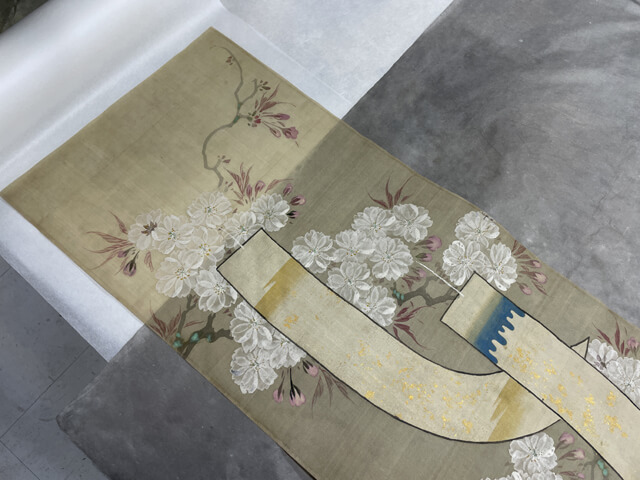
The upper sheet is ordinary washi, while the lower sheet is the specially prepared gray washi.
At first glance, this may seem like a minor difference.
However, paying attention to such subtle details is essential when preserving the original appearance and character of a work of art.
Restoration Completed
After a lengthy restoration process, we successfully completed the remounting of all 8 hanging scrolls. Remounting involves dismantling the old mounting, restoring and reinforcing the original artwork as necessary, applying new backing paper, and assembling the scroll with new mounting fabrics.
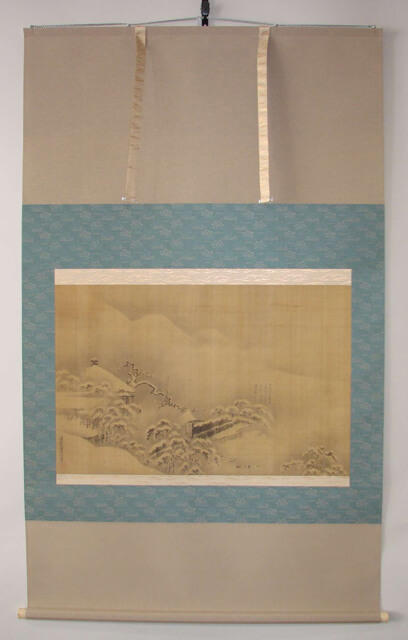
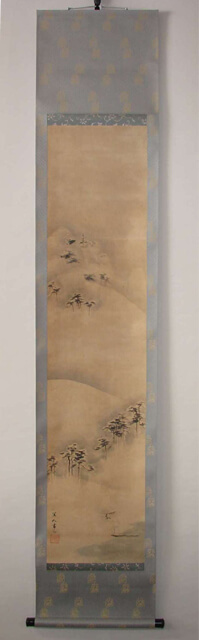
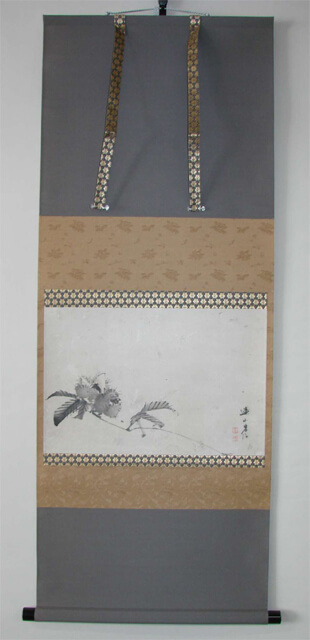
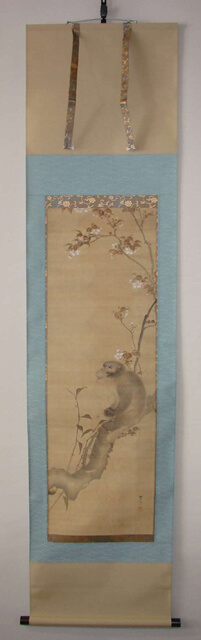
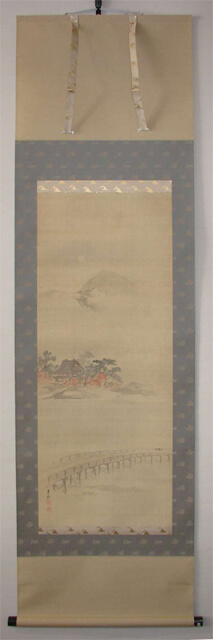
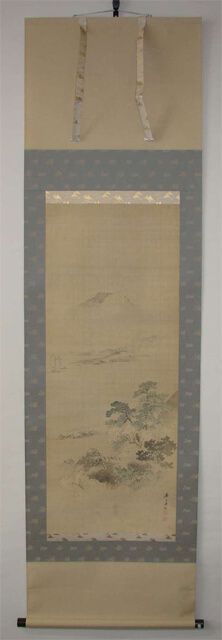
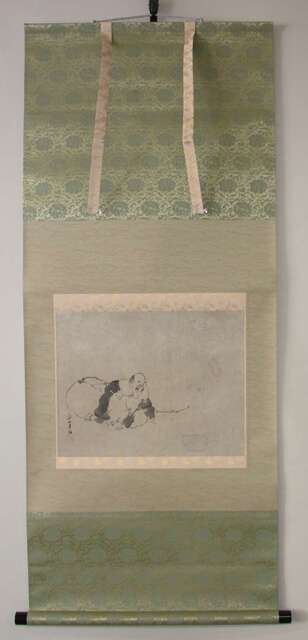
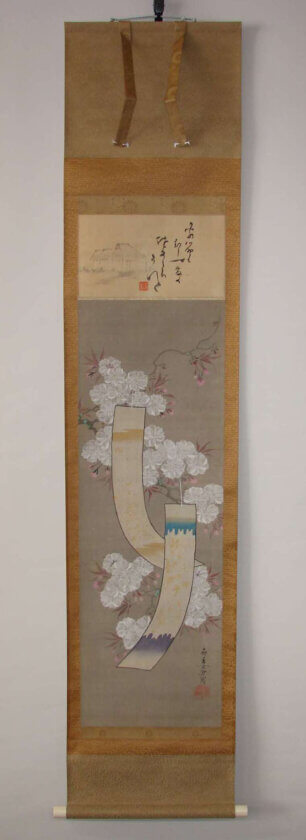
Every piece presented its own challenges during restoration, but the results were truly remarkable.
We selected different mounting fabrics for each artwork, carefully considering its individual atmosphere and the overall balance of the finished scroll.
Looking at them together, it is wonderful to see how each piece has developed its own distinctive character.
The hanging scroll restored using the specially prepared gray backing paper also turned out beautifully.
We believe we were able to preserve the original painting’s subdued background tone while bringing out the beauty of its white gofun pigments.
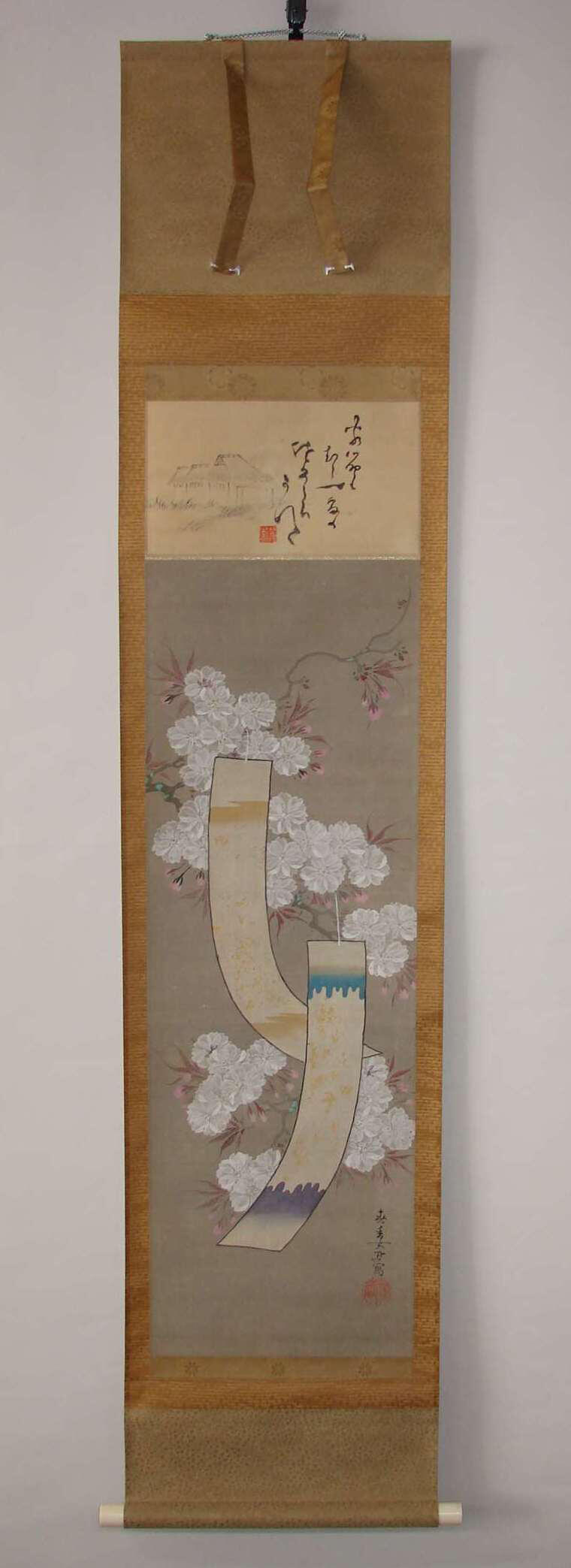
Although the backing paper is normally invisible from the front, paying attention to such hidden details is an essential part of preserving the original character of a work of art.
Transferring the Lids of Old Paulownia-Wood Boxes to New Boxes
In addition to restoring the hanging scrolls themselves, we also carried out some rather unusual work.
This involved transferring sections of the original paulownia-wood box lids to newly made storage boxes.
One of the scrolls entrusted to us was a large, wide-format painting depicting Mount Fuji, which had suffered extensive deterioration.
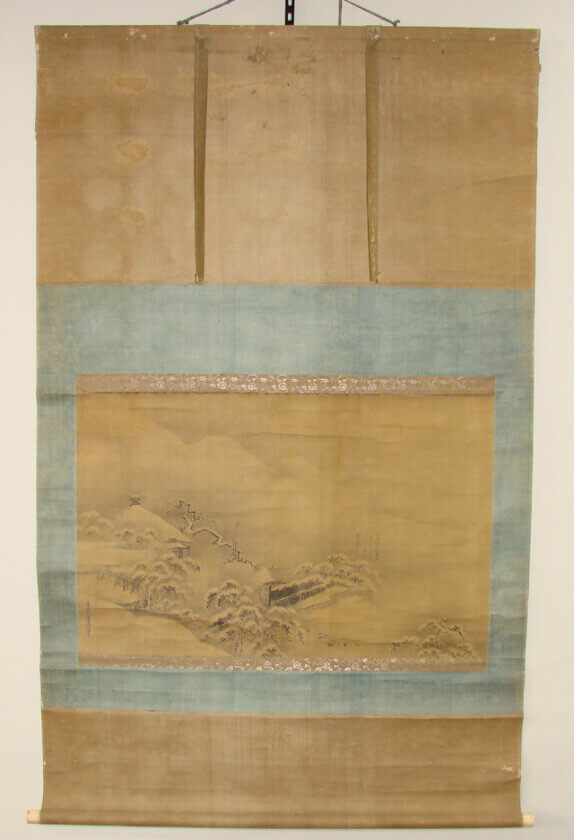
Because of its fragile condition, we recommended storing the restored scroll using a futomaki, a special thick cylindrical support designed to reduce the stress placed on a hanging scroll when it is rolled for storage.
By increasing the diameter around which the scroll is rolled, a futomaki helps reduce the risk of developing folds and creases.
This type of storage method can be particularly useful for severely damaged or weakened hanging scrolls.
For more information about futomaki, please see our related article:
However, there was one complication.
The Mount Fuji scroll already had an old paulownia-wood storage box, and its lid contained handwritten inscriptions and other information about the artwork.
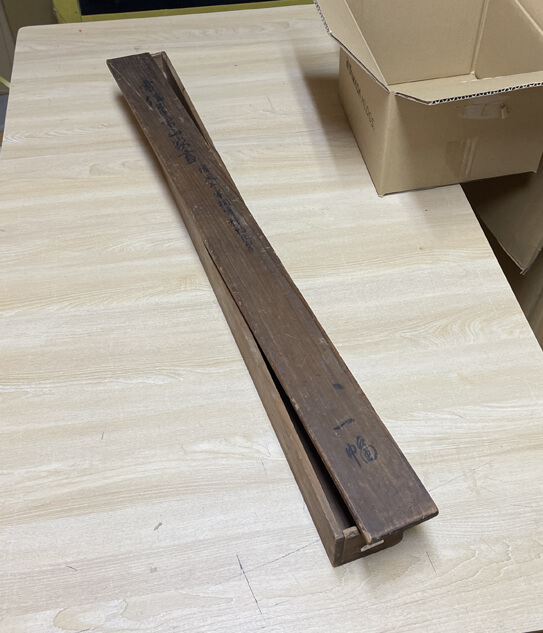
Such inscriptions, known as hakogaki, may record important details such as the title of a work or the name of its artist.
Therefore, even when an old storage box needs replacing, its lid cannot simply be discarded without considering the historical information it may contain.
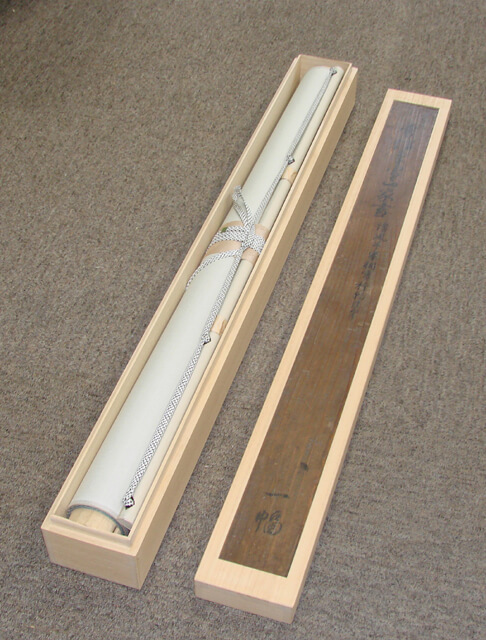
To preserve these valuable inscriptions, we carefully cut out the relevant section of the original lid and incorporated it into the lid of a newly made paulownia-wood box designed to accommodate the futomaki.
This allowed us to provide suitable storage for the restored hanging scroll while also preserving the information recorded on its original box.
We encountered a similar issue with the hanging scroll restored using the gray backing paper.
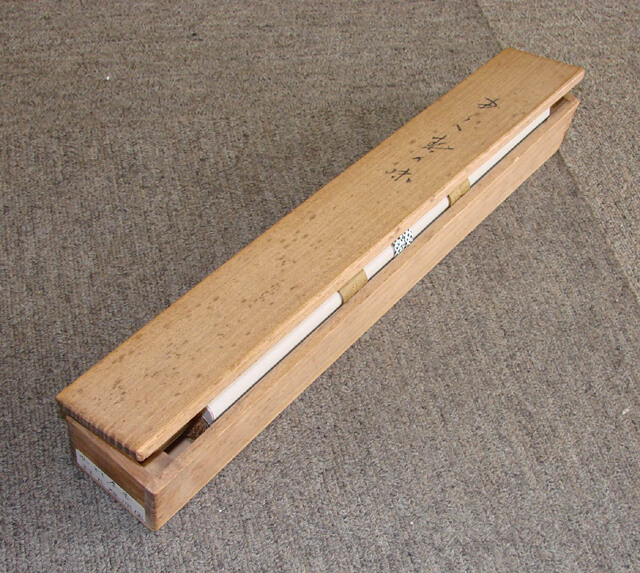
In fact, when an old hanging scroll is remounted, it is not unusual for it to become too large to fit into its original storage box.
Over time, the backing paper of an old scroll may deteriorate and become thinner, leaving the entire mounting weakened and compressed.
When the scroll is properly remounted with fresh backing paper, its overall thickness may increase.
As a result, the diameter of the rolled scroll can become larger than before.
In this particular case, the scroll had originally fitted inside its old box, although rather tightly.
After remounting, however, the rolled scroll had become thicker, and the lid of the original box would no longer close.
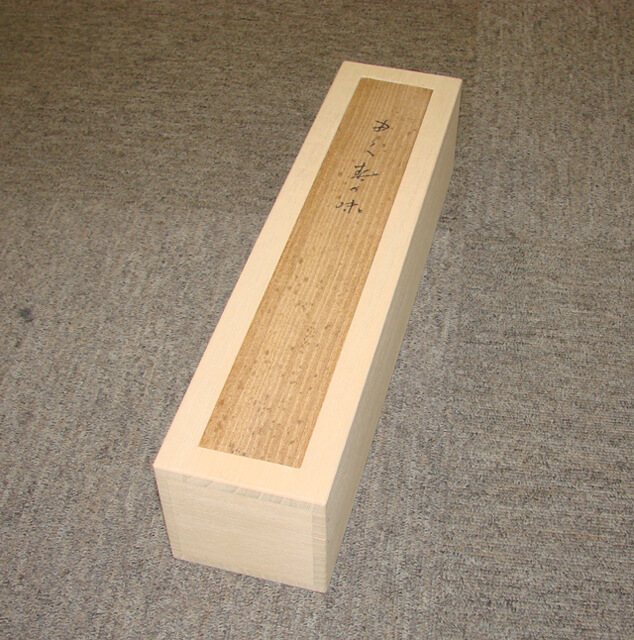
We therefore prepared a new paulownia-wood box with greater internal depth.
Once again, the original lid contained handwritten information that we wished to preserve.
As with the Mount Fuji scroll, we carefully transferred the inscribed section of the old lid to the new box.
The restored scroll could now be stored comfortably without forcing it into a box that was too small, while the historical information from the original box was also preserved.
Naturally, these additional modifications involved extra costs.
However, after we explained our recommendations, the couple readily agreed to both proposals.
They have a genuine and profound appreciation for Japanese art and culture.
For them, it is not simply a matter of displaying their paintings beautifully. They also want to ensure that their collection is properly cared for and preserved in the best possible condition for the future.
We were delighted to do everything we could to support that commitment.
When people think about hanging scroll restoration, their attention naturally tends to focus on repairing the artwork itself.
However, proper long-term preservation also requires consideration of accessories such as paulownia-wood storage boxes and futomaki.
We believe that preserving not only the artwork itself but also the historical information and materials associated with it is an important part of responsible kakejiku restoration.
Conclusion
Once again, we had a truly enjoyable and rewarding time with our visitors from Switzerland.
Seeing their happiness when the treasured hanging scroll that had previously been considered too damaged to restore was finally returned to a displayable condition was especially meaningful to us as professional mounting and restoration craftsmen.
The 8 new hanging scrolls also presented a variety of interesting challenges, from preparing specially colored gray backing paper to transferring inscribed sections of old paulownia-wood box lids into newly made boxes.
Restoring a hanging scroll is not simply a matter of repairing damaged areas.
What matters is preserving as much of the artwork’s original character and beauty as possible, while ensuring that it can continue to be safely displayed and stored for many years to come.
The choice of mounting fabric can also dramatically change the overall impression of a hanging scroll.
Selecting fabrics and designing a mounting that complements both the artwork and the space in which it will be displayed is another enjoyable aspect of the restoration process.
As our Swiss clients experienced, visitors to our workshop can examine the actual fabrics and choose colors and patterns together with us, allowing the finished mounting to reflect their personal preferences.
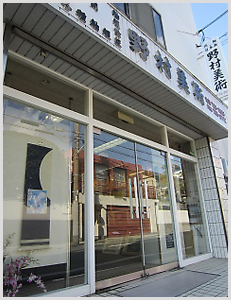
At ART NOMURA, we welcome visitors to our workshop in Kobe for consultations regarding hanging scroll restoration, and we also accept restoration and remounting requests from clients throughout Japan and around the world.
If you have an old or damaged hanging scroll that requires attention, or if you are considering having a treasured artwork remounted, please do not hesitate to contact us.
We carefully examine the condition of each individual artwork and recommend the most appropriate restoration approach, always striving to preserve its unique character and beauty.