Mounting a Shikoku 88 Temple Pilgrimage Scroll as a Kakejiku for a Customer on Awaji Island
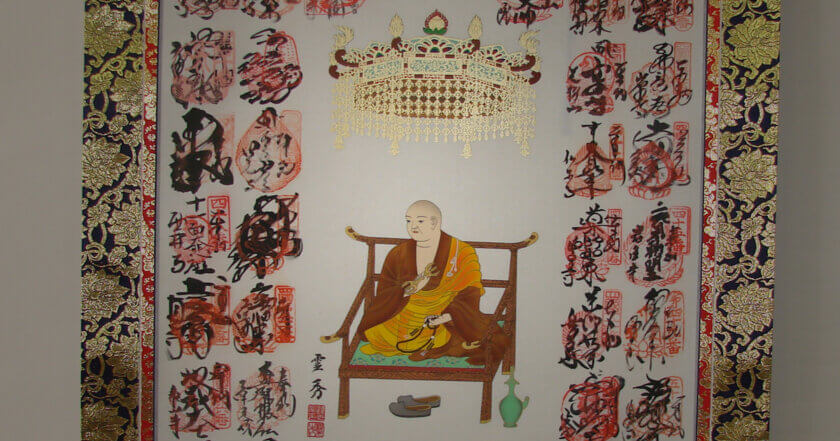
A pilgrimage scroll filled with seals and calligraphy collected while visiting the 88 temples of the Shikoku Pilgrimage.
After completing the pilgrimage, the scroll can be mounted as a kakejiku, allowing the memories and record of visiting all 88 temples to remain in the form of a single hanging scroll.
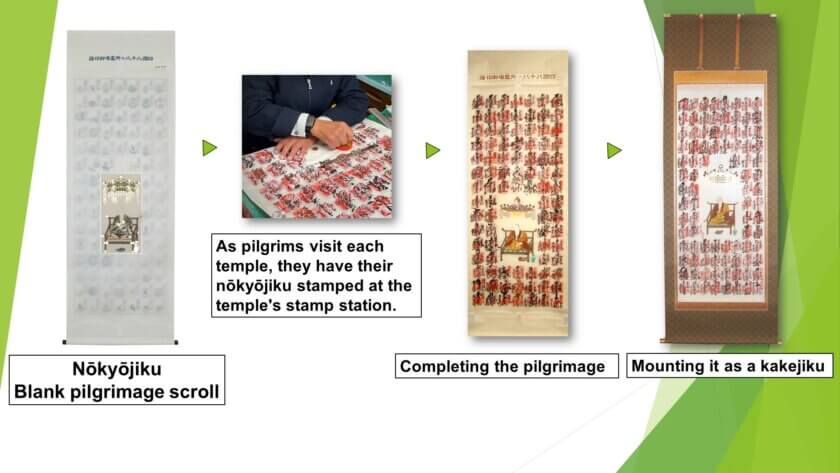
This time, we were asked to mount a Shikoku 88 Temple Pilgrimage scroll for a customer living in Sumoto City on Awaji Island.
Awaji Island is geographically close to Shikoku, and through our many years of working throughout the region, we have found that a particularly large number of people there complete the Shikoku Pilgrimage and have their pilgrimage scrolls mounted as kakejiku.
In this article, we will introduce the scroll before mounting, the process of selecting the mounting style, and the completed kakejiku.
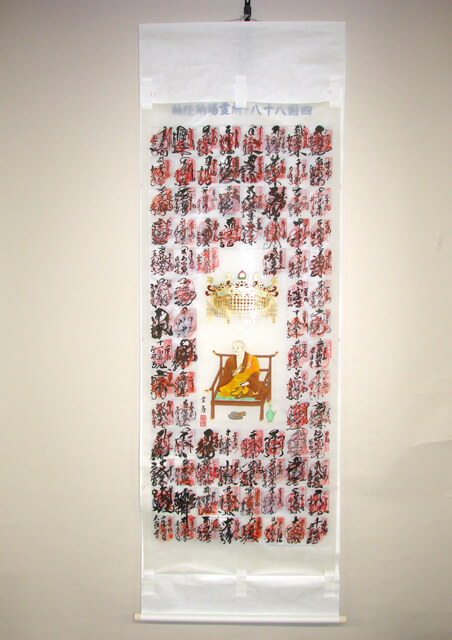
An Order Through the Hyōgo Prefectural School Welfare Association
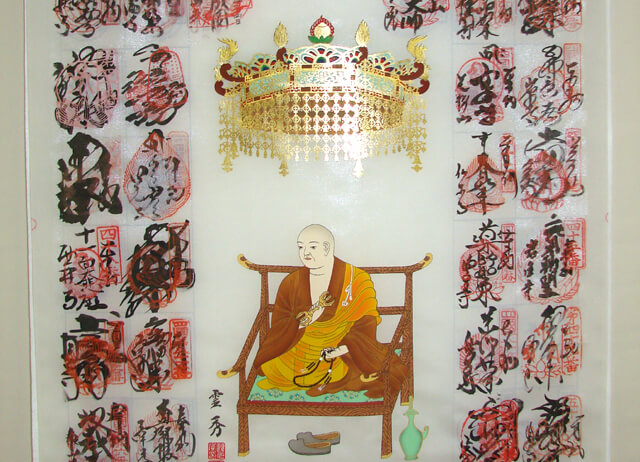
Our customer was a school teacher working in Sumoto City.
ART NOMURA is an authorized supplier for the Hyōgo Prefectural School Welfare Association, and it was through this connection that we received the request to mount the Shikoku 88 Temple Pilgrimage scroll.
The customer told us that he had completed the pilgrimage together with his wife.
It appears that not long after visiting all 88 temples, they decided to have the pilgrimage scroll mounted as a kakejiku.
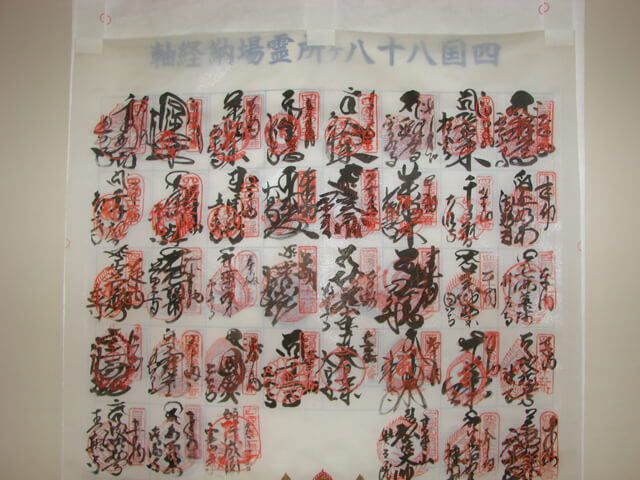
The scroll we received was new, so this was not a remounting project in which an old kakejiku is dismantled and rebuilt.
Instead, we would take a newly completed pilgrimage scroll bearing the seals collected from all 88 temples and mount it for the first time as a kakejiku that could be displayed.
Selecting the Mounting Style at the Customer’s Workplace
For this project, we visited the customer at his workplace, where we received the pilgrimage scroll and discussed which mounting style he would like.
However, the meeting took place during a short break from work.
In a situation like this, spending a long time explaining every detail of kakejiku construction and mounting fabrics can actually become a burden for the customer.
At ART NOMURA, there are occasions when we take plenty of time to explain the characteristics of different fabrics and mounting styles in detail.
There are also occasions like this one, where we focus only on the essential points within the limited time available.
Some customers want to understand every detail of kakejiku mounting, while others simply want to understand the basic differences and then make their decision based on their budget and personal taste.
We believe it is important to adjust the depth of our explanation according to each customer and situation.
For this project, we showed the customer our sample book of Buddhist mounting styles.
The book contains around 20 different mounting patterns, so there are quite a few options available.
In reality, however, customers do not necessarily examine every single pattern with the same level of interest.
Some are eliminated almost immediately, while others naturally catch the eye.
This customer did not appear to have especially detailed or particular requirements.
After considering both his budget and personal preference, he made his decision relatively quickly:
“This one.”
His choice was ART NOMURA’s Buddhist mounting Pattern No. 05, “Renge Honbutsu.”
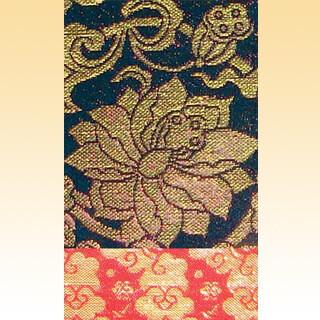
A Classic Buddhist Mounting: “Renge Honbutsu”
The “Renge Honbutsu” pattern selected for this project is one of the most traditional and orthodox combinations of fabrics among our Buddhist mounting styles.
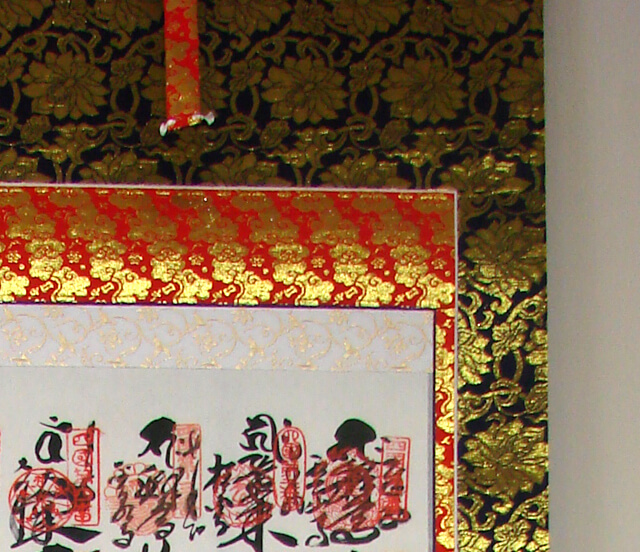
It combines gold brocade featuring lotus motifs on a deep navy ground with a red brocade called Tomita-gumo, featuring a traditional stylized cloud pattern.
The combination is decorative, but it is not unusual or overly elaborate.
Rather, it has the dignity and formality traditionally associated with Buddhist kakejiku mounting.
At this point, it is worth briefly explaining why lotus flowers appear so often in Buddhist mounting.
The lotus grows from muddy water yet rises above it to produce a beautiful flower without being stained by the mud.
Because of this characteristic, the lotus came to symbolize the Buddhist idea that even people living amid worldly desires and attachments can ultimately attain enlightenment.
This is why lotus motifs appear throughout Buddhist art, including lotus pedestals beneath Buddhist statues, temple furnishings, ritual objects, and many other forms of Buddhist decoration.
Naturally, lotus patterns have also long been used in the fabrics chosen for mounting Buddhist kakejiku.
The gold brocade with its lotus design also works particularly well with the red Tomita-gumo fabric.
The addition of red among the deep navy and gold gives definition to the overall design and creates a very traditional Buddhist appearance.
The pilgrimage scroll itself is filled with the red seals of the 88 temples, so the red fabric also harmonizes naturally with the colors already present in the artwork.
There is a reason why combinations such as this have remained standards of Buddhist mounting for so many years.
How a Shikoku 88 Temple Pilgrimage Scroll Is Mounted
This pilgrimage scroll is made of silk.
Most pilgrimage scrolls produced for routes such as the Shikoku 88 Temple Pilgrimage are made of silk.
Because this was a new scroll, no restoration work was required.
Even so, transforming a single sheet of silk into a finished kakejiku requires a number of traditional mounting processes.
The main steps for this project were as follows.
- 1. Color-Fixing
- Kakejiku mounting involves the use of a considerable amount of water. We therefore apply a color-fixing treatment to help prevent the calligraphy and red seals from bleeding during the mounting process.
- 2. First Backing — Hada-Urauchi
- Japanese paper is applied to the reverse of the pilgrimage scroll as its first backing layer.
- 3. Fabric Preparation and Cutting
- The fabrics selected for the “Renge Honbutsu” mounting are cut to the required dimensions for each section.
- 4. Assembling the Fabric Sections — Tsukemawashi
- The prepared fabrics are joined around the main artwork in sequence using paste.
- 5. Middle Backing — Naka-Urauchi
- A second backing layer is applied to the entire mounting.
- 6. Edge Folding — Mimi-Ori
- The left and right edges of the kakejiku are folded toward the back to create the appropriate thickness and finish.
- 7. Final Backing — Sō-Urauchi
- The third and final backing layer is applied to the entire kakejiku.
- 8. Final Finishing
- The roller rod, hassō, hanging cord, tying cord, and other fittings are attached to complete the kakejiku.
From the front, a finished kakejiku may appear to be a single unified object.
Behind that appearance, however, are many individual processes that must be carefully completed one by one.
A Dignified Mounting That Complements the 88 Temple Seals
Here is the completed kakejiku.
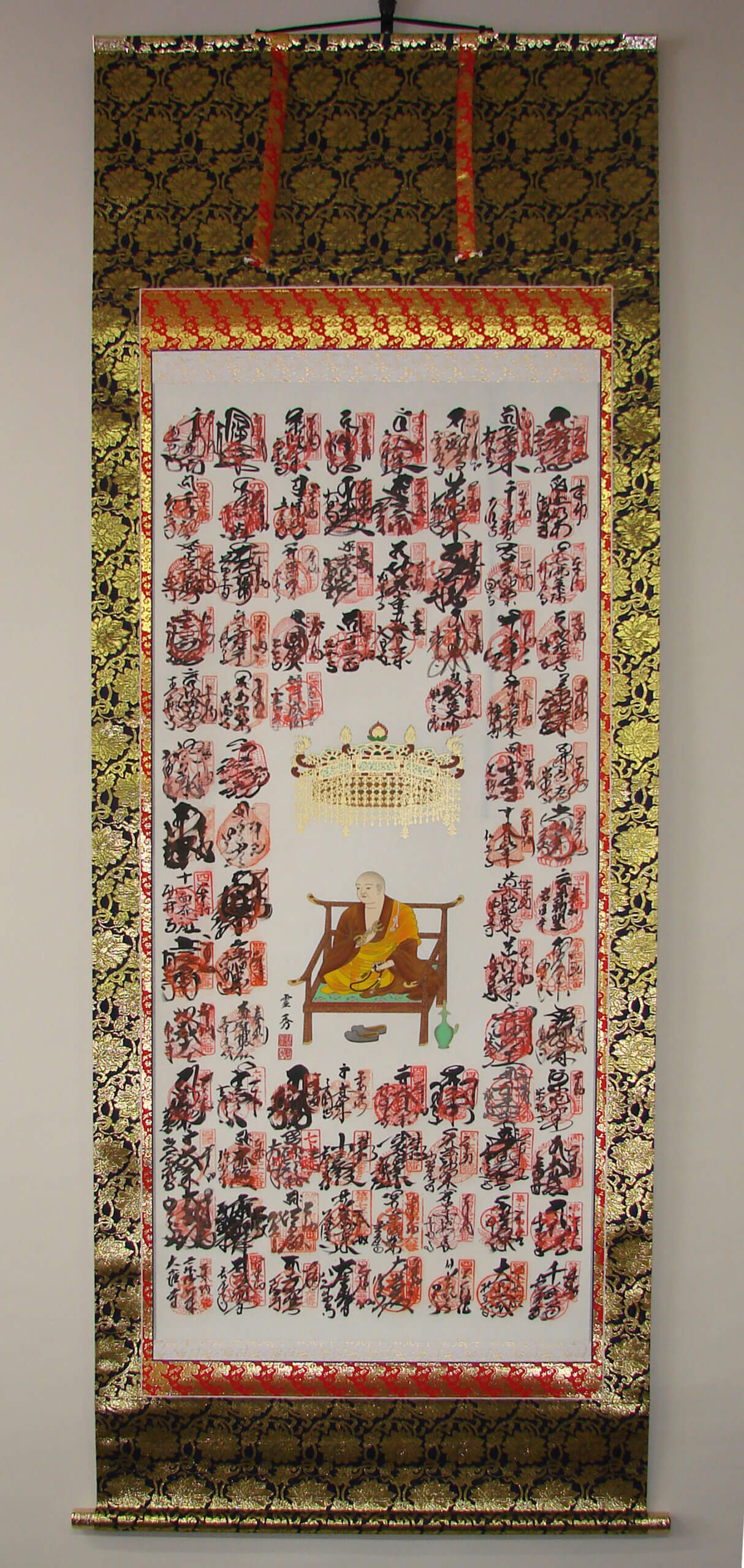
Before mounting, it was simply a single pilgrimage scroll. Once surrounded by the deep navy and gold lotus brocade, however, it immediately took on the solemn and dignified appearance of a traditional Buddhist kakejiku.
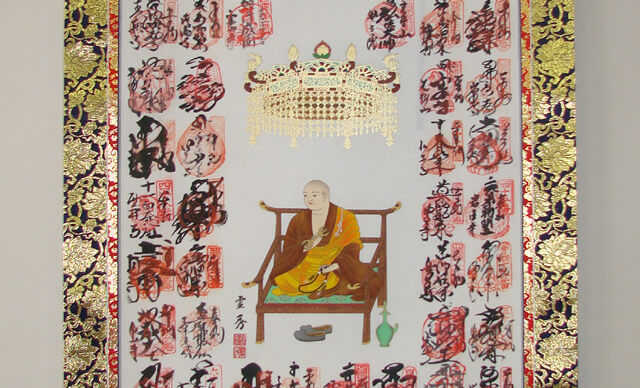
The red Tomita-gumo fabric also works beautifully with the many red seals on the scroll.
The result is decorative without becoming excessively showy, retaining the traditional character of Buddhist mounting.
We believe the finished kakejiku has an appropriately dignified and stately appearance for a record of the Shikoku 88 Temple Pilgrimage completed together by the customer and his wife.
Preserving the Record of the Shikoku 88 Temple Pilgrimage as a Kakejiku
A Shikoku 88 Temple Pilgrimage scroll is not simply a sheet containing the seals of each temple.
It preserves the time and effort accumulated by visiting each temple one by one and receiving its seal and calligraphy along the way.
For this project, we mounted the pilgrimage scroll completed by the customer and his wife as a traditional Buddhist kakejiku using a classic mounting style.
There are many different ways to mount a kakejiku, but there is no need to choose rare fabrics or highly individual designs simply for the sake of being different.
As in this case, choosing a traditional Buddhist mounting that has been used for generations can allow the character and dignity of a Shikoku 88 Temple Pilgrimage scroll to emerge naturally.
Some customers enjoy taking plenty of time to compare individual fabrics and hear detailed explanations about each option.
Others prefer to understand the essential differences and make a quick decision based on their budget and personal taste.
At ART NOMURA, we adapt our approach to each customer’s circumstances and preferences while proposing a mounting style appropriate for the pilgrimage scroll itself.
If you have completed the Shikoku 88 Temple Pilgrimage and would like to have your pilgrimage scroll mounted as a traditional Japanese kakejiku, please feel free to contact ART NOMURA.
More Information About Shikoku 88 Temple Pilgrimage Kakejiku
If you would like to learn more about how a Shikoku 88 Temple Pilgrimage kakejiku is made, please watch this video.