Mounting a Saigoku 33 Kannon Pilgrimage Nōkyōjiku as a Dignified Kakejiku | Fukusaki, Hyōgo
We also handle wholesale work for business clients, and we are often entrusted with mounting requests through our trade partners.
This time, one of our wholesale clients, a kimono shop in Fukusaki, Hyōgo, asked us to mount a nōkyōjiku used for the Saigoku 33 Kannon Pilgrimage for one of their customers.
What Is a Nōkyōjiku Used for the Saigoku 33 Kannon Pilgrimage?
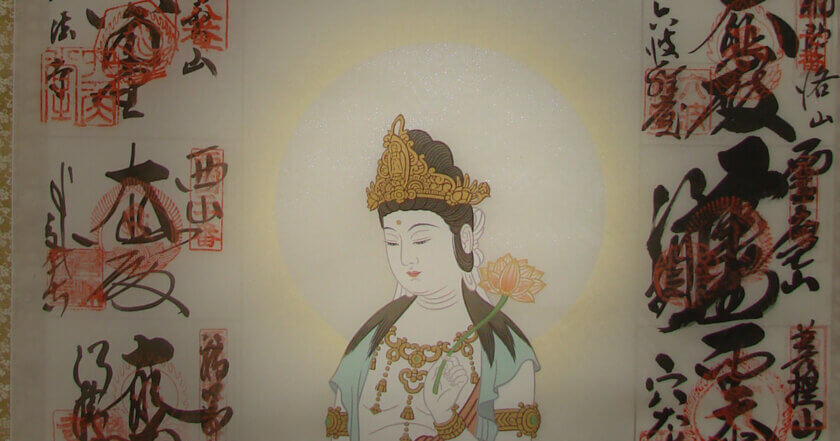
The Saigoku 33 Kannon Pilgrimage is one of Japan’s best-known pilgrimage routes, centered mainly in the Kansai region and consisting of thirty-three Kannon temples.
As pilgrims visit each temple and receive goshuin seals, the nōkyōjiku gradually becomes a record of their spiritual journey itself.
It is not merely a commemorative item, but a precious piece filled with the owner’s prayers and memories. For that reason, when preparing it as a kakejiku, it is important to mount it in a way that respects its significance.
Background of the Request
In recent years, the kimono industry has become less stable than it once was, and many kimono shops now offer a wider range of services to their customers beyond kimono alone.
As part of that shift, they often receive inquiries about mounting and then pass those requests on to us.
This project came about in exactly that way, with our wholesale partner, the kimono shop, receiving a consultation from their customer about mounting a nōkyōjiku and then entrusting the work to us.
The Key Point of This Project
In this project, the most important thing was to achieve a finish with the proper dignity appropriate for a nōkyōjiku.
A nōkyōjiku used for the Saigoku 33 Kannon Pilgrimage carries a distinctive presence through its bold ink inscriptions and red seals, so the choice of fabric can greatly change the overall impression.
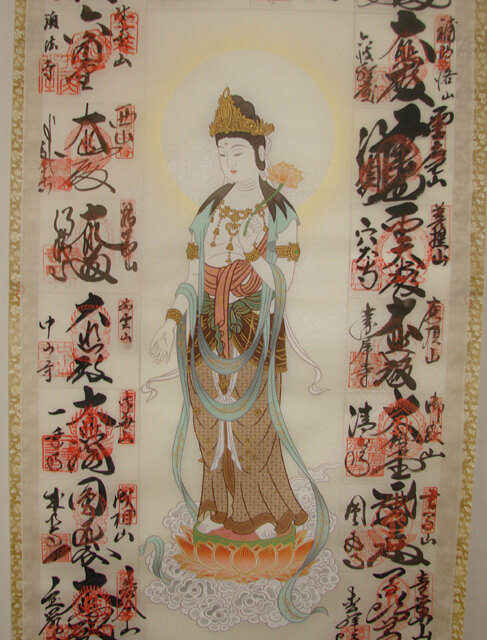
If the atmosphere is too light, it will not match the weight and significance of the nōkyōjiku. On the other hand, if it feels too heavy, it may become difficult to display comfortably in an everyday setting.
For that reason, it was essential to balance religious solemnity with the elegance needed for display in the home.
About the Mounting Fabric Used This Time
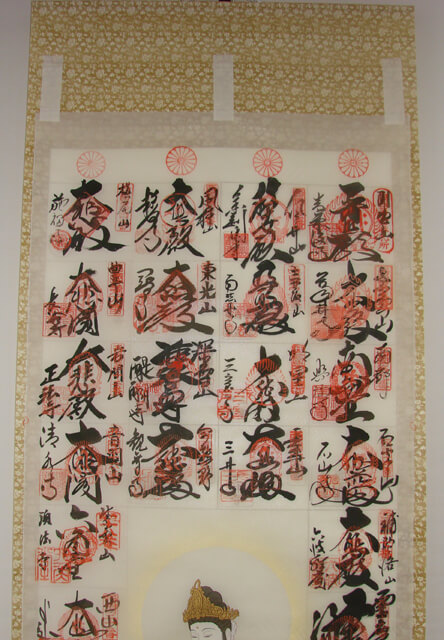
For this piece, we used our Buddhist mounting pattern No. 9, Kon-unpō.
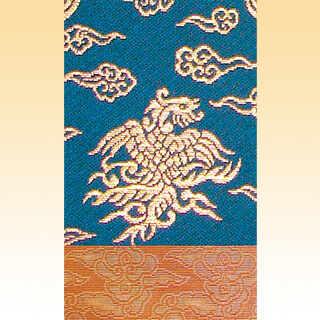
Kon-unpō is a luxurious fabric with phoenix motifs woven in gold thread over a deep navy ground. The rich navy tone gives the whole work a refined sense of depth, while the gold pattern adds an elegant brilliance.
It works especially well with the central Kannon image as well as the surrounding temple inscriptions and red seals, bringing the entire scroll together in a dignified and harmonious way.
What We Paid Attention to in Mounting This Nōkyōjiku
When mounting a nōkyōjiku, it is important not only to finish it properly as a kakejiku, but also to proceed safely while taking great care with the ink and red seals.
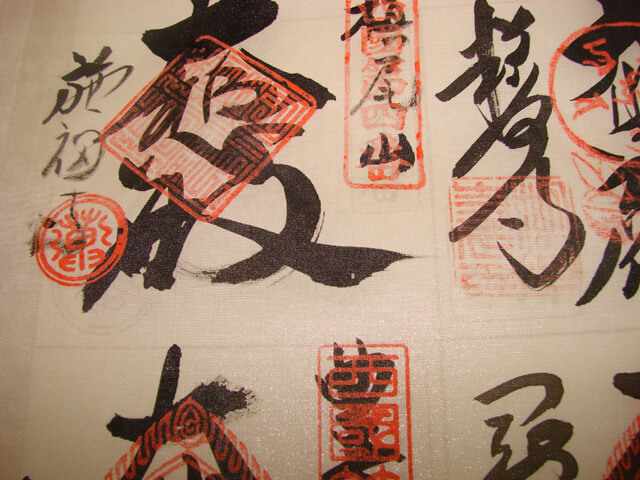
Because mounting work uses a considerable amount of moisture, we carefully performed color-fixing treatment on each inscription and seal one by one to help prevent bleeding before moving forward with the process.
Mounting Process
The overall process for this mounting project was as follows.
1. Color-Fixing
Because mounting work involves a significant amount of water, we first applied color-fixing treatment to help prevent the ink and red seals from bleeding.2. First Backing
We applied backing paper to the reverse side of the work to create a stable foundation for the mounting.3. Fabric Preparation and Cutting
We prepared and cut our Buddhist mounting pattern No. 9, Kon-unpō, to the required dimensions for each part.4. Assembling the Fabric Sections
We joined the prepared fabric sections in sequence to build the form of the kakejiku.5. Middle Backing
We carried out the second backing process to improve the overall stability.6. Edge Folding
We adjusted the thickness and finish at both sides to refine the scroll’s shape beautifully.7. Final Backing
We applied the third backing to stabilize the entire structure firmly.8. Final Finishing
We attached the bottom roller, the top support of the scroll, known as the hassō, the hanging cord, and the other finishing elements, and then completed the final adjustments.
Condition After Completion
After mounting, the nōkyōjiku retained its original solemn atmosphere while gaining a much stronger presence as a complete kakejiku.
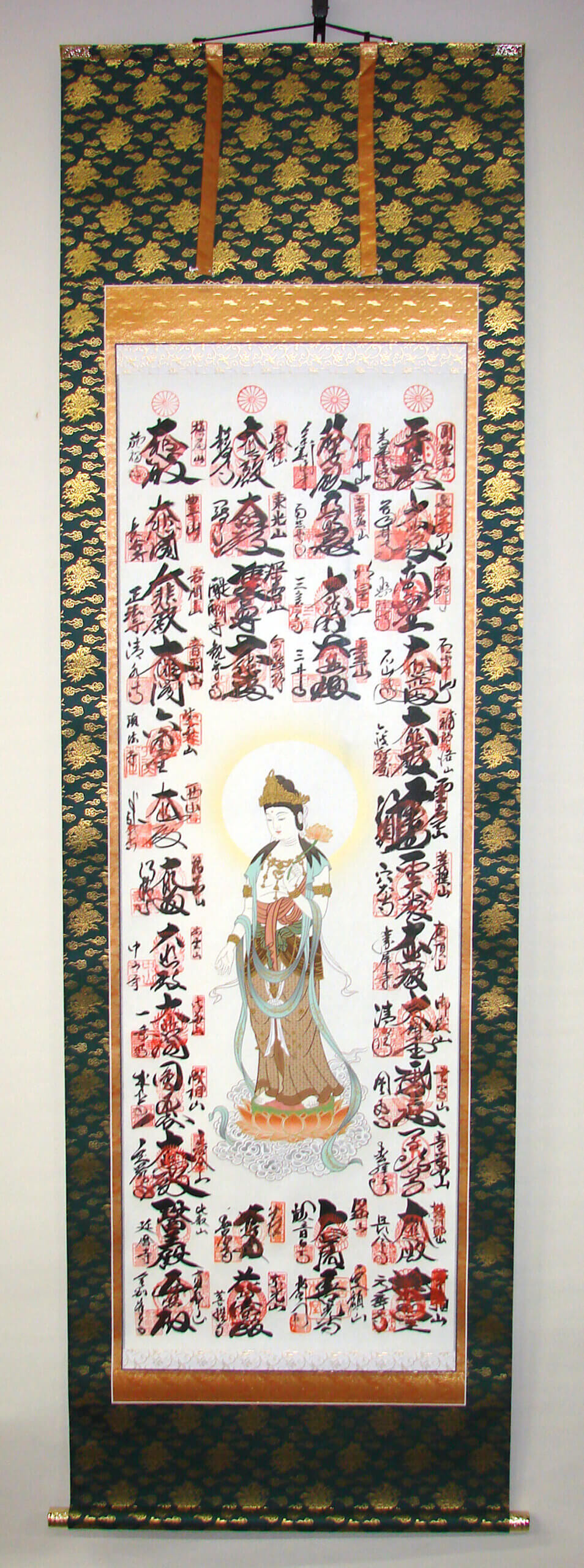
The deep navy fabric tightens the overall composition, while the gold phoenix motifs add both elegance and dignity. The central image of Kannon stands out beautifully, and the surrounding ink inscriptions and red seals are also brought into pleasing harmony within the whole composition.
A nōkyōjiku used for the Saigoku 33 Kannon Pilgrimage truly conveys its beauty and spiritual weight more fully when it is properly finished in this kind of Buddhist mounting.
We Also Accept Requests Through Wholesale Partners
As in this case, we accept not only direct requests from individual customers, but also mounting orders through wholesale partners.
Kimono shops, Buddhist goods stores, and other art-related businesses may sometimes receive consultations from their own customers regarding mounting. In such cases, we can take care of the actual mounting work on their behalf.
We would be very pleased if this helps our trade partners offer additional services to their customers, while also creating outcomes that those end customers appreciate.
Conclusion
This time, we were entrusted by a kimono shop in Fukusaki, Hyōgo, one of our wholesale partners, with mounting a nōkyōjiku used for the Saigoku 33 Kannon Pilgrimage, and we finished it using our Buddhist mounting pattern No. 9, Kon-unpō.
A nōkyōjiku is a precious object that preserves both the record of a pilgrimage and the prayers of its owner. For that reason, it is important to choose a fabric suitable for the work and to complete the mounting carefully so that it becomes a dignified single scroll.
We accept not only this kind of nōkyōjiku mounting, but also mounting requests through wholesale partners.
If you are considering mounting a nōkyōjiku used for the Saigoku 33 Kannon Pilgrimage or any other pilgrimage scroll, please feel free to contact us.