Requested by a Customer in Australia | Stain Removal and Remounting of a White Heron Kakejiku
Receiving continued requests from customers overseas is something we are truly grateful for, as it shows that our work is being appreciated.
Today, we would like to introduce a restoration and remounting project for a white heron kakejiku that was entrusted to us by a customer in Australia.
This customer is a repeat client who has previously asked us to restore and remount other kakejiku as well. He has a deep affection for the works he owns and always consults with us very carefully. This project began when he contacted us and said that he would like to send us another scroll for his next restoration project.
A Request to Restore a White Heron Kakejiku with Heavy Staining
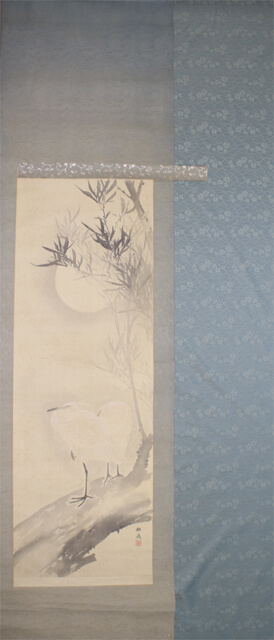
The work we received this time was a hanging scroll depicting a white heron standing quietly in a tranquil setting. With its serene sense of space, the soft expression of the moon, and the beautiful combination of bamboo, the work has an overall quiet and elegant atmosphere.
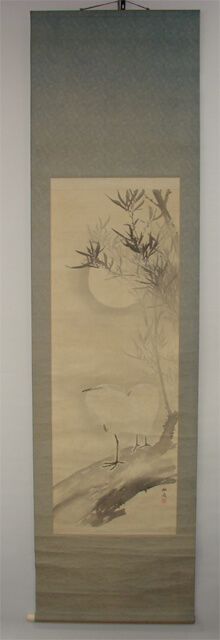
When placing the order, the customer had one special request. He hoped that the roller ends from a previous kakejiku restoration project could be reused for this remounting.
After carefully considering his request, we decided that once the white heron kakejiku arrived, we would check whether the roller ends we had kept from the previous project would be suitable for this remounting.
The Condition Confirmed After the Work Arrived
When the white heron kakejiku arrived, we unpacked it and checked whether the roller ends we had kept from the previous project would be suitable for this remounting. It appeared that they could most likely be reused.
As this was something the customer was particularly concerned about, we informed him at an early stage that they would most likely be reusable so that he could feel reassured.
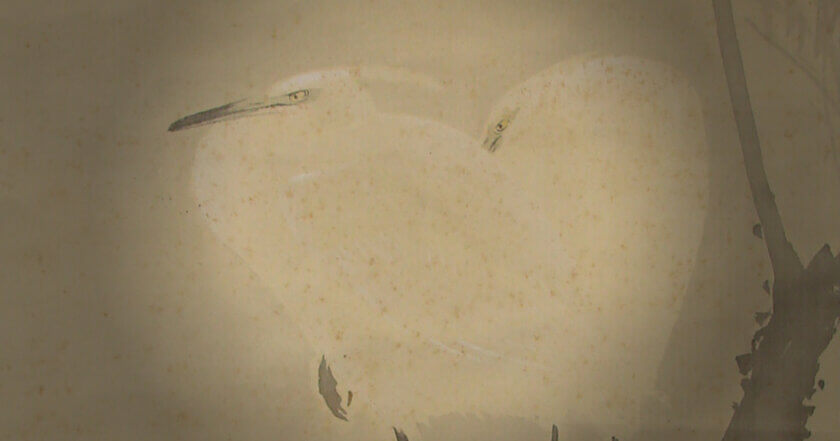
At the same time, however, we found that the honshi had developed quite severe staining.
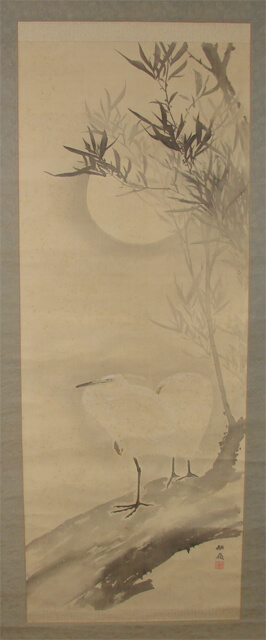
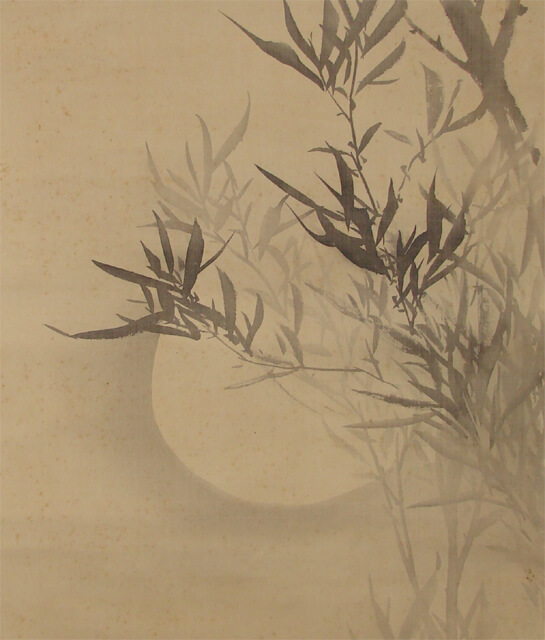
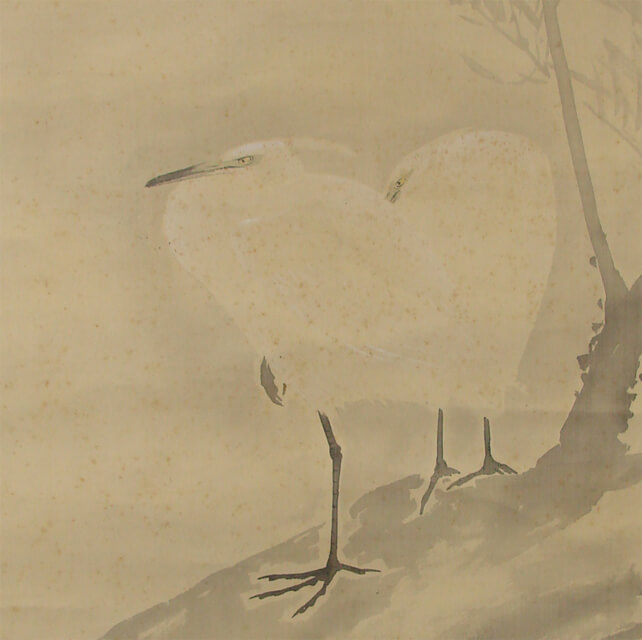
This is not unusual in old kakejiku, but in this case as well, the overall surface showed the effects of dirt and stains, and in its current state it was difficult to say that the charm of the white heron painting could be fully appreciated.
That said, it is important not to casually promise that everything can be made “as good as new.”
Although we would carry out stain removal, there are cases in which complete removal is difficult depending on the type of stain and the condition of the work. For that reason, before moving forward with the restoration, we explained frankly that while we would perform stain removal, we could not guarantee complete removal.
In projects with overseas customers in particular, it is very important to communicate not only the possibilities of restoration but also its limitations. Rather than creating unrealistic expectations, carefully sharing a realistic outlook is essential for building a lasting relationship of trust.
The Challenge of Choosing Fabric: “The Original Blue” or “The Current Color”
After that, we moved on to selecting the mounting fabric. The customer told us that he would prefer a blue tone similar to the original fabric.
However, there was one difficulty in choosing the fabric for this particular project. The existing fabric had faded significantly over time.
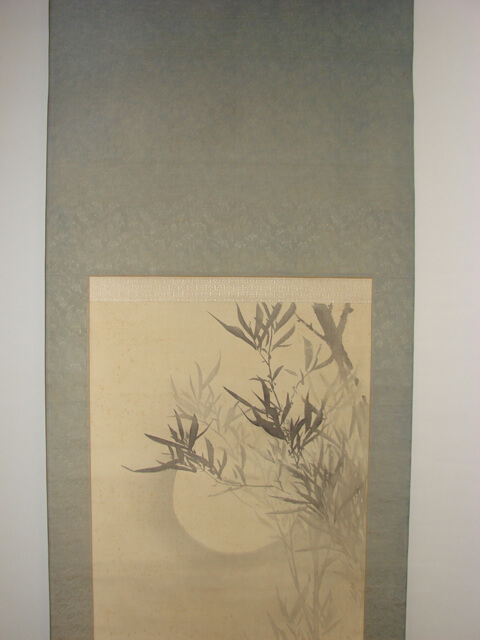
It seems to have originally been a blue-toned fabric, but over many years the color had faded, and differences in tone had also appeared from place to place. In other words, the direction of the selection changed depending on whether we wanted to come closer to the original blue or instead reflect the softer impression created by many years of aging and fading.
With both possibilities in mind, we selected several blue fabric options and proposed them to the customer. The key point in this design process was that we did not simply line up similar colors, but instead presented options with a range of possibilities based on how the work itself should be seen.
From among those options, the customer chose this fabric. We believe it was a beautiful choice, one that gently supports the quiet image while still properly bringing out the presence of the white heron.
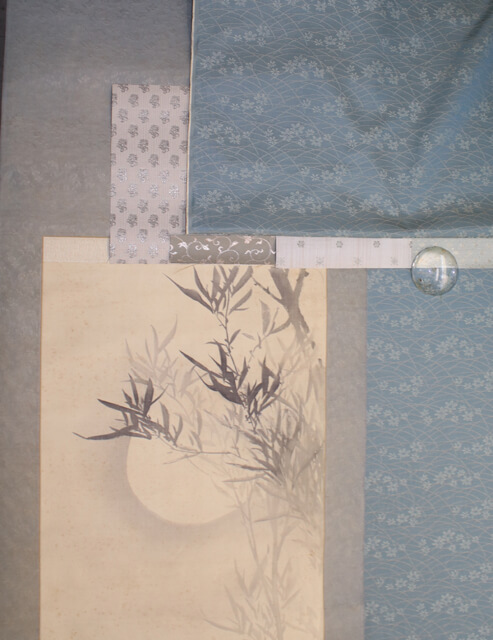
For the Ichimonji, He Wanted Something Light and Restrained Rather Than White
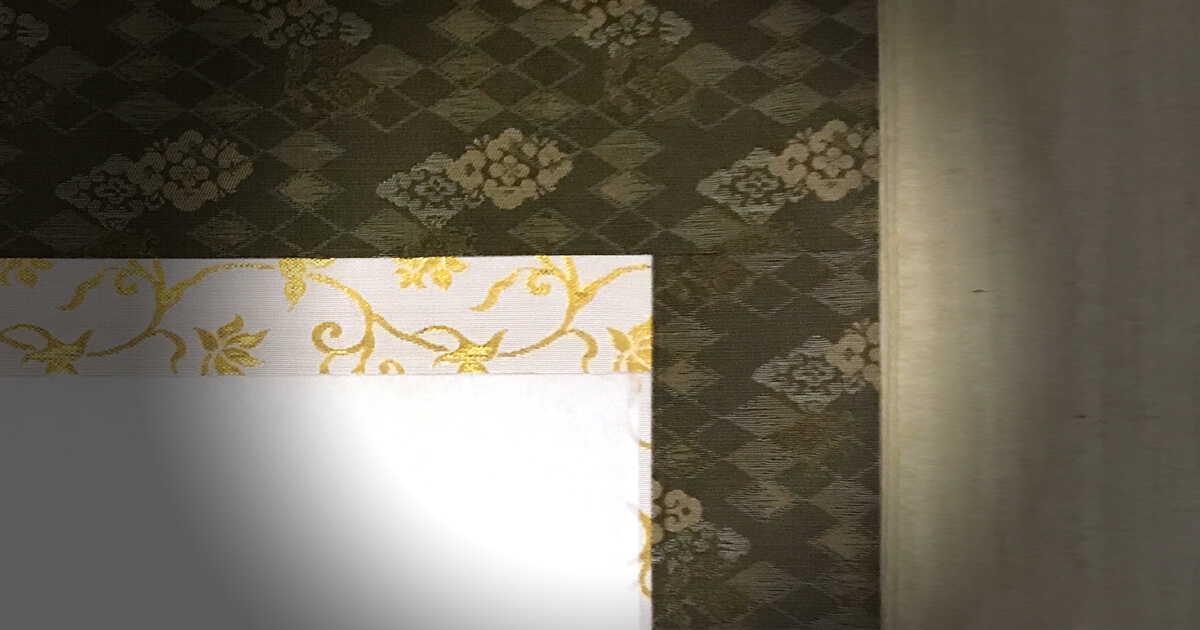
Once the main mounting fabric had been decided, we moved on to considering the ichimonji fabric. In a kakejiku remounting project, the choice of ichimonji can significantly change the dignity and atmosphere of the whole piece.
So we asked the customer about his preferences for the ichimonji, and he told us the following:
- He preferred something other than a white-based fabric.
- A light green or gray tone might work well.
- He liked sparse, minimal patterns rather than dense ones that would feel too assertive.
We were very grateful to receive such specific preferences. When a customer has a clear sense of aesthetic direction, it becomes much easier for us as restorers to share the same vision in words and reduce the risk of any gap between expectation and final result.
Based on those preferences, we proposed several ichimonji fabrics that would harmonize with the blue main fabric while preserving the quiet atmosphere of the white heron painting.
As a result, the customer selected this gray ichimonji fabric.
The combination of blue and gray has a calm dignity, and the pattern density was just right, making it a very suitable pairing for this work.
The customer also requested that the remounting include ichimonji-otoshi, which helped solidify the final overall design. For more information about ichimonji-otoshi, please see our related article.
The White Heron Kakejiku, Once Heavily Stained, Was Brought Back to a Displayable Form
After the specifications were finalized, we proceeded with the actual stain removal and remounting work, and the white heron kakejiku was completed successfully.
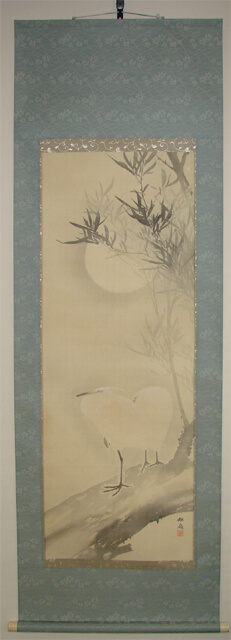
The finished scroll achieved a refined balance between the blue main fabric and the gray ichimonji. Without disturbing the quiet atmosphere originally present in the painting, the remounting instead gave it an even more polished and elegant impression.
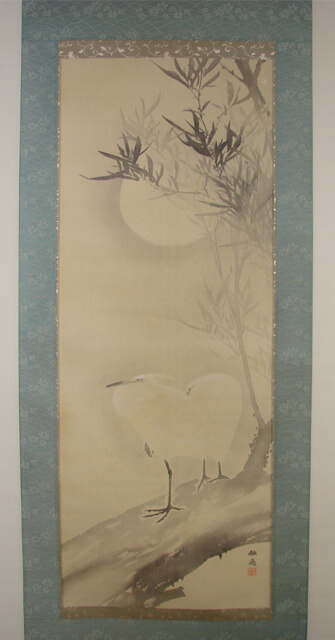
In addition, the roller ends the customer had wished to reuse were successfully incorporated, resulting in a finish with a strong sense of unity with the work as a whole.
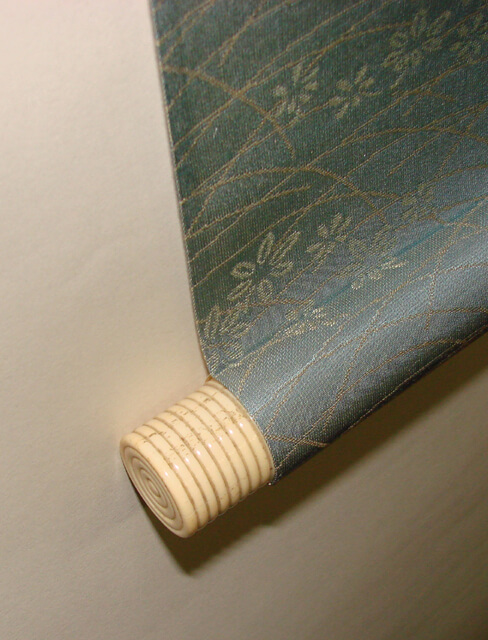
The prominent stains were greatly improved, and the finished result allowed the beauty of the painting to be appreciated once again.
Feedback from the Customer
We were delighted to receive the following feedback from the customer.
A marvelous result on the cleaning and remounting. You would never know it had such bad stains previously. Roller ends look great, thanks for your understanding in that regard. I should mention, the roller ends you installed on the prawn painting were an inspired choice, they suit it very well.
Couldn’t be happier. Thank you to you and your staff for all their efforts.
In restoration and remounting work, of course the finished object itself is important, but receiving words like these is the greatest encouragement of all.
He Even Sent Us a Photo of the Scroll Displayed in His Home
Later on, the customer kindly sent us a photograph showing the scroll displayed in his home. Placed within the actual living space, the white heron kakejiku blended beautifully into the calm interior and gave off a quiet but dignified presence.
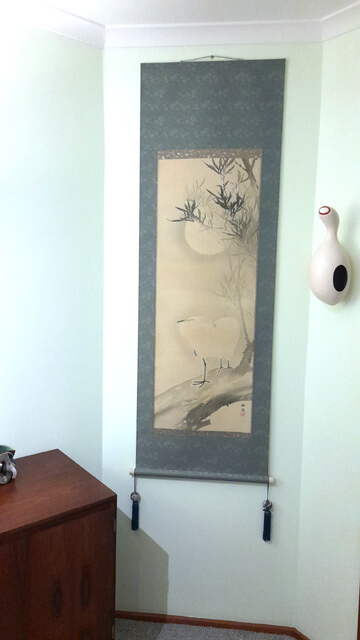
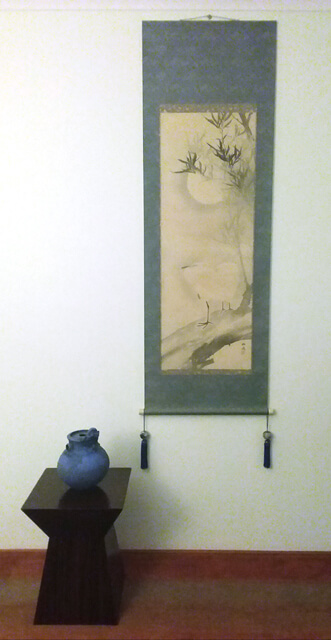
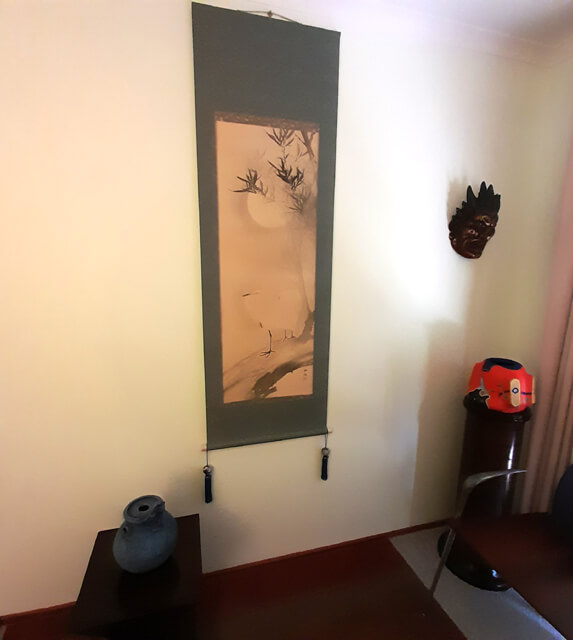
There is a different kind of joy in seeing a completed kakejiku in the workshop and in seeing it returned to the customer’s daily life. They were such lovely photographs that they made us want to say, “We believe the artwork itself must be happy as well.”
For us as kakejiku restorers, it was truly a pleasure to see a work that once had very noticeable staining return to a place where it could again be treasured and displayed in the customer’s space.
Even with Overseas Customers, We Proceed Carefully by Sharing Opinions and Refining the Details Together
This case was not simply a matter of removing stains and remounting the scroll.
There was the request to reuse roller ends carried over from a previous project. There was also the question of how to interpret the faded color of the old fabric. In addition, there were detailed preferences regarding the color and pattern of the ichimonji.
By carefully organizing each of these conditions one by one and discussing them thoroughly with the customer, we were able to complete this white heron kakejiku in a way that felt fully considered and satisfying.
With overseas customers, distance can naturally create uncertainty. For that reason, we do our best to communicate the condition of the work carefully, share the specifications clearly, and confirm the intended final image as we move forward.
That is why, after the restoration is complete, we believe it leads to work that makes customers feel genuinely glad they entrusted the project to us.
For Those Considering Kakejiku Restoration or Remounting
A kakejiku is not finished simply because it has deteriorated.
Even if there are stains or dirt, and even if the mounting fabric has become old and worn, there are many cases in which proper restoration and remounting can return it to a condition in which it can once again be displayed with confidence.
As in this case, we also do our best to accommodate detailed wishes such as wanting to preserve parts from a previous mounting, retain the original atmosphere, or adjust the appearance so that it suits a present-day interior space.
If you are considering the restoration or remounting of an old kakejiku, we would be happy to hear from you. We have handled many requests not only from customers in Japan, but also from customers overseas.
From checking the condition of the work, to proposing an appropriate remounting direction, to shipping the finished scroll after completion, we respond with care at every stage.
We would be honored to help preserve your treasured kakejiku in a form that can continue to be displayed with confidence for many years to come.
If you are considering kakejiku restoration or remounting, please feel free to contact us whether you are in Japan or overseas.