Kakejiku Restoration in Japan|A Severely Damaged Tiger Scroll from the United States
Visiting Our Shop for Kakejiku Restoration
We receive a large number of inquiries about kakejiku restoration from customers all over the world.
In most cases, we discuss the project online, the scroll is shipped to us, we carry out restoration and remounting, and then we return it to the customer. However, recently we have had more opportunities to meet customers in person at our shop and discuss restoration details face-to-face.
In this article, we would like to share an episode about a customer who visited us for kakejiku restoration while traveling in Japan from the United States.
Communication Before the Visit
The customer who contacted us was visiting Japan for the first time, and it seems they had planned from the beginning to come to our shop specifically for scroll restoration.
While staying at a hotel, the customer contacted us in advance to ask whether the scroll could be restored and whether it would be possible to visit our shop. These are the photos of the scroll that the customer sent us from the hotel.
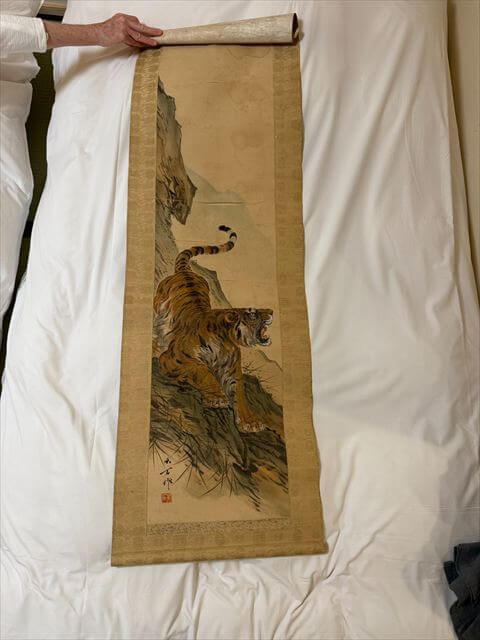
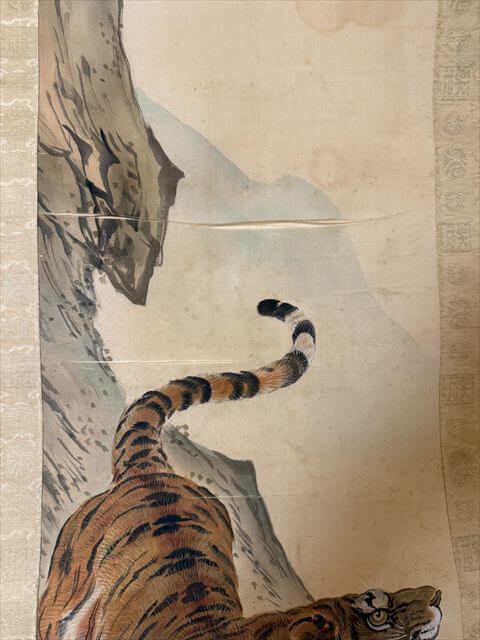
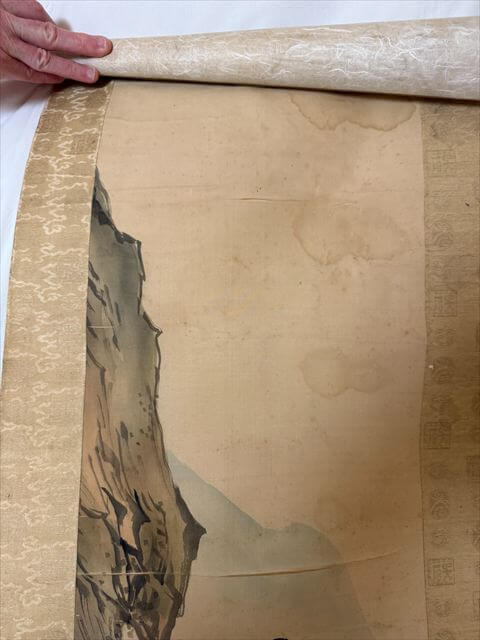
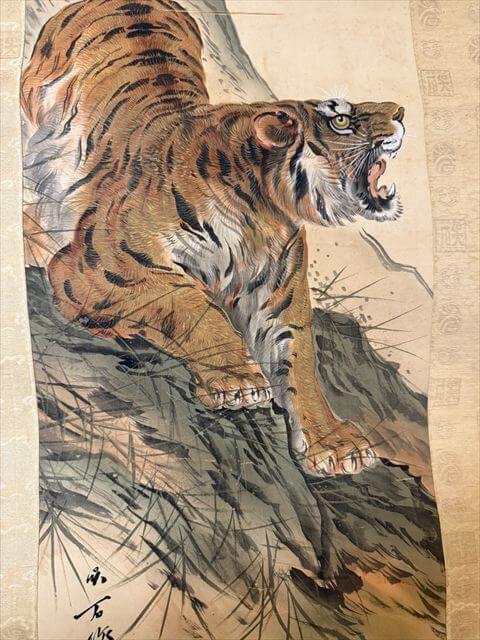
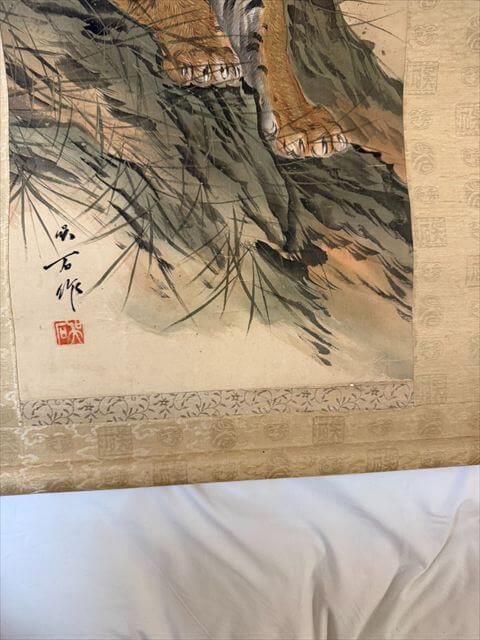
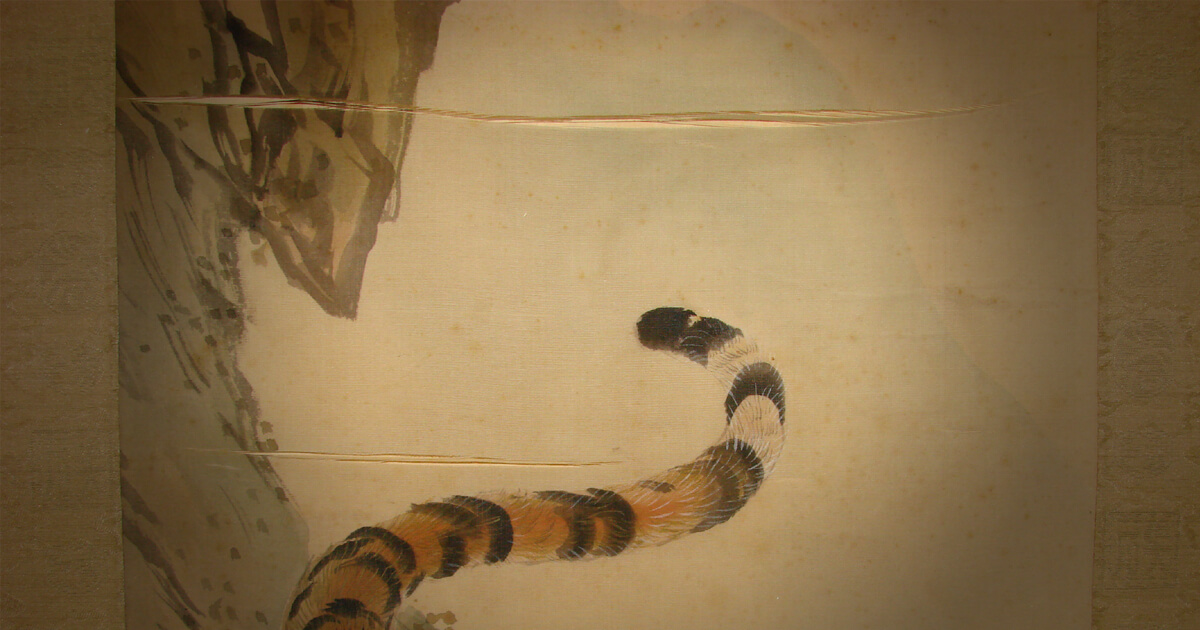
From the photos alone, the damage appeared quite severe. We could see multiple areas where the artwork had completely torn, and we anticipated that additional tearing could occur during the remounting process.
For that reason, we explained that retouching would be necessary so that missing areas and tears would not interfere with viewing the work. We also provided an approximate estimate that included those restoration procedures.
Our intention was to prevent the customer from making the trip to our shop only to discover that the restoration cost exceeded their budget and that they could not proceed.
The customer accepted our estimate and, after sightseeing in Kyoto, traveled to Kobe by Shinkansen, transferred to a local line, and then walked from Tarumi Station to our shop.
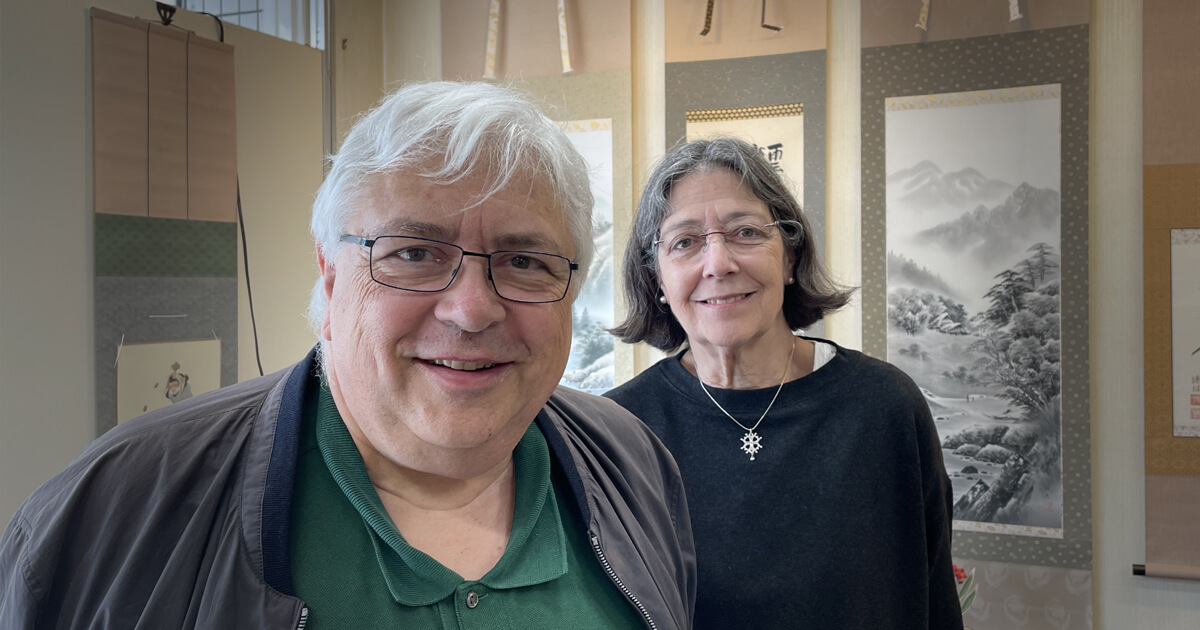
Here is the customer who visited us this time.
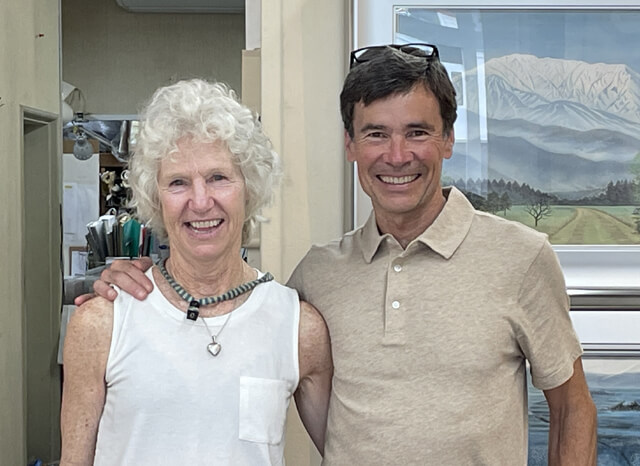
Both of them were refined and kind, and we had a wonderful conversation about art, travel, and the beauty of Japan. We were especially impressed by their words that Japan is very clean, that people are polite and gentle, and that nature here is wonderful.
The scroll they brought had apparently belonged to the customer’s father, and they had a strong desire to restore it and display it again. Because they came all the way to our shop and entrusted us with this important piece, our staff also felt strongly that we wanted to do everything we could for them.
Consultation for Restoring the Tiger Scroll
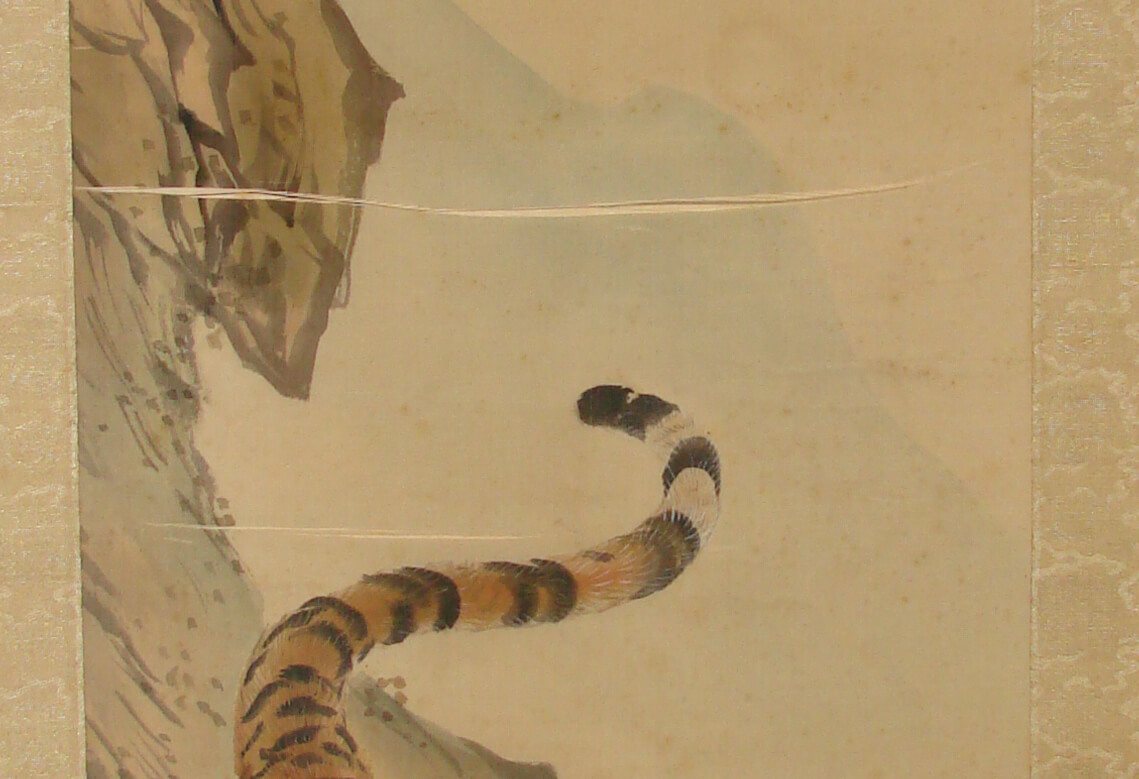
We examined the actual tiger scroll that the customer brought, and its condition was even more seriously damaged than we had expected.
In this area, the painting had completely torn. It was in such a fragile condition that it was easy to imagine it worsening immediately with even a small impact or any undue force.
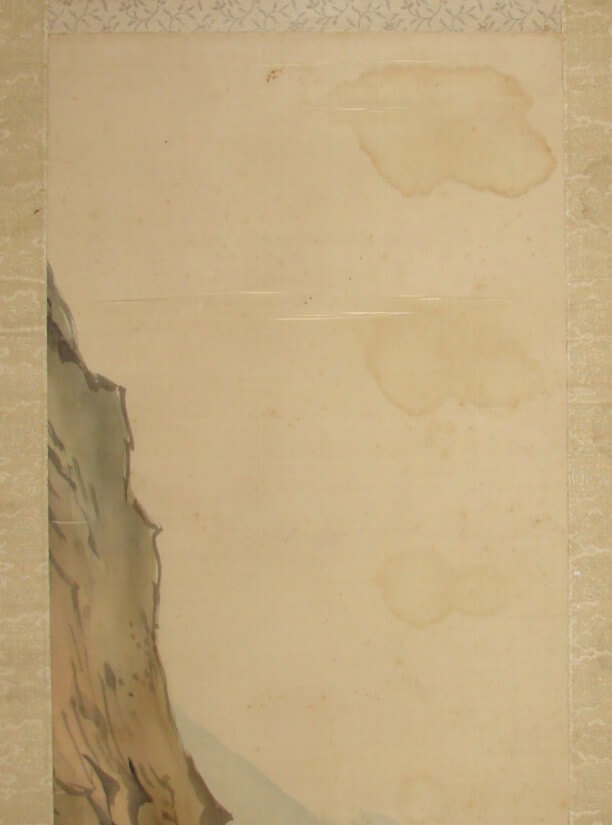
In this area as well, there was tearing, along with extremely heavy staining.
When proceeding with the restoration, we carefully explained the following risks again to the customer.
- When removing the old backing paper during remounting, we will take every possible precaution to avoid enlarging existing tears, but it is unavoidable that some tearing may spread to a certain extent.
- Areas with tears will interfere with appreciation if left as they are, so we will retouch them so they can be viewed naturally.
- The stain in the upper right is very severe, but because the work is in a fragile condition, using an overly aggressive stain removal process could cause the artwork itself to fail and suffer further damage. Therefore, we will prioritize preservation of the work and limit stain reduction to the safest extent possible.
The customer fully understood these risks and still told us they wanted to place full trust in us and leave everything to our care.
Regarding the choice of mounting fabric and the mounting style, the customer did not have particularly strict preferences. They said they would choose from our suggestions as long as the overall atmosphere was similar to the current scroll. We presented several candidate fabrics, and the fabric for the new mounting was decided.
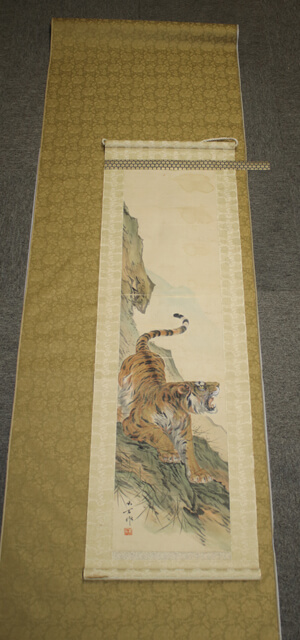
Also, the top and bottom fabric sections of this scroll were extremely short, and the proportions were not in line with typical Japanese kakejiku balance, resulting in an awkward appearance. Therefore, we asked the customer whether they would like us to remount it using standard Japanese proportions.
If we did so, the overall length would become about 30 cm longer than it is now. Depending on where the scroll will be displayed, this could create limitations, so we explained that point as well.
The customer requested a standard Japanese-style balance, but they felt an increase of 30 cm might be too much due to space limitations where it would be displayed. They asked whether we could adjust it to about a 20 cm increase instead. We therefore decided to remount the scroll while keeping good overall balance and moderating the added length.
Finally, we confirmed optional items one by one and completed the consultation. The customer was especially pleased with our recommendation of a paulownia wood storage box and exclaimed, “The box is magic!!” which left a strong impression on us.
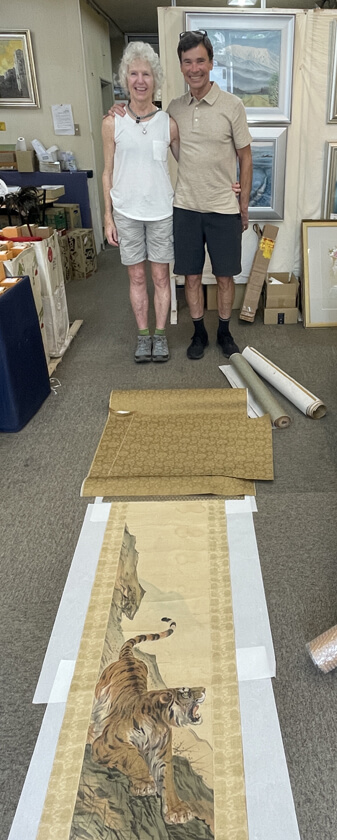
Confirming the Consultation Details
To reconfirm the details discussed at our shop, we later prepared meeting documents and asked the customer to review them by email.
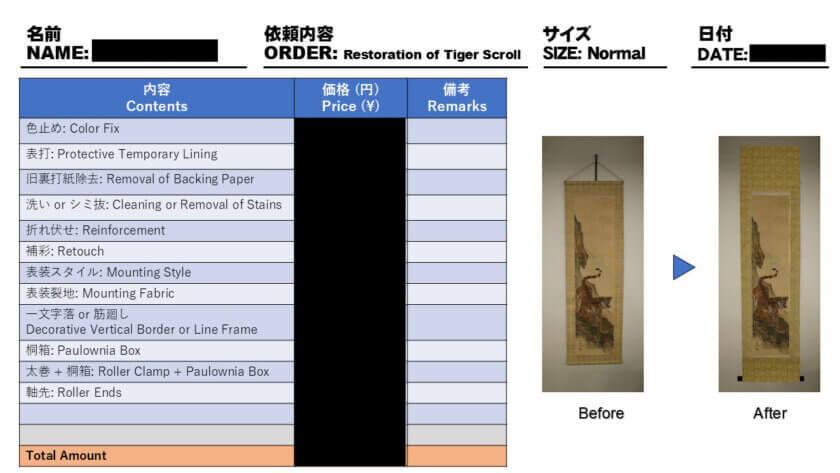
At the same time, we also create a mock-up illustration showing the expected appearance after remounting, and we thoroughly confirm together that there are no differences in understanding.
Once we received the customer’s final confirmation, we began the restoration.
Restoration Details and Overall Process
For this project, we proceeded with restoration in the following general flow.
1. Fixing pigments and protecting the artwork
First, we carried out a fixing process so that pigments and ink would not lift or run during restoration. After that, we performed protective measures to minimize damage during remounting.2. Removing the old backing paper (peeling work)
We carried out the “peeling” process to remove the old backing paper on the reverse side of the scroll.3. Washing and stain reduction
We carried out washing and stain reduction to remove dirt and stains from the artwork. However, because the condition of the scroll was fragile, we limited the treatment to the safest possible extent. While the staining improved considerably, complete removal was not achievable. In our assessment, the stains were reduced significantly, and the visual distractions to appreciating the painting were greatly minimized.4. First backing and reinforcement (hada-urauchi and ore-fuse)
We applied a first backing and reinforced the torn areas with ore-fuse to strengthen and stabilize the damaged sections.5. Retouching
We retouched the torn and missing areas so the work could be appreciated naturally. Because this artwork is painted on silk, the approach differs slightly from retouching on paper, so we proceeded carefully.6. Remounting
Finally, we remounted the scroll using the fabric and specifications selected by the customer. As discussed, we increased the total length by about 20 cm and finished the mounting within that plan.
Restoration Completed
After a long and challenging restoration, the scroll has finally been brought back to life.
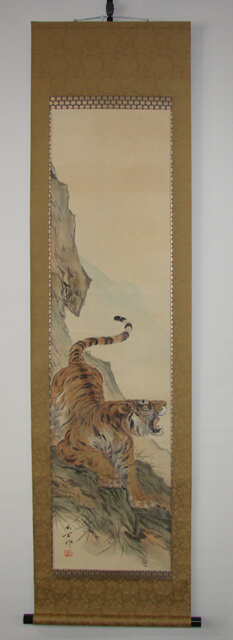
The proportions of the kakejiku are now balanced in a traditional Japanese manner, allowing for calm and comfortable viewing.
The areas that had tears can now be appreciated naturally thanks to careful retouching.
Although stain removal was not perfect, we were able to reduce the stains to a level where they are not particularly distracting when viewing the work.
Feedback from the Customer
We contacted the customer promptly and shipped the scroll to the United States.
The customer was very pleased upon receiving it and kindly left the following review.
Art Nomura did a magnificent job restoring a 100 year old scroll. It was badly damaged and deteriorated, and had been rejected by several restoration people. Art Nomura restored it beautifully.
We learned for the first time from this review that the customer had been turned down by several restoration providers. Knowing that they were in such a difficult situation and still chose to rely on us and visit our shop made us even happier.
We were able to meet the customer’s expectations and revive a scroll filled with precious memories of their father, and we feel truly proud of the result.
Conclusion
At our shop, we also accept consultations and requests for kakejiku restoration in person, just like this case.
Unlike purely online communication, meeting in person allows us to discuss the project while matching fabrics directly to the artwork, which makes it possible to share a clearer image of the final result after remounting.
If you are having trouble with restoration of a precious kakejiku, please feel free to contact us. We will do our utmost, with all the skill and care we can provide, to restore your work.