
Mounting a Scroll of the Pilgrimage: The Largest Class of Nōkyō Scrolls — The Hyakukannon Sacred Sites
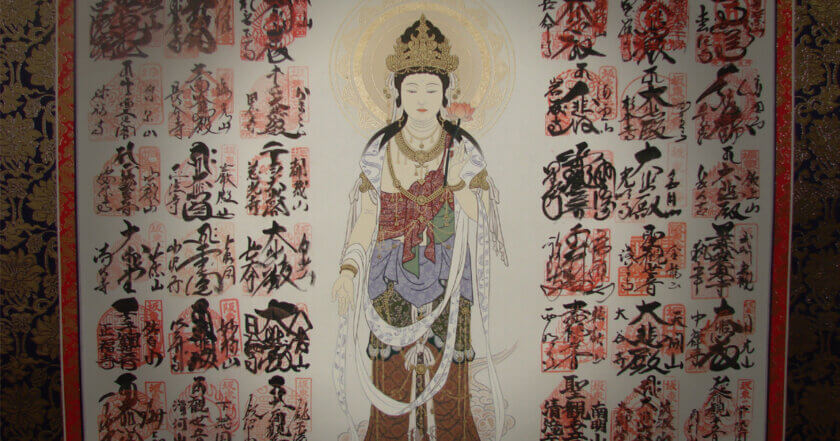
What Is the Hyakukannon Pilgrimage?

One of Japan’s Most Expansive and Historic Pilgrimages


Japan is home to many traditional pilgrimage routes, but among them, the Hyakukannon Pilgrimage (One Hundred Kannon Pilgrimage) stands out for its vast scale and deep historical significance.

The term Hyakukannon refers collectively to the following three Kannon (Avalokiteśvara) pilgrimage routes:

  • Saigoku 33 Kannon Pilgrimage (established in the Nara period)
  • Bandō 33 Kannon Pilgrimage (established in the Kamakura period)
  • Chichibu 34 Kannon Pilgrimage (developed around the Muromachi period)

Each originated in a different era and region, reflecting Japan’s long-standing and diverse traditions of Buddhist devotion.

From Saigoku to Bandō to Chichibu — The Birth of the Hyakukannon

+Saigoku 33 Kannon (Nara period)
The oldest Kannon pilgrimage in Japan, centered in the Kansai region. It is often regarded as the foundation of Japan’s Kannon worship.

+Bandō 33 Kannon (Kamakura period)
Modeled after the Saigoku pilgrimage and established in the Kantō region.
This route covers a distance of approximately 1,300 kilometers, a remarkable journey considering that it was originally traveled entirely on foot.

+Chichibu 34 Kannon (Muromachi period)
Located in the Chichibu region of present-day Saitama.

Originally consisting of 33 temples, its increase to 34 is evidenced by a stone monument dated 1525 (Daiei 5) at the ruins of Iwao Castle in Nagano Prefecture.

The inscription lists:

“Chichibu 34 / Saigoku 33 / Bandō 33”

This discovery suggests that the concept of the Hyakukannon—100 Kannon pilgrimage—was already conceived by this time.

The Hyakukannon Pilgrimage — Once Considered the Most Difficult in Japan

Because it spans from western to eastern Japan, the Hyakukannon pilgrimage has historically been considered one of the most challenging:

  • ・Enormous distances
  • ・Numerous mountainous temples
  • ・Difficult travel conditions in pre-modern times

For these reasons, very few people historically managed to complete the entire pilgrimage.

In recent years, however, interest in the Hyakukannon pilgrimage has grown once again.
As transportation has improved, more people are attempting this extensive journey, and we at our studio have seen an increase in requests to mount completed Hyakukannon nōkyō scrolls into hanging scrolls (kakejiku), commemorating the achievement.

A Commission to Mount a Hyakukannon Nōkyō Scroll

The episode introduced here is one such request from a couple living in Kobe.

They visited our studio carrying a large nōkyōjiku scroll filled with the stamps from all three pilgrimages—a testament to the long spiritual journey they had completed together.

Hyakukannon nōkyōjiku scrolls are among the largest formats of pilgrimage scrolls, with all 100 temple stamps arranged around a central image of Kannon. Their sheer size and visual density make the mounting process particularly demanding, requiring precise balance and careful fabric selection.

Selected Mounting Fabric

For this project, the clients selected our Buddhist mounting pattern No. 5, “Renge” (Lotus Buddha Pattern).
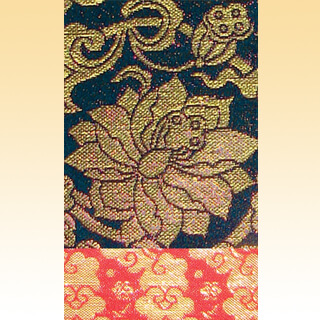
This elegant gold brocade features lotus motifs and harmonizes beautifully with Buddhist imagery.
It enhances both the purity of the central Kannon figure and the powerful presence of the one hundred vermilion stamps.

For a scroll of this scale and importance, it was an ideal choice.

The Completed Hyakukannon Scroll

Once mounted, the scroll radiated an impressive harmony:
the shimmering gold brocade, the vivid pilgrimage stamps, and the serene central Kannon image all came together to form a profoundly dignified work.
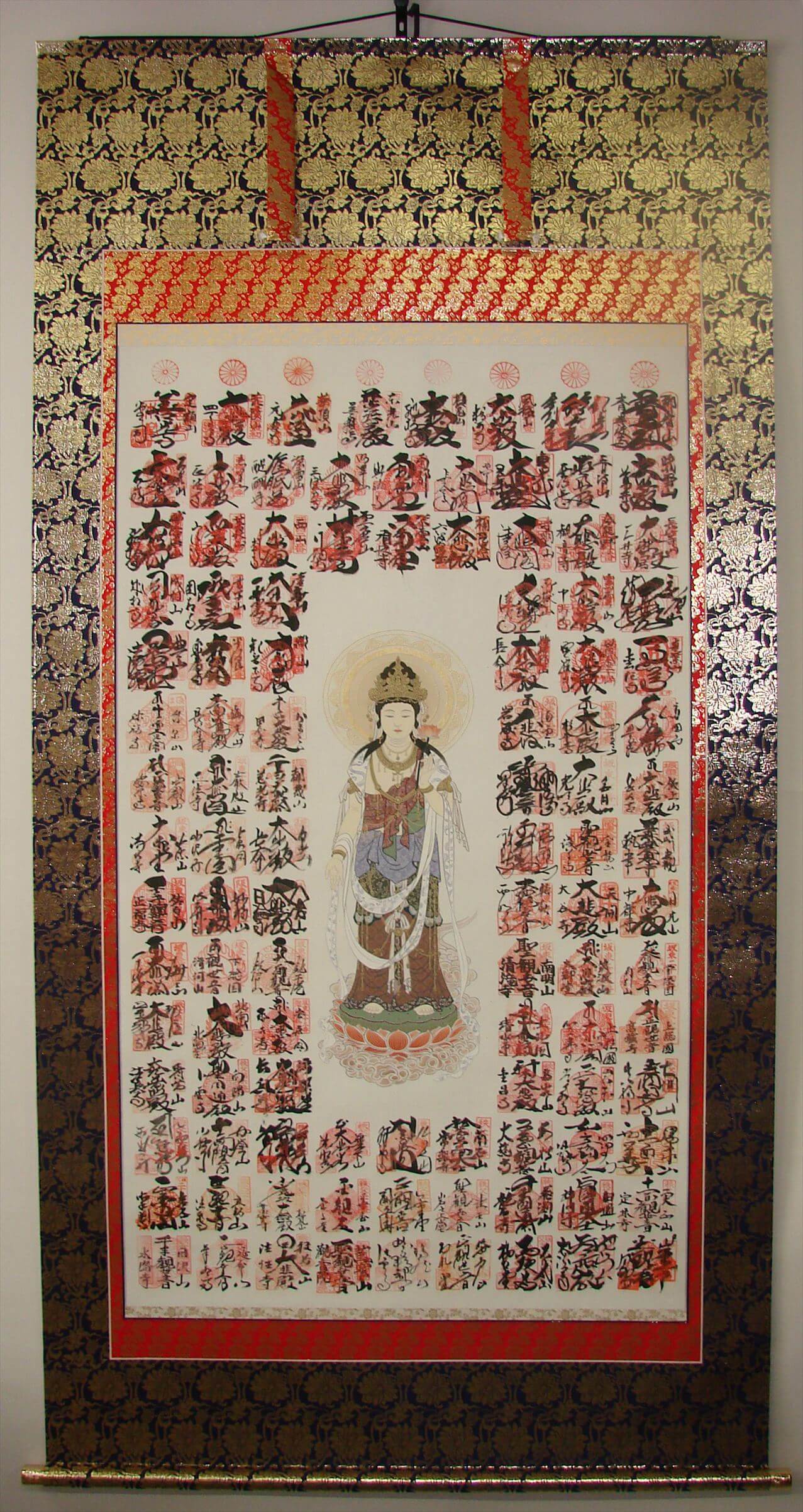
Large nōkyōjiku scrolls especially reveal the difference that professional mounting can make.

In this case, the “Renge” brocade supported the overall composition beautifully, resulting in a piece suitable for long-term display and preservation.

The clients were deeply moved upon seeing the finished scroll, expressing how grateful they were to have their pilgrimage preserved in such a magnificent form.

We, too, felt honored to help commemorate such a meaningful journey.

For Those Considering Mounting a Hyakukannon Nōkyōjiku Scroll

The Hyakukannon pilgrimage is one of the most historically rich and geographically extensive pilgrimages in Japan.

Mounting the nōkyōjiku scroll—the proof of the journey—greatly enhances its beauty and helps preserve it as a cherished record for future generations.

We welcome consultations regarding nōkyōjiku scroll mounting for the Hyakukannon, Saigoku, Bandō, Chichibu, and other pilgrimage routes.
 

Contact Us

Please fill out the form below and submit for your inquiry.

❈FirstName
❈LastName
Country
❈E-mail
(❈Confirm E-mail)
❈Inquiry category Question
Consultation
Impression
Request
Others
❈Comment

is the mark for required item.


Your privacy is important to us. We are committed to protecting your privacy.

(or press ESC or click the overlay)

CEO Message

Our Feelings For Kakejiku


 The Japanese people have long set a high value on aesthetic senses since ancient times. As a result, the
peculiar culture which is not seen in other countries blossomed and many aspects of the modern Japanese
culture come from it. Parts of Japanese culture has been introduced to people in other countries recently,
so the number of people from other countries who are interested in Japanese culture has been increasing.
However, the Japanese aesthetic senses, which are the bases of Japanese culture, have been nurtured
through a long history, intertwining various elements intricately, such as climate, geographical features,
religion, customs and so on. Therefore, they are very difficult to understand not only for people from other
countries, but even for the Japanese people. I think the best tool which conveys these difficult senses
understandably is a “kakejiku.”
 The kakejiku (a hanging scroll; a work of calligraphy or a painting which is mounted and hung in an
alcove or on a wall) is a traditional Japanese art. It's no exaggeration to say that paintings are what
express aesthetic senses at all times and places. The kakejiku is an art which expresses the Japanese
aesthetic senses. The kakejiku has long been used in traditional Japanese events, daily life and so on since
ancient times. As a result, there are various customs of kakejiku in Japan; kakejiku and the life of the
Japanese are closely related. We can see Japanese values through kakejiku.
 The kakejiku is a cultural tradition which the Japanese people should be proud of. However, many people
in other countries don't know much about it because it hasn't been showcased as much. This is why I
decided to try to introduce it. The kakejiku world is very interesting and beautiful. We want not only the
Japanese, but also many people from other countries to know and enjoy it. I hope that many people will
love kakejiku someday.

(or press ESC or click the overlay)
Company Profile
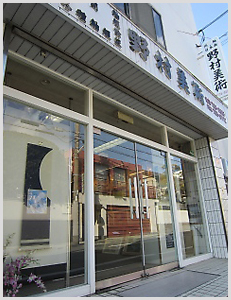
syaoku.jpg(120220 byte)

Name Art Nomura


President Tatsuji Nomura


Founded1973


Established1992


Address7-23 Babadori, Tarumi-ku, Kobe city,
Hyougo Prefecture, 655-0021, Japan


Capital10 million yen


URLhttp://nomurakakejiku.com


Our Business

 Art Nomura is an art dealer which produces kakejiku (hanging scrolls). We mount many paintings and calligraphic works in kakejiku in my factory. Kakejiku are our main product. We also remount and repair old or damaged kakejiku. We share the traditional Japanese art of kakejiku with people all over the world.


(or press ESC or click the overlay)
Access Map

Access Map


 The Japanese people have long set a high value on aesthetic senses since ancient times. As a result, the
peculiar culture which is not seen in other countries blossomed and many aspects of the modern Japanese
culture come from it. Parts of Japanese culture has been introduced to people in other countries recently,
so the number of people from other countries who are interested in Japanese culture has been increasing.
However, the Japanese aesthetic senses, which are the bases of Japanese culture, have been nurtured
through a long history, intertwining various elements intricately, such as climate, geographical features,
religion, customs and so on. Therefore, they are very difficult to understand not only for people from other
countries, but even for the Japanese people. I think the best tool which conveys these difficult senses
understandably is a “kakejiku.”
 The kakejiku (a hanging scroll; a work of calligraphy or a painting which is mounted and hung in an
alcove or on a wall) is a traditional Japanese art. It's no exaggeration to say that paintings are what
express aesthetic senses at all times and places. The kakejiku is an art which expresses the Japanese
aesthetic senses. The kakejiku has long been used in traditional Japanese events, daily life and so on since
ancient times. As a result, there are various customs of kakejiku in Japan; kakejiku and the life of the
Japanese are closely related. We can see Japanese values through kakejiku.
 The kakejiku is a cultural tradition which the Japanese people should be proud of. However, many people
in other countries don't know much about it because it hasn't been showcased as much. This is why I
decided to try to introduce it. The kakejiku world is very interesting and beautiful. We want not only the
Japanese, but also many people from other countries to know and enjoy it. I hope that many people will
love kakejiku someday.

(or press ESC or click the overlay)