
Hayami Gyoshū and Red Plum and White Plum — The Genius of Composition Seen in a Pair of Hanging Scrolls
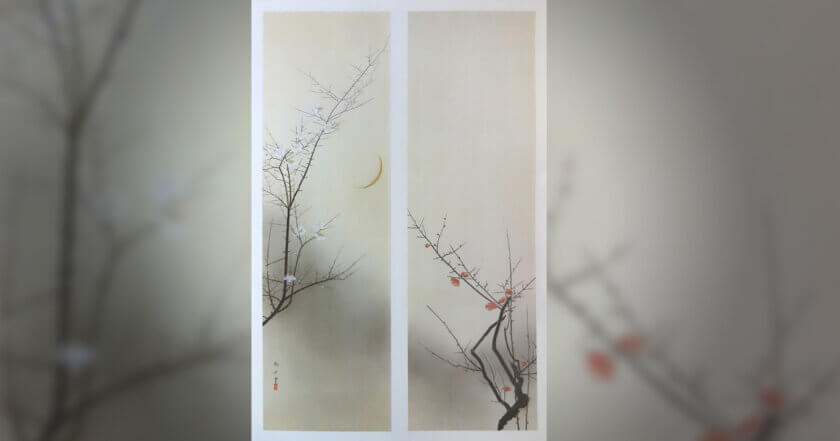
A Brilliant Talent Gone Too Soon: Hayami Gyoshū
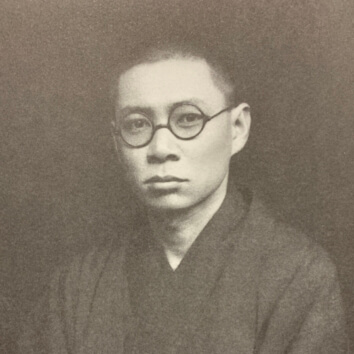
Hayami Gyoshū (1894–1935) was a Japanese painter active from the Taishō period to the early Shōwa era.
He died suddenly of typhoid fever at the age of forty, yet in his short life he left an unmistakable mark on the history of nihonga (modern Japanese-style painting).
One of Gyoshū’s most striking qualities is that he never settled into a single style. He was always searching for a new kind of expression.
He once wrote: “It is admirable to have the courage to climb to the top of a ladder. But even more admirable is the courage to climb down again—and then climb once more.”
True to those words, he would reach a peak in one approach and then move on to the next challenge. As a result, he produced multiple masterpieces—each distinct in genre and character—including Important Cultural Properties such as Enbu (Flames Dancing) and Meiju Chiri Tsubaki (Famous Tree: Scattered Camellias).
Red Plum and White Plum — A Bold Composition That Uses the Pair Format to Full Effect
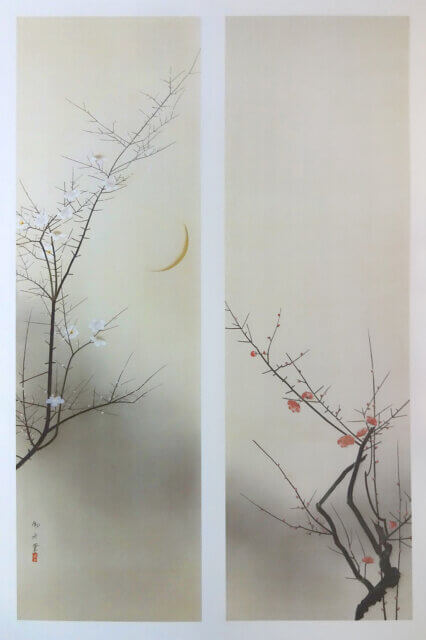
Red Plum and White Plum in the collection of the Yamatane Museum of Art is a work made as a pair of hanging scrolls (a “double-scroll” composition).
What makes this piece so compelling is how perfectly Gyoshū exploits the two-scroll format.
In the right scroll, the red plum is arranged so that, viewed on its own, a large area of empty space remains in the upper portion. Ordinarily, one might feel tempted to “fill” that space—perhaps with an inscription, or with a moon. Gyoshū deliberately avoids doing so. Instead, the branch of the red plum is boldly stylized and thrusts upward with force, as if passing the baton to the left scroll.
In the left scroll, the white plum receives that motion and rises powerfully, like an ascending dragon. Near the top of the composition, a small moon is placed with great restraint—quietly establishing that this is a nocturnal scene. With that single element, the paired scrolls can be read as a landscape in moonlight, where red and white blossoms glow in the night air.
A Subtle Accent in Pale Ink
There is another detail worth noting. At the point where the visual “baton” moves from the red plum to the white plum, a faint wash of pale ink runs across the space, reminiscent of the Milky Way. This delicate use of ink heightens the stillness and tension of the night. It even seems to convey the chill of early spring—the crisp air that lingers when plums bloom.
By fully embracing the pair format and unifying two separate scrolls into a single world, Gyoshū demonstrates extraordinary compositional mastery. In that precision—making the two-scroll structure itself part of the artwork’s logic—his genius becomes unmistakably clear.
Summary (for the end of the article)
Red Plum and White Plum is a work in which the very format of a paired hanging scroll becomes the engine of its composition. The open space above the red plum in the right scroll is not treated as a “gap,” but as a deliberate passage that carries the viewer’s gaze toward the left scroll. There, the white plum completes the movement, while the small moon and the faint touch of ink quietly summon the chill and stillness of the night.
A world that only becomes whole when the two scrolls are seen together—this precision of design is where Hayami Gyoshū’s extraordinary compositional power truly reveals itself.