Shikoku Pilgrimage Temple: No. 38: Sada-san Fudaraku-in Kongōfuku-ji
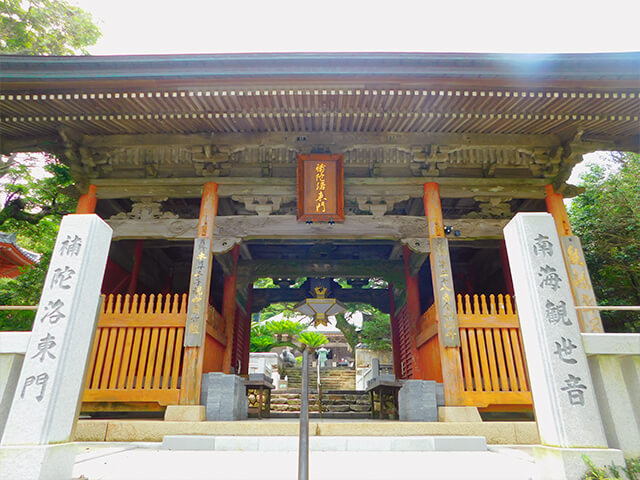
Precincts Flourishing with Subtropical Trees Such as Akō
- Name: Sada-san Fudaraku-in Kongōfuku-ji
- Principal Image: Sanmen Senju Kanzeon Bosatsu (Three-Faced, Thousand-Armed Kannon)
- Goeika (Pilgrimage Song):
- Fudaraku! Here at the cape is a boatman’s pole;
- whether one takes it up or lays it down, all is guided by the Dharma of Mount Sada.
Access From Temple No. 37, Iwamoto-ji
- On foot: Via National Route 56, National Route 321, and Prefectural Route 27. A long journey crossing many mountain passes. 95 km, approx. 30 hours.
- By Car: Same route as on foot. 95 km, approx. 3 hours.
- Public Transport: From JR Kubokawa Station, take the Tosa Kuroshio Railway for 1 hour 20 minutes to Nakamura Station. Transfer to the Kōchi Seinan Kōtsū Bus bound for Ashizurimisaki for 1 hour 50 minutes, and get off at Ashizurimisaki.
The Southernmost Temple in Shikoku
At the southernmost tip of Shikoku lies Cape Ashizuri (Ashizurimisaki), where a chalk-white lighthouse stands atop sheer cliffs. Kongōfuku-ji is built on high ground overlooking this cape.
Cape Ashizuri is one of Shikoku’s leading tourist destinations. The area around Kongōfuku-ji is bustling with hotels, eateries, and souvenir shops. Yet once you step into the temple precincts, that bustle gives way to a remarkable sense of tranquility. Dotted with halls and pagodas amid a virgin forest of subtropical trees such as akō (fig trees) and birō (fan palms), the precincts have an expansive and serene feel. The temple grounds are said to cover an area of over 38,000 tsubo (approx. 126,000 square meters) encompassing the cape.
A Temple of the Fudaraku Faith
This temple was founded by Kōbō Daishi, who was granted an imperial plaque reading “Fudaraku Tōmon” (Eastern Gate of Fudaraku) by Emperor Saga. The plaque hanging on the current Niō-mon Gate is said to be a replica of it.
“Fudaraku” (Potalaka) refers to the southern ocean Pure Land of Kannon, and the Fudaraku faith, which flourished from around the Heian period, involves offering prayers toward this distant realm across the sea. It was particularly prominent in areas such as Kumano in Wakayama Prefecture.
In Kumano, an ascetic practice known as Fudaraku Tokai was conducted, in which monks set out to sea in small boats bound for the Pure Land of Kannon across the horizon. It was regarded as a journey of no return, and monks are said to have ventured into the rough seas out of deep religious devotion.
Ashizuri was also one such site for Fudaraku Tokai. The “Fudaraku Tōmon” plaque on Kongōfuku-ji’s Niō-mon Gate embodies the meaning of a gateway leading toward the land of Fudaraku. Within the precincts stands the Gongen-dō Hall, dedicated to the deities of Kumano.
How Cape Ashizuri Got Its Name
The name “Ashizurimisaki” (Cape Ashizuri) also appears to be linked to this sea of Fudaraku. In the literary work Towazugatari, believed to have been written in the late Kamakura period, there is the following tale: Long ago, Kongōfuku-ji was a humble temple inhabited only by a head priest and an acolyte boy. In those days, the cape was an extremely remote place far removed from human habitation. Few people visited, and the two struggled even to secure their daily meals. One day, another young acolyte began visiting the temple, and the temple’s acolyte shared his meager food with him. The head priest scolded him for giving away food when they had so little, but he continued to share. One day, the visiting acolyte invited him to see his home. The two went to the cape and set out southward in a small boat. To the head priest’s astonishment, they appeared as two bodhisattvas standing at the bow and stern of the boat. Overcome with grief, the priest cried out and stamped his feet (ashizuri). According to the tale, this is how Cape Ashizuri got its name.
Prospering with Imperial Devotion in the Heian Period
In the late Heian period, Kongōfuku-ji attracted the devotion of court nobles from the capital as a sacred Kannon site. This may have been connected to the popularity of the Kumano faith among aristocrats at the time, and successive emperors also held deep reverence for the temple. Furthermore, the Heian poet Izumi Shikibu and Gofukakusa-in Nijō, the aforementioned author of Towazugatari, visited this temple. The temple gradually prospered as the Fujiwara clan donated shōen (manorial estates) in Tosa. At its peak, it became a sacred center of Shinto-Buddhist syncretism, boasting 16 halls and pagodas and 22 shrines within its grounds. During the Edo period, it continued to flourish under the patronage of the Yamauchi clan, lords of the Tosa Domain. Although it suffered a period of decline during the Meiji-era anti-Buddhist movement (Haibutsu Kishaku), it was subsequently restored.
Historic Temple Halls and Structures
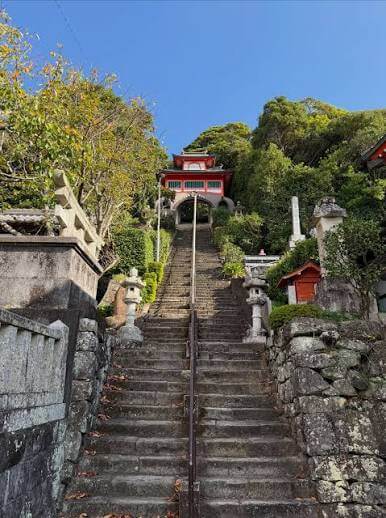
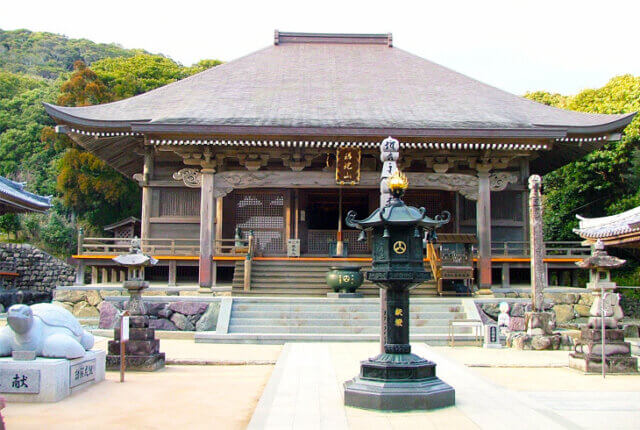
Passing through the Niō-mon Gate from the national highway and ascending a few stone steps, temple structures such as the Hondō and Aizen-dō come into view. Behind the Goma-dō Hall on the right stands the Tahōtō (Two-storied Pagoda). The temple enjoyed deep devotion from the Minamoto clan as well; the Tahōtō is said to have been erected by Minamoto no Mitsunaka—father of Minamoto no Yorimitsu, famed for slaying the demon Shuten-dōji of Mt. Ōe—as a memorial offering for Emperor Seiwa. The present pagoda was rebuilt during the Meiji period. On the stone water basin of the chōzuya (purification font), the Tosa Kashiwa oak crest of the Yamauchi clan is carved, said to have been donated in the 16th year of Kan’ei (1639).
The Seven Wonders of Ashizuri and Kōbō Daishi Legends
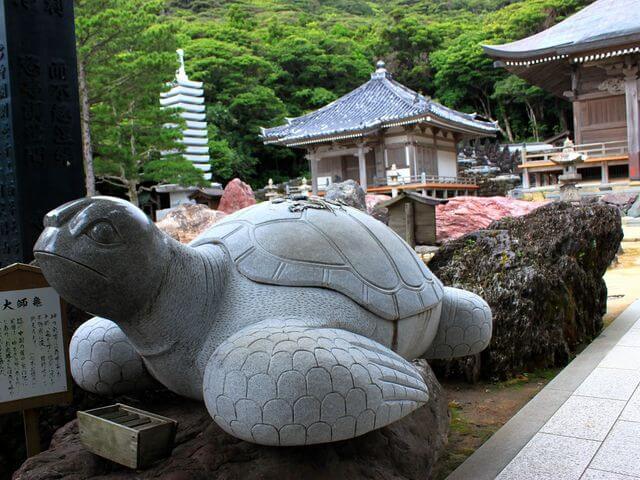
The trail leading from the temple toward the Ashizurimisaki Lighthouse is known as the “Camellia Tunnel,” where camellias grow in dense clusters. February is the peak season, when deep crimson flowers color the surrounding landscape. Dotted along the trail are historic spots known as the Seven Wonders of Ashizuri, which convey legends associated with Kōbō Daishi, such as “Daishi’s Claw-Carved Rock” (Daishi no Tsumagaki-ishi). Among these seven wonders is the “Turtle-Calling Rock” (Kameyobi-iwa). Commemorating the legend that Kōbō Daishi crossed to the offshore Fudō-iwa Rock on the back of a sea turtle to pray, a stone turtle statue known as “Daishi Kame” was erected. It is said that rubbing the turtle’s head brings blessings.
DATA
Address: 214-1 Ashizurimisaki, Tosashimizu City, Kōchi Prefecture
Phone: 0880-88-0038
Access: From Nakamura Station on the Tosa Kuroshio Railway, take the Kōchi Seinan Kōtsū Bus bound for Ashizurimisaki for 1 hour 50 minutes, get off at Ashizurimisaki, and walk 5 minutes.
Parking: Available (Free)
Lodging: 20 rooms, accommodating up to 80 guests. In principle, guests participate in the morning service and Dharma talk held in the shukubō’s Goma-dō Hall. Approx. 6,500 yen per night with two meals. Advance reservations required. (Note: As of October 2026, the temple lodging is reported to be closed. The accommodation details and rates above are based on older information. Please contact the temple directly for the latest information.)
Your Pilgrimage, Your Art
Completing the Shikoku Pilgrimage is a once-in-a-lifetime journey—but what if you could preserve it in a form that lasts forever?
Many pilgrims collect red stamps and calligraphy from each temple on a special silk scroll called a nōkyōjiku.
This sacred record of your path can be transformed into a kakejiku—a traditional Japanese hanging scroll—not only preserving the memories, but turning them into a work of cultural and spiritual art.
It’s more than a souvenir—it’s a way to honor your journey, your prayers, and your growth.
To learn more about how a nōkyōjiku becomes a kakejiku, and what makes this transformation so meaningful, please refer the below link.