Mounting a Photograph as a Japanese Hanging Scroll | A UK Photographer’s Work Printed on Japanese Paper
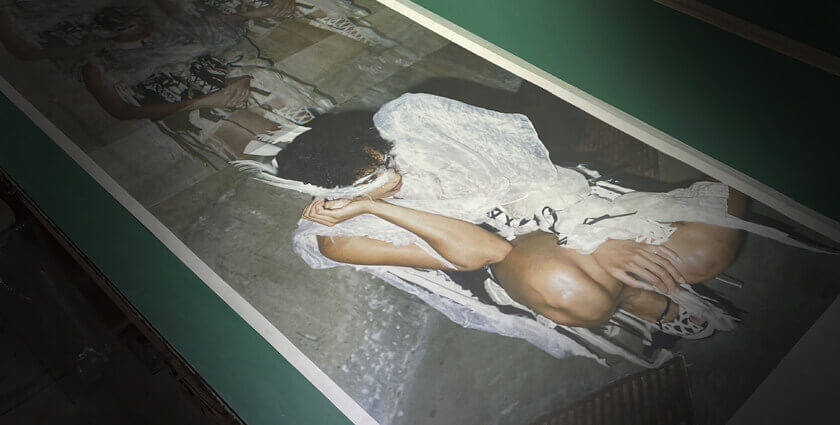
Can a photographic work be displayed not in a conventional frame, but as a traditional Japanese hanging scroll?
This project began when a film photographer based in the UK contacted us about having one of his own photographic works made into a traditional Japanese hanging scroll, known as a kakejiku.
Rather than attaching ordinary photographic paper directly to a hanging scroll, we first printed the image onto Japanese paper suitable for traditional mounting. That printed paper then became the artwork itself and was mounted as a kakejiku.
At first, this may sound relatively simple. In reality, however, successfully printing a photograph onto Japanese paper and then turning that printed sheet into a stable hanging scroll present two very different challenges.
In this article, we introduce how we translated a contemporary photographic work into the traditional Japanese format of a kakejiku.
A Photographer’s Request: “I Want to Turn My Photograph Into a Kakejiku”
Our client, whom we will refer to as Mr. A, is a photographer based in the UK.
He works with film cameras rather than digital cameras, and from speaking with him, it was clear that he approaches photography not simply as a means of recording something, but as an artistic practice.
For this project, he selected one of his own portrait photographs.
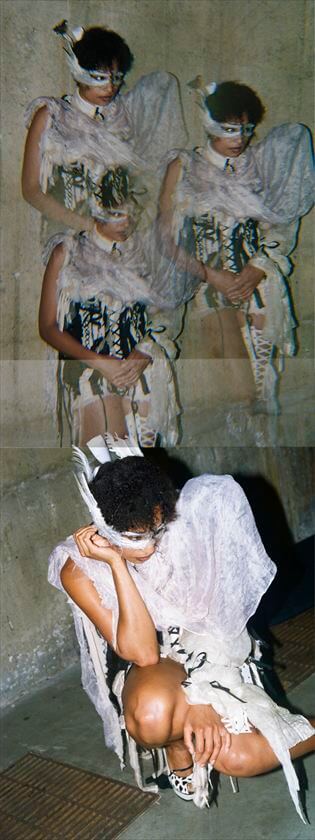
Against a dark and subdued background, figures dressed in white emerge strongly from the composition, giving the photograph a quiet but powerful presence.
“I would like to turn this photograph into a kakejiku.”
That was where this project began.
Why Ordinary Photographic Paper Is Not Suitable for a Hanging Scroll
The first thing we explained was that ordinary photographic paper is generally not suitable for mounting directly as a kakejiku.
A Japanese hanging scroll is designed not only to be displayed, but also to be rolled up for storage.
For this reason, the artwork itself needs to retain a certain degree of flexibility.
Ordinary photographic paper is relatively thick and often has a stiff surface coating. If such material is forced into a hanging-scroll format, repeated rolling can place excessive stress on it and may lead to creasing or other problems.
We therefore proposed a different approach:
Print the photographic image onto Japanese paper
↓
Mount the printed paper as the main artwork
↓
Finish it as a traditional hanging scroll
For the print, we used a specially prepared type of Japanese paper, or washi, made primarily from kōzo (paper mulberry), whose fibers have traditionally been used in Japanese papermaking.
The paper was suitable for both printing and traditional mounting. Not every type of washi can be used successfully for both purposes.
The finished printed image measured approximately 54 × 150 cm.
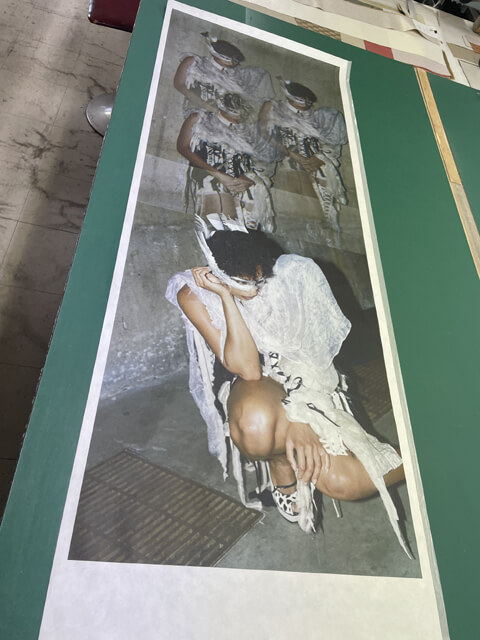
This already made it a considerably large work for a hanging scroll.
Digital Color and Color Printed on Japanese Paper Are Not the Same
In fact, before we even began the mounting process, one of our main concerns was the printing itself.
The photograph contains a great deal of dark coloration, meaning that a large amount of ink had to be applied over almost the entire surface of the paper.
When printing such a dark image on a sheet this large, one concern is simply whether the printing process itself will remain stable.
Another challenge is color.
The colors seen on a computer or smartphone screen will never appear exactly the same once printed onto paper.
We therefore checked the actual printed result carefully and adjusted the color balance so that the atmosphere of the original photograph could be preserved as closely as possible.
This was particularly important because the dark tones are a major part of the character of the work.
If the image became too dark, important details could disappear.
If it became too bright, the heavy and subdued atmosphere of the photograph could be lost.
Finding the right balance required careful adjustment.
Being Printable Does Not Mean It Can Be Mounted in the Usual Way
This was the part of the project that required the greatest technical care.
The Japanese paper used for this project was made with mounting applications in mind.
However, compared with the paper normally used for Japanese painting or calligraphy, it is still relatively thick.
On top of that, this particular sheet had absorbed a large amount of ink across almost its entire surface.
In other words, we were dealing with:
a somewhat thicker sheet of Japanese paper
combined with
a large amount of absorbed ink.
If we had mounted it in exactly the same way as an ordinary work on paper, the finished hanging scroll could have become too thick, potentially creating problems when rolled.
We already knew this from previous experience.
Simply because a material can technically be mounted does not mean that it should be treated in exactly the same way as ordinary calligraphy or painting paper.
For this project, we therefore introduced additional processing different from our standard mounting method in order to reduce the risk of future problems.
The specific technique is part of our workshop know-how, so we will not go into detail here, but it did require additional stages and extra care during the mounting process.
The important thing is that a kakejiku should not merely look beautiful on the day it is completed.
A hanging scroll is repeatedly rolled and unrolled over many years.
If additional work at the mounting stage can reduce the possibility of problems later, we believe it is better to take those precautions from the beginning.
That was our decision in this case.
Choosing a Dark Silver Fabric With a Traditional Shippō Pattern
We also discussed the mounting fabrics carefully with Mr. A.
The photograph itself is dark, quiet, and visually weighty.
Rather than surrounding it with something bright or overly decorative, we felt that a subdued silver fabric with sufficient visual depth would better support the atmosphere of the photograph.
We ultimately selected a dark silver mounting fabric woven with Shippō, a traditional Japanese pattern made from repeating and overlapping circles.
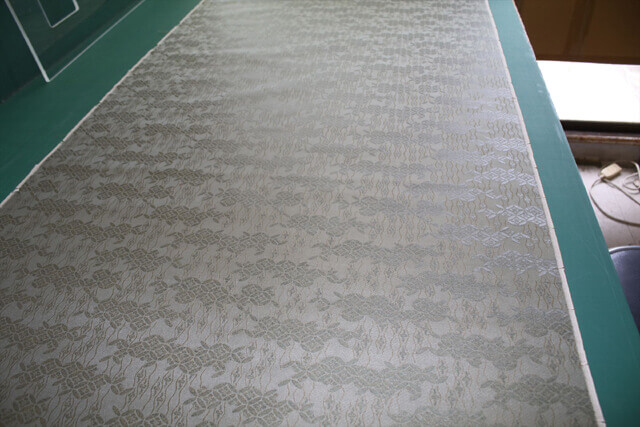
Shippō is one of Japan’s best-known auspicious patterns.
Because its circles continue and connect without interruption, the pattern has long been associated with harmony, relationships, prosperity, and continuity.
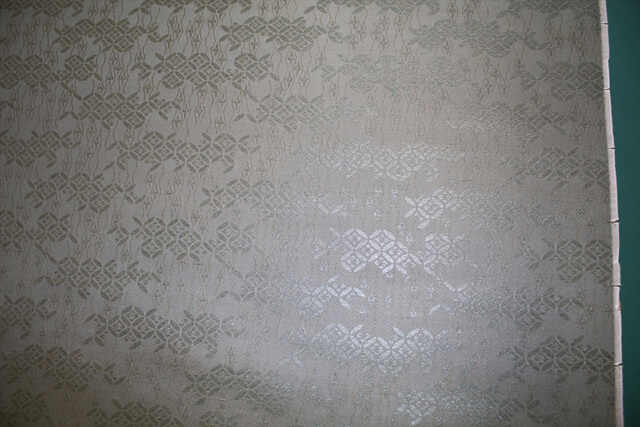
The name Shippō also refers to the “Seven Treasures” described in Buddhism.
There is something almost religious in the stillness of this photograph, along with a certain heavenly quality.
For that reason, we felt that the meaning and visual character of the Shippō pattern also resonated naturally with the world of the photograph.
A White Decorative Border Echoing the Subject’s Clothing
Another distinctive element of the mounting is the narrow white decorative fabric border surrounding the photograph.
In traditional Japanese mounting, this type of border is known as ichimonji-otoshi.
This was requested by Mr. A.
Within the otherwise dark composition, the white clothing worn by the subject immediately draws the eye.
We therefore used a white fabric around the photograph to carry that same white element into the mounting itself.
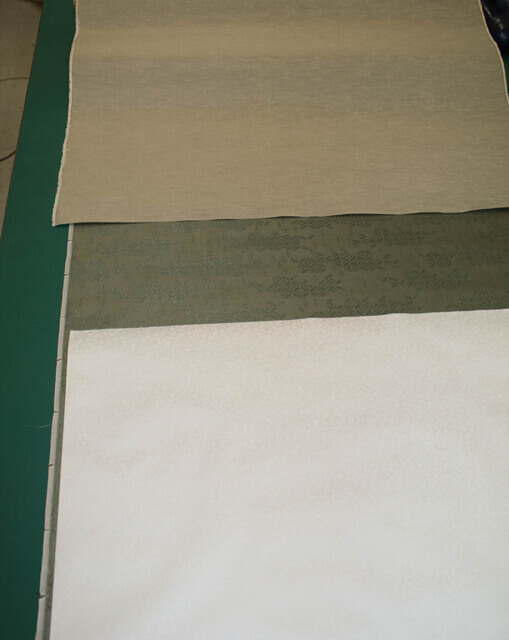
When Mr. A saw the design mock-up, he commented:
“I love how the white ichimonji-otoshi stands out against the silver the most, and how similar it looks to the fabric the artist is wearing.”
Rather than treating the photograph and the hanging-scroll mounting as two completely separate elements, the idea was to carry colors found within the photograph outward into the surrounding design.
For us, this is one of the most interesting aspects of designing a kakejiku.
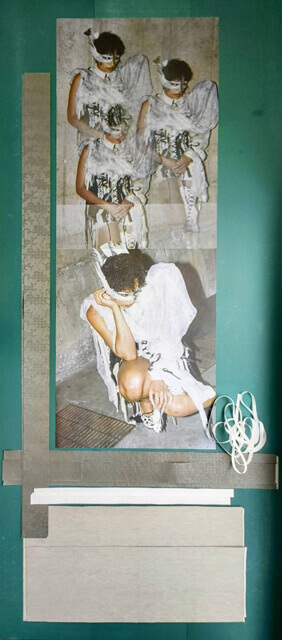
A Large Hanging Scroll Measuring Approximately 230 cm in Length
The completed hanging scroll measured approximately 71 × 230 cm. It became a work with considerable presence.
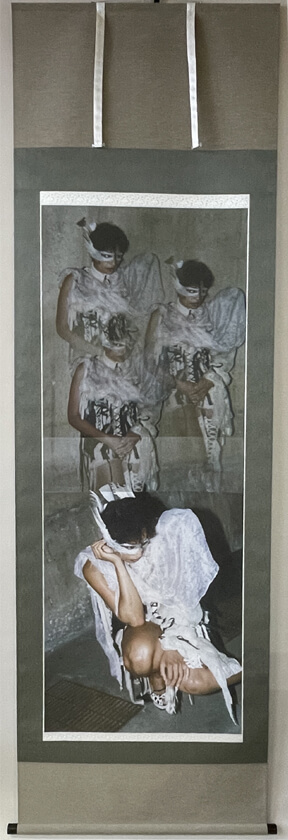
The silver fabric changes subtly depending on how the light falls across it, but it does not become overly decorative.
Instead, it supports the dark atmosphere of the photograph, while the white decorative border helps sharpen and frame the composition.
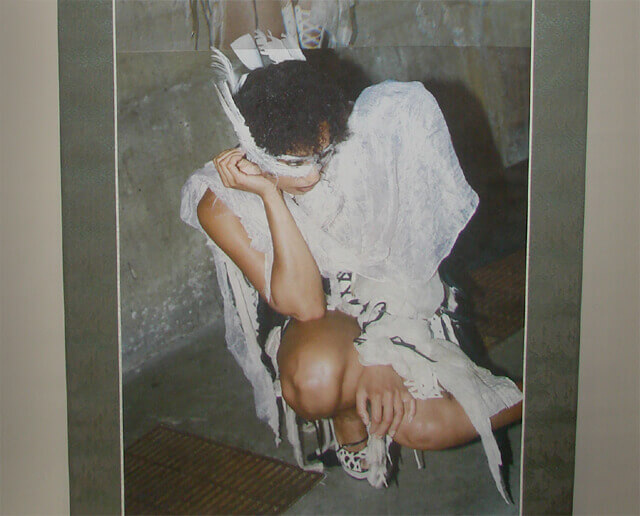
Although the original work is a contemporary photograph, it fit surprisingly naturally into the traditional hanging-scroll format.
This project reminded us once again that kakejiku are not limited to Japanese paintings and calligraphy.
With the right materials and appropriate treatment, contemporary photographic works can also use the hanging-scroll format as another means of artistic expression.
“Wow!” From the Moment We Began Unrolling It
After the kakejiku was completed, Mr. A travelled from the UK to Japan and visited our workshop in person to collect it.
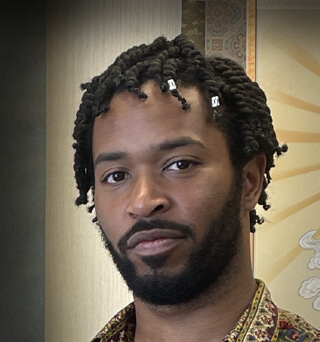
Since he had come all this way, we decided to unroll the finished work in front of him.
A hanging scroll is opened gradually from the top.
At first, the photograph itself was not yet visible.
The moment the silver mounting fabric began to appear, Mr. A reacted with:
“Wow!”
As we continued opening the scroll, the upper section of the photograph gradually appeared, followed by the figures, until finally the entire composition came into view.
We could clearly see his expression becoming more excited as more of the work was revealed.
His reaction was so easy to read that we found ourselves becoming happy as well.
Normally, we could simply open the hanging scroll smoothly in one motion.
But this time, we deliberately went a little more slowly.
He had travelled all the way from the UK, so we wanted him to enjoy not only the finished work itself, but also the moment in which it gradually revealed itself.
By the time the entire kakejiku was open, it was very clear how pleased he was with the result.
For those of us who make these works, this is perhaps the most rewarding moment of all.
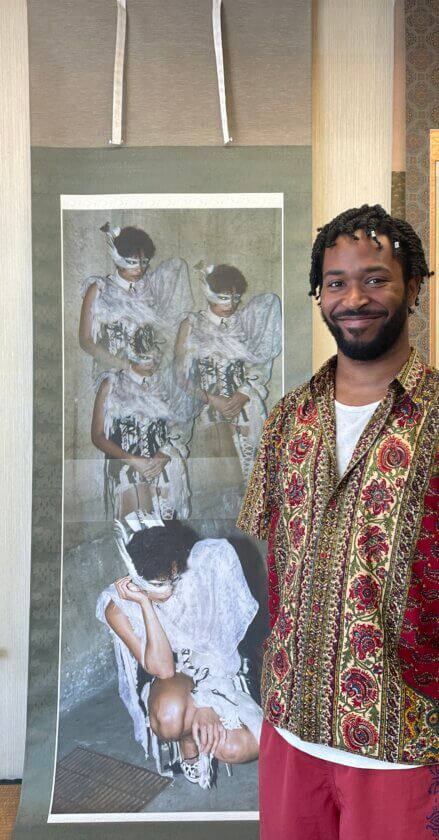
“I Want to Remember Who Made This Kakejiku”
Another memorable moment occurred during the handover.
The finished kakejiku was to be stored in a traditional paulownia-wood storage box, commonly used in Japan to protect hanging scrolls.
Originally, we had planned to leave the box completely plain.
After seeing the completed work, however, Mr. A asked whether the name of the person who had made the hanging scroll could be recorded on the box.
To summarize what he told us:
“I took the photograph, but you put it together and made it into this kakejiku. I respect that work, and I want to remember who made it.”
We therefore wrote my name inside the paulownia box on the spot.
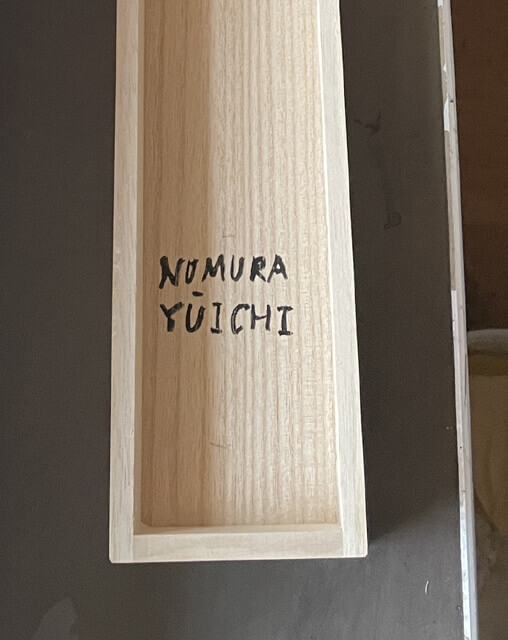
The photographer created the image.
The image was transferred onto Japanese paper.
We then transformed that printed work into a kakejiku.
A single work was completed through the hands and skills of people working in different disciplines.
The fact that Mr. A wanted that contribution to remain as part of the work’s record was something we found deeply rewarding as makers.
Feedback From Our Client
Soon after collecting the work, Mr. A kindly left us a Google review:
“I had some important work made here. Nomura-san was very patient with me in the production process.”
During the production process, he had also told us:
“You have my trust fully.”
Before the work was completed, we went through a number of discussions regarding the image data, color, mounting materials, and overall design.
Because we had taken the time to work through those details together, it was particularly rewarding for us to finally show him the finished hanging scroll in person and see how pleased he was with it.
Photography as Another Form of Expression Through Kakejiku
Requests to turn photographic works into traditional Japanese hanging scrolls are still relatively unusual.
However, that does not mean photography cannot be mounted in this format.
The important questions are:
What kind of paper should the image be printed on?
How should that printed paper be mounted?
And what fabrics and colors will best support the visual world of the photograph?
Each of these elements needs to be considered individually.
In this project, a contemporary film photograph was combined with the traditional Japanese craft of kakejiku mounting.
The result has a very different presence from a conventionally framed photograph, and the way the work is perceived changes as well.
If you are considering presenting your own photography or digital artwork in the form of a Japanese hanging scroll, please feel free to contact us with the image data and your preferred dimensions.
After reviewing the work and the materials involved, we can advise you on what kind of mounting approach may be possible.