Kakejiku Restoration | Remounting a Chinese Painting With Severe Creases and Discoloration
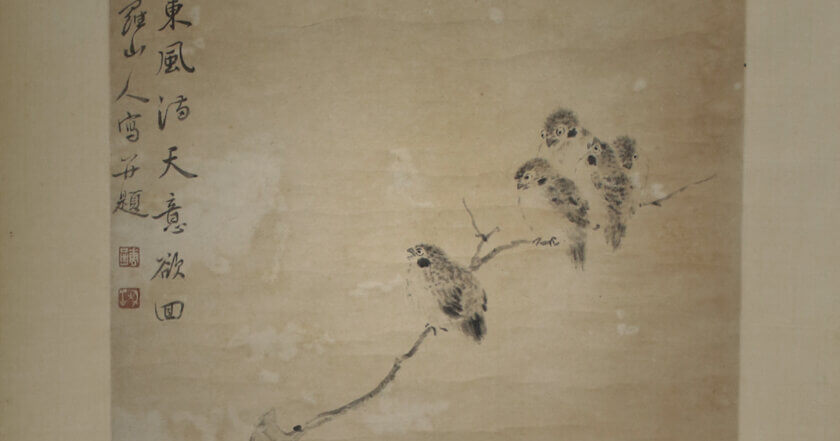
When examining an old kakejiku, visible problems such as stains or creases do not always reveal the true condition of the artwork.
When we first saw photographs of the kakejiku sent to us from Canada for restoration, it was already clear that the piece had suffered considerable damage.
However, once we dismantled the mounting, we discovered that the honshi, or the main artwork, was far more fragile than we had expected. We also found traces of previous remounting treatments that had affected its present condition.
In this article, we introduce how we restored and remounted this Chinese painting, which had developed severe creases and extensive uneven discoloration, and brought it back to a condition in which it could once again be appreciated as a work of art.
A Chinese Painting Kakejiku Sent From Canada
Our client for this project was based in Canada.
The artwork had been purchased through Christie’s and was mounted as a Chinese hanging scroll.
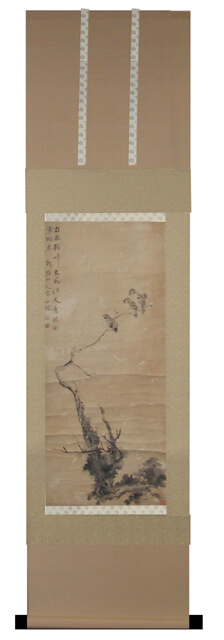
It is a quiet ink painting depicting sparrows perched on the branches of an old tree.
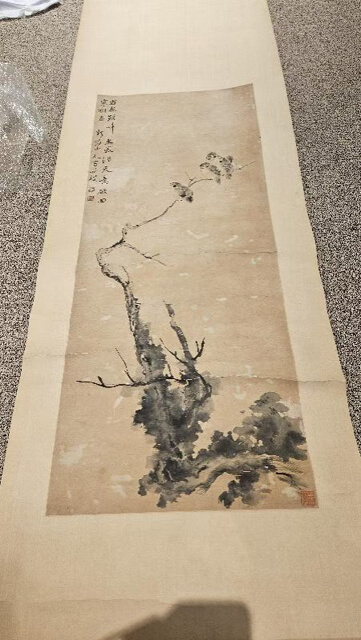
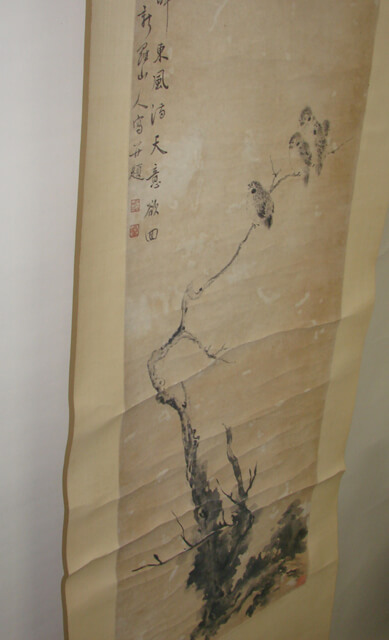
When we first looked at the photographs sent to us, the most striking problem was the series of severe horizontal creases running across the honshi.
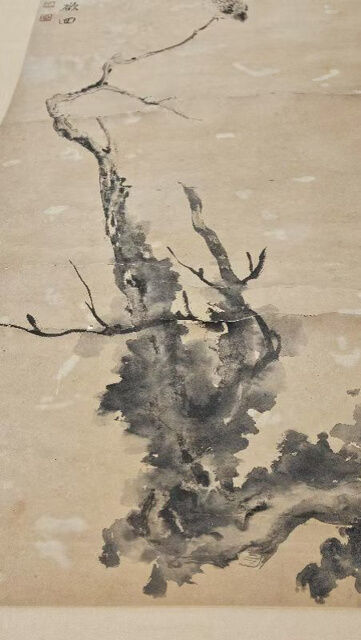
In particular, several large creases extended repeatedly across the middle and lower sections of the painting.
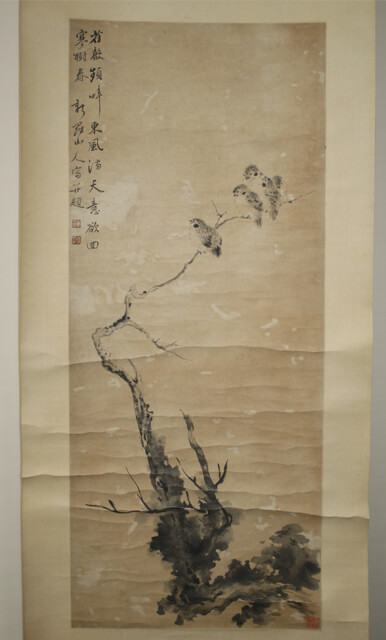
Another major concern was the irregular discoloration throughout the artwork. Bands of brownish color variation spread across the surface, while many areas appeared to have turned white. The damage was so visually prominent that the creases and uneven coloration drew the eye before the painting itself could be appreciated.
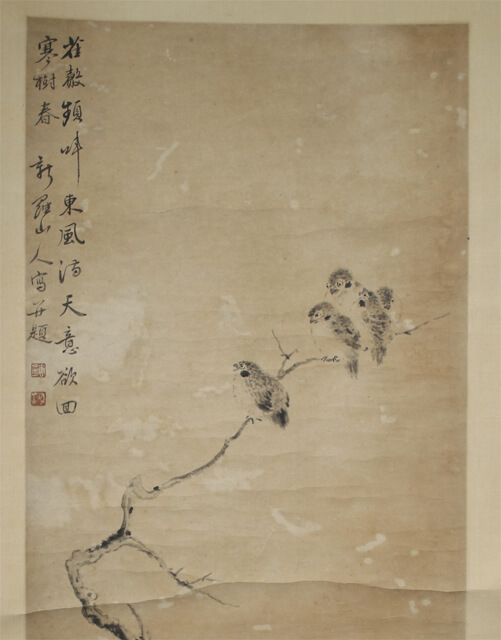
The True Cause of the White Patches Was Not Visible From Photographs Alone
When the artwork first arrived at our workshop, we initially thought that the pale areas might largely be the result of severe staining or discoloration.
However, once we dismantled the mounting and began removing the old backing paper, we discovered that the situation was much more complicated.
The white areas did not all have the same cause.
Some areas appeared pale because of discoloration, while in others the honshi itself had become extremely thin. There were also places where parts of the original paper had already been lost.
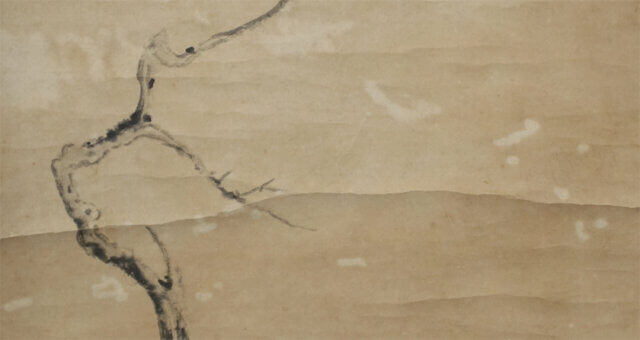
One thing, however, was common to all of these areas.
Every place that appeared white was also an area where the original artwork had become extremely fragile.
This became the first major challenge of the restoration.
We could not proceed to the next stage without removing the old backing paper.
However, in the weakened areas there was a real risk that the original paper could come away together with the backing.
To make matters more difficult, the old backing paper did not separate easily.
Two of us worked together, constantly checking the condition of the artwork and removing the backing little by little.
It would have been faster to proceed more aggressively, but doing so could have damaged the original work.
This stage required an exceptional amount of concentration and care.
Previous Remounting Made This Restoration Even More Difficult
As the work progressed, it became apparent that the scroll had been remounted several times in the past.
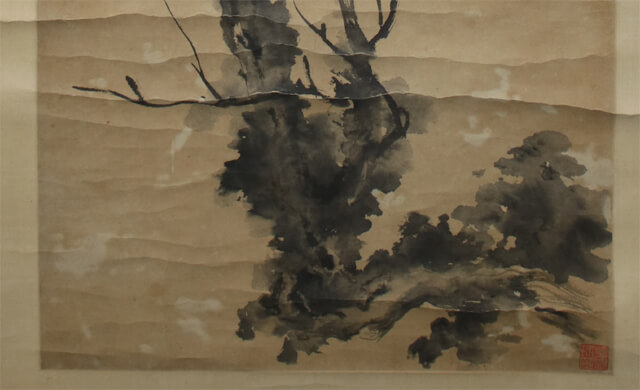
The fact that an old work has undergone previous remounting is not unusual.
The problem in this case was that some of the earlier treatments could not be considered ideal.
A very strong adhesive had been used in the previous mounting.
Paper that did not match the surrounding color had also been applied to areas of loss, and in some places this itself contributed to the uneven appearance of the painting.
In addition, the severe creases had not been sufficiently reinforced with ore-buse, a technique in which narrow strips of Japanese paper are applied from the reverse to strengthen weakened crease lines.
The future condition of a kakejiku can vary greatly depending on what materials were used and how previous treatments were carried out.
In this case, the strong adhesive and thick backing papers may have made the scroll relatively stiff, placing additional stress on areas that had already been creased.
Combined with long-term storage conditions, the insufficient reinforcement of existing creases during the previous remounting may also have contributed to their deterioration.
With Stain Removal, the Difficult Question Is Not “Can We Remove It?” but “How Far Should We Go?”
After removing the old backing paper, the next stages were cleaning and stain removal.
This required another very difficult judgment.
As the photographs before restoration show, there was considerable uneven discoloration across the honshi.
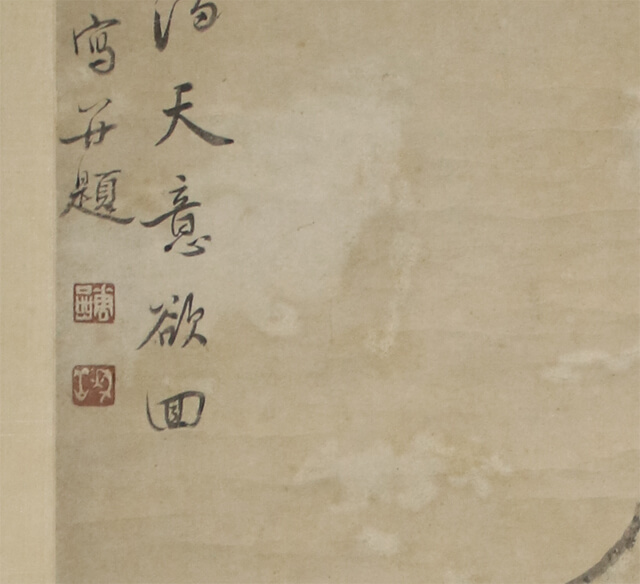
Even if the creases were repaired, the painting would still be difficult to appreciate if those strong color variations remained.
At the very least, the most distracting areas of uneven coloration needed to be reduced.
However, the original paper itself was extremely fragile.
A stronger treatment might have produced a cleaner appearance.
At the same time, taking that extra step could also have damaged the artwork.
This is one of the most difficult aspects of stain removal on old paintings.
The question is not simply how much discoloration can be removed.
We also have to decide where we should stop.
For this reason, we did not carry out an aggressive treatment all at once.
Instead, we worked gradually, checking the condition of the artwork at each stage.
We would proceed a little, inspect the result, and then continue carefully.
It took time, but eventually we were able to greatly reduce the prominent bands of uneven discoloration that had been visible before restoration.
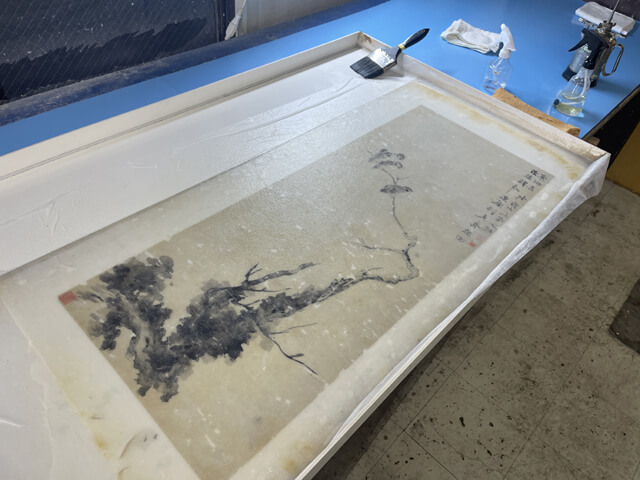
Even simply bringing the background tone into better balance can dramatically change the way a painting is perceived.
Before restoration, the uneven background itself demanded attention.
After treatment, the eye can once again move naturally toward the old tree and the sparrows.
An Enormous Amount of Crease Reinforcement and Retouching
This artwork contained an exceptionally large number of creases.
We therefore carried out ore-fuse, reinforcing the creased areas from the reverse with narrow strips of Japanese paper.
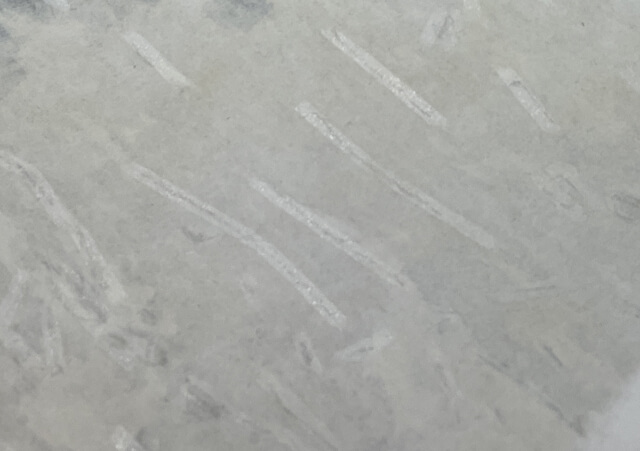
There were far more than just one or two creases.
Each weakened line across the artwork had to be treated individually, making this an extremely time-consuming process.
When beginning work like this, there are moments when we genuinely wonder whether the end will ever come.
However, this is not a step that can simply be omitted.
If a severely creased work is remounted without proper reinforcement, stress can once again concentrate along the same lines and the creases may continue to worsen in the future.
It takes determination to work through every one of them.
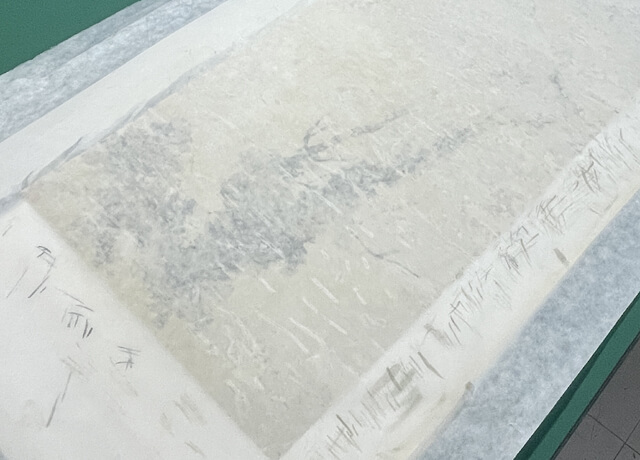
In addition, this honshi contained a great many areas of loss.
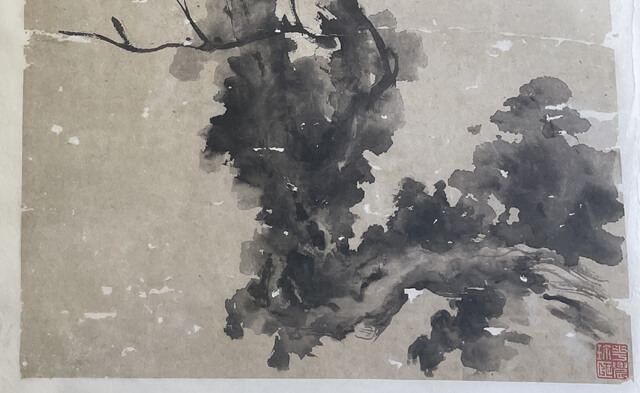
We therefore carried out retouching in areas where the losses appeared as distracting white patches, adjusting them so that the painting could once again be viewed naturally.
Retouching does not mean freely painting in the missing areas.
We carefully observe the surrounding tones and ink and adjust only what is necessary so that the losses do not stand out excessively.
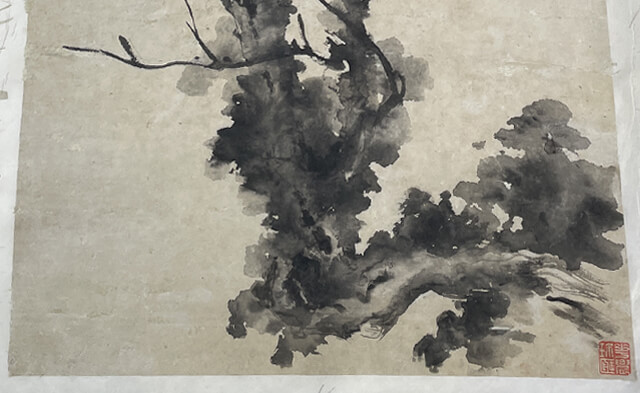
The crease reinforcement and retouching alone required a considerable amount of time.
Preserving the Character of the Original Mounting While Improving the Overall Balance
We also discussed the new mounting with the client in detail.
The original mounting was very simple and differed somewhat from the more common Japanese kakejiku format.
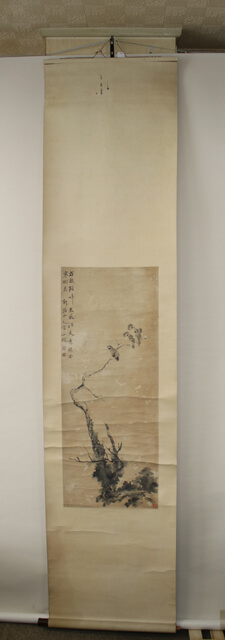
At first, we also considered remounting the work in a Japanese style.
However, the client told us that they wanted the finished scroll to remain as simple as possible, stay close to the original atmosphere, and avoid using a mounting fabric that would draw attention away from the painting.
We therefore ultimately decided to retain the basic structure of the original mounting.
The original scroll, however, was unusually long in proportion to the artwork.
We agreed with the client to adjust the overall length so that the finished scroll would have a more natural balance.
For the mounting fabric, we avoided strong patterns and proposed several understated materials that would not compete visually with the painting.
The final choice was a high-grade fabric in a soft gray tone.
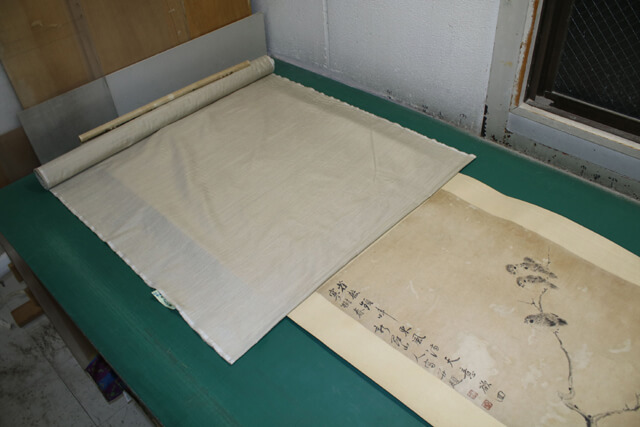
Although it is a premium-quality material, it is not ornate.
For this particular painting, we felt that allowing the quiet world of the sparrows and old tree to remain the focus was more important than making the mounting fabric itself stand out.
Comparing the Scroll Before and After Restoration
Here is the completed kakejiku.
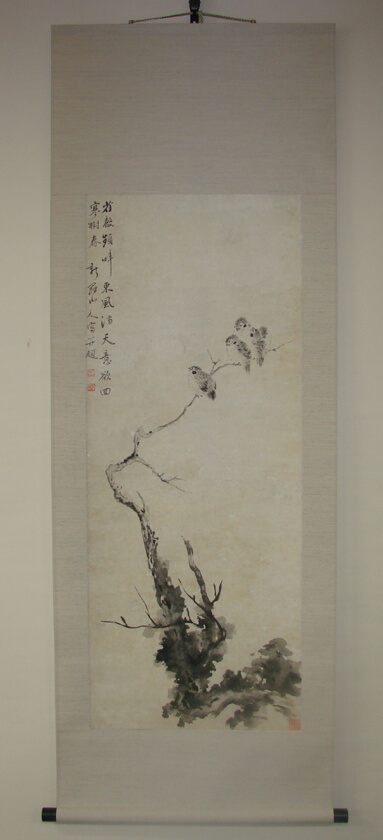
The difference becomes clear when compared with its condition before restoration.
Before treatment, the severe horizontal creases running across the artwork and the irregular background discoloration were the first things the eye noticed. In particular, the large horizontal creases attracted more attention than the flow of the old tree or the sparrows themselves.
After restoration, these visual distractions were greatly reduced.
Of course, restoration does not mean making a centuries-old artwork look like brand-new paper.
The natural signs of age remain, as do areas of deterioration that cannot and should not be completely removed.
However, we believe we were able to change the work from something in which the damage dominated the viewer’s attention into a painting that can once again be appreciated for the image itself.
The delicate branches extending from the old tree.
The sparrows perched at their tips.
The viewer’s eye can once again move naturally through the original composition.
Futomaki Storage After Restoration
Because the honshi itself had become extremely fragile, we also paid careful attention to how the finished scroll would be stored.
We adopted a futomaki storage method, which increases the diameter around which the scroll is rolled.
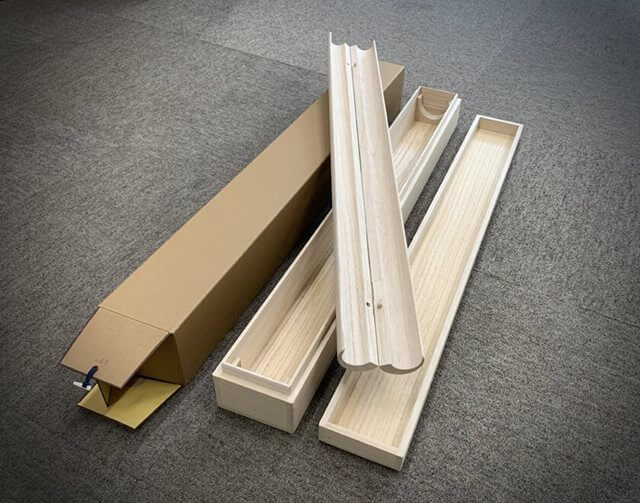
This creates a gentler curve when the kakejiku is rolled compared with winding it tightly around a smaller-diameter roller.
Restoration is not only about making a scroll look better at the moment the work is completed.
It is equally important to consider how the artwork can be kept stable for as long as possible afterward.
For a work such as this, which had suffered severe creasing, the method of storage after restoration is an important part of the overall treatment.
Safely Returned to Canada
After the restoration and remounting were completed, we sent photographs of the finished kakejiku to the client for confirmation.
The scroll was then returned to Canada via FedEx.
We later received the following message from the client:
“Thank you so much! We received the package today.”
We were pleased to know that the restored artwork had arrived safely.
With Old Kakejiku, the True Condition Is Sometimes Only Revealed After Dismantling
One of the most memorable aspects of this restoration was that the white patches visible at the beginning did not have a single cause.
Some were the result of staining or discoloration.
In other areas, the original paper had become extremely thin or had already been lost.
There were also areas where previous repairs using differently colored paper had created further visual unevenness.
Beneath all of this were traces of earlier remounting treatments.
When restoring an old kakejiku, it is not always enough to treat only what can be seen from the front.
There are many things that become apparent only after the mounting has been dismantled, and the restoration plan sometimes has to be adjusted according to what is discovered.
Another important consideration is knowing when not to go too far.
We may want to remove more staining.
We may want to make the creases less visible.
But if doing so places the original artwork at risk, the treatment becomes counterproductive.
At ART NOMURA, we aim to balance improving the appearance of a work with preserving the original artwork for the future, adjusting our approach according to the condition of each individual scroll.
Even a kakejiku with severe creases, uneven discoloration, or traces of previous repairs may, depending on its condition, be restored to a state in which it can once again be displayed and appreciated once again.
If you are looking at an old hanging scroll and wondering, “Is this too damaged to restore?”, we encourage you to let us examine its condition first.
We accept inquiries regarding kakejiku restoration and remounting from both Japan and overseas.