Kakejiku Restoration | Stain Removal and Remounting of a Japanese Ink Painting Scroll
When an old kakejiku is unrolled after many years, it is not uncommon to discover numerous stains across the artwork.
In this case, we were contacted by a customer in Nishiwaki, Hyōgo Prefecture, regarding a kakejiku that had been treasured by her late father.
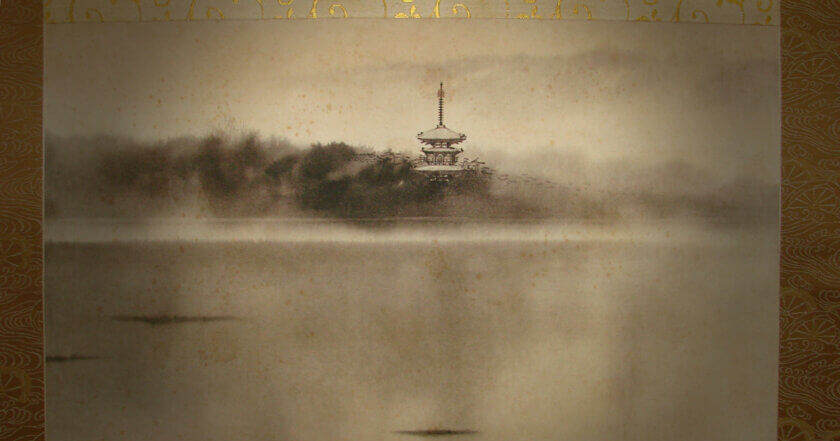
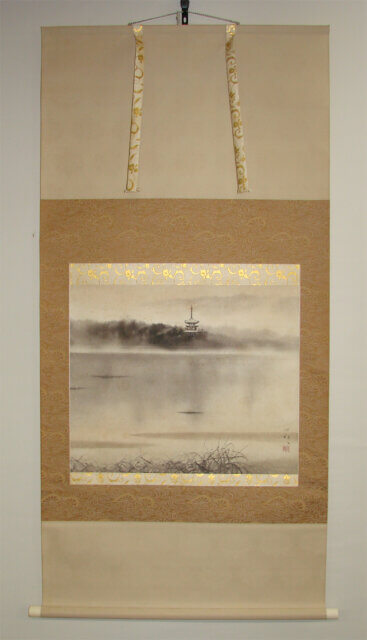
The artwork is an ink landscape depicting a pagoda, painted by Japanese artist Hamada Saburō.
A large number of stains had developed across the entire artwork, but there was an additional challenge: part of the ink used in the painting was unusually sensitive to moisture.
In this article, we introduce how we carefully removed as much of the staining as possible while preventing the ink from bleeding, and then remounted the work so that it could once again be displayed and enjoyed.
Restoring a Kakejiku Treasured by the Customer’s Father
The customer lives in Nishiwaki, Hyōgo Prefecture.
We visited her home to inspect the condition of the kakejiku in person.
The scroll had belonged to her late father, who was very fond of kakejiku and had collected several other hanging scrolls as well.
This particular piece was one that he often displayed and enjoyed during his lifetime.
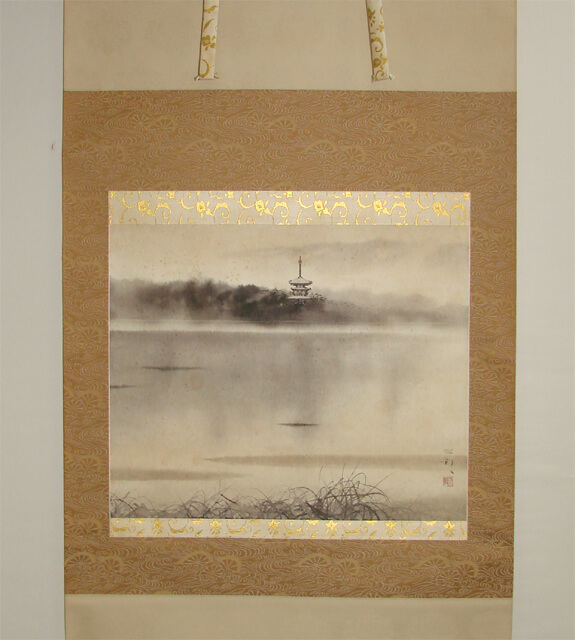
After his passing, however, the scroll remained stored away in a cupboard.
The customer had been aware for some time that stains were developing across the artwork, but she had never quite found the right opportunity to have it restored.
This is not unusual with old kakejiku.
Many people think, “I would like to have it repaired someday,” only for several years to pass before they finally decide to take action.
In this case, the customer eventually decided that she wanted to have the scroll cleaned and restored so that it could be displayed once again, and contacted us for advice.
An Ink Landscape with a Pagoda by Hamada Saburō
The artwork is an ink landscape by Hamada Saburō, featuring a pagoda in the distance.
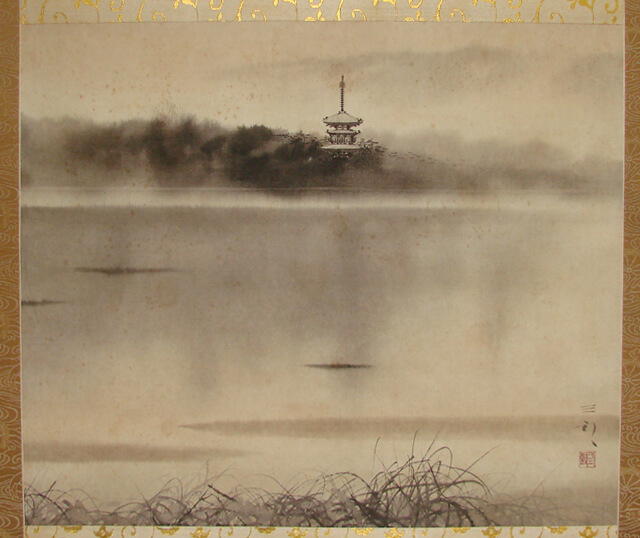
Hamada Saburō was born in Kanagawa Prefecture in 1924 and studied under the Nihonga master Maeda Seison.
At exhibitions of the Japan Art Institute, he received Tokutai and Mukansa recognition twice, had works selected for the Inten exhibition 32 times, and was selected for the Spring Exhibition 17 times.
His works were also acquired by the Hakone Open-Air Museum and Japan’s Ministry of Foreign Affairs.
He lived in Okamura, Isogo Ward, Yokohama, and was active mainly through the Japan Art Institute during the latter half of the Shōwa period.
One of the distinctive qualities of Hamada Saburō’s work is his soft ink expression, created through skillful use of blurring and bleeding.
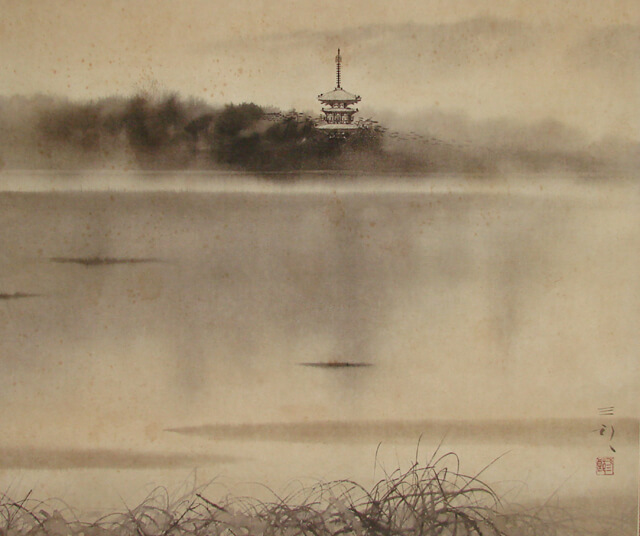
In this painting, the distant pagoda, mist, and surface of the water are all rendered with delicate washes of pale ink.
Rather than defining every form with clear outlines, the work seems to create an atmosphere through the subtle gradations and natural diffusion of the ink itself.
Extensive Staining Across the Entire Artwork
When we inspected the scroll, its overall structure remained intact, but numerous small brown stains had developed across the paper.
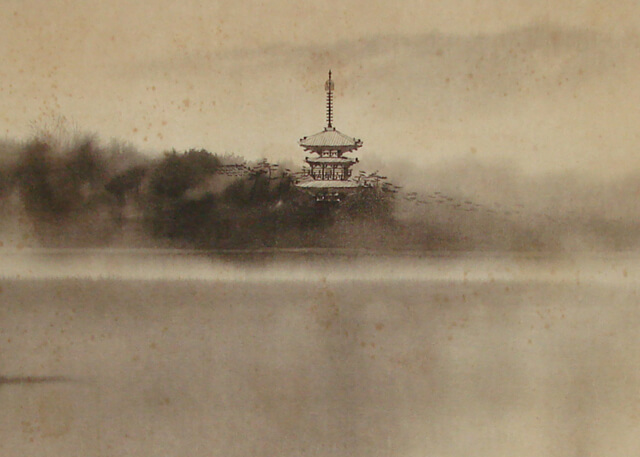
Because this is a pale ink painting with large areas of open space, each stain was particularly noticeable.
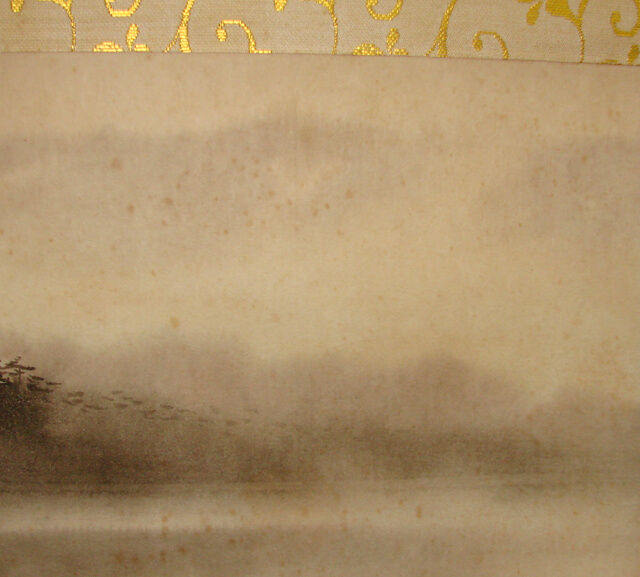
With a richly colored painting, some staining may visually blend into the image.
In a work dominated by pale ink, however, the stains can easily interfere with the viewer’s appreciation of the artwork.
In this condition, the eye tends to be drawn to the stains before the painting itself.
It is not possible to determine the exact cause of the staining from the current condition alone.
However, we were told that the scroll had remained stored in a cupboard for a long period after the customer’s father passed away.
It is therefore possible that humidity or other environmental factors during storage gradually contributed to the staining.
We ultimately agreed to remove as much of the staining as safely possible and then remount the entire kakejiku.
Removing the Stains Without Causing the Ink to Bleed
The most delicate part of this restoration was the condition of the ink used in the painting.
The artwork was painted on paper, and the ink has a subtle reddish tone.
During our preliminary testing, we found that the red component of the ink was relatively prone to color transfer and could bleed when exposed to moisture.
This was the difficult part.
Stain removal requires the use of cleaning agents, and once these agents have been applied, they must be thoroughly rinsed from the artwork.
As a result, a considerable amount of water is inevitably used during the stain-removal process.
In this particular painting, however, that moisture created a risk that the ink itself could bleed or lose color.
There would be little point in removing the stains if doing so damaged the artwork itself.
We therefore carried out a thorough color-fixing treatment beforehand to help prevent the sensitive color from moving.
Only after this preparation did we proceed with the stain removal, carefully monitoring the condition of the ink throughout the process.
Of course, our goal is never simply to “remove every stain” regardless of the consequences.
We aim to reduce the staining as much as possible while continually assessing the condition of the artwork and working only within a safe range.
Remounting While Preserving the Original Atmosphere
Along with the stain removal, we also remounted the entire kakejiku.
When an old hanging scroll is remounted, the original mounting fabrics are generally replaced with new ones.
It is usually impossible to obtain exactly the same fabrics that were used many years ago.
For this project, we therefore selected new fabrics that would preserve the original color balance and calm atmosphere of the scroll as closely as possible.
The customer left the fabric selection to us, so we chose materials within the agreed budget that were similar in tone and overall character to the previous mounting.
The painting itself is a very quiet and atmospheric ink landscape, so there was no reason for the new mounting to overpower it.
Rather than dramatically changing the design, we aimed to preserve the overall impression of the kakejiku as the customer’s father had known and enjoyed it, while renewing the mounting itself.
Stain Removal and Remounting Process
The general restoration process for this kakejiku was as follows.
- Color-Fixing
We first treated the artwork to help prevent the sensitive ink and color from moving when exposed to moisture.
- Disassembling the Kakejiku
The old mounting fabrics, roller rod, and other components were removed so that the artwork itself could be separated from the existing mounting.
- Removing the Old Backing Paper
The old backing paper attached to the reverse of the artwork was carefully removed.
- Washing and Stain Removal
The artwork was first washed while carefully monitoring the condition of the ink. We then used appropriate cleaning agents to reduce the stains as much as safely possible. After the stain-removal treatment, the artwork was thoroughly rinsed so that no cleaning agents remained in the paper.
- New Backing
New Japanese paper was applied to the reverse of the artwork to prepare it for remounting.
- Remounting
Finally, the artwork was remounted as a kakejiku using the newly selected fabrics.
In this project, the initial color-fixing treatment and the stain-removal process were particularly important.
An ink painting is not necessarily resistant to water simply because it was painted with sumi ink.
The way an artwork reacts to moisture can vary depending on the ink, paper, and other materials used by the artist.
For this reason, the condition of each artwork must be assessed individually before deciding how the restoration should proceed.
The Stains Were Greatly Reduced, Allowing the Painting to Be Enjoyed Again
The remounting was completed successfully. Compared with its condition before restoration, the numerous small stains that had spread across the artwork were significantly reduced.
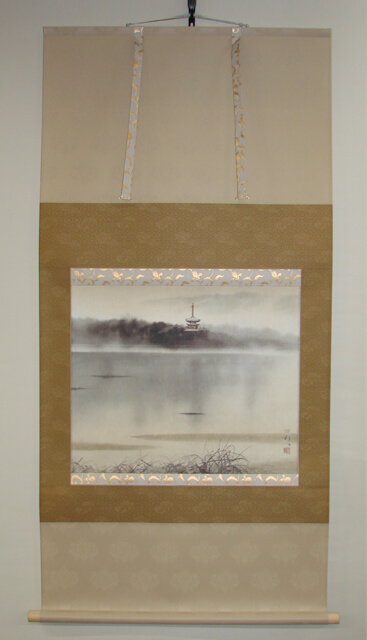
Of course, stain removal on an old artwork is not intended to make the paper look completely new again.
In this case as well, we continually monitored the effect on the ink and worked within the range that we considered safe for the artwork.
As a result, the stains no longer dominate the viewing experience, allowing the painting itself to become the focus once again.
The pale water, mist, and distant pagoda can now be appreciated much more naturally.
We also renewed the mounting without dramatically changing its overall appearance, preserving the calm atmosphere of the original kakejiku.
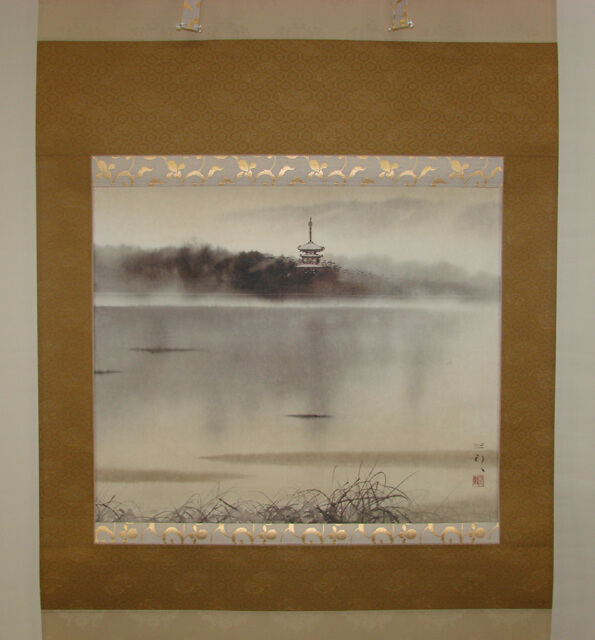
A scroll that the customer’s father had often displayed and enjoyed during his lifetime can now once again be hung and appreciated at home.
We hope that it will continue to be enjoyed by the family for many years to come.
If You Notice Stains on Your Kakejiku, Have Its Condition Checked
The customer in this case had already noticed the stains some time ago.
Even so, when it comes to having an old kakejiku repaired, it is very common to think, “I will have it restored someday,” only for years to pass.
Staining, mold, and other forms of deterioration may gradually progress depending on the storage environment.
Even when stains appear similar, the appropriate treatment can vary greatly depending on whether the artwork is on paper or silk and on the type of ink and pigments used.
In this case, the main challenge was not simply removing the stains, but determining how far we could safely proceed while protecting the moisture-sensitive color within the ink.
Restoring a kakejiku is not simply a matter of removing dirt.
The artwork itself must always come first, and the appropriate level of treatment must be determined according to its actual condition.
Even if an old kakejiku has been stored away for many years, or a scroll inherited from a family member has developed extensive staining, it may still be possible to restore and remount it so that it can once again be displayed and enjoyed.
If you have a treasured kakejiku that you would like to display again, or an old scroll covered with stains and are unsure whether it can be restored, please feel free to contact us.