Kakejiku Restoration | Repairing Severe Stains, Creases, and Tears
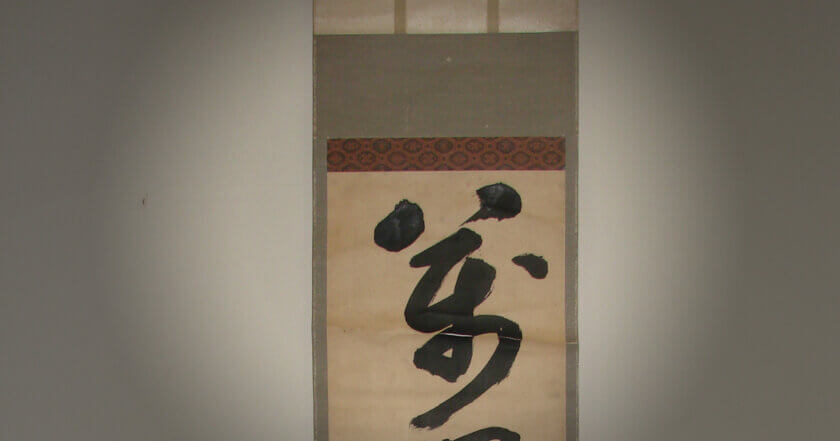
Over many years, kakejiku hanging scrolls can develop various forms of damage, including stains, discoloration, deep creases, and tears.
However, the most difficult part of restoring an old kakejiku is not always the damage that is immediately visible.
The tea-ceremony kakejiku we received this time had become extremely thin, and the fibers of the paper itself had weakened considerably.
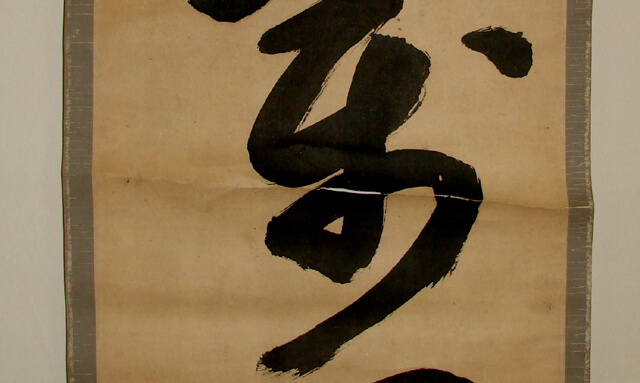
The paper was so fragile that too much moisture could cause it to swell, soften, and even begin to break down.
When a scroll is heavily soiled, simply cleaning it more aggressively is not the answer.
Restoration requires carefully judging the boundary between “how much cleaner can we make it?” and “at what point would further treatment begin to damage the artwork?”
This time, we would like to introduce the restoration and remounting of a calligraphic tea-ceremony kakejiku that had been handed down for many years in the home of a customer from Suma Ward, Kobe.
Referred by a Previous Customer Whose Tea-Ceremony Kakejiku We Restored
The customer first contacted us after being introduced by another customer for whom we had previously restored and remounted a tea-ceremony kakejiku.
When a previous customer introduces someone new to us, it is always a great honor for us.
The customer, who lives in Suma Ward, Kobe, brought a kakejiku that had been in the family for many years directly to our workshop.
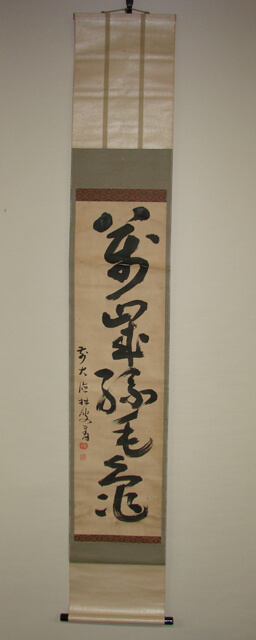
The scroll features bold and powerful calligraphy and is at least several decades old. Although it had been passed down within the family for many years, its condition had deteriorated considerably.
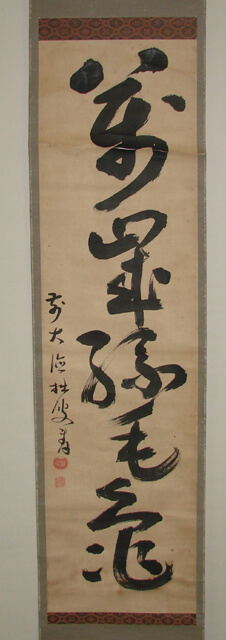
This was the customer’s first time requesting restoration of a kakejiku mounting.
Their request was simple:
“Please preserve as much of the current atmosphere of the kakejiku as possible.”
They entrusted the detailed mounting specifications to us.
The Problem Was Not Only the Stains — the Paper Itself Had Weakened
When we opened the kakejiku and examined it closely, we found that the deterioration was quite advanced.
The first thing that stood out was the extensive staining and discoloration across the artwork.
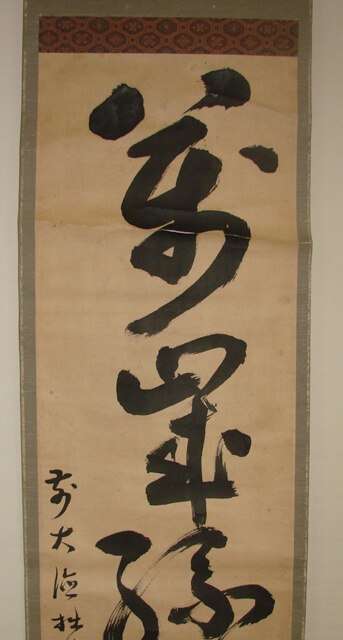
In old kakejiku, discoloration and stains can develop through a combination of many factors, including storage conditions, humidity, airborne contaminants, and the natural aging of the paper itself.
In this case as well, it was difficult to identify a single cause. The present condition was most likely the result of several factors accumulating over many years.
There were also a number of severe creases across the artwork.
As paper deteriorates, the repeated stress created when a kakejiku is rolled and unrolled can deepen existing creases. Eventually, those creases may develop into actual tears.
In this scroll, there were already areas where the paper had split open.
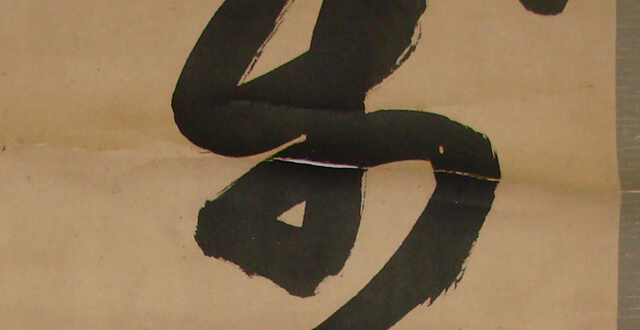
However, what concerned us most was not simply the visible tearing.
The honshi, meaning the original artwork itself, had become extremely thin, and the fibers forming the paper had weakened significantly.
An amount of moisture that would normally cause no problem could make this paper swell and soften. In some areas, excessive moisture could even cause the paper to begin breaking down.
This placed major limitations on the cleaning and stain-reduction treatments that could be performed later.
This was the part of the restoration that required particular care.
Removing the Old Backing Paper Also Involved Significant Risk
When remounting a kakejiku, the existing mounting is first dismantled, and the old backing papers adhered to the reverse of the artwork are removed.
When the original paper itself has become as weak as it had in this case, even this process is far from straightforward.
Because the artwork had already become so thin, attempting to forcibly remove areas where the old backing paper remained firmly attached could cause the original paper to come away together with the backing.
Applying further force could then cause additional damage to the artwork.
There would be little point in perfectly removing the old backing paper if doing so damaged the original artwork.
For this reason, we carefully examined the condition of the paper and peeled away the old backing paper little by little.
When restoring old kakejiku, it is important not only to know what treatments can be performed, but also to judge how far those treatments should be taken.
Cleaning and Stain Reduction Without Damaging the Artwork
After removing the old backing paper, we proceeded with cleaning and stain reduction.
As the photographs taken before restoration show, a considerable amount of dirt and discoloration had accumulated across the artwork.
Naturally, we wanted to recover as much of the original brightness of the paper as possible.
However, in this case, applying too much moisture was itself a risk.
If removing the stains had been made the sole priority and the treatment had been pushed too far, the already weakened paper fibers could have been damaged even further.
We therefore continued the cleaning and stain reduction while constantly monitoring the condition of the artwork and working only within a safe range.
As a result, we were able to remove a significant amount of the accumulated discoloration, and the paper regained much of its brightness.
When reducing stains on an old kakejiku, completely removing every trace of discoloration is not necessarily the correct goal.
There is no benefit in making an artwork look cleaner if the treatment itself damages the original paper.
How far should the treatment be taken?
Making that judgment is one of the most important parts of kakejiku restoration.
Repairing the Tears With New Backing and Ink Retouching
After cleaning and stain reduction, a new layer of Japanese backing paper was applied to the reverse of the artwork.
This new backing supports the weakened honshi from behind and helps stabilize the entire sheet.
However, when the original paper has completely torn open, as it had in this case, applying a new backing alone does not complete the repair.
The light-colored new backing paper remains visible through the opened tear.
Because this artwork consists primarily of black calligraphy, a pale line of backing paper appearing within the brushwork would make the damaged area extremely noticeable.
We therefore applied ink retouching to the areas where the backing paper remained visible through the tears.
By carefully adjusting the tone to match the surrounding ink, we were able to make the repaired areas less distracting when the work is viewed normally.
Restoring a kakejiku is not simply a matter of joining torn paper together.
The goal is to restore the work to a condition in which it can once again be appreciated as a complete artwork without the repaired areas drawing unnecessary attention.
The Restoration Process
The overall restoration and remounting process was as follows.
- Color-Fixing
- Dismantling the Kakejiku
- Removing the Old Backing Papers
- Cleaning and Stain Reduction
- Applying New Backing
- Reinforcing Creases and Tears
- Ink Retouching
- Remounting With New Fabrics
- Final Finishing
Looking only at the individual steps, the process is not dramatically different from a typical kakejiku remounting.
However, the difficulty of kakejiku restoration is not determined simply by the number of procedures involved.
When the original paper itself has become extremely fragile, as in this case, even routine procedures such as removing old backing papers or cleaning require far greater care and judgment than usual.
A New Tea-Ceremony Mounting That Preserves the Original Character
Once the restoration of the artwork itself was complete, we moved on to the new mounting.
The customer had asked us to preserve as much as possible of the atmosphere of the original kakejiku.
We therefore remounted the work in a traditional chagake style, a type of mounting used for kakejiku displayed during the Japanese tea ceremony.
The main mounting fabric is a subdued brown tone that does not compete with the bold black calligraphy.
For the ichimonji, the narrow decorative fabric immediately above and below the artwork, we selected a red-toned fabric.
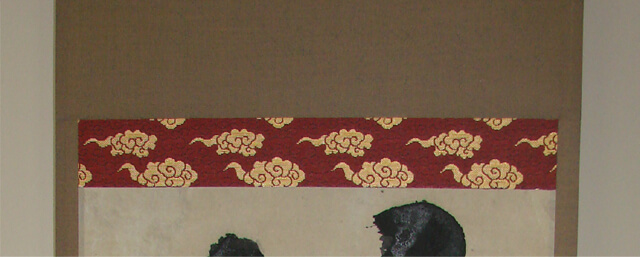
Keeping the calm impression of the previous kakejiku in mind, we selected the new fabrics so that the overall mounting would come together naturally.
The impression created by a kakejiku can change significantly depending on the fabrics surrounding the artwork.
When a customer entrusts the detailed specifications to us, we consider both the individual character of the artwork and the atmosphere created by its previous mounting when designing the new presentation.
The Stains Were Reduced and the Artwork Regained Its Brightness
Comparing the finished kakejiku with its condition before restoration, the difference is considerable.
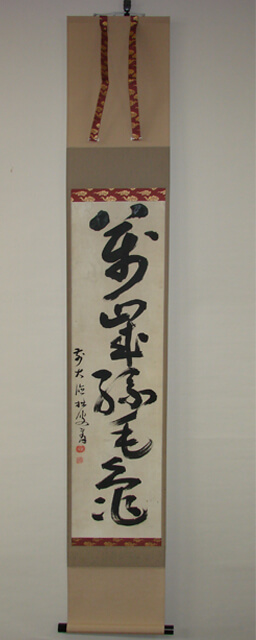
Much of the discoloration that had accumulated over many years was reduced, allowing the paper itself to regain brightness.
As a result, the calligraphy also appears clearer and more distinct.
The areas that had been badly torn were reinforced with new backing and carefully retouched with ink, making the damage far less noticeable during normal viewing.
Most importantly, a kakejiku that had suffered considerable deterioration could once again be displayed and enjoyed.
The purpose of restoring an old kakejiku is not to make it look brand new.
What matters is preserving the character that an artwork has acquired over many years while stabilizing damaged areas and remounting it so that it can continue to be safely enjoyed into the future.
“Thank You for Creating Such a Wonderful Mounting”
After the work was completed, the customer returned to our workshop to see the finished kakejiku in person.
Upon seeing the restored scroll, they told us:
“Thank you for creating such a wonderful mounting.”
We were very pleased to hear these words.
And there was another happy development.
The customer told us that they had another artwork at home that had also deteriorated and was currently mounted as a ranma-gaku, a framed work originally intended for display above sliding doors or in an architectural transom area, making it difficult to display in their present home.
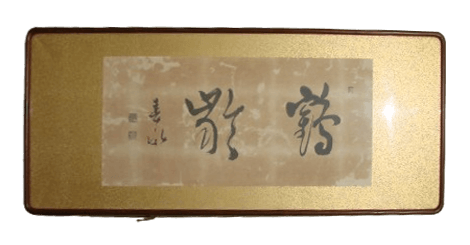
Having been pleased with the result of this kakejiku restoration, they asked us:
“Could you also remount this one as a kakejiku?”
After seeing our work firsthand and being pleased with the result, the customer entrusted us with another important artwork.
For us, there is no greater compliment.
We are now looking forward to seeing how this next framed work will be transformed into a kakejiku.
Please Contact Us About Heavily Damaged Kakejiku and Tea-Ceremony Scrolls
Among old kakejiku that have remained in a family home for many years, some may appear at first glance to have only stains or creases, while the paper itself has actually become severely weakened.
That was the case with this scroll.
The challenge was not only the visible stains and tears, but also the extremely fragile condition of the original paper.
With a kakejiku in this condition, restoration is not as simple as cleaning more aggressively or simply covering a torn area.
It is essential to assess the condition of the original artwork and decide how far treatment can safely be taken without sacrificing the work itself.
At our own workshop, we examine each kakejiku individually and propose the restoration and remounting methods appropriate to its condition.
If you have an old kakejiku at home with severe stains, deep creases, or tears, or if you would like to preserve the atmosphere of an older scroll while having it remounted, please do not assume that it is beyond repair simply because the damage appears extensive.
We will first examine its present condition and then recommend an appropriate restoration and remounting approach for the individual artwork.