Kakejiku Insect Damage Repair | Remounting an Insect-Damaged Scroll From an Aikidō Dōjō
When people think of insect damage to a kakejiku, they may imagine a hanging scroll that has been left in storage for many years.
However, the scroll in this case suffered insect damage while it was actually on display at an Aikidō dōjō in the United States.
What made the situation even more surprising was that the kakejiku was displayed inside a wooden case with a transparent panel covering the front.
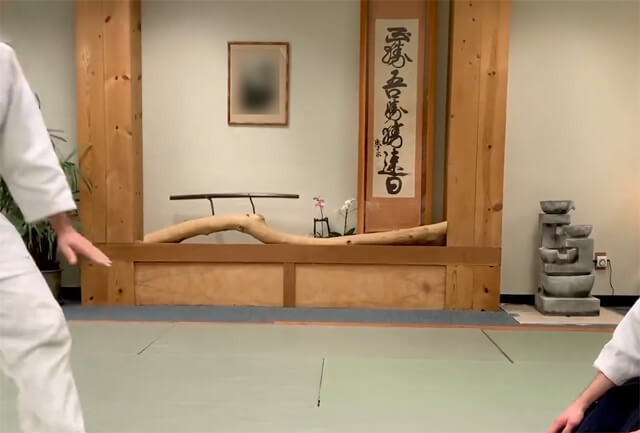
In this project, we repaired the insect-damaged calligraphy and completely remounted the scroll. At the same time, we reconsidered its unusually long original mounting, which measured approximately 217 cm in total length, and redesigned it as a much shorter kakejiku of approximately 160 cm so that it would fit neatly inside the dōjō’s display case.
We hope this article will be useful not only to those dealing with insect damage to a kakejiku, but also to anyone considering remounting an old hanging scroll or adjusting its dimensions to suit a particular display space.
An Insect-Damaged Kakejiku From an Aikidō Dōjō in the United States
This project began with an inquiry from an Aikidō dōjō in the United States.
The initial message was essentially:
“Our dōjō scroll has suffered damage from insects. Can it be repaired, and what would be the best course of action?”
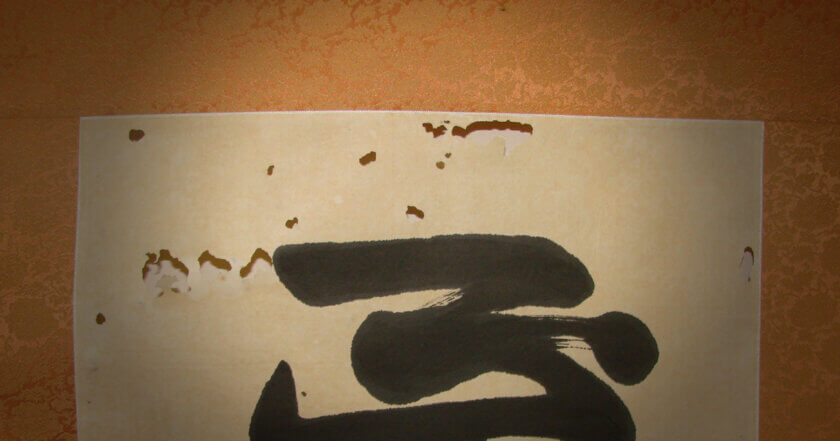
We first examined photographs of the scroll, and the damage was clearly more extensive than one or two small insect holes.
There were multiple irregular losses in the honshi (main artwork), particularly around the uppermost calligraphy.
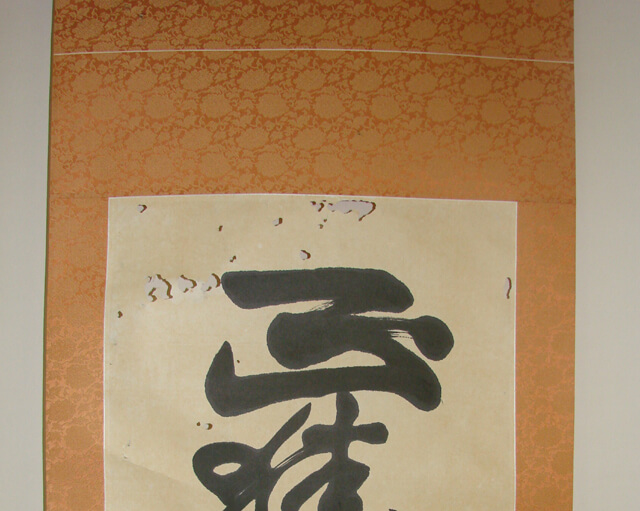
When viewed close up, it is easy to see where the paper itself had been eaten away by insects.
Insect damage to a kakejiku is not simply a cosmetic problem caused by visible holes.
Because the paper itself has been lost, weakened areas can potentially develop into further tears as the scroll is repeatedly rolled and unrolled.
After assessing the condition, we determined that it would be necessary to dismantle the old mounting, return the work to the state of the honshi alone, and carry out a complete remounting.
Insect Damage Even Inside a Display Case
One particularly interesting aspect of this case was the environment in which the insect damage occurred.
The kakejiku had been displayed inside a wooden case in the dōjō, with a transparent plastic panel covering the front.
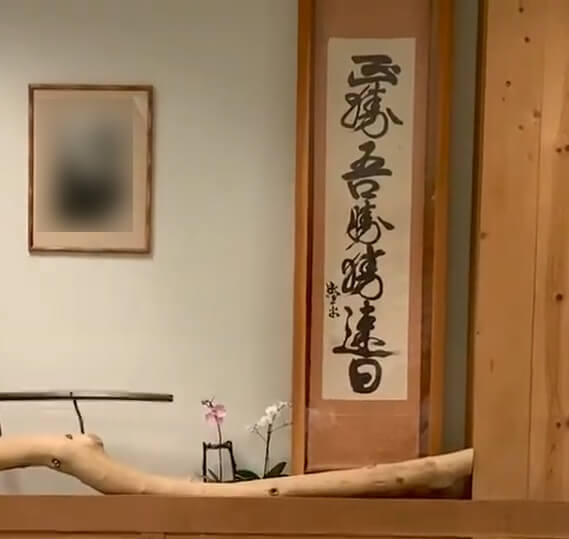
In other words, this was not a scroll that had simply been left forgotten in a storage box for many years.
According to the client, the same scroll had previously been displayed for many years at another location while exposed to the surrounding air, yet it had suffered no insect damage at that time.
Of course, we cannot conclude that the current display case itself caused the insect damage.
We are not able to inspect the local humidity or the exact environmental conditions inside the case.
However, prolonged exposure to high humidity is not favorable for a kakejiku.
If air circulation inside a case is poor and moisture tends to accumulate, displaying a scroll there for a long period may increase the risk of insect activity, mold, and other forms of deterioration.
For a kakejiku, neither permanent display nor permanent storage is ideal.
It is better to display the scroll periodically, enjoy it for a certain period, and then roll it up and allow it to rest.
Repeating this cycle is important for enjoying a kakejiku for many years.
Repairing the Holes Alone Is Not Enough
For this project, we proposed completely remounting the kakejiku.
The main restoration process was as follows:
Dismantling the old mounting
↓
Removing the old backing paper
↓
Cleaning the honshi
↓
Applying new Japanese paper backing
↓
Retouching the areas lost to insect damage
↓
Remounting the work with new mounting fabric
One of the difficult aspects of repairing insect damage is making the areas where paper has been lost appear visually natural again.
Once the old backing paper is removed and the honshi is backed with new Japanese paper, the new backing becomes visible through the holes where the original paper has been eaten away.
If left untreated, these damaged areas would appear noticeably lighter than the surrounding original paper.
We therefore retouch the exposed areas so that the color of the new backing does not look unnatural against the aged tone of the honshi.
The objective is to prevent the insect-damaged areas from drawing unnecessary attention when the work is viewed.
In other words, this type of restoration is not simply a matter of filling holes.
The goal is to return the work to a condition in which it can once again be appreciated naturally as a kakejiku.
The Unusual Total Length of Approximately 217 cm
After the kakejiku arrived in Japan and we examined it in person, another feature immediately caught our attention in addition to the insect damage.
It was the overall length of the scroll.
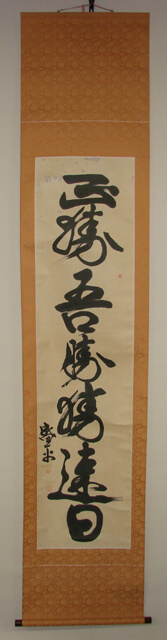
The original mounting measured approximately 217 cm in total.
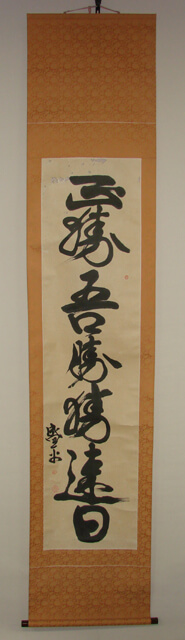
As can be seen in the photographs, an especially large amount of mounting fabric had been used above the honshi.
The calligraphy itself is certainly long and narrow, but even taking that into account, the overall scroll was considerably longer than a typical Japanese kakejiku of this type.
Since we were already carrying out a complete remounting, this gave us an opportunity to reconsider whether the original mounting proportions should be retained or whether the scroll should be redesigned using proportions more typical of traditional Japanese mounting.
We therefore discussed this point with the client.
If mounted according to more standard Japanese proportions, a total length of approximately 194 cm would normally be appropriate for a honshi of this size.
Another characteristic often found in traditional Japanese mounting is the use of narrow decorative fabric sections called ichimonji above and below the artwork, which provide a visual accent.
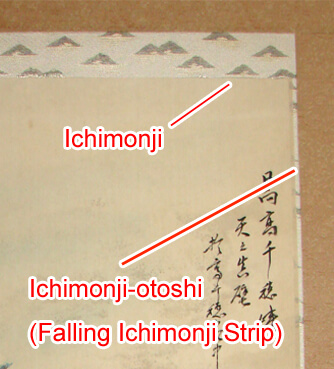
After we explained these differences, the client told us:
“We would like to change to the traditional Japanese mounting style.”
Choosing the Mounting Fabric From Several Proposals
Once the mounting style had been decided, the next step was selecting the fabric.
We combined an image of the actual honshi with several candidate mounting fabrics and prepared multiple visual mock-ups showing how the finished kakejiku might look.
It can be surprisingly difficult to imagine the appearance of a completed hanging scroll simply by looking at individual fabric samples.
For this reason, ART NOMURA prepares visual proposals when necessary so that clients can compare the overall atmosphere of each design before deciding on the final specifications.
In this case, the client selected Fabric Option B.
Initially, we were also planning to use an ichimonji-otoshi design, in which decorative ichimonji fabric surrounds the honshi.
The client then explained that the color associated with the dōjō’s kamon was purple and asked:
“Would it be possible to change the ichimonji to a purple fabric as well?”
Because the ichimonji and ichimonji-otoshi use the same fabric, we were preparing to propose several purple fabric candidates.
However, another condition soon emerged that required us to reconsider the entire mounting design.
The Display Case Was 160 cm, While the Honshi Alone Was About 140 cm
The client requested:
“We would like the kakejiku to fit neatly inside the display case we have been using.”
When we confirmed the dimensions of the case, we learned that its height was approximately 160 cm.
Until then, the upper portion of the long scroll had been rolled up in order to fit inside the case, and the client wanted to resolve this issue during the remounting.
For this particular kakejiku, however, 160 cm was an extremely restrictive overall length.
The reason is simple: the honshi alone already measures approximately 140 cm.
If the entire finished scroll were limited to 160 cm, only about 20 cm would remain for all of the mounting fabric above and below the artwork.
Our initial estimate for a traditionally proportioned Japanese mounting had been approximately 194 cm, meaning that we now needed to shorten the scroll by more than another 30 cm.
A kakejiku cannot simply be completed by reducing the amount of fabric.
There must still be mounting fabric above and below the honshi, as well as a wooden top stave called a hassō and a roller rod at the bottom.
At the same time, the visual proportions of the completed hanging scroll also need to be considered.
This became the most difficult aspect of the mounting design in this project.
Omitting the Ichimonji to Fit the Scroll Within Approximately 160 cm
To create a functional and visually balanced kakejiku within the limited total length of 160 cm, we recommended omitting both the ichimonji and the ichimonji-otoshi.
If an ichimonji were inserted, its height would become too similar to that of the remaining tenchi, the main mounting fabric above and below the honshi
This would reduce the visual contrast between the different sections and result in an awkward overall balance.
The client understood our reasoning, and the final specifications were therefore decided as follows:
Traditional Japanese mounting style
Total length: approximately 160 cm
Mounting fabric: Option B
No ichimonji
No ichimonji-otoshi
Rather than forcing conventional Japanese proportions onto the scroll, we prioritized the client’s very clear requirement that the finished kakejiku fit inside the dōjō’s existing display case.
A kakejiku is not complete simply because the artwork has been mounted.
Considering where and how it will actually be displayed is also an important part of creating a scroll that truly works for its owner.
Repairing the Insect Damage and Remounting the Kakejiku
Once the specifications had been finalized, we began the restoration and remounting work.
The old mounting fabric, roller rod, and other components were removed, and the old backing papers attached to the reverse of the honshi were carefully taken away.
We then cleaned the honshi while closely monitoring its condition and applied new Japanese paper backing.
In areas where the original paper had been lost due to insect damage, we carried out retouching so that the new backing paper would not appear visually conspicuous.
Finally, we used the client’s selected Fabric Option B and constructed the new kakejiku while carefully balancing the proportions within the limited overall length of approximately 160 cm.
In this project, our work was not simply to repair the insect damage.
We also needed to combine conservation of the honshi with a mounting design specifically adapted to the environment in which the scroll would actually be displayed.
Completed: From Approximately 217 cm to Approximately 160 cm
Here is the completed kakejiku.
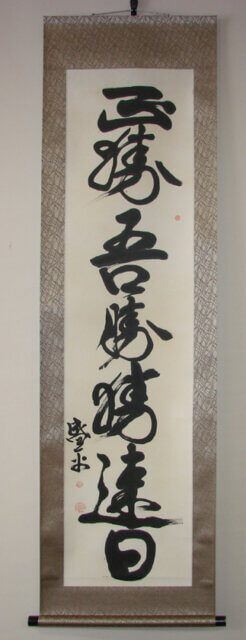
The original mounting measured approximately 217 cm in total length, while the new mounting was shortened to approximately 160 cm to suit the display case.
The difference is quite striking when the Before and After images are compared.
In the original mounting, there was a large amount of fabric above and below the honshi, particularly at the top. In the completed version, these areas were significantly reduced to create a much simpler composition.
The selected Fabric Option B has a subdued gray-brown tone.
It does not compete with the strength of the black calligraphy and allows the honshi itself to remain the visual focus, resulting in a calm and restrained mounting.
The insect-damaged losses that had been particularly noticeable near the top of the honshi were also made far less conspicuous through the new backing and retouching.
Because we not only repaired the insect damage but also significantly changed the proportions of the entire kakejiku, the finished scroll has a very different impression from the original.
When we sent photographs of the completed work to the client, we received the following reply:
“Wonderful, thank you for the update.”
We were very pleased to receive this response.
The kakejiku had been treasured and displayed at the Aikidō dōjō for many years, and we hope that it can now once again be displayed in front of the dōjō members for many years to come.
How to Help Prevent Insect Damage to a Kakejiku
The client also asked us how insect damage could be prevented after the restoration.
When a kakejiku is rolled and allowed to rest, we generally recommend storing it in a paulownia wood box together with insect-repellent incense.
Kakejiku are sensitive to both excessive humidity and excessive dryness.
Keeping a hanging scroll displayed in the same condition for an extended period can also place stress on the mounting. When a scroll remains hanging for too long, the entire mounting can gradually lose some of its flexibility, so it is important to roll it up and allow it to rest after a period of display.
However, this does not mean that a kakejiku should simply be placed in a paulownia box and left untouched for many years.
Its condition should be checked from time to time, and periodically displaying the scroll is also an important part of proper care.
In this case, the client wished to modify the dōjō’s display case so that the kakejiku could remain on display throughout the year.
From the standpoint of preservation and long-term durability, ART NOMURA generally does not recommend displaying a kakejiku continuously all year round.
We explained this point to the client in advance and ultimately respected their preferred method of use by creating the scroll to fit within the display case.
When restoring a kakejiku, it is important not only to repair the damaged areas but also to consider how the scroll will be displayed and stored afterward.
Conclusion: Repairing Insect-Damaged Kakejiku According to Their Condition and Display Environment
Repairing insect damage to a kakejiku is not simply a matter of treating the visible holes.
The condition of the backing papers, the extent of the losses, and the strength of the original paper all need to be examined before deciding whether a complete remounting is necessary.
In this project, we not only restored the areas damaged by insects but also reconsidered the original mounting, which measured approximately 217 cm, and redesigned the kakejiku so that it would fit inside the dōjō’s approximately 160 cm display case.
The most appropriate mounting depends not only on the condition of the artwork, but also on where it will be displayed and how the owner intends to continue using it.
At ART NOMURA, we inspect the actual condition of each kakejiku and propose not only the restoration method, but also the mounting fabric, dimensions, and appropriate care after completion.
If you are considering the repair or remounting of a kakejiku affected by insect damage, tears, stains, or other deterioration, please feel free to contact us. We welcome inquiries from both Japan and overseas.