Creating a Kakejiku From a Calligraphy Image | AI-Enhanced Printing of Handwritten Brushwork
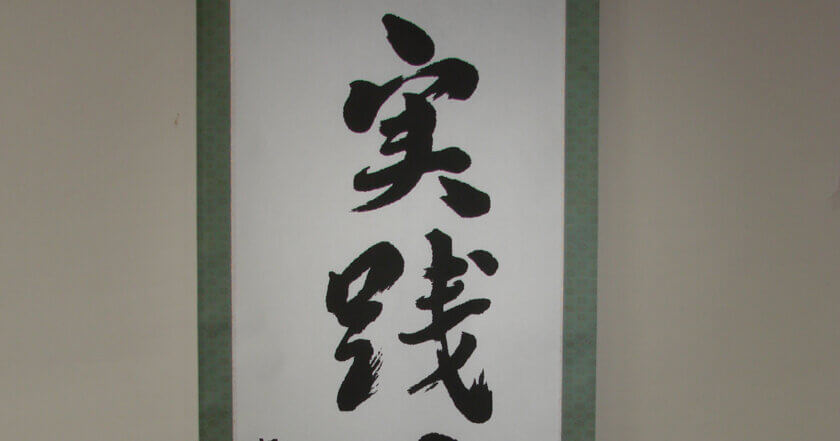
The rapid development of AI technology has been remarkable, and at ART NOMURA, we also make use of AI when we believe it can help us better realize a customer’s wishes in the process of making a kakejiku.
In this case, we used AI to enhance the resolution of an image containing handwritten calligraphy by the customer’s teacher, and then used that data to create an original kakejiku.
The Words “Jissen Aiki” Cherished by His Teacher
In aikidō, “Aiki” (合気) refers broadly to the principle of harmonizing with an opponent’s movement and energy rather than directly opposing force with force.
“Jissen Aiki” (実践合気) can therefore be understood as “putting Aiki into practice” — embodying these principles through actual training rather than leaving them only as theory.
Our customer contacted us with a very meaningful request.
His teacher, who had spent many years teaching at an aikidō dōjō, had become unable to return to the dōjō due to illness.
The customer wanted the teacher’s spirit and teachings to continue to be passed down to the students, and therefore hoped to create a kakejiku featuring the words “Jissen Aiki” (実践合気), which his teacher had always valued deeply.
The finished scroll would be displayed at the center of the dōjō, watching over the students during their daily training and serving as a reminder of the principles they had learned from their teacher.
It was therefore intended to be much more than a decorative hanging scroll.
Our Proposal Using AI
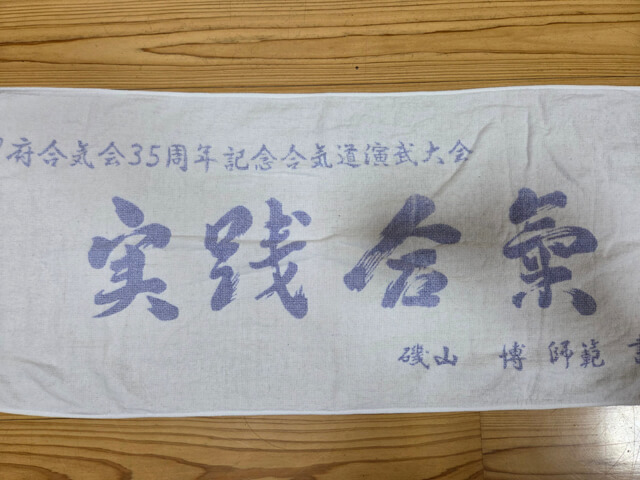
The customer’s original request was for us to use an image of the words “Jissen Aiki,” handwritten by his teacher on a towel, as a reference and ask one of our calligraphers to write a new version in a similar style.
Of course, we could have proceeded exactly as requested.
However, since an image of the teacher’s actual handwritten calligraphy still existed, we felt that using his own brushwork and printing it at high resolution might better suit the purpose of this particular project.
The original image could not simply be enlarged and printed as it was, so we prepared suitable printing data with the help of AI technology.
The basic process was as follows:
- 1. Use AI to extract the necessary handwritten characters from the original image.
- 2. Rearrange the horizontal writing into a vertical composition and adjust the placement using image-editing software.
- 3. Use AI to enhance the resolution of the calligraphy so that it would remain suitable for viewing when enlarged.
- 4. Print the completed data onto Japanese paper suitable for mounting using a large-format printer.
Once we confirmed that this method was feasible, we presented the customer with two options:
・A handwritten kakejiku newly created by another calligrapher using the teacher’s style as a reference.
・A printed kakejiku using the actual brushwork written by the teacher himself.
The Customer’s Decision
What mattered most to the customer was that the writing should truly be his teacher’s own.
For that reason, he was very pleased with our proposal to preserve as much of the teacher’s original brushwork as possible through high-resolution printing, and he chose this method.
The customer immediately understood the possibilities offered by this approach and also asked whether additional inscriptions and seals could be extracted from other materials and incorporated into the final design.
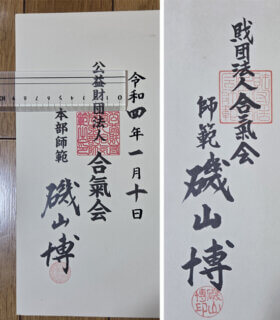
In the past, extracting only a particular signature or seal from an image would have required a considerable amount of manual work using image-editing software.
Today, AI can greatly improve the efficiency of this extraction process.
Afterward, however, the placement, scale, proportions, and overall visual balance were still carefully adjusted by human judgment.
Selecting Mounting Fabrics to Suit the Dōjō
Once the printing data had been finalized, we moved on to discussing the mounting specifications.
The customer explained that much of the interior of the dōjō consisted of brown wooden paneling, so he preferred a mounting fabric in either blue or green.
We therefore prepared a new visual mock-up using a green fabric.
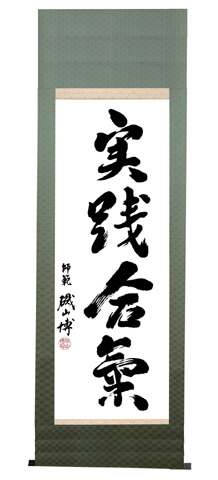
The contrast between the white honshi and the green mounting fabric worked beautifully and further emphasized the strength of the calligraphy.
For this scroll, we also proposed an Ichimonji-otoshi arrangement to give the overall mounting a more refined and formal appearance.
In a typical kakejiku, a decorative fabric called ichimonji is placed above and below the main artwork.
Ichimonji-otoshi is a mounting style in which the same ichimonji fabric is also applied in narrow strips along the left and right sides of the artwork, so that the entire work is surrounded by the same fabric.
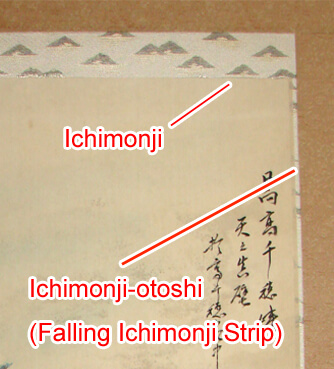
By framing all four sides of the artwork in this way, the boundary between the calligraphy and the surrounding mounting becomes clearer, giving the entire composition a more defined and cohesive appearance.
It works particularly well with bold calligraphy such as this.
The Completed “Jissen Aiki” Kakejiku
This is the completed kakejiku, created through a combination of our proposals and the customer’s requests.
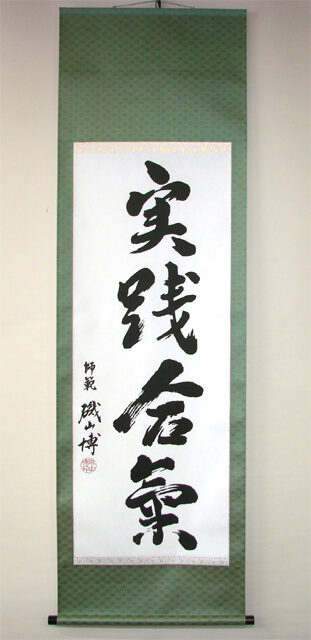
The finished scroll preserves the powerful character of the teacher’s original brushwork while also harmonizing naturally with the atmosphere of the dōjō.
The green mounting fabric creates a calm appearance, while the white ichimonji fabric surrounding the artwork gives the entire composition an elegant sense of definition.
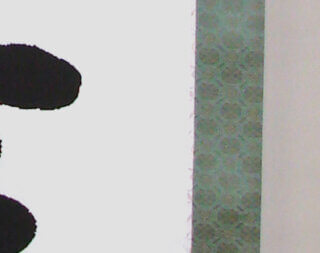
We believe the finished kakejiku is well suited to being displayed in the dōjō for many years to come.
Feedback From the Customer
After receiving the finished scroll, the customer kindly sent us the following message:
“I received the kakejiku yesterday. I would like to express my deepest gratitude for creating such a wonderful hanging scroll. We will treasure it and display it at the center of our dōjō.”
We were extremely pleased to receive such kind words.
We sincerely hope that this kakejiku will continue to watch over the students during their training and serve as a lasting symbol through which their teacher’s teachings can be passed down for many years to come.
Using AI Enhancement to Print Handwritten Calligraphy
By making use of AI technology, the possibilities for creating original kakejiku from handwritten material have expanded.
Calligraphy that may previously have been difficult to enlarge because of limited image resolution or the condition of the original photograph can now, in some cases, be transformed into data suitable for creating an original hanging scroll.
If you have handwritten calligraphy left by a family member or teacher, writing preserved only in an old photograph, or lettering found in a printed document that you would like to preserve as an original kakejiku, please feel free to contact ART NOMURA and send us the image for review.