Shikoku Pilgrimage Temple: No. 35: Iō-zan Kyōchi-in Kiyotaki-ji
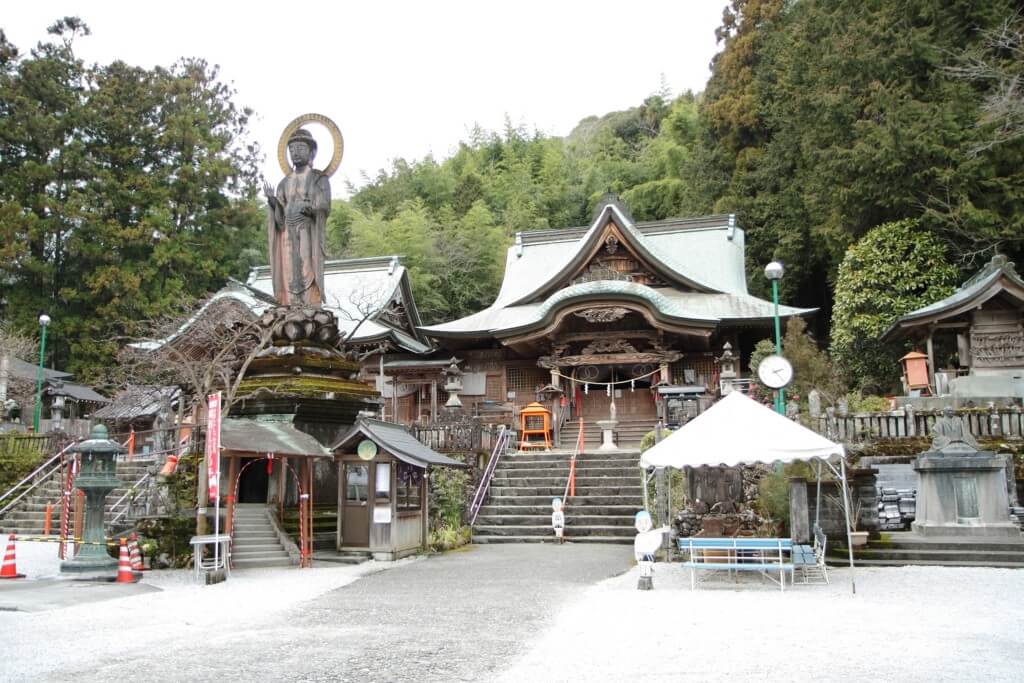
Welcomed by a Giant Statue of Yakushi Nyorai
- Name: Yakushi Nyorai (Medicine Buddha)
- Principal Image: Yakushi Nyorai (Medicine Buddha)
- Goeika (Pilgrimage Song):
- Draw its clear water, and the heart too becomes pure at Kiyotaki-ji;
- blossoms of spray scatter over the rocks like feathered robes.
Access From Temple No. 34, Tanema-ji
- On foot: Walk through the rural landscape along Prefectural Route 279 and cross the Niyodo River via Niyodogawa Ōhashi. Note that passing through the central part of Tosa City along the way can be tricky to navigate. After passing under the Kōchi Expressway, climb the steep road. Approx. 9.5 km, 3 hours.
- By Car: Go via Prefectural Route 279, National Route 56, and central Tosa City.
- Public Transport: From the Ōhashikitazume bus stop (a 45-minute walk from Tanema-ji), take the Tosaden Kōtsū Bus bound for Takaoka Eigyōsho for 8 minutes, get off at Takaoka Kōkō-dōri, and walk 40 minutes.
The Steep Hatchō-zaka Slope
Kiyotaki-ji stands on the slopes of Mt. Kiyotaki, which rises north of central Tosa City, at an elevation of about 140 meters. The temple approach follows the winding Hatchō-zaka. Pilgrims on foot make their way up the twisting road through citrus orchards, often short of breath. The upper section is also known as Rukan-zaka, literally the “Sweat-Pouring Slope,” because it is said to be so steep that walkers break into a sweat even in midwinter. Motorists can drive to the parking lot above the Niō-mon Gate, but if possible, it is worth making the climb on foot.
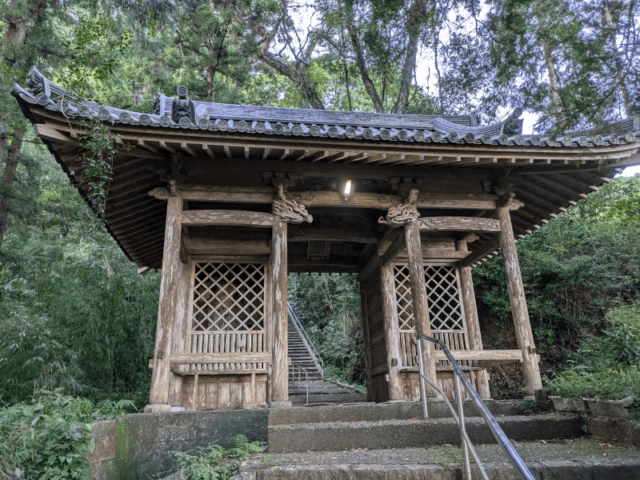
The Niō-mon Gate Built in the Meiji Era
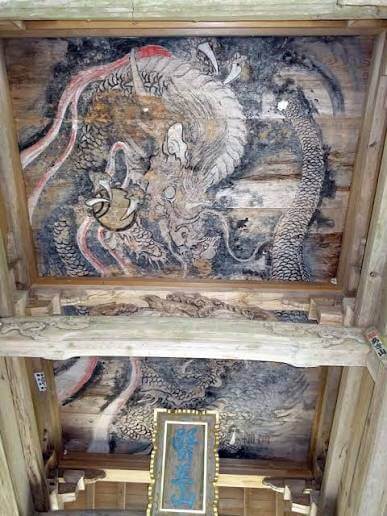
After making your way up the steep road, the Niō-mon Gate suddenly comes into view. It is a large hakkyakumon, or eight-legged gate. Although imposing in scale, its single-story structure and sparse use of bracket complexes give it a simple appearance. Dragon carvings adorn the bracket arms, or hijiki, atop the front support posts, while a dragon painted on the ceiling during the Meiji era can be seen at the center. The gate is designated as a Tangible Cultural Property by Tosa City. Visitors arriving by car do not pass through the gate on their way to the parking lot, so it is worth walking back down the steps to see it.
Yakushi Nyorai Welcoming Pilgrims
A steep flight of stone steps rises beyond the Niō-mon Gate. At the top, the path opens onto the grounds of Kiyotaki-ji. There, a 15-meter-tall standing statue of Yakushi Nyorai welcomes pilgrims after their arduous climb. Within the statue’s pedestal is a yakuyoke kaidan-meguri, a dark passage that visitors navigate by touch while praying for protection from misfortune. Behind the statue, another flight of stone steps leads to the Hondō and Daishi-dō, which stand side by side. The Hondō is built in the irimoya-zukuri style and features a kōhai entrance canopy topped with a karahafu, together with a chidorihafu gable, giving it a magnificent appearance. The Daishi-dō has a distinctive design, with an especially large karahafu-topped kōhai.
Overlooking the Niyodo River
The view from the precincts is spectacular. The main feature of the view is the Niyodo River (Niyodo-gawa). Celebrated in the works of novelist Tomiko Miyao, the Niyodo River originates at Mt. Ishizuchi and flows into Tosa Bay. The open rural landscape around Takaoka where the Niyodo River flows has a charm that makes pilgrims stop in their tracks. The roof of the restroom on the way from the Hondō to the Nōkyōjo serves as an observation deck, where you can sit down and enjoy the view.
Named for a Miraculous Spring Associated with Kōbō Daishi
The temple’s name derives from a legend concerning Kōbō Daishi. While undertaking ascetic practice here, he struck the ground with his kongō-zue staff upon completing his period of practice, causing clear water to gush forth like a waterfall.
A Temple Associated with Shinnyo
To the front left of the Hondō, in a densely wooded area, stands a memorial stone pagoda associated with Prince Takaoka (Takaoka Shinnō). Prince Takaoka was the third prince of Emperor Heizei and entered the Buddhist priesthood following a political upheaval. Taking the Buddhist name Shinnyo, he became one of Kōbō Daishi’s ten great disciples. Shinnyo visited Kiyotaki-ji in Jōgan 3 (861) while seeking shelter from a storm and traveled to Tang China the following year. He is said to have died while journeying from Tang China toward Tenjiku (India). The pagoda is believed to be a gyakushū-tō, a memorial pagoda erected by Prince Takaoka himself before his journey to Tang China to pray in advance for his own afterlife. The surrounding area is called Irazu no Mori, or the “Forbidden Grove.” It is a sacred area closed to visitors, and a yōhaijo, or place for worship from afar, has been established nearby.
DATA
Address: 568-1 Takaoka-chō Tei, Tosa City, Kōchi Prefecture
Phone: 088-852-0316
Access: From JR Kōchi Station, take the Tosaden Kōtsū Bus bound for Takaoka Eigyōsho for 51 minutes, get off at Takaoka Kōkō-dōri, and walk 40 minutes.
Parking: Available (Free)
Lodging: None
Your Pilgrimage, Your Art
Completing the Shikoku Pilgrimage is a once-in-a-lifetime journey—but what if you could preserve it in a form that lasts forever?
Many pilgrims collect red stamps and calligraphy from each temple on a special silk scroll called a nōkyōjiku.
This sacred record of your path can be transformed into a kakejiku—a traditional Japanese hanging scroll—not only preserving the memories, but turning them into a work of cultural and spiritual art.
It’s more than a souvenir—it’s a way to honor your journey, your prayers, and your growth.
To learn more about how a nōkyōjiku becomes a kakejiku, and what makes this transformation so meaningful, please refer the below link.