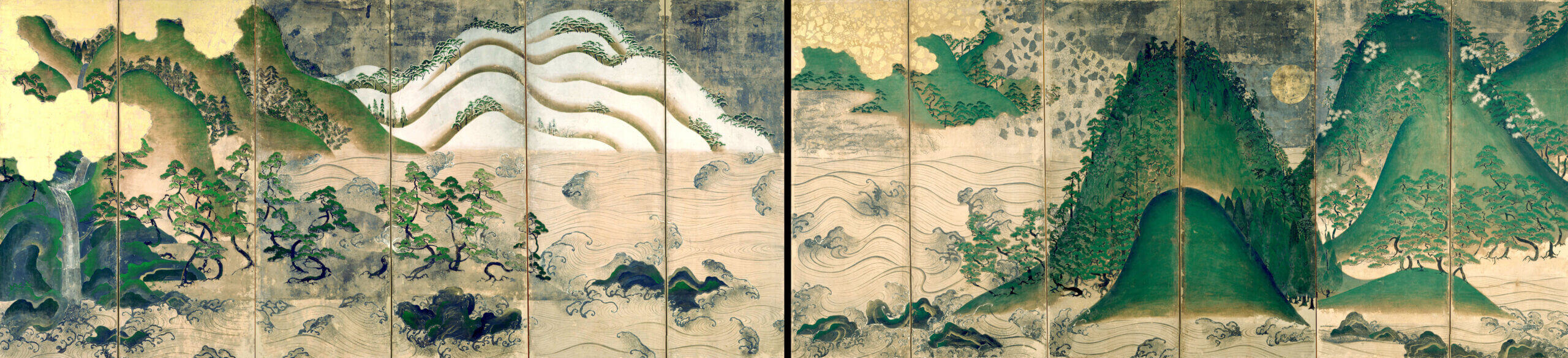
“Jitsugetsu Shiki Sansui-zu Byobu” (Sun and Moon Four Seasons Landscape Folding Screen)
Historical Background
Production Era and Cultural Context
The “Jitsugetsu Shiki Sansui-zu Byobu” is believed to have been created during the Muromachi period (14th to 16th century). While the exact creator remains unknown, scholarly debate suggests that the screen was produced sometime between the mid-15th century (Muromachi mid-period) and the late 16th century (Momoyama period). The Muromachi period saw the flourishing of both the Chinese-influenced ink wash painting and the native Japanese Yamato-e painting style. This folding screen belongs to the latter category, focusing on vivid representations of Japan’s natural landscapes throughout the four seasons.
While Zen-influenced Chinese-style landscape paintings were dominant at the time, this screen is unique in its deliberate emphasis on Japanese scenery, rendered in vibrant colors. This structure is believed to represent more than just seasonal landscapes—it conveys the Japanese cosmology and worldview of the era.
Religious Influence and Purpose
The screen features the sun and moon, along with depictions of the four seasons in a single composition. Scholars suggest that this layout is not merely for aesthetic appeal but is an expression of a cyclical view of the universe, a concept closely related to Shingon Esoteric Buddhism.
The screen has been passed down at Amanosan Kongō-ji Temple in Osaka Prefecture, where it was reportedly used in Kanjō (Abhisheka) rituals. Kanjō is a sacred ceremony in Esoteric Buddhism in which disciples receive the transmission of secret teachings. This folding screen, with its symbolism of the sun, moon, and seasonal transformations, was likely placed in the ceremonial space to help participants feel the universal cycle and divine energy of nature.
During the late Muromachi period, the Higashiyama culture (centered around Ginkaku-ji Temple) flourished, which valued refined simplicity over ostentatious decoration. This aesthetic is reflected in the screen, where subdued “antique silver” tones are used instead of the radiant gold leaf seen in Momoyama-period works.
Artistic Techniques and Style
Composition and Structure
The “Jitsugetsu Shiki Sansui-zu Byobu” is a six-panel pair of folding screens. The right screen (Ushiku) features spring and summer, while the left screen (Sashiku) portrays autumn and winter, together forming a complete depiction of the four seasons.
The lower portion of the painting features a vast sea with powerful, undulating waves, depicted with dynamic brushwork. A pine forest extends across the central portion, backed by gently rounded mountains painted in a stylized bell-shaped form, distinguishing it from conventional landscape paintings.
The transition between seasons is conveyed horizontally:
- The sun is positioned between spring and summer
- The moon is placed between autumn and winter
These celestial elements serve as focal points and symbolize the perpetual cycle of nature.
Coloring and Gold/Silver Leaf Techniques
The screen is painted on paper with mineral pigments (nihonga), including malachite green, ultramarine, and ochre. Highlights are applied to pine needles and wave crests using white pigment.
- The sun is rendered in radiant gold leaf
- The moon is depicted in subdued silver leaf
Additionally, kirihaku (cut gold leaf) techniques are employed in the sky, creating an effect as if fragments of the sky are breaking apart and falling—an unusual and surreal visual element.
The depiction of waves also stands out: rather than being painted with smooth, fluid lines, the wave crests are rounded and hook-shaped, arranged in a repetitive pattern that gives the scene a decorative rhythm.
Recent Research and Discoveries
Re-examining the Production Date
For a long time, the exact date of creation for this screen remained uncertain. However, recent studies suggest that the screen may date back to the early Muromachi period (first half of the 15th century).
Evidence supporting this hypothesis includes:
- The absence of gold-background aesthetics characteristic of the later Momoyama period.
- The lack of stylistic influences from the Kanō school, which dominated the Momoyama period.
- The screen’s subdued aesthetic, reflecting the Higashiyama culture associated with Ashikaga Yoshimasa’s era.
Scientific Analysis and Preservation
In 1997–1998, a major restoration of the screen revealed that the artwork was painted on multiple small sheets of kozo (mulberry paper), approximately 30cm × 45cm each, joined together. This structure is unusual for folding screens, suggesting an innovative production method.
Furthermore, in 2017, the Tokyo National Research Institute for Cultural Properties conducted X-ray fluorescence analysis, revealing that the use of white pigments in this screen is unlike any other known Japanese painting techniques. The findings suggest a transitional phase in the history of Japanese painting materials, as the screen exhibits a blend of lead white (used until the Muromachi period) and shell white (which became common in the Edo period). This discovery has drawn scholarly attention as a significant milestone in Japanese art history.
Comparison with Other Seasonal Landscape Screens
Comparison with Ink Paintings (Muromachi Period)
Many traditional Japanese paintings depict the transition of the four seasons, but few do so with as bold a composition as this screen.
A representative example is the “Four Seasons Landscape Screens” (Important Cultural Property), attributed to the monk-painter Shūbun and housed at the Tokyo National Museum. Shūbun’s work, influenced by Chinese landscape painting, uses ink wash techniques and subtle gradations, creating a meditative atmosphere.
By contrast, the “Jitsugetsu Shiki Sansui-zu Byobu” employs rich color and gold/silver leaf, emphasizing decorative opulence over subtle ink aesthetics. This screen is considered a culmination of the Yamato-e tradition, whereas Shūbun’s work exemplifies the Zen-influenced ink painting tradition.
Comparison with Momoyama Period Gold Leaf Screens (Kanō School)
During the Momoyama period (late 16th century), large-scale gold-leaf screens became the dominant decorative art form. Artists from the Kanō school, such as Kanō Eitoku, created folding screens adorned with imposing compositions and highly stylized figures.
While the “Jitsugetsu Shiki Sansui-zu Byobu” also employs gold and silver leaf, it differs in that it emphasizes naturalistic elements rather than political or militaristic themes. The mountains and waves are painted freely and energetically, rather than being constrained by rigid symmetry.
Provenance and Transmission
Preservation at Amanosan Kongō-ji Temple
The “Jitsugetsu Shiki Sansui-zu Byobu” has been preserved at Amanosan Kongō-ji Temple in Osaka for centuries. The temple, founded in the Nara period, flourished under imperial patronage and was known as the “Women’s Mount Kōya”, as it allowed female devotees to worship.
Unlike many other historical paintings that have been lost, damaged, or taken abroad, this screen has remained intact due to the careful stewardship of the temple.
Exhibitions and Current Status
Today, the screen is occasionally exhibited at Kongō-ji Temple and is also lent to major national museums, such as the Tokyo National Museum and Kyoto National Museum.
Following its designation as a National Treasure in 2018, public interest in the screen has grown, and researchers continue to investigate its origins and artistic significance.