
Itō Jakuchū’s Paintings 004: “Genpo Yōka (Exquisite Flowers from the Mysterious Garden)” and “Sokenchō (a Collection of Woodblock Prints by Jakuchū)”
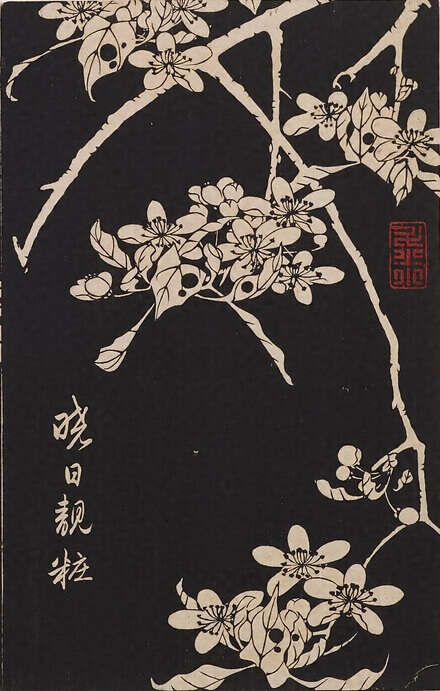
Genpo Yōka

“Genpo Yōka” depicts forty-eight images of flowers, insects and vegetables with bold expression and delicate monochrome drawing, and is produced as a simple black and white ink rubbing print without any gradation.

Although there is no variation in tone, the sharp lines drawn in black capture the tense postures of insects and the shapes of plants, portraying a strange world with Jakuchū’s unique interpretation and succinct expression.

Many of the screens are taken from works that Jakuchū drew throughout his life.

The technique of takuhanga differs from that of ordinary print books in that the black-and-white screen is reversed.

Instead of applying paint to a woodblock engraved with a pattern on a convex plate and rubbing with a barrel to copy it onto paper, the paper is moistened and tapped from above and pressed into the concave surface of the woodblock, as in rubbings on an intaglio plate, and then rubbed with sumi ink onto it.

Black background and white pattern. This technique has been used since the Song dynasty (960-1279) in China for the calligraphy of handbooks, and was used for sharp and subtle expressions.

This technique, called takuhanga, was introduced to Japan with the arrival of the Ōbaku school of Zen Buddhism and started around the Genroku period (1688-1704).

This is probably the reason why Jakuchū, who had close ties with the Ōbaku monks, dared to use rubbed woodblock prints, which were used for calligraphy, and it is an unprecedented achievement in the history of woodblock prints.

On the other hand, “Sokenchō” is a work that has not been widely introduced, as it has been transmitted in an incomplete form without a complete volume.
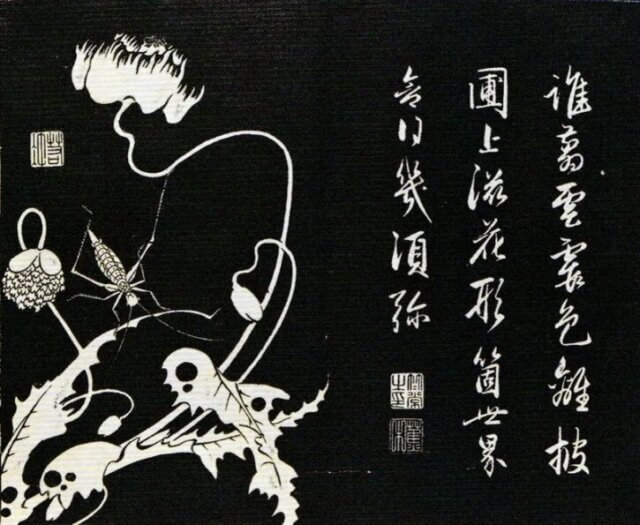
Sokenchō

It is bound in a book with thirty-six rubbed woodblock-printed illustrations of flowers, birds and insects.

Each picture is accompanied by a poem by Zen master Daiten, and compared to the Genpo Yōka, the line engravings are gentler and the engraving has a rough feel, lacking in clarity and tension.

However, on the contrary, one can feel the gentle expression of plants.

The paper and the ink for use are also considered to be of lower quality.
    NameRequired

    SexRequired

    MaleFemale

    CountryRequired

    e-mailRequired

    CommentRequired

    Attached File
    ※Up to 3 MB for each file.


    ← ← "MUST CHECK" / Please confirm the above contents again and check this button.

    Contact Us

    Please fill out the form below and submit for your inquiry.

    ❈FirstName
    ❈LastName
    Country
    ❈E-mail
    (❈Confirm E-mail)
    ❈Inquiry category Question
    Consultation
    Impression
    Request
    Others
    ❈Comment

    is the mark for required item.


    Your privacy is important to us. We are committed to protecting your privacy.

    (or press ESC or click the overlay)

    CEO Message

    Our Feelings For Kakejiku


     The Japanese people have long set a high value on aesthetic senses since ancient times. As a result, the
    peculiar culture which is not seen in other countries blossomed and many aspects of the modern Japanese
    culture come from it. Parts of Japanese culture has been introduced to people in other countries recently,
    so the number of people from other countries who are interested in Japanese culture has been increasing.
    However, the Japanese aesthetic senses, which are the bases of Japanese culture, have been nurtured
    through a long history, intertwining various elements intricately, such as climate, geographical features,
    religion, customs and so on. Therefore, they are very difficult to understand not only for people from other
    countries, but even for the Japanese people. I think the best tool which conveys these difficult senses
    understandably is a “kakejiku.”
     The kakejiku (a hanging scroll; a work of calligraphy or a painting which is mounted and hung in an
    alcove or on a wall) is a traditional Japanese art. It's no exaggeration to say that paintings are what
    express aesthetic senses at all times and places. The kakejiku is an art which expresses the Japanese
    aesthetic senses. The kakejiku has long been used in traditional Japanese events, daily life and so on since
    ancient times. As a result, there are various customs of kakejiku in Japan; kakejiku and the life of the
    Japanese are closely related. We can see Japanese values through kakejiku.
     The kakejiku is a cultural tradition which the Japanese people should be proud of. However, many people
    in other countries don't know much about it because it hasn't been showcased as much. This is why I
    decided to try to introduce it. The kakejiku world is very interesting and beautiful. We want not only the
    Japanese, but also many people from other countries to know and enjoy it. I hope that many people will
    love kakejiku someday.

    (or press ESC or click the overlay)
    Company Profile
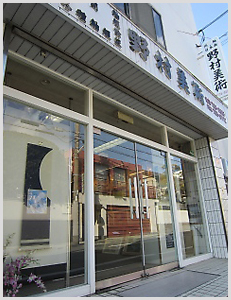
    syaoku.jpg(120220 byte)

    Name Art Nomura


    President Tatsuji Nomura


    Founded1973


    Established1992


    Address7-23 Babadori, Tarumi-ku, Kobe city,
    Hyougo Prefecture, 655-0021, Japan


    Capital10 million yen


    URLhttp://nomurakakejiku.com


    Our Business

     Art Nomura is an art dealer which produces kakejiku (hanging scrolls). We mount many paintings and calligraphic works in kakejiku in my factory. Kakejiku are our main product. We also remount and repair old or damaged kakejiku. We share the traditional Japanese art of kakejiku with people all over the world.


    (or press ESC or click the overlay)
    Access Map

    Access Map


     The Japanese people have long set a high value on aesthetic senses since ancient times. As a result, the
    peculiar culture which is not seen in other countries blossomed and many aspects of the modern Japanese
    culture come from it. Parts of Japanese culture has been introduced to people in other countries recently,
    so the number of people from other countries who are interested in Japanese culture has been increasing.
    However, the Japanese aesthetic senses, which are the bases of Japanese culture, have been nurtured
    through a long history, intertwining various elements intricately, such as climate, geographical features,
    religion, customs and so on. Therefore, they are very difficult to understand not only for people from other
    countries, but even for the Japanese people. I think the best tool which conveys these difficult senses
    understandably is a “kakejiku.”
     The kakejiku (a hanging scroll; a work of calligraphy or a painting which is mounted and hung in an
    alcove or on a wall) is a traditional Japanese art. It's no exaggeration to say that paintings are what
    express aesthetic senses at all times and places. The kakejiku is an art which expresses the Japanese
    aesthetic senses. The kakejiku has long been used in traditional Japanese events, daily life and so on since
    ancient times. As a result, there are various customs of kakejiku in Japan; kakejiku and the life of the
    Japanese are closely related. We can see Japanese values through kakejiku.
     The kakejiku is a cultural tradition which the Japanese people should be proud of. However, many people
    in other countries don't know much about it because it hasn't been showcased as much. This is why I
    decided to try to introduce it. The kakejiku world is very interesting and beautiful. We want not only the
    Japanese, but also many people from other countries to know and enjoy it. I hope that many people will
    love kakejiku someday.

    (or press ESC or click the overlay)