
Ōhashi Suiseki’s Summary | The Best of Tiger Painters (2/3)
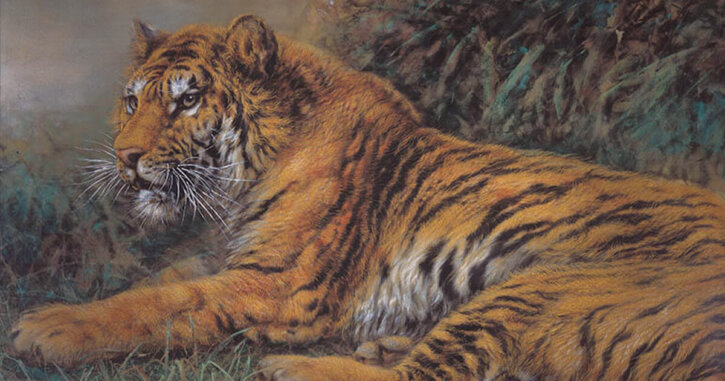
Debut in the Art World

4th Naikoku Kangyō Hakurankai Exhibition


Ōhashi Suiseki’s debut in the art world was in 1895 ((Meiji 28, 1895), at the age of 31.

He exhibited his work at the fourth Naikoku Kangyō Hakurankai Exhibition, a series of five government-led exhibitions in Japan aimed at fostering export items, for which he received a certificate of merit and a silver medal.

Subsequently, he exhibited at exhibitions in Japan and gradually gained recognition through a series of awards.

The situation in the Japanese art world at the time was as follows.

In 1898, Okakura Tenshin was forced to resign from the Tokyo Art School due to the ‘Art School Riots’, and founded the Japan Art Institute (Nihon Bijutsu-in). This was the beginning of the Nihon Bijutsu-in (Inten Exhibition), which has continued to the present day.

This led to many painters joining the Nihon Bijutsuin (Japan Art Institute), and the Japanese art world became divided into the Old School, centred on the Japan Art Association (formerly the Ryūchikai), the New School, centred on Okakura Tenshin, and a group in between.

It was also around this time that Yokoyama Taikan, Hishida Shunsō and others began to take up the challenge of a new method of expression, namely the fuzzy style.

Highly Rated Worldwide

1900: Paris Exposition


The Paris Exposition of 1900 was a milestone year for the event, and the enthusiasm of France and other countries to exhibit at this World’s Fair was extraordinary.

It was regarded as an important exhibition for Japan to determine whether its own paintings were up to world standards, and preparations were led by the Japan Art Association.

It is thought that political factors played a major role in the selection of works for the jury at this time, mainly by the Japan Art Association rather than the Okakura Tenshin group, which had ousted from public office.

Ōhashi Suiseki, who was not that well-known in the art world at the time, was awarded a gold medal, beating other well-known painters. (Ōhashi Suiseki received a gold medal, Hashimoto Gahō, Kawabata Gyokushō, Imao Keinen and Kuroda Seiki silver medals, Yokoyama Taikan, Takeuchi Seihō and Shimomura Kanzan bronze medals, and Uemura Shōen, Araki Jippo and Wada Eisaku were commended.)

This was the moment when Ōhashi Suiseki’s realistic tiger paintings were recognised worldwide. This established Ōhashi Suiseki as a tiger painter, who subsequently became a focus of attention in the Japanese art world and influenced many other painters.

Interestingly, after the Paris Expo, Takeuchi Seihō stayed in Europe and thoroughly studied Western-style painting. Perhaps partly out of frustration at losing out on the world stage to the then near-unknown Ōhashi Suiseki, Takeuchi Seihō went to the zoo and thoroughly sketched lions, which were difficult to see in Japan at the time, and after returning to Japan he produced a series of large gold screens with lions.

The Paris Expo is of great significance if it is thought that Ōhashi Suiseki had a major influence on Takeuchi Seihō, who is regarded as the twin master of Yokoyama Taikan in the history of modern Japanese painting.

1904: St. Louis World’s Fair


The 1904 World’s Fair in St Louis, USA, was the largest World’s Fair ever held, with more than 1,500 exhibition structures built on land roughly four times the size of the 1900 Paris Expo.

It was a major event, attended by some 20 million people from 44 countries.

Japan was in the midst of the Russo-Japanese War, but aimed to be on the same level as the world’s leading nations, so it joined in.

The enthusiasm of the Japanese state can be felt from the documents of the time, including the construction of a large Japanese garden on a large site and a building in the style of the Golden Pavilion.

Ōhashi Suiseki’s tiger painting was also exhibited at the St Louis Expo, where it was highly acclaimed and again awarded a Gold Medal.

1910: British-Japanese Exhibition


The largest event about Japan in the West at the beginning of the 20th century, organised jointly with Britain to show to the world that Japan had won the Sino-Japanese and Russo-Japanese wars and had become a first-class country on a par with the Western powers.

The site area of the venue, which amounts to 22,550㎡, is the largest ever.

The exhibition was a great success, attracting more than 8 million visitors, many from neighbouring countries due to the enthusiasm with which even national treasures were exhibited.

Here, too, Ōhashi Suiseki’s tiger painting was awarded a gold medal, and it can be said that Ōhashi Suiseki’s status as a painter is no longer in doubt.
    NameRequired

    SexRequired

    MaleFemale

    CountryRequired

    e-mailRequired

    CommentRequired

    Attached File
    ※Up to 3 MB for each file.


    ← ← "MUST CHECK" / Please confirm the above contents again and check this button.

    Contact Us

    Please fill out the form below and submit for your inquiry.

    ❈FirstName
    ❈LastName
    Country
    ❈E-mail
    (❈Confirm E-mail)
    ❈Inquiry category Question
    Consultation
    Impression
    Request
    Others
    ❈Comment

    is the mark for required item.


    Your privacy is important to us. We are committed to protecting your privacy.

    (or press ESC or click the overlay)

    CEO Message

    Our Feelings For Kakejiku


     The Japanese people have long set a high value on aesthetic senses since ancient times. As a result, the
    peculiar culture which is not seen in other countries blossomed and many aspects of the modern Japanese
    culture come from it. Parts of Japanese culture has been introduced to people in other countries recently,
    so the number of people from other countries who are interested in Japanese culture has been increasing.
    However, the Japanese aesthetic senses, which are the bases of Japanese culture, have been nurtured
    through a long history, intertwining various elements intricately, such as climate, geographical features,
    religion, customs and so on. Therefore, they are very difficult to understand not only for people from other
    countries, but even for the Japanese people. I think the best tool which conveys these difficult senses
    understandably is a “kakejiku.”
     The kakejiku (a hanging scroll; a work of calligraphy or a painting which is mounted and hung in an
    alcove or on a wall) is a traditional Japanese art. It's no exaggeration to say that paintings are what
    express aesthetic senses at all times and places. The kakejiku is an art which expresses the Japanese
    aesthetic senses. The kakejiku has long been used in traditional Japanese events, daily life and so on since
    ancient times. As a result, there are various customs of kakejiku in Japan; kakejiku and the life of the
    Japanese are closely related. We can see Japanese values through kakejiku.
     The kakejiku is a cultural tradition which the Japanese people should be proud of. However, many people
    in other countries don't know much about it because it hasn't been showcased as much. This is why I
    decided to try to introduce it. The kakejiku world is very interesting and beautiful. We want not only the
    Japanese, but also many people from other countries to know and enjoy it. I hope that many people will
    love kakejiku someday.

    (or press ESC or click the overlay)
    Company Profile
    syaoku.jpg(120220 byte)

    Name Art Nomura


    President Tatsuji Nomura


    Founded1973


    Established1992


    Address7-23 Babadori, Tarumi-ku, Kobe city,
    Hyougo Prefecture, 655-0021, Japan


    Capital10 million yen


    URLhttp://nomurakakejiku.com


    Our Business

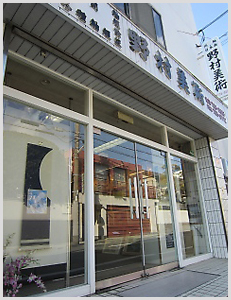
     Art Nomura is an art dealer which produces kakejiku (hanging scrolls). We mount many paintings and calligraphic works in kakejiku in my factory. Kakejiku are our main product. We also remount and repair old or damaged kakejiku. We share the traditional Japanese art of kakejiku with people all over the world.


    (or press ESC or click the overlay)
    Access Map

    Access Map


     The Japanese people have long set a high value on aesthetic senses since ancient times. As a result, the
    peculiar culture which is not seen in other countries blossomed and many aspects of the modern Japanese
    culture come from it. Parts of Japanese culture has been introduced to people in other countries recently,
    so the number of people from other countries who are interested in Japanese culture has been increasing.
    However, the Japanese aesthetic senses, which are the bases of Japanese culture, have been nurtured
    through a long history, intertwining various elements intricately, such as climate, geographical features,
    religion, customs and so on. Therefore, they are very difficult to understand not only for people from other
    countries, but even for the Japanese people. I think the best tool which conveys these difficult senses
    understandably is a “kakejiku.”
     The kakejiku (a hanging scroll; a work of calligraphy or a painting which is mounted and hung in an
    alcove or on a wall) is a traditional Japanese art. It's no exaggeration to say that paintings are what
    express aesthetic senses at all times and places. The kakejiku is an art which expresses the Japanese
    aesthetic senses. The kakejiku has long been used in traditional Japanese events, daily life and so on since
    ancient times. As a result, there are various customs of kakejiku in Japan; kakejiku and the life of the
    Japanese are closely related. We can see Japanese values through kakejiku.
     The kakejiku is a cultural tradition which the Japanese people should be proud of. However, many people
    in other countries don't know much about it because it hasn't been showcased as much. This is why I
    decided to try to introduce it. The kakejiku world is very interesting and beautiful. We want not only the
    Japanese, but also many people from other countries to know and enjoy it. I hope that many people will
    love kakejiku someday.

    (or press ESC or click the overlay)