
Ōhashi Suiseki’s Summary | The Best of Tiger Painters (1/3)
The State of Japanese Art in Ōhashi Suiseki’s Early Years

Early Meiji Period: the Great Devastation of Japanese Art


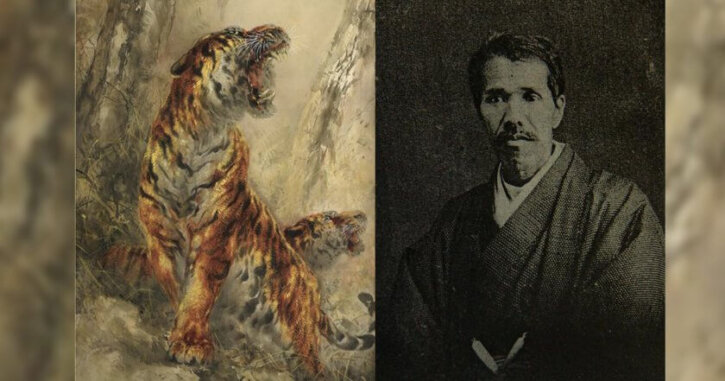
Ōhashi Suiseki was born in Gifu prefecture in 1865, at the very end of the Edo period (1603-1868), when the Japanese art world was in the midst of a period of great change, as the long-lasting Edo period came to an end and the new Meiji period began. In 1868, the Meiji government issued a decree separating Buddhism from Shintoism, and the movement to abolish Buddhism spread throughout Japan, devastating Japanese Buddhist art. In addition to this, the end of the shogunate system in the Edo period brought an end to the master-painter relationship, and the loss of patrons led to a large number of painters being forced into poverty. The Kano school of painters, which flourished in the Edo period, was no exception, and even Kano Hōgai, whose “Kannon (Goddess of Mercy)” is one of the absolute masterpieces in the history of Japanese painting, and Hashimoto Gahō, one of the leading figures in Japanese painting in the Meiji period, had to live in poverty at times. The influx of Western paintings further diminished the value of Japanese art, and Japanese art was greatly devastated in the early Meiji period.

Birth of the Concept of Japanese-style Paintings


The Ryūchi-kai (later the Nihon Bijutsu Kyōkai) was founded in 1878 by a group of government officials with the aim of protecting Japanese art. The protection of Japanese art begins with this association. Ernest Fenollosa, who had come to Japan to teach Western philosophy to the Japanese, was one of the brains of the group. (Fenollosa had always had a keen interest in art, having studied oil painting and drawing in his own country, and after coming to Japan he became increasingly interested in Japanese art.) In 1882, Fenollosa gave a lecture entitled “Bijutsu Shinsetsu” at a conference organised by the Ryūchi-kai, in which he compared the characteristics of Japanese and Western paintings and argued for the superiority of Japanese paintings. It was during this lecture that the term “Japanese-style painting” was used for the first time and the concept of “Japanese-style painting” was born.

After this, Fenollosa distanced himself from the traditional idea of the Ryūchi-kai, which aimed at the pure preservation of Japanese art, and launched the Kanga-kai, which aimed at innovating Japanese painting into a world-class style by adding the essence of Western painting to the traditional Japanese painting. Together with Okakura Tenshin, Kanō Hōgai, Hashimoto Gahō, and others, Fenollosa began his search for a new style of Japanese painting.

In 1887, the Tokyo School of Fine Arts, a government-run art school, was established, and under the leadership of Okakura Tenshin, the school’s first president, artists such as Yokoyama Taikan, Hishida Shunsō, and Shimomura Kanzan began to emerge.

Ōhashi Suiseki’s Childhood – Training Period


Ōhashi Suiseki, who had studied painting with his father, loved to draw pictures from his childhood. 1880 (Meiji 13, at the age of 15), he studied painting with a local painter Toda Hodō, and then with Hodō’s master Amano Hōko in Kyoto. In 1886 (Meiji 18, at the age of 21), he apprenticed himself to Watanabe Shōka in Tokyo.

Period of Hardship – Encounter with a Tiger

Sudden Death of His Mother and Master


In 1887, the year after Ōhashi Suiseki moved to Tokyo to study under Watanabe Shōka, his mother and Watanabe Shōka died suddenly, and deep grief overcame Ōhashi Suiseki. Suiseki returned to his hometown and began to study painting on his own.

Nōbi Earthquake and Death of His Father


Life back home was short-lived when, in 1891, the Nōbi Earthquake (M8.0 ~ M8.4, intensity 7), the largest inland earthquake in Japanese history, hit Gifu Prefecture.

The death toll was 7,273 and 1,71775 people were injured.

The first report from a newspaper reporter was, “Gifu is gone”.

Suiseki’s father was killed by the disaster, and once again Suiseki was struck with great sadness.

In the midst of his heartbreak, Suiseki visited Kyoto to bury his father’s ashes. There, Suiseki purchased a photograph of a tiger painting by Maruyama Ōkyo, and as if trying to forget his grief, he practiced tiger painting using it as a model.

Birth of ‘Suiseki of Tiger Painting’


Then, Suiseki saw a real tiger for the first time at a tiger show that was being held to cheer up the people affected by the Nōbi earthquake.

Tigers were not native to Japan, so previous painters had imagined and depicted them as large cats. Maruyama Ōkyo was no exception.

Even Saeki Ganku, who painted realistic tiger paintings in the late Edo period, had never actually seen a tiger, but imagined a tiger by covering its skull with tiger skin. It was not until the Meiji era (1868-1912) that tigers became visible to the general public.

This encounter with the tiger brought about a profound change in Suiseki, and he began to go to the tiger every day as if possessed, spending all his time sketching.

Just as if Itō Jakuchū had chickens in his garden and painted realistic chickens after thorough observation, Suiseki also pursued a thoroughly realistic tiger.

This is how ‘Suiseki of Tiger Painting’ was born.
    NameRequired

    SexRequired

    MaleFemale

    CountryRequired

    e-mailRequired

    CommentRequired

    Attached File
    ※Up to 3 MB for each file.


    ← ← "MUST CHECK" / Please confirm the above contents again and check this button.

    Contact Us

    Please fill out the form below and submit for your inquiry.

    ❈FirstName
    ❈LastName
    Country
    ❈E-mail
    (❈Confirm E-mail)
    ❈Inquiry category Question
    Consultation
    Impression
    Request
    Others
    ❈Comment

    is the mark for required item.


    Your privacy is important to us. We are committed to protecting your privacy.

    (or press ESC or click the overlay)

    CEO Message

    Our Feelings For Kakejiku


     The Japanese people have long set a high value on aesthetic senses since ancient times. As a result, the
    peculiar culture which is not seen in other countries blossomed and many aspects of the modern Japanese
    culture come from it. Parts of Japanese culture has been introduced to people in other countries recently,
    so the number of people from other countries who are interested in Japanese culture has been increasing.
    However, the Japanese aesthetic senses, which are the bases of Japanese culture, have been nurtured
    through a long history, intertwining various elements intricately, such as climate, geographical features,
    religion, customs and so on. Therefore, they are very difficult to understand not only for people from other
    countries, but even for the Japanese people. I think the best tool which conveys these difficult senses
    understandably is a “kakejiku.”
     The kakejiku (a hanging scroll; a work of calligraphy or a painting which is mounted and hung in an
    alcove or on a wall) is a traditional Japanese art. It's no exaggeration to say that paintings are what
    express aesthetic senses at all times and places. The kakejiku is an art which expresses the Japanese
    aesthetic senses. The kakejiku has long been used in traditional Japanese events, daily life and so on since
    ancient times. As a result, there are various customs of kakejiku in Japan; kakejiku and the life of the
    Japanese are closely related. We can see Japanese values through kakejiku.
     The kakejiku is a cultural tradition which the Japanese people should be proud of. However, many people
    in other countries don't know much about it because it hasn't been showcased as much. This is why I
    decided to try to introduce it. The kakejiku world is very interesting and beautiful. We want not only the
    Japanese, but also many people from other countries to know and enjoy it. I hope that many people will
    love kakejiku someday.

    (or press ESC or click the overlay)
    Company Profile
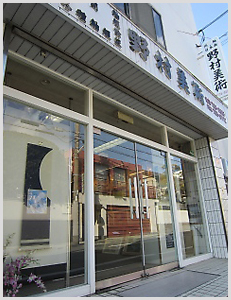
    syaoku.jpg(120220 byte)

    Name Art Nomura


    President Tatsuji Nomura


    Founded1973


    Established1992


    Address7-23 Babadori, Tarumi-ku, Kobe city,
    Hyougo Prefecture, 655-0021, Japan


    Capital10 million yen


    URLhttp://nomurakakejiku.com


    Our Business

     Art Nomura is an art dealer which produces kakejiku (hanging scrolls). We mount many paintings and calligraphic works in kakejiku in my factory. Kakejiku are our main product. We also remount and repair old or damaged kakejiku. We share the traditional Japanese art of kakejiku with people all over the world.


    (or press ESC or click the overlay)
    Access Map

    Access Map


     The Japanese people have long set a high value on aesthetic senses since ancient times. As a result, the
    peculiar culture which is not seen in other countries blossomed and many aspects of the modern Japanese
    culture come from it. Parts of Japanese culture has been introduced to people in other countries recently,
    so the number of people from other countries who are interested in Japanese culture has been increasing.
    However, the Japanese aesthetic senses, which are the bases of Japanese culture, have been nurtured
    through a long history, intertwining various elements intricately, such as climate, geographical features,
    religion, customs and so on. Therefore, they are very difficult to understand not only for people from other
    countries, but even for the Japanese people. I think the best tool which conveys these difficult senses
    understandably is a “kakejiku.”
     The kakejiku (a hanging scroll; a work of calligraphy or a painting which is mounted and hung in an
    alcove or on a wall) is a traditional Japanese art. It's no exaggeration to say that paintings are what
    express aesthetic senses at all times and places. The kakejiku is an art which expresses the Japanese
    aesthetic senses. The kakejiku has long been used in traditional Japanese events, daily life and so on since
    ancient times. As a result, there are various customs of kakejiku in Japan; kakejiku and the life of the
    Japanese are closely related. We can see Japanese values through kakejiku.
     The kakejiku is a cultural tradition which the Japanese people should be proud of. However, many people
    in other countries don't know much about it because it hasn't been showcased as much. This is why I
    decided to try to introduce it. The kakejiku world is very interesting and beautiful. We want not only the
    Japanese, but also many people from other countries to know and enjoy it. I hope that many people will
    love kakejiku someday.

    (or press ESC or click the overlay)