Ito Jakuchū’s Sumi-ink Painting Masterpiece ‘Fruit and Vegetable Nirvana’
During the Edo period, various unusual drawings of the Nirvana were produced as paintings and craft shows, but Ito Jakuchū shows us one of the most sophisticated and bizarre Nirvana paintings of all.
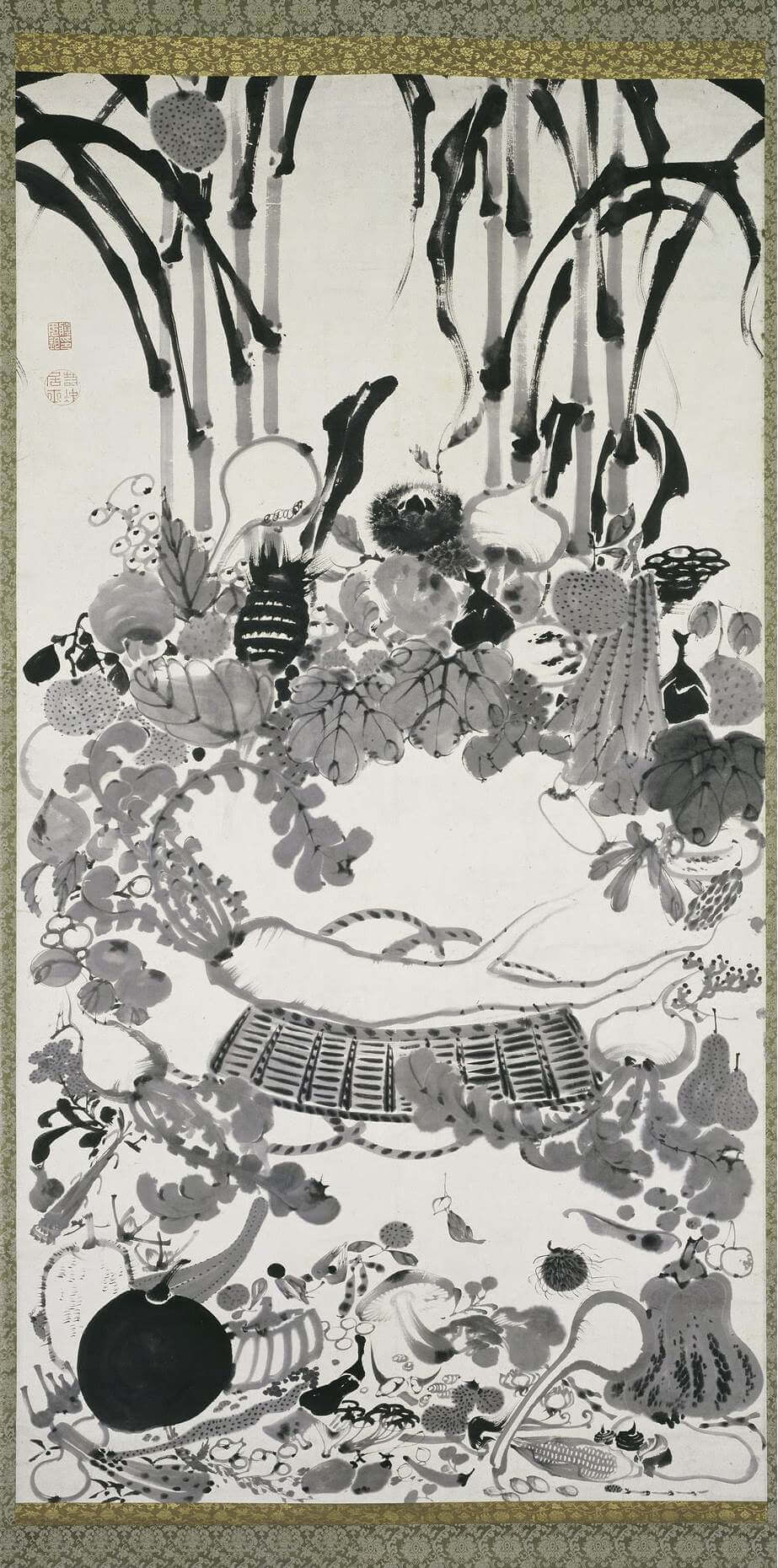
In this painting, in which vegetables and fruits are gathered together to form a scene of the Buddha’s death, the radish on the upside-down basket is the Gautama Siddhartha lying on a dais, and the eight corn stalks standing behind him correspond to the sal trees.
Surrounding the radish are persimmons, peaches, turnips, citrons, taros, chestnuts, aubergines, melons, lotus roots, bitter gourds, snap pears, cherries, small potatoes, pumpkins, corn, horsetail, lily bulb, Japanese ginger, matsutake mushrooms, arrowhead, enoki mushrooms, chillies, dried persimmons, ginger, yam, cucumbers, gourds, bladder cherries, wax gourds, and bamboo shoots, etc. are likened to various bodhisattvas, disciples of the Buddha, lay people and animals grieving over the death of the Buddha.
The head of the radish faces the left side of the screen, whereas the head of the Buddha is on the left side of the screen in ordinary nirvana paintings, and there are exactly eight corn stalks in the painting, whereas there are eight sal trees, etc. Needless to say, the fact that the content of the painting is replaced by a vulgar one while the formal rules are properly observed is a technique common to parodies of the Nirvana paintings of all ages and cultures.
It has also been pointed out that the painting is based on the usual Nirvana in detail: the orange hanging from the upper left represents a begging bowl wrapped in a bag and hung on a branch; the upside-down gourd in the bottom right of the painting represents a lion lying on its back and lamenting; and the loofah in the bottom left represents an elephant.
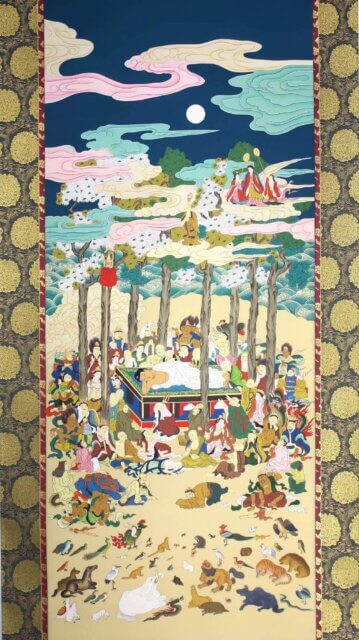
Although people often talk about this painting at the level of a parody of the Nirvana, this is not actually the case.
Itō Jakuchū was such a devout Buddhist that he devoted himself to depicting and presenting the “Dōshoku Sai-e” (30 pictures of the Colorful Realm of Living Beings) paintings for the Shōkoku-ji temple.
It has been suggested that the death of Jakuchū’s mother in 1779 was the trigger for the painting, and that the artist was praying for her mother’s attaining Buddhahood and the prosperity of the family business. This theory should be taken. Of course, this is not unrelated to the fact that Jakuchū was born and raised as the heir to a bluegoods wholesaler in the Nishikikōji area of Kyoto.
A humorous look at the big screen, full of vitality. Rich medium-ink faces and lines with clean dark-ink accents. Jakuchū broke new ground not only in colouring flower-and-bird paintings such as the Dōshoku Sai-e paintings, but also in ink painting.