
A Utopia of Art and Nichiren Buddhism that Reversed the Banishment of Hon-ami Kōetsu! 64 Years in Takagamine, Rakuhoku with Wealthy Merchants.
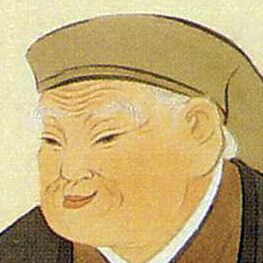
Hon-ami Kōetsu

Hon-ami Kōetsu (1558-1637), the founder of the Rimpa school, refused to bow down to anyone during his life.

Hon-ami Kōetsu was warned by Tokugawa Ieyasu about his influence over court nobles and powerful townspeople, and was banished from the centre of Kyoto, but he took advantage of this and set about creating an idealistic village in the land he was given.

Nichiren Sect, the Spiritual Basis of Hon-ami Kōetsu

What was it that sustained Hon-ami Kōetsu’s actions and spirit? It may have been the samurai blood inherited from his father Kōji and the uprightness of mind strictly taught by his mother Myōshū.

Faith is key when discussing the Hon-ami family. The medieval period in Japan was a time when religion had a great influence. Literally, religion influenced people’s daily activities. At the time, the most powerful religion in the capital was Nichiren sect, which was also the religion of the Hon-ami family.

Nichiren sect, founded in the Kamakura period (1185-1333) by Nichiren, a native of Awa province (southern Chiba prefecture), was characterised by absolute devotion to the Lotus Sutra and aimed to create an ideal world (Jōjakkōdo) in the present world (shaba). It can be said that Nichiren sect was the opposite of Jōdo sect and Jōdo Shin sect, which are also Buddhist sects, but both of which prayed for rebirth in the Pure Land of Ultimate Bliss.

Nichiren sect, which affirmed this world, was enthusiastically received by the merchant class, which was beginning to gain economic power in Kyoto.

This was because, while the view that “money-making was despicable” was strong, only Nichiren sect did not deny it, but rather regarded it as a valuable thing.

Praised as the ‘Three Brushes of the Kan-ei Era’.

Kōetsu grew up in this environment, while his parents forbade extravagance and he himself was content to live a modest life.

Despite being a wealthy merchant, he kept to a modest lifestyle, wearing cotton nightclothes and having only one servant until his death. Much of his income was donated to temples and other institutions.

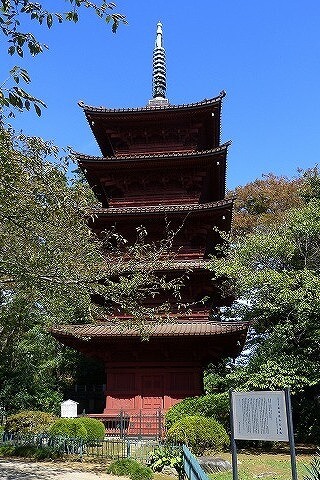
The five-storey pagoda of the famous Hokkekyō-ji temple in Ichikawa, Chiba Prefecture, is known to have been built by the Hon-ami family.
Kōetsu studied in this environment and worked his way up to become a great artist.

His elegant style of calligraphy is known as the ‘Kōetsu style’ and he is praised as one of the ‘Three Brushes of the Kan-ei Era’, along with Konoe Nobutada and Shōkado Shōjō.
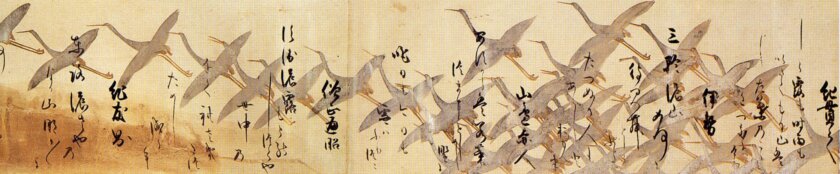
Calligraphy on Lotus painted paper by Hon-ami Kōetsu

He studied the tea ceremony with Furuta Oribe and formed a close friendship with Sen no Sōtan, grandson of Sen no Rikyū.

Art Village at the Falling Sun

In 1615, Kōetsu received the land of Takagamine in the north of Kyoto from Tokugawa Ieyasu, and set out to make it his ‘utopia’. The basis for this was still artistic activity and religious belief.

He called in family members, friends and servants who knew his mind. The condition was that they would share the faith of Nichiren sect.

According to the Kōetsu-cho Kozu Utsushi, drawn later, 56 houses were built and four Nichiren sect temples, including the Kōetsu-ji and the Jōshō-ji, were built with Iraka (roofs).

Among those gathered was Ogata Sōkaku, grandfather of the brothers Ogata Kōrin and Ogata Kenzan, who later took over the Rimpa school. The building of the wealthy merchant Chaya Shirōjirō, known as the ‘Three Chiefs of Kyoto’, also lined the streets.

Masterpieces of calligraphy, painting, *maki-e and ceramics were produced here one after another.

On the other hand, it was said that the temple was continually echoing the title ‘Namu-Myōhō-Renge-Kyō’ in the morning and evening.

Kōetsu lived 22 years after moving to Tayagamine and died at the age of 80, 1637.

It was a happy enough life, not only because of the flamboyant fame of the great artist, but also because he was blessed with children and grandchildren.

However, after Kōetsu’s death, the Hon-ami family faced difficulties. The family business did not do well and the artworks they produced were not selling.

Instead, the Ogata family (Kariganeya) emerged as the official shop e of Emperor Gomizunō’s consort, Tōfukumon-in (Tokugawa Kazuko).


Maki-e: A Japanese lacquer decoration technique in which pictures, patterns, and letters are drawn with lacquer on the surface of lacquerware, and then metal powder such as gold or silver is sprinkled and fixed on the surface of the lacquerware.

In 1679, the Hon-ami family returned Takagamine, the dreamland of Kōetsu, to the Shogunate. They were no longer in control of the area.

64 years of ‘utopia in art and faith’ thus quietly brought the curtain down on history.

Nevertheless, the Kōetsu-ji and the Jōshō-ji still continue to transmit the Dharma light. During the autumn tourist season, the Takagamine area is always full of people yearning for the memory of Kōetsu.
    NameRequired

    SexRequired

    MaleFemale

    CountryRequired

    e-mailRequired

    CommentRequired

    Attached File
    ※Up to 3 MB for each file.


    ← ← "MUST CHECK" / Please confirm the above contents again and check this button.

    Contact Us

    Please fill out the form below and submit for your inquiry.

    ❈FirstName
    ❈LastName
    Country
    ❈E-mail
    (❈Confirm E-mail)
    ❈Inquiry category Question
    Consultation
    Impression
    Request
    Others
    ❈Comment

    is the mark for required item.


    Your privacy is important to us. We are committed to protecting your privacy.

    (or press ESC or click the overlay)

    CEO Message

    Our Feelings For Kakejiku


     The Japanese people have long set a high value on aesthetic senses since ancient times. As a result, the
    peculiar culture which is not seen in other countries blossomed and many aspects of the modern Japanese
    culture come from it. Parts of Japanese culture has been introduced to people in other countries recently,
    so the number of people from other countries who are interested in Japanese culture has been increasing.
    However, the Japanese aesthetic senses, which are the bases of Japanese culture, have been nurtured
    through a long history, intertwining various elements intricately, such as climate, geographical features,
    religion, customs and so on. Therefore, they are very difficult to understand not only for people from other
    countries, but even for the Japanese people. I think the best tool which conveys these difficult senses
    understandably is a “kakejiku.”
     The kakejiku (a hanging scroll; a work of calligraphy or a painting which is mounted and hung in an
    alcove or on a wall) is a traditional Japanese art. It's no exaggeration to say that paintings are what
    express aesthetic senses at all times and places. The kakejiku is an art which expresses the Japanese
    aesthetic senses. The kakejiku has long been used in traditional Japanese events, daily life and so on since
    ancient times. As a result, there are various customs of kakejiku in Japan; kakejiku and the life of the
    Japanese are closely related. We can see Japanese values through kakejiku.
     The kakejiku is a cultural tradition which the Japanese people should be proud of. However, many people
    in other countries don't know much about it because it hasn't been showcased as much. This is why I
    decided to try to introduce it. The kakejiku world is very interesting and beautiful. We want not only the
    Japanese, but also many people from other countries to know and enjoy it. I hope that many people will
    love kakejiku someday.

    (or press ESC or click the overlay)
    Company Profile
    syaoku.jpg(120220 byte)

    Name Art Nomura


    President Tatsuji Nomura


    Founded1973


    Established1992


    Address7-23 Babadori, Tarumi-ku, Kobe city,
    Hyougo Prefecture, 655-0021, Japan


    Capital10 million yen


    URLhttp://nomurakakejiku.com


    Our Business

     Art Nomura is an art dealer which produces kakejiku (hanging scrolls). We mount many paintings and calligraphic works in kakejiku in my factory. Kakejiku are our main product. We also remount and repair old or damaged kakejiku. We share the traditional Japanese art of kakejiku with people all over the world.


    (or press ESC or click the overlay)
    Access Map

    Access Map


     The Japanese people have long set a high value on aesthetic senses since ancient times. As a result, the
    peculiar culture which is not seen in other countries blossomed and many aspects of the modern Japanese
    culture come from it. Parts of Japanese culture has been introduced to people in other countries recently,
    so the number of people from other countries who are interested in Japanese culture has been increasing.
    However, the Japanese aesthetic senses, which are the bases of Japanese culture, have been nurtured
    through a long history, intertwining various elements intricately, such as climate, geographical features,
    religion, customs and so on. Therefore, they are very difficult to understand not only for people from other
    countries, but even for the Japanese people. I think the best tool which conveys these difficult senses
    understandably is a “kakejiku.”
     The kakejiku (a hanging scroll; a work of calligraphy or a painting which is mounted and hung in an
    alcove or on a wall) is a traditional Japanese art. It's no exaggeration to say that paintings are what
    express aesthetic senses at all times and places. The kakejiku is an art which expresses the Japanese
    aesthetic senses. The kakejiku has long been used in traditional Japanese events, daily life and so on since
    ancient times. As a result, there are various customs of kakejiku in Japan; kakejiku and the life of the
    Japanese are closely related. We can see Japanese values through kakejiku.
     The kakejiku is a cultural tradition which the Japanese people should be proud of. However, many people
    in other countries don't know much about it because it hasn't been showcased as much. This is why I
    decided to try to introduce it. The kakejiku world is very interesting and beautiful. We want not only the
    Japanese, but also many people from other countries to know and enjoy it. I hope that many people will
    love kakejiku someday.

    (or press ESC or click the overlay)