The Genius of Ogata Kōrin as Seen in “Kakitsubata-zu Byōbu, Irises Painting Folding Screen”
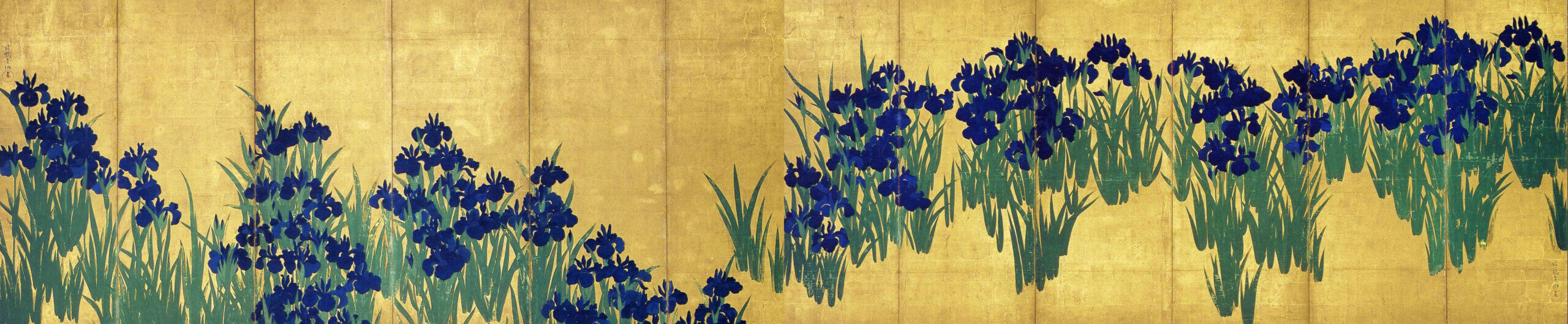
“Kakitsubata-zu Byōbu, Irises Painting Folding Screen” by Ogata Kōrin

Ogata Kōrin was a painter active in Kyoto during the Edo period. His impressive works, which later became the driving force behind the creation of the school of painting known as the Rimpa school, also fascinate people today.

In this article, we will introduce the charms of his masterpiece, the Irises folding screen.

Fewer colours

The number of colours used in the Irises folding screen is largely limited to verdigris and ultramarine blue colours. The rest of the colours are extremely few, with the only colour being the gold of the background.

In Japan, of course, there was a custom from that time of appreciating monotone works that used no colour at all, such as suiboku-ga (ink painting), but apart from this, coloured works were also favoured.

The variation in colour is less than in other countries due to the nature of the material, but even so, it is unusual to find so few colours as in the case of the Irises folding screen.

It is clear that this expression was quite experimental for Ogata Kōrin. Moreover, as this work was early in his artistic career, it shows that he possessed an exceptional sense of style.

Such a sense is understandable, as his lineage contains the same DNA as that of Hon-ami Kōetsu, the founder of the Rimpa school.

However, the Irises folding screen actually has another trick up its sleeve.

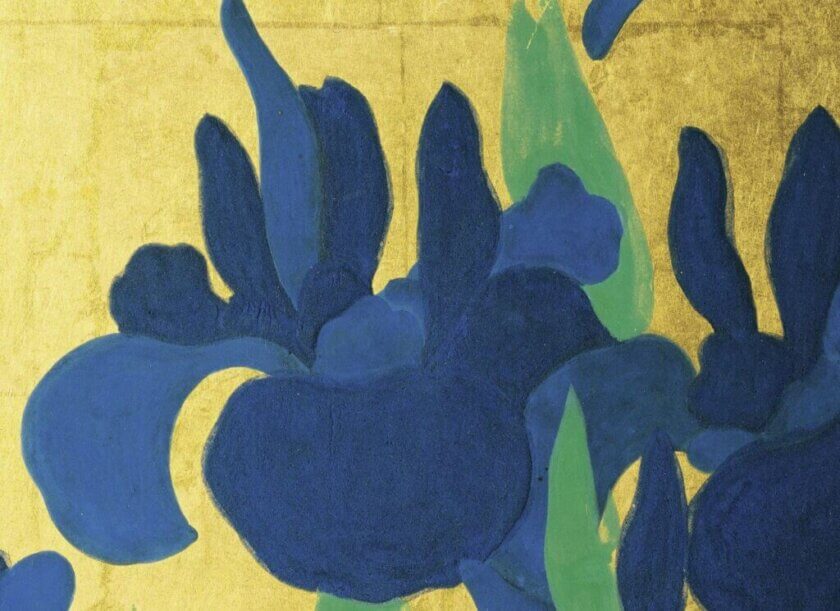
From a distance, the painting looks as if it is painted in only two colours, verdigris and ultramarine blue, but closer inspection reveals that the blue of the petals has been painted in several different shades of paint. In contrast, the leaves are painted monotonously in green. In this way, the leaves are more like a garnish to complement the flowers, allowing the viewer to concentrate on the changing colours of the petals.

It is an interesting piece of work with a really well-calculated elaboration.
Frequent Use of Copying and Pasting

Ogata Kōrin was born the second son of a Kyoto kimono merchant called Karigane-ya.

The Karigane-ya was a high-class kimono merchant that received orders from the Toyotomi and Tokugawa families, who were the powerful men of the time, so their products were all first-class.

Moreover, as mentioned earlier, the wife of Ogata Dōan, the founder of the Karigane-ya, was the sister of Hon-ami Kōetsu, and the Ogata and Hon-ami families were related.

Furthermore, some research suggests that Tawaraya Sōtatsu also married a member of the Hon-ami family, so it is clear that these three families were closely related.

For these reasons, the works of Hon-ami Kōetsu and Tawaraya Sōtatsu were normally exhibited in the Karigane-ya.

Considering that the Karigane-ya was a house where many national treasures were placed in modern terms, one can imagine how unusual Ogata Kōrin’s upbringing must have been.

Such uniqueness of Ogata Kōrin is also expressed in this work, the Irises folding screen.

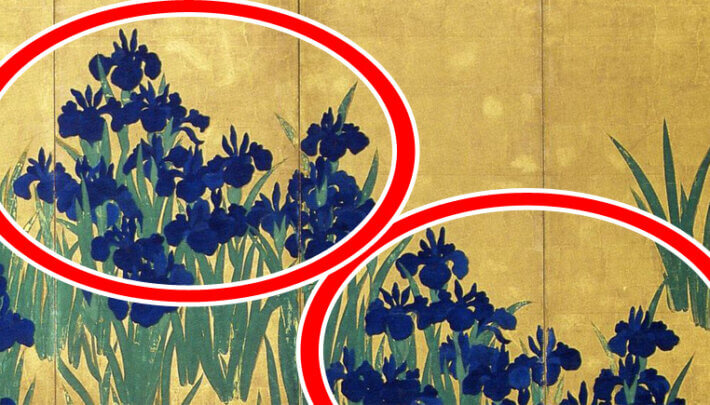
The same shape is actually used elsewhere in the depiction of these irises.

In modern terms, it is a copy-and-paste.
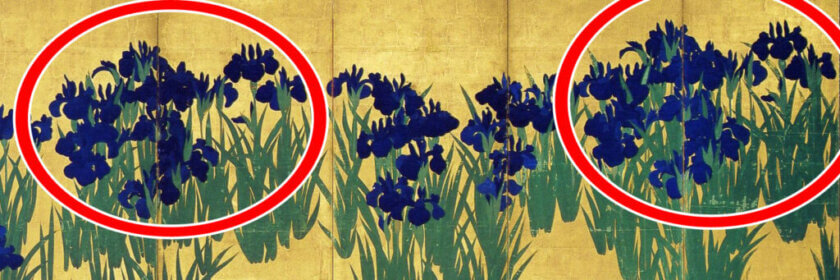
The expression brilliantly turned the conventional view of painters at the time that a painting was to be completed by depicting each object in different style.

The reason why Ogata Kōrin came up with this copy-and-paste technique stems from his upbringing in a kimono merchant environment.

Japanese kimono designs usually use a lot of repetition of the same pattern.

Ogata Kōrin appropriated this technique to the world of painting.

A characteristic of the Rimpa school, not only Ogata Kōrin, is the successful transfer of the designs used in these crafts and the sensibilities associated with them to the world of painting.

In Kyoto, not only kimonos, but also fans, *makie and various other crafts have been produced since ancient times, and naturally the designs used in these crafts were also well developed. The designs of these crafts could have come to the world of painting at any time, and it was Hon-ami Kōetsu and Tawaraya Sōtatsu who triggered this trend, and Ogata Kōrin who developed it rapidly.

The Irises folding screen by Ogata Kōrin is truly a milestone of the Rimpa school.

This work is stored at the Nezu Museum in Tokyo and is exhibited every year in May, when the irises are in bloom, and should be seen if you have the opportunity.


*Makie: Maki-e (蒔絵, literally: sprinkled picture (or design)) is a Japanese lacquer decoration technique in which pictures, patterns, and letters are drawn with lacquer on the surface of lacquerware, and then metal powder such as gold or silver is sprinkled and fixed on the surface of the lacquerware.
    NameRequired

    SexRequired

    MaleFemale

    CountryRequired

    e-mailRequired

    CommentRequired

    Attached File
    ※Up to 3 MB for each file.


    ← ← "MUST CHECK" / Please confirm the above contents again and check this button.

    Contact Us

    Please fill out the form below and submit for your inquiry.

    ❈FirstName
    ❈LastName
    Country
    ❈E-mail
    (❈Confirm E-mail)
    ❈Inquiry category Question
    Consultation
    Impression
    Request
    Others
    ❈Comment

    is the mark for required item.


    Your privacy is important to us. We are committed to protecting your privacy.

    (or press ESC or click the overlay)

    CEO Message

    Our Feelings For Kakejiku


     The Japanese people have long set a high value on aesthetic senses since ancient times. As a result, the
    peculiar culture which is not seen in other countries blossomed and many aspects of the modern Japanese
    culture come from it. Parts of Japanese culture has been introduced to people in other countries recently,
    so the number of people from other countries who are interested in Japanese culture has been increasing.
    However, the Japanese aesthetic senses, which are the bases of Japanese culture, have been nurtured
    through a long history, intertwining various elements intricately, such as climate, geographical features,
    religion, customs and so on. Therefore, they are very difficult to understand not only for people from other
    countries, but even for the Japanese people. I think the best tool which conveys these difficult senses
    understandably is a “kakejiku.”
     The kakejiku (a hanging scroll; a work of calligraphy or a painting which is mounted and hung in an
    alcove or on a wall) is a traditional Japanese art. It's no exaggeration to say that paintings are what
    express aesthetic senses at all times and places. The kakejiku is an art which expresses the Japanese
    aesthetic senses. The kakejiku has long been used in traditional Japanese events, daily life and so on since
    ancient times. As a result, there are various customs of kakejiku in Japan; kakejiku and the life of the
    Japanese are closely related. We can see Japanese values through kakejiku.
     The kakejiku is a cultural tradition which the Japanese people should be proud of. However, many people
    in other countries don't know much about it because it hasn't been showcased as much. This is why I
    decided to try to introduce it. The kakejiku world is very interesting and beautiful. We want not only the
    Japanese, but also many people from other countries to know and enjoy it. I hope that many people will
    love kakejiku someday.

    (or press ESC or click the overlay)
    Company Profile
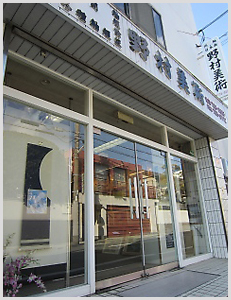
    syaoku.jpg(120220 byte)

    Name Art Nomura


    President Tatsuji Nomura


    Founded1973


    Established1992


    Address7-23 Babadori, Tarumi-ku, Kobe city,
    Hyougo Prefecture, 655-0021, Japan


    Capital10 million yen


    URLhttp://nomurakakejiku.com


    Our Business

     Art Nomura is an art dealer which produces kakejiku (hanging scrolls). We mount many paintings and calligraphic works in kakejiku in my factory. Kakejiku are our main product. We also remount and repair old or damaged kakejiku. We share the traditional Japanese art of kakejiku with people all over the world.


    (or press ESC or click the overlay)
    Access Map

    Access Map


     The Japanese people have long set a high value on aesthetic senses since ancient times. As a result, the
    peculiar culture which is not seen in other countries blossomed and many aspects of the modern Japanese
    culture come from it. Parts of Japanese culture has been introduced to people in other countries recently,
    so the number of people from other countries who are interested in Japanese culture has been increasing.
    However, the Japanese aesthetic senses, which are the bases of Japanese culture, have been nurtured
    through a long history, intertwining various elements intricately, such as climate, geographical features,
    religion, customs and so on. Therefore, they are very difficult to understand not only for people from other
    countries, but even for the Japanese people. I think the best tool which conveys these difficult senses
    understandably is a “kakejiku.”
     The kakejiku (a hanging scroll; a work of calligraphy or a painting which is mounted and hung in an
    alcove or on a wall) is a traditional Japanese art. It's no exaggeration to say that paintings are what
    express aesthetic senses at all times and places. The kakejiku is an art which expresses the Japanese
    aesthetic senses. The kakejiku has long been used in traditional Japanese events, daily life and so on since
    ancient times. As a result, there are various customs of kakejiku in Japan; kakejiku and the life of the
    Japanese are closely related. We can see Japanese values through kakejiku.
     The kakejiku is a cultural tradition which the Japanese people should be proud of. However, many people
    in other countries don't know much about it because it hasn't been showcased as much. This is why I
    decided to try to introduce it. The kakejiku world is very interesting and beautiful. We want not only the
    Japanese, but also many people from other countries to know and enjoy it. I hope that many people will
    love kakejiku someday.

    (or press ESC or click the overlay)