Summary | Art History of Japan | Painting
Introduction
This time, I would like to introduce a summary of Japanese painting history.
Well, what do you think of when you hear the word “Japanese painting”?
Kanō-ha school?
Ok, ok. That’s right.
The Kanō-ha school is the largest group of painters in the history of Japanese art. That’s a pretty good answer.
What else?
Yokoyama Taikan?
Yes, he is one of the great masters of modern Japanese painting, along with Takeuchi Seihō.
His paintings of Mt. Fuji are very popular. This is also a good answer.
What else?
Itō Jakuchū?
That’s right.
He’s one of the most eccentric painters of the Edo period, and his paintings of chickens are synonymous with him.
Nowadays he’s very popular, not only in Japan but also in the world, and his recent exhibition was very popular with a lot of visitors.
Is there anything else?
Oh, Ukiyo-e!
That’s right… Ukiyo-e, indeed…
Katsushika Hokusai is very famous. His work called “The Great Wave of Kanagawa” is wonderful, isn’t it?
That work is said to be the most famous Japanese painting in the world.
Well…, even if we say “Japanese painting”, there are many kinds of works.
So, the question is: do you know when these works were created?
Or do you know the background of the period in which they were painted?
I think many of you may be unaware of these. There are people who know a lot about the artists and their works from a micro perspective, but don’t really understand the whole flow from a macro perspective.
But I think this situation is unavoidable.
The history of Japanese painting is related to the history of Japan and the history of Buddhism and Shintoism, and it is difficult to understand unless you study them in total.
This is why I think it has been so difficult for people to study the history of Japanese painting.
In this lecture, I will introduce the history of Japanese painting in a compact way, and I will leave out many things, but I hope you will get a rough idea of the flow of the history.
Later on, you will be able to study in detail the parts of each period that interest you.
This lecture can be used as a review of the history of Japanese painting, or as an introduction to it.
So let’s get started.
Asuka Period
The history of Japanese painting began in the Asuka period. The Asuka period is from 592 to 710, and what happened in Japan during this period is that Buddhism was introduced to Japan.
In Japan, there was originally a native religion called Shinto, but at this time, Buddhism was introduced from abroad and Buddhism started in Japan.
When we were students, we learned that Buddhism was introduced from Baekje in 538, but now there are many theories, so please understand that Buddhism was introduced from India to Japan through China and Baekje around that time.
In order to spread the teachings of Buddhism, the production of Buddhist paintings began in Japan. In this period, Buddhist paintings were used for barrier paintings and designs for craftworks.
The technique of making hanging scrolls is also thought to have been introduced from China through Baekje, along with the arrival of Buddhism. So the arrival of Buddhism brought many changes to Japan.
Now let’s move on. “What? It’s the end of the Asuka period?” You might be surprised, but we’re going to go on and on (laughs). If we don’t move forward at this pace, we’ll never get to the present day.
Nara Period
Now let’s move on to the Nara period.
The Nara period is the period from 710 to 794.
Do you know Nara?
Yes, Nara is the name of the city. The capital of Japan used to be in Nara.
From there, the capital moved to Kyoto, and then finally to Tōkyō as we know it today.
Nara is a very popular tourist destination because of its atmosphere as an ancient capital, so if you have a chance, please go there.
In this period, the production of Buddhist paintings was also flourishing.
It was a continuation of the Asuka period. In the background of this period, there was the Japanese envoy to China.
At that time, China was more civilised than Japan, so from Japan’s point of view, it was a country to be admired.
So the Japanese government sent more and more students to China to learn about the advanced culture, and the students brought back the advanced Buddhism and Buddhist paintings, so the production of Buddhist paintings became more and more prosperous.
In addition to this, there was the idea of the “nation of protection” during this period, and this idea was also one of the reasons why the production of Buddhist paintings flourished.
What is this idea of “nation protection”?
It is the idea of using the power of Buddhism to resolve the confusion in the country.
In this era, there were many epidemics and social unrest. It was a time when things like the modern coronavirus were spreading.
When the emperor was worried about how to govern the country, he decided to use the power of Buddhism to govern the country.
In the process, he started to build large Buddhist statues and a lot of temples, thereby making Buddhist paintings more and more popular.
This is the flow of the times.
Heian Period
Uh-huh, ok… from this Nara period, we now move on to the Heian period. The Heian period lasted from 794 to 1185.
This period is divided into the early part and the latter part.
In the early part of this period, esoteric Buddhist paintings began to appear.
“What is esoteric painting?”
If you are wondering, don’t worry. I’ll explain it to you now.
The Buddhism that flourished during the Nara period (710-794) was called Nara Buddhism, partly because the capital was located in Nara. As the Nara period progressed, Nara Buddhism became too powerful and began to interfere in the world of politics.
There are those annoying people who interfere in everything – it’s like that.
There was even one monk who said, “I’m going to be the emperor!”
I think he was getting carried away!
As a result, there was a movement to eliminate the influence of Nara Buddhism from politics, which led to the Heian period (794-1185). That’s why the capital was moved from Nara to Kyoto.
Then, in the process of trying to find a new Buddhism that was not Nara Buddhism, which the government had already had enough of, Tendai and Shingon Buddhism emerged. Saichō and Kūkai appear on the stage of history.
It was during this period that Kūkai went to the Tang Dynasty in China on a mission to learn about esoteric Buddhism and came back.
Esoteric Buddhism is a very core part of Buddhist teachings, and based on this, Kūkai founded the Shingon sect.
The Shingon sect of Buddhism is characterized by rituals that emphasize a solemn atmosphere. For example, the ritual of burning goma (homa) in a darkened room. Buddhist paintings were used to create such a solemn atmosphere. Well, it seems that decorating the room with Buddhist paintings would create the atmosphere, doesn’t it?
You may feel as if the Buddha were jumping out of the painting and talking to you.
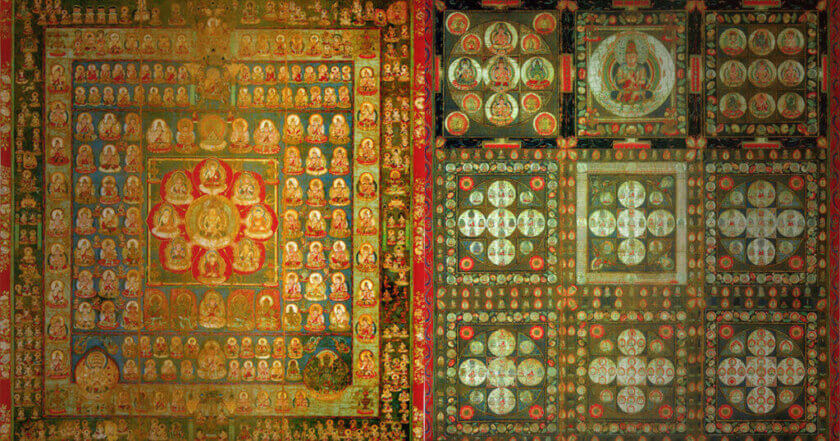
Among such Buddhist paintings, mandalas are said to be the most important.
The mandala is a set of two Buddhist paintings, the Mandala of the Womb Realm and the Mandala of the Vajrayana Realm, and these two represent the truth of the world.
The Kūkai also brought back mandalas from the Tang Dynasty, and based on them, they began to be produced in Japan.
It was probably around this time that hanging scrolls also began to be produced in Japan in earnest.
Thus, in the early part of the Heian period (794-1185), among Buddhist paintings, a slightly different type of Buddhist paintings, esoteric Buddhism paintings represented by mandalas, appeared and were highly valued, and esoteric art flourished.
The latter half of the Heian period saw a shift to the aristocratic culture.
Around this time, the Japanese government felt that the Chinese culture, which had seemed so advanced until then, had fallen into a rut and abolished the envoys to China.
Instead, a culture matured within Japan, and various things were developed.
It is said that hiragana was also created during this period.
The Yamato-e style of painting was born out of this process of creating something unique to Japan.
The term “Yamato-e” is used to describe Japanese paintings, which are unique to Japan, as opposed to the paintings that came from China, which are called ” Kara-e”.
Yamato-e is characterized by its depiction of aristocratic customs and events.
Also, in the latter half of the Heian period, the belief in the Pure Land was born.
In this period, the idea of the Latter Day of the Law was born. The idea is that Buddha’s teachings would no longer be effective after thousands of years of his death, and the world would come to an end. As a result, social unrest emerged.
Moreover, warriors appeared and even monks at temples became armed forces in this era, so the period became very rough. It was like a picture of hell…
So in Kyoto, the capital of Japan, there were piles of dead bodies lying around, and the people had to eat them to survive.
Whoa! That’s just a hell of a picture~!
Therefore, the atmosphere of the end of the world became widespread among the aristocracy, and the aristocracy wanted to save themselves, so they looked to Buddhism for an answer, and came up with the idea that if they died, Amitabha would come to their rescue and they would be reborn in the Pure Land, where they would be enlightened and everyone would be happy. This is the Pure Land belief.
So, in the hope that Amitabha would come to our aid, the image of Amitabha coming to save us was frequently painted. This is called the Amida Raigō-zu, an image of the descent of Amitabha. This is a characteristic of this late Heian period painting history.
Then there were the picture scrolls…yes, picture scrolls were often painted in this era.
The most famous one is called the Tale of Genji Emaki. At that time, there was a long love story of aristocrats called The Tale of Genji written by Murasaki Shikibu, and the Tale of Genji Emaki is a picture scroll of the story that can be opened horizontally in chronological order.
One of the most innovative aspects of this work is that it depicts a scene of aristocrats doing something from an oblique angle upwards by removing the roof of the aristocrat’s house, which is a common technique in Yamato-e paintings of this period.
Don’t you think that composition is very innovative?
The idea of taking off the roof and looking at what the nobles are doing from an angle… I want to say, “What an outstanding idea!”
This is a very interesting picture scroll with a very innovative way of drawing.
There is also a famous picture scroll called Chōjū-jinbutsu-giga (鳥獣人物戯画, literally “Animal-person Caricatures”).
Famous scenes depict animals wrestling and chasing each other like humans. It’s often referred to as the beginning of a comic book.
Such a variety of picture scrolls became a feature of the latter half of the Heian period.
Kamakura Period
So far we have seen the culture of the aristocracy, but now we come to the Kamakura period and the age of the samurai.
Let’s take a look at how painting changed in the age of the samurai, the Kamakura period.
Do you know Kamakura?
If you do, you might be quite a Japan expert. Oops, that’s impolite to the people of Kamakura, sorry.
Kamakura is the name of the city and is near Tōkyō. There is also a large Kamakura Buddha here.
Japanese people really love the Great Buddha. Of course, I love it too.
The Kamakura Shogunate was established here in Kamakura.
The Kamakura period lasted from 1185 to 1333.
What happened during the Kamakura period was the introduction of ink painting and Zen painting from the Sung dynasty China.
During the Tang dynasty (618-907), China’s ink production techniques were greatly developed. This led to the creation of many of the paintings that we now consider to be ink paintings, such as landscapes and flower-and-bird paintings. These paintings were introduced to Japan from China.
Next, I would like to talk about Zen painting. Zen is a school of Buddhism that focuses on meditation through zazen sitting, and it became very popular in China around the Sung dynasty, and it was introduced to Japan in this period.
Zen Buddhism in China has since declined, but in Japan Zen Buddhism has become associated with many different cultures and is still popular today. Even without the idea of religion, it has a great influence on the Japanese sense of beauty.
Japanese Zen Buddhism is famous all over the world.
It is well known that Steve Jobs, the founder of Apple, was also devoted to Zen.
Do you think I could be like Steve Jobs if I devoted myself to Zen?
Of course not. I know that.
Back to the story.
At the same time, Zen painting was also introduced to Japan. Zen painting is a kind of painting that was done to spread the teachings of Zen. In the Kamakura period, many Zen paintings were made, such as portraits of masters and paintings of Bodhidharma.
Of course, the aristocratic culture of Yamato-e, Amida-raigō-zu, and picture scrolls was also upgraded in parallel, but the samurai, who had taken power from the aristocracy, were more receptive to new things, so Zen painting and ink painting were accepted.
In addition, it seems to us that ink painting is very powerful because of its bold composition and strong brushwork. This powerful image must have been very popular with the samurai… so this kind of painting became very popular.
Muromachi Period
Next came the Kenmu-no-shinsei period (1333-1336), a period of three years of political turmoil, followed by the Muromachi period (1336-1573).
There are probably very few Japanese people who know what Muromachi is.
This is also the name of a place in Kyoto, Muromachi-dōri street, where the third shogun of the Muromachi Shogunate, Ashikaga Yoshimitsu, built a very luxurious mansion, hence the name Muromachi Period.
No way, it’s the name of a street. Anything is possible, isn’t it?
The Muromachi period lasted from 1336 to 1573, which was more than two hundred years. It was as long as the Edo period, so a lot of things happened.
This period was really long.
A lot of things happened in this period, and it is said that the foundation of many things imagined today as “Japanese-style” was established in this period.
I’ve written a lot on the whiteboard, but don’t be scared, hahaha…
It was during this period that many things came into being, such as the traditional Japanese-style room, the tokonoma Japanese-style alcove, the tea ceremony, and so on. Let’s take a look at that period from now on.
The period is divided into three parts: the first part, the second part, and the third part.
The first part of the period was basically a continuation of the Kamakura period. The culture of the Kamakura period was influenced by the culture of the Song and Yuan dynasties in China. Ink painting, Zen painting, and so on.
However, a slightly unique feature has emerged. This was the emergence of painters with close ties to the Ashikaga shogunate, which was in power at the time. So there were more and more painters who were connected to powerful people.
One of the most famous painters was Josetsu.
Josetsu was active from the middle of the 14th century to the beginning of the 15th century, when Ashikaga Yoshimitsu and Ashikaga Yoshimochi were active.
In the second of the Muromachi period, the Ōnin War broke out.
The Ōnin War began with the issue of the succession of the Ashikaga shogunate, which led to a huge conflict in Kyoto. In addition, the struggle for authority among the major feudal lords over the succession led to a major war, which lasted for more than ten years.
More than ten years is a long time to fight. It was during this period that many of the cultural treasures produced before this period were destroyed by fire…
Oh! My God! … I am tired of the shallowness of human nature.
OK. Let’s change our minds and look at what happened in this period.
A characteristic feature of this period was the appearance of the Ami family.
There were many members of the Amis family: Zeami, Nōami, Geiami, Sōami, and so on.
The Ami clan was the family that handled the artistic matters of the Ashikaga shogunate.
The position responsible for the art and miscellaneous affairs of the shogun was called “Dōbōshū”, and was mainly held by the Ami family.
There were many members of this family in this period, so the names are a bit confusing.
The three most famous members in the art world were Nōmi, Geiami, and Sōami, three generations of parents and children.
These three men were the leaders of the art world at the time.
Next came a man called Tenshō Shūbun.
This man was also an official painter of the Ashikaga shogunate, so you can think of him as the next official painter of the shogunate after Josetsu.
And next is Sesshū Tōyō. Finally, Sesshū is here.
Sesshū is relatively well known to most people who study the history of Japanese painting, and here he appears.
Sesshū had studied painting under Tenshō Shūbun, but he did not succeed in his career.
Then, a rival named Oguri Sōtan was chosen as Shūbun’s successor as a government painter.
At that time, Sesshū was asked by the lord of Suō Province, now Yamaguchi Prefecture: “Would you like to come and work in my country?”, and he went to Suō Province.
So, this was a turning point for Sesshū.
The lord of Suō Province was trading with the Ming Dynasty of China at that time. When the lord sent a ship to Ming Dynasty, he asked Sesshū: “Hey, Sesshū, you’ve always wanted to go to China, why don’t you take this ship and go there? Why don’t you go to the home of ink painting and study there?”
Then Sesshū replied: `Aaahhhh! Oh my God! I want to go! I’ve always wanted to go to China!’.
Then he took the ship to Ming Dynasty.
At that time, Sesshū’s paintings had a very sharp sense of expression, so they were not well received in Japan, but when he went to Ming Dynasty, his sharp sense of expression was much more accepted in Ming Dynasty.
Ming people said: ‘There is a great painter from Japan! There is no painter like him even in China!’
Ming people praised Sesshū’s painting.
After receiving such a great reputation in China, Sesshū felt “Oh… my ink painting was not wrong. I’m glad I came to China”, and he returned to Japan with more confidence.
After returning to Japan, he confidently painted pictures that had been approved in the home of ink painting, and became a great success in Japan.
Sesshū had a long-lasting influence on later painters, and he became a milestone in ink painting, as later painters would always refer back to Sesshū if they had any questions.
And the next one is Kanō Masanobu, so finally, we see the Kanō school!
This man was the successor to Oguri Sōtan as a government painter, and the Kanō school, the largest group of painters in Japan, first emerged in the middle of the Muromachi period.
Whereas the Kanō school flourished mainly among samurai, the Kanō school’s rival, the Tosa school mainly flourished among court nobles. The Tosa school painted Yamato-e for the court’s official painting office. It was Tosa Mitsunobu who triggered the great development of the Tosa school.
These two men, Kanō Masanobu and Tosa Mitsunobu, were rivals. Please keep in mind the Kanō school of samurai and the Tosa school of court nobles.
These two schools would continue to exist until the end of the Edo period.
The third part of the Muromachi period is now upon us. During this time, the Kanō school laid the foundations for its prosperity.
This was done by Kanō Motonobu, the son of Kanō Masanobu.
What Kanō Motonobu did was to organize the painting methods of the many paintings that had come from China.
The paintings that came from China did not fit the Japanese architectural style.
Japanese architecture is unique, with fusuma sliding doors and tokonoma alcove in Japanese-style rooms, so there were problems with the size and expression of Chinese paintings.
Kanō Motonobu updated the way of painting in order to apply it well to such things. He adopted the good points of the Tosa school and created his own style of painting.
Around this time, the Kanō school also began to receive orders for large paintings, such as wall paintings and folding screens, from various authorities other than the shogunate.
At first, I thought he was happy because he was getting so many orders, but things were not so simple.
No matter how many orders we get, if we can’t handle them, we’ll get complaints.
If it had been this time, we might have been killed.
How did Kanō Motonobu manage to overcome this large volume of orders?
Kanō Motonobu created a manual of painting techniques so that many pupils could learn to paint in the same way in order to fulfill the many orders.
The mass production system was achieved by teaching different apprentices to paint to a certain level of quality.
This is why the Kanō school has a method of undertaking large projects with the whole school.
No matter how many orders the Kanō School received, it had the capacity to cope with them.
This is the key to the prosperity of the Kanō school.
So, even if a work is said to have been painted by Kanō Motonobu, it is said that some of it was actually painted by different pupils and the rest by Kanō Motonobu. It is quite difficult to authenticate.
Oh, I see… It’s interesting, isn’t it?
Anyway, so much happened in the Muromachi period.
After this period, it was the era of the warring states.
Azuchi-Momoyama Period
The Azuchi-Momoyama period, which lasted from 1573 to 1603, was a period of less than fifty years, but it is one of the most important periods in the history of Japanese painting. This is because it was a period when there remained so many gorgeous works of art that anyone could easily understand their magnificence.
During the Warring States period, there were many feudal lords who had their own castles in their territories.
And in order to show off their power in the castle, they had painters create a lot of very gorgeous works. They competed with each other, and that’s why there are so many paintings left.
Ok, so let’s take a look at what kind of painters there were, in turn.
Well, the four most famous painters were Kanō Eitoku (狩野永徳), Hasegawa Tōhaku, Kaihō Yūshō, and Unkoku Tōgan.
These four painters are collectively known as the four great masters of the Momoyama art world.
However, in my personal opinion, Kanō Eitoku was by far the most powerful of the four great masters.
Kanō Eitoku was the grandson of Kanō Motonobu, who laid the foundations of the Kanō school.
As for Kanō Motonobu, I introduced him at the end of the Muromachi period. He was the one who established the mass production system of the Kanō school. Do you remember him? If you have forgotten, please kindly watch that part of the video again.
Kanō Eitoku’s most famous work is a Chinese Lions Painting folding screen. If you are a fan of Japanese art, you may have seen it at least once. It is gorgeous and powerful work. Another representative work is the Rakuchu-Rakugai-zu Byobu folding screen. It is said to be a gift from Oda Nobunaga to Uesugi Kenshin, depicting the scenery of Kyoto.
Next! Kanō Eitoku’s rival was Hasegawa Tōhaku.
This painter, Hasegawa Tōhaku, was originally born in Noto Province, now Ishikawa Prefecture, and he came to Kyoto and studied in the Kanō school at first, but he became more and more skilled from then on, and gradually became a threat to the Kanō school.
There were many conflicts between Hasegawa Tōhaku and the Kanō School over important projects, and at times the work of the Kanō School was threatened. Kanō Eitoku regarded such Hasegawa Tōhaku as dangerous.
Hasegawa Tōhaku’s masterpiece is the Pine Trees Folding Screen. Of course, he also painted glittering pictures, but this masterpiece is an ink painting. This ink painting is so high quality that it is considered to be the masterpiece of Japanese ink painting.
It is said that this work may have depicted the landscape of Noto, Hasegawa Tōhaku’s hometown. This is because his son died prematurely shortly before Hasegawa Tōhaku painted this work, and it is thought that his grief may have led him to think of his hometown.
The reason why this work is called a masterpiece of ink painting is that the work gives the impression of an air that is invisible to the eye.
Later, in the Meiji period, some artists tried to find a way to depict the air in their paintings, and they came up with the “Mōrōtai”, a drawing method with vague line drawing. However, this work was already able to express the air in this period, so it is regarded as a masterpiece.
Next is Kaihō Yūshō. This person has a very complicated career, he was a monk, a samurai, and a painter.
He is a famous painter of dragons, and the painting of dragons on the sliding doors of the Kenninji temple in Kyoto is very famous. I’ve been to see it and it’s really cool! I think it’s still open to the public sometimes, so if you have a chance to go there, please go and see it.
The last one is a painter called Unkoku Tōgan, who is sometimes called “the man who succeeded Sesshū Tōyō”.
“The man who succeeded Sesshū Tōyō” is such a cool catchphrase that we can hardly be afraid to say it, but he was more than capable of it.
He was asked by Mōri Terumoto, the lord of the Chōshū domain (present-day Yamaguchi prefecture), to revive Sesshū’s paintings, and was given the hermitage where Sesshū had lived, as well as some of Sesshū’s works. While Tōgan copied many of Sesshu’s works, he left behind a large number of works that made him famous in the era.
These four painters are considered to be the four great masters of the Momoyama period. However, as I mentioned earlier, Kanō Eitoku was by far the most talented.
But this Kanō Eitoku, he was so overwhelming that he received too many orders… He had a mass production system, but he drew too many pictures, and he died early among the four.
I think he was overworked… a bit too tired…
The death of Kanō Eitoku had a huge impact on the Kanō school.
Since Kanō Eitoku, the mainstay of the school, died, the influence of the Kanō school in the art world declined, and at the same time, Hasegawa Tōhaku became very powerful.
In fact, the Kanō school was robbed of its work by Hasegawa Tōhaku.
Moreover, around the time of Eitoku’s death, the struggle for political supremacy was very fierce.
The current government of the Toyotomi family is in a shaky state after the death of the charismatic Toyotomi Hideyoshi. Tokugawa Ieyasu was looking to take over from the weakened Toyotomi family, and the Imperial Court had maintained its influence since ancient times.
Which of the three major powers to follow was a matter of life and death for the Kanō school, which was supported by the authority of the time.
The Kanō school must have been in a state of panic.
I think they were all shouting something like this. “We have to take over from Kanō Eitoku, and Hasegawa Tōhaku is getting stronger, and which side should we follow, the Toyotomi, the Tokugawa, or the Imperial Court? Oh, My Goooooood!!!!”
The Kanō school thought about how they could survive in this turbulent time and came up with a strategy known as the “three sides strategy of the Kanō school”.
This was a strategy to have the family members divided and served to all three powerful families at that time, the Toyotomi family, the Tokugawa family, and the Imperial Court.
The idea was that whichever power survived, some members of the family would survive, and that they would be able to expand their power again and survive into the next era.
It was a desperate measure, but it is quite clever, isn’t it? I think it’s a great idea.
It shows the comprehensive strength of a family with a manual and mass production system.
And eventually, it was the Tokugawa family that survived. The court did not fail to survive, but it was the Tokugawa family that came to power in the next period.
The Kanō school, which gained overwhelming power in the system of the Edo shogunate of the Tokugawa family, is called “Edo Kanō”.
Unfortunately, the Kanō school, which served the Toyotomi family, was suspected by the Tokugawa family of being a remnant of the Toyotomi group, and although they managed not to be killed, they were not seen in the light of day and had to remain in Kyoto. They ended up working for the imperial court and the court nobles, but the painters of the Tosa School, who had already been in service to the court, were powerful there, so they didn’t get much public attention. This branch of the Kanō school is called Kyo Kanō.
It was a bit of a sad and cruel drama, but painters had to do it to survive.
After such a survival strategy, we move on to what happened to the Edo period.
Edo Period
The Edo period lasted from 1603 to 1868, about 250 years. This Edo period was very long. It was one of the longest periods in Japanese history, but there were no major wars, although many small ones did occur.
The long period of peace and tranquillity was a time when people’s minds were enriched and a variety of cultures flourished.
This is why there were so many different painters. Let’s look at them one by one.
Kanō School
First of all, it was the Kanō school that became the centre of the art world in this period. The Kanō school, which survived by bringing in the power game, flourished as the official painter of the shogunate.
Kanō Tan-yū was favored by Tokugawa Ieyasu, the first shogun, and Tokugawa Hidetada, the second shogun, so the Kanō school became more and more powerful in the shogunate system. The Kanō school started to send their painters to various clans as official painters, so the whole school became completely integrated into the system.
So it was the Kanō school that was by far the most unchallenged.
Tosa School
Next to the Kano school, the Tosa school was the most powerful. The Tosa school worked for the emperor and the court nobles.
The Tosa school was led by the influential painter Tosa Mitsuoki.
These two schools, the Kano and the Tosa, remained at the centre of the art world until the end of the Edo period.
However, they both concentrated too much on systematisation, so the style of their work became unchanging, and both groups gradually fell into a rut.
As if to break out of this rut, the Edo period was characterized by the emergence of many different cultures and artists.
This diversity is the reason why the Edo period is particularly popular in the history of Japanese painting.
As a gallery, we would like to see more than just the Kano and Tosa schools, wouldn’t we?
Let’s take a look at these now.
Rinpa School
First of all, there is the famous Rimpa school.
This is where the Rimpa school comes in. Have you ever heard of Rimpa school?
The Rimpa school was so influential that it had a revival from the Meiji period to the early Shōwa period.
The Rimpa school is characterised by a highly decorative style.
It is a worldview that incorporates the patterns and designs of the kimonos and crafts into the world of painting.
So, let’s take a look at who were actually there.
The first painter of the Rimpa school was Tawaraya Sōtatsu in the early Edo period.
Tawaraya Sotatsu painted the famous painting of the Wind God and Thunder God.
The next artist to appear on the stage was Ogata Kōrin. His famous work, “Irises” folding screen, is very famous today.
Ogata Kōrin was born into a family of high-class kimono makers, which gave him a particular aesthetic sense. Using katagami, a type of paper used to design kimono patterns, he rhythmically arranged several identical irises patterns to create his “Irises” folding screen.
The next painter to appear on stage was Sakai Hōitsu. Sakai Hōitsu is best known for his work on the Summer and Autumn Grasses screens. He was a great admirer of Ogata Kōrin and painted this painting on the back of one of his screens.
The next painter to appear on the scene was Suzuki Kiitsu. His masterpiece is the painting of morning glories on a gold folding screen, rhythmically depicting countless morning glories as if they were flying through a golden sky.
It is interesting that while Ogata Kōrin painted the irises rhythmically, Suzuki Kiitsu painted the morning glories rhythmically.
They are the four great masters of the Rimpa school.
Ukiyo-e
Next up will be the one you have all been waiting for, Ukiyo-e. Yes, ukiyo-e!
Ukiyo-e is very popular among people outside of Japan.
This too appeared in the Edo period.
In the early Edo period, the 17th century, a man named Hishikawa Moronobu started mass-producing a single sheet of woodblock prints, and he is sometimes referred to as the ‘founder of Ukiyo-e’.
In the early Edo period, a man named Hishikawa Moronobu changed the style of ukiyo-e from a booklet style, which included both reading material and pictures, to a single sheet style, which included only a picture.
The idea of selling a single picture print was groundbreaking at the time and was the beginning of the style of ukiyo-e, which is why he is sometimes referred to as ‘the founder of ukiyo-e’.
However, his masterpiece is not a print but hand-painted ukiyo-e. His most famous work is “The Beauty Looking Back”.
We tend to think of ukiyo-e as woodblock prints, but originally it was the hand-drawn works that were the mainstream.
Anyway, the mass production style of a single picture print became popular from Hishikawa Moronobu.
Next came Suzuki Harunobu.
Suzuki Harunobu was a very famous painter who produced Nishiki-e woodblock prints in multiple colours.
Until this man came along, ukiyo-e prints were not so multicoloured.
The colourful woodblock prints that we now imagine when we hear the word ukiyo-e begin to be produced by this painter.
It’s time to start enjoying the world of Ukiyo-e.
Well, next comes Kitagawa Utamaro.
Kitagawa Utamaro was a very popular painter because he focused only on the upper half of a woman’s body.
His paintings were shocking to the public, as most of the figures depicted in ukiyo-e were full-body figures.
These works focusing on the upper part of the body are known as Ōkubi-e.
Next is Tōshusai Sharaku. He was also a famous ukiyo-e painter for his Ōkubi-e.
Kitagawa Utamaro became famous for his Ōkubi-e paintings of beautiful women, while Tōshusai Sharaku became famous for his Ōkubi-e paintings of actors.
Tōshusai Sharaku is an extremely enigmatic painter and still not very clear about him.
However, his works have such a strong impact that many people imagine him when they think of ukiyo-e. Wow, great!!
Now, the next one is the famous Katsushika Hokusai.
It’s finally here! The one you’ve been waiting for, Katsushika Hokusai!
His most famous work is The Great Wave off Kanagawa, which is considered to be the most famous Japanese painting in the world.
Many people who don’t know much about Japanese painting only know this work.
This is one of a series of works called the 36 Views of Mount Fuji.
Other famous series of works were the 53 Stations of the Tokaido Route and the 100 Famous Views of Edo. They appeared as a rival to the 36 Views of Mount Fuji.
These were painted by Utagawa Hiroshige.
This painter is also popular abroad. He is very famous for his influence on Van Gogh.
Towards the end of the Edo period, Utagawa Kuniyoshi, famous for his caricatures, appeared on the scene.
He originally became famous for his samurai paintings, but his caricatures are more impressive.
There are so many addictive and interesting works that even today’s people are captivated by them.
You might even get hooked!
He was very fond of cats, and often used them as a motif in his work.
This is the rough outline of ukiyo-e history.
Nanga
Next in line is the Nanga painting.
Nanga is the Japanese version of Nanzong painting. Nanzong painting is a style of painting that began to be painted in the Jiangnan region of China during the Tang and Song dynasties. Nanga is based on this style of painting and was developed in Japan.
Ikeno Taiga is one of the most famous Nanga painters of the Edo period. Despite his many eccentricities, he was a very popular painter at the time. It is said that he loved travelling and climbing mountains. This painter is definitely worth checking out.
Another famous Nanga artist is Yosa Buson. His most famous work is “A black hawk and two crows”.
It is very famous in Japan as it was used in the design of a postage stamp.
Another famous Nanga painter is Tani Bunchō.
He was a painter who made Nanga very popular in the Kantō region.
Ikeno Taiga and Yosa Buson were mainly active in Kyoto.
Maruyama-Shijō School
Yes, and next will be the Maruyama-Shijō school.
The founder of the Maruyama School was Maruyama Ōkyo.
This man was a painter who worked in Kyoto and became famous for his realistic style of painting.
There was a landscape painting called Megane-e, and if we watched it in a special box with a convex lens, we could see the landscape in three dimensions.
Maruyama Ōkyo had seen it and learned about perspective, which led him to start drawing realistic pictures.
He is especially famous for his realistic paintings of flowers and birds.
Maruyama Ōkyo trained many disciples and formed a school, the Maruyama School, in Kyoto.
Next comes Matsumura Goshun, a pupil of Maruyama Ōkyo. Strictly speaking, he wasn’t a pupil.
Matsumura Goshun originally studied with Yosa Buson, but later tried to become a pupil to Ōkyo.
Then Ōkyo said, “No, no, no, you don’t need to be my pupil. You are a very talented painter, so don’t be my pupil, just be my friend for life. And let’s study painting together.”
It was Matsumura Goshun who was refused to become Ōkyo’s disciple and was treated as an equal.
What an amazing painter he is!!!
After the death of Maruyama Ōkyo, Matsumura Goshun inherited and developed the style of the Maruyama School and created the Shijō School.
The name “Shijō School” comes from the area around the Shijō-dōri street in Kyoto, where Goshun and his pupils lived.
The style is characterised by a refined expression that combines the realistic style of Ōkyo with poetic elements which Goshun learned from Yosa Buson.
Eccentric Painter
In the Edo period, there were three main eccentric painters.
These are Itō Jakuchū, Soga Shōhaku and Nagasawa Rosetsu.
Itō Jakuchū is becoming more and more famous in the world these days. His chicken paintings are very famous.
He kept chickens in his house and sketched them all the time to depict very realistic chickens.
Yes, the chickens in his paintings are more realistic than the real ones.
Of course, he painted a lot of other things too, but he’s so famous for his chickens that he’s been called ‘the Jakuchū of chickens’.
In 2016, the Tokyo Metropolitan Art Museum held an exhibition called Jakuchū on the 300th anniversary of his birth, and the waiting time was 320 minutes.
It’s amazing that we have to wait over 5 hours for an exhibition. It’s like a contest of endurance. That’s how popular Jakuchū is.
“Jakuchū Le Royaume coloré des êtres vivants” was held at the Petit Palais in Paris in 2018, making him one of the most popular painters in the world.
And next will be Soga Shōhaku.
Many of you may not know Soga Shōhaku, but he created extremely grotesque paintings.
Some people are uncomfortable with his aggressive style, but he created a lot of really unusual works that only he could draw.
And he was apparently a very difficult painter.
He used to turn away those who tried to mount him by saying as follows.
‘I don’t have any pictures for you!’ Fuck you! Go home!’
He was a very difficult person, but it is said that he was very close to Ikeno Taiga, but not so close to Maruyama Ōkyo.
The next one is Nagasawa Rosetsu who lived at the same time. Nagasawa Rosetsu was a pupil of Maruyama Ōkyo.
Ōkyo had ten excellent disciples, and among them, Nagasawa Rosetsu was the first or second most talented.
However, it is said that Nagasawa Rosetsu did not obey his master at all and drew very crazy pictures and his master was often angry with him.
Sounds like he was a problem student.
But he left behind a lot of amazing work.
One of them, a folding screen depicting an elephant and a cow, is very unique and interesting.
He left a number of works in several temples in Wakayama Prefecture, so please visit them if you have a chance.
These three painters are known as the three great eccentric painters of the Edo period.
Nanpin School
The last group of painters is known as the Nanpin school.
During the Edo period, Japan was closed to the rest of the world, but only in Nagasaki did it trade with the Netherlands, China, and other countries.
Under such circumstances, the Tokugawa shogunate invited a painter from China called Shen Nanpin.
It was this man who introduced to Japan the realistic and slightly grotesque flower and bird paintings of the Song and Yuan dynasties.
The style of the painting was something that hadn’t been done in Japan before, so it was received with great sensation.
Kumashiro Yūhi, who was influenced by Shen Nanpin, spread the style to many people. Kumashiro Yūhi’s pupil, Sō Shiseki, also spread the Nanpin style to many people.
This group of artists influenced by Shen Nanpin is known as the Nanpin School.
Although not a member of the Nanpin school, Tani Bunchō, Itō Jakuchū, Maruyama Ōkyo, and many other painters of the time were influenced by him.
So, we’ve taken a quick look at the Edo period.
Was the pace a little fast?
That’s how much there was to see in the Edo period.
If I were serious, I could give a lecture about the Edo period all day long…it is so profound.
Well, the Edo period, which lasted for about 250 years, came to an end with the arrival of the Black Ships, the opening of the country’s isolation, and the anti-shogunate movement.
Let’s take a look at the Meiji period in the context of Westernisation.
Meiji Period
Yes, the long Edo Period is over and the Meiji Period is next.
The period from 1868 to 1912 was characterized by “the Dawn of a New Japanese Painting”. I think it comes down to this.
You may say, ‘Wait. What do you mean by Japanese paintings? Aren’t the ones we’ve seen so far Japanese paintings too?’
But the term ” Japanese painting” is a very sensitive term in the history of Japanese art.
The concept of “Japanese painting” itself did not exist in Japan until the Meiji era.
In the Meiji era (1868-1912), Western paintings were introduced from the West. In order to compete with them, Japanese painters had to rethink and define what their own Japanese paintings had been until then. The term was born out of this process.
Until then, small factions and genres existed in Japan, and there was mutual recognition of these differences, but no such awareness of identity as Japanese paintings compared to foreign paintings had been formed.
For example,
Westerner: What is your painting?
Japanese painter A: What? It’s a painting of the Kanō school, yeah, Kanō school.
W: What is a Kanō School painting? Do you mean Japanese paintings?
J: Japanese painting? What’s that? The Kanō school is the Kanō school.
W: OK. Thank you, I can’t get through to him. Let’s hear from somebody else. What is your painting?
Japanese painter B: Wow, this is ukiyo-e.
W: Is this a Japanese painting?
J: What’s that? I don’t know. Never thought about that. It’s important to sell.
W: Oh my god. Where are the Japanese paintings? I think it was something like this.
Therefore, there are cases in which Japanese paintings up to the Edo period are included in the broad framework of Japanese paintings, and there are cases in which paintings created after the Meiji period are considered to be Japanese paintings, making ‘Japanese painting’ a sensitive term with very subtle differences in usage.
OK. Let’s take a look at what happened at the dawn of Japanese painting in the Meiji period.
First, the Black Ships came to Japan, then the Edo Shogunate opened the country, and then the Edo Shogunate disappeared and the Meiji Restoration took place. What happened as a result of this was a very difficult situation for painters.
Yes, painters suffered greatly in the early Meiji Era because of the drastic changes in the environment.
The following is a summary of the triple suffering of painters due to the Meiji Restoration.
The first is that the patron disappeared.
During the Edo period (1603-1867), under the shogunate and domain system, many painters were employed by their domains as “official painters”. They were paid a salary. However, in the Meiji Era, the shogunate and domain system was abolished, and all such people were dismissed from their jobs.
Well, it’s like the company went bankrupt.
The new company, the Meiji government, which was built on the site of the bankrupt company, did not hire me like before, and said, “We are going to operate under a different system, so we cannot hire you like the Edo shogunate. Goodbye”
So many painters lost their patrons and were forced to quit their jobs due to poverty. In other words, they had to change jobs. That was one of the first hardships.
The second hardship was the decline in the value of Japanese culture due to westernisation.
Western culture came to Japan and the Japanese got too excited about the following.
“Western is awesome after all! Civilisation, yay!”
As a result, Japanese culture was no longer looked at and the value of Japanese culture dropped. So, Japanese painters had to suffer because they could no longer make a living by painting Japanese pictures.
The third hardship was the movement to abolish Buddhism.
What is the movement to abolish Buddhism?
This movement is worth checking out as it had the greatest impact on Japanese art and Buddhism in the early Meiji period.
Let’s look at this in a little more detail.
The Meiji government issued a decree on the separation of Shintoism and Buddhism.
First, in 1868, the new Meiji government adopted the policy of nationalising Shintoism in order to realise the ideals of ‘Restoration of the Imperial Sovereignty’ and ‘Theocracy’, and issued a decree separating Shintoism and Buddhism in order to prohibit the previously widespread practice of mixture of Shinto and Buddhism.
I’ll explain this one more time in slightly different words.
Until then, Shintoism and Buddhism had been mixed together in Japan, but the Meiji Government decided that it would be better to separate them in order to promote politics mainly through the Emperor, who was regarded as a descendant of the gods in Japanese mythology, and issued a decree separating Shinto and Buddhist religions.
But unfortunately, this Shinto separation decree was completely misunderstood and passed on to the people.
The Japanese people felt that Buddhism was no longer necessary because Japan was going to adopt Shintoism, and Buddhism in Japan became a very marginalised religion.
And this anti-Buddhist movement became more and more radical.
There were various incidents, such as Buddhist statues in temples being destroyed and hanging scrolls of Buddhist paintings being burnt.
Thus, the early Meiji period was a very difficult time for Japanese-style painters, who had a very difficult time making a living.
As a result of these developments, the value of Japanese art has declined to the point where more and more Japanese art was exported abroad.
However, as expected, Japanese people started to realise that it would be bad for their own culture if it were to fall into disrepair.
So in 1878, an association called the Ryūchikai was created.
This was a group of key government officials that was formed to protect Japanese culture.
Then, a man named Ernest Fenollosa joined the Ryūchikai.
This Ernest Fenollosa was a foreigner hired from America to teach philosophy in Japan.
At first, he came to Japan to teach philosophy, but he felt a strong sense of crisis over the devastation of Japanese art.
He thought. ‘This is such a wonderful Japanese culture, why are the Japanese letting it fall into disrepair? I have to do something to revive Japanese art.’
During this period, the Japanese art philosopher Okakura Tenshin worked as Fenollosa’s assistant.
Okakura Tenshin could speak English and was well versed in Japanese art, so the two worked together from then on.
Then, Ernest Fenollosa gave a presentation on the excellence of Japanese painting viewed from abroad at a lecture hosted by the Ryūchikai.
Fenollosa said at that speech.
“Ladies and gentlemen, Japanese paintings are wonderful. Japanese paintings are more wonderful than Western paintings. You should have more confidence in their excellence.”
In this lecture, the term “Japanese painting” was used for the first time. It is surprising that it was a foreigner, not a Japanese, who used the term “Japanese painting” for the first time.
Ernest Fenollosa later left the Ryūchikai and founded an organization called the Kangakai with Okakura Tenshin.
The difference between the Ryūchikai and the Kangakai was that the Ryūchikai tried to preserve traditional Japanese painting as it was, while the Kangakai tried to improve traditional Japanese painting by adding the advantages of Western painting to create a new style of Japanese painting that would be accepted around the world. Ernest Fenollosa and Okakura Tenshin later became active mainly in the Kangakai.
As a result, two painters of the last generation of the Kanō school, Kanō Hogai and Hashimoto Gahō, were discovered at the Kangakai.
When Kanō Hogai was discovered by Ernest Fenollosa and Okakura Tenshin, there were already only 5-6 years left until his death.
After the encounter with these two men, Kanō Hogai started to improve his Japanese-style painting under the direction of Ernest Fenollosa in order to create a new style of Japanese-style painting at once, and produced a variety of works.
The works he produced in those few years are known as “The Dawn of a New Japanese Painting”.
The most representative of these is “Hibo Kannon” (Avalokitesvara as a Merciful Mother).
This is an excellent piece – a favorite of mine, too.
This Buddhist painting depicts Avalokitesvara as a Merciful Mother in a realistic and mystical manner. It is said that this work was painted with Mary, mother of Jesus in mind.
Kanō Hōgai left behind a tremendous work of art that had never been seen before.
Unfortunately, Kanō Hogai died soon after producing that work.
If he had lived longer, I feel that the history of Japanese painting would have been different.
What happened after that was the establishment of the Tokyo School of Fine Arts in 1887, under the trend to catch up with and exceed Western paintings.
Okakura Tenshin was then appointed as the de facto first headmaster of the Tokyo School of Fine Arts.
From here he proceeded to have a variety of activities. It is no exaggeration to say that Japanese art revolves around Okakura Tenshin.
Okakura Tenshin preached a rather innovative ideal of Japanese painting to the next generation of Japanese painters at the Tokyo School of Fine Arts.
Okakura Tenshin himself was not a painter, so practical instruction was provided by Hashimoto Gahandō and Kawabata Gyokushō, and graduates of the Tokyo School of Fine Arts would be active in the art world in the future.
It looked like smooth sailing for Tenshin Okakura, but unfortunately, trouble occurred here.
That was the art school riot of 1898.
Okakura Tenshin, who was very influential at the time, had great political power, but he was also quite forceful and had many enemies around him.
Then, information that Okakura Tenshin had an affair with the wife of Kuki Ryūichi, a member of the Ryūchikai and a powerful figure in the political world, was spread by someone with a grudge against Okakura Tenshin to people involved in the art world.
This caused quite a stir.
People who had heard the news said,
“How can we entrust the principal of the Tokyo School of Fine Arts to such a person?”
The situation was very rough!!
As a result, Okakura Tenshin lost his position and left the school, which was a great shocking event. This is the Art School Riot.
Although Okakura Tenshin had been so determined to create a new style of Japanese painting at the Tokyo School of Fine Arts, his ambition was broken in the middle and he was very depressed.
But in the midst of such a situation, admirers of Okakura Tenshin gathered together and said to Tenshin, “No, no, no, no, no, no, no, no, no, no. Please don’t be so depressed because Master Okakura Tenshin is great. We, your disciples, will work as your hands and feet to realize the ideals that you wanted to realize, so let’s work together to create the new future of Japanese-style painting.”
Then Okakura Tenshin responded like this.
“‘All right, all right. OK, if you guys insist, I’ll make you world-class painters somehow. Follow me!”
The organization established in this vein is the Nihon Bijutsu-in, which remains in existence today.
Hashimoto Gahō and other young painters who would go on to lead the art world participated in this association.
For example, Yokoyama Taikan, Hishida Shunsō, and Shimomura Kanzan.
All of these painters left the Tokyo School of Fine Arts with Okakura Tenshin during the Art School Riots and joined the Nihon Bijutsu-in, a new school organisation that continues to challenge and explore new forms of Japanese painting expression.
Compared to the new school organisation (Nihon Bijutsu-in), the Ryūchikai was an organisation of the old school, as its stance was to preserve the traditional style of expression of Japanese painting.
This conflict between the different stances of the new and old schools influenced the movement of the art world quite a bit later on.
Then, the Nihon Bijutsu-in, a new school of art centred on Okakura Tenshin, did not have a smooth start.
While many of you today may think that the new and innovative stance of the Nihon Bijutsu-in is cool, in those days most buyers of Japanese paintings were conservative, and the new style of the Nihon Bijutsu-in was not accepted at all at the beginning.
Conversely, it is very interesting that unlike in Japan, the painting styles of Yokoyama Taikan and Hishida Shunsō, who were central figures in the Nihon Bijutsu-in, were admired in the USA and other countries.
The Nihon Bijutsu-in was not well received in Japan, but a turning point came.
It was that the Bunten exhibition was established in 1907.
This Bunten is the earlier form of the Nitten, which is one of the two major exhibitions in the current Japanese art world, the Nitten, and the Inten (held by the Nihon Bijutsu-in).
After various name changes and twists and turns from the Bunten exhibition, it became the current Nitten. The characteristic feature of these exhibitions, which began with the Bunten exhibition, is that it was created with the involvement of the government.
The background to the establishment of the Bunten was related to Japan’s victory in two wars.
Japan considered itself to have joined the ranks of advanced nations by winning the Sino-Japanese War, which began in 1894, and the Russo-Japanese War, which began in 1904.
Up until then, Japan had a sense of inferiority toward Western countries.
Until the end of the Edo period, Japan was closed off from the rest of the world and was unaware of the evolution of other countries. When the closed-door policy was ended and new cultures from abroad entered the country, Japan became acutely aware of how provincial Japan was.
Moreover, Japan was shown an overwhelming difference in military power as well, and unequal trade treaties were signed, so they were completely denied a sense of self-esteem.
So in the Meiji era, rapid modernisation was promoted under the slogan of catching up with and overtaking Western countries.
And winning the wars against the major powers made Japan feel like one of the first-class countries.
I’m not sure about that criterion either, though. It’s hard for me to understand the feeling of being great because you won the war, but at that time Japan won the wars and got carried away.
Japan has gotten so carried away that it wants to pretend to be a first-class, civilised country.
The Bunten Exhibition was therefore organised by the Ministry of Education to hold a Japanese version of the governmental art exhibition, modelled on overseas governmental art exhibitions.
The Japanese government probably wanted to create something like a unified standard of value for Japanese art and show it to the outside world.
However, at the time, the Japanese art world was largely divided into the Old School and the New School, and each art organisation had its own ideology, so they did not get along very well. The existence of the Bunten exhibition became a source of conflict in the art world.
At the first Bunten exhibition, there were so many New School painters on the jury that the Old School painters got sulky and all boycotted the exhibition!
So the first Bunten exhibition only featured New School painters.
However, after the first Bunten exhibition, the cabinet changed and the next Minister of Education was on good terms with the old school groups, so for the second Bunten exhibition, painters from the old school were appointed to the jury.
This made the New School painters angry, and in turn, caused them to boycott the second Bunten exhibition.
It seems to me that it’s kind of a very selfish thing to do, but for the painters of the time, it was an unforgivable event.
The Bunten exhibition had a troubled start, but it has somehow managed to find a balance as it moved forward.
In 1911, just before the Meiji era ended and the new Taishō era began in 1912, Hishida Shunsō, one of the leading New School painters, died prematurely.
For a Japanese art fan like myself, the death of Hishida Shunsō is a truly disappointing event.
The leading figures in modern Japanese art history were Okakura Tenshin and his disciples Yokoyama Taikan and Hishida Shunsō, who most reflected the will of Okakura Tenshin.
Hishida Shunsō was paired with Yokoyama Taikan, and together they were trying to express a new style of Japanese painting.
Hishida Shunso suffered because his new style of painting was not accepted in Japan, where there were many conservative buyers, but Okakura Tenshin took him and Yokoyama Taikan to the USA to hold a very successful exhibition, where he gained confidence.
After returning to Japan, Hishida Shunso continued to believe in himself and tried to express himself in a new style of Japanese painting, despite his hardships. Just as he was finally gaining recognition at the Bunten Exhibition and beginning to see a ray of hope, he died prematurely at the age of 36.
Too sad, isn’t it?
Too disappointing, isn’t it?
At the time of his death, his works Falling Leaves and Black Cat, which are considered absolute masterpieces in the history of modern Japanese art, were exhibited at the Bunten exhibition and were highly acclaimed.
His painting career was just beginning.
Hishida Shunso’s partner Yokoyama Taikan was also extremely disappointed by his death.
Later, Yokoyama Taikan, one of the great masters of modern Japanese painting, looked back on Hishida Shunsō in later years and said.
‘Shunsō was more of a genius than I am. If Shunsō had lived on, I think the Japanese art world would be more advanced.’
Hishida Shunsō, a painter who was considered a genius by the genius Yokoyama Taikan, died in 1911.
Now, let’s look at what happened next in the Taishō era after the sad death of Hishida Shunsō.
Taishō Period
The Taisho period lasted only about 15 years, from 1912 to 1926, but a great variety of works were produced during that time.
The background to this is the victories in the Sino-Japanese and Russo-Japanese wars, which I have just explained.
These victories generated confidence that Japan had joined the first-class nations.
Furthermore, the fact that Japan was economically booming at this time also spurred confidence.
With an increased sense of self-esteem, the Japanese people began to respect individuality, and more and more unique works of art were created.
The first thing that happened during this period was a re-evaluation of Tawaraya Sōtatsu.
Tawaraya Sōtatsu, I introduced you when we talked about the Edo period.
He was a painter of the Rinpa school, wasn’t he?
Although Ogata Kōrin was highly regarded at the time, Tawaraya Sōtatsu was not so highly regarded in Japan, partly because his birth was a mystery.
This is due in large part to the fact that Sakai Hōitsu was infatuated with Ogata Kōrin, not Tawaraya Sōtatsu. Suzuki Kiitsu was also a direct disciple of Sakai Hōitsu, so he naturally inherited his love for Ogata Kōrin.
So yes, Tawaraya Sōtatsu was like a forgotten entity.
So even though Tawaraya Sōtatsu’s folding screens were more and more leaked abroad, Japanese people didn’t seem to mind at all.
It was around this time that a trend emerged within the art world to go back and study the roots of Japanese painting and began to research the classics.
This led to research into the founder of the Rinpa school, Tawaraya Sōtatsu, and a tremendous re-evaluation of his innovative decorative expression as the key to the evolution of Japanese painting at the time.
As a result, the painting style of the Rinpa school, including that of Tawaraya Sōtatsu, was adopted by a great variety of artists.
Tawaraya Sōtatsu attracted so much attention that Okakura Tenshin instructed Yokoyama Taikan and others to study Tawaraya Sōtatsu and incorporate his style into their own paintings.
There was considerable debate in the Japanese art world between the Meiji and Taisho eras about the heavy emphasis on realistic painting.
There was the following opinion, especially among the new school groups.
‘Is it art to depict everything realistically, only what you see? No, it is not. In Japanese painting, there must be an expression beyond realism that cannot be expressed by realism. That expression is the identity of Japanese painting.”
It was thought that the hints for this expression could be found in Tawaraya Sōtatsu and the Rimpa school.
This trend of Rimpa studies continued from around this time until the beginning of the Shōwa period.
Now, the next matter I would like to introduce is the Revival Inten Exhibition.
Inten is an exhibition held by the Nihon Bijutsu-in, an organisation founded by Okakura Tenshin, who was forced out of his post during the Tokyo Art School Riot in the Meiji era.
When it was first established, the group worked on a variety of activities, but gradually the members’ different directions in art led to disintegration, and Okakura Tenshin and his core disciples – Yokoyama Taikan, Hishida Shunsō, Shimomura Kanzan, and Kimura Buzan – moved their base to Izura in Ibaraki Prefecture.
However, since that time, Okakura Tenshin had gained a worldwide reputation and became extremely busy.
He became the head of the Department of Chinese and Japanese Art at the Museum of Fine Arts, Boston, USA, and wrote and published books in English, which became bestsellers, and he was sought after all over the world.
He has truly gone from being the Okakura of Japan to the Okakura of the world.
So the Nihon Bijutsu-in was virtually inactive from around 1903 onwards.
However, Okakura Tenshin died in 1913 due to overwork and illness.
While various parties were grieving, Yokoyama Taikan and Shimomura Kanzan revived the inactive Nihon Bijutsu-in in an attempt to realise the ideals of Okakura Tenshin.
Then, the exhibition that was held was the re-established Inten Exhibition. This is the new form of the Inten exhibition.
At the time, Yokoyama Taikan and Shimomura Kanzan were judges for the Bunten exhibition, but the Bunten management committee became angry when they decided to hold a re-established Inten exhibition, and Yokoyama Taikan was expelled from the Bunten management committee.
The Bunten side probably could not tolerate Yokoyama Taikan trying to hold an exhibition that could be a rival to the Bunten.
Shimomura Kanzan also followed Yokoyama Taikan in resigning from his position at the Bunten exhibition to devote himself to the re-established Inten exhibition.
Although the Nihon Bijutsuin was just one of the local organisations, it became as influential as the Bunten, the governmental exhibition.
This is because, at the time, there were many painters who were dissatisfied with the management of the Bunten exhibition, and many of them participated in the exhibition that Yokoyama Taikan, the leader of the New School painters, revived in accordance with the will of the great thinker Okakura Tenshin.
The management committee of the Bunten exhibition did not like the flow of painters to the re-established Inten exhibition because it would be easier to maintain its authority if many talented painters participated in the Bunten exhibition.
In this way, the government exhibition, which began with the Bunten exhibition, and the re-established Inten exhibition were to compete in the future as the two major forces.
However, as time went on, the criticism against the Bunten exhibition became louder and louder. The reason was that the criteria for the evaluation of works and the method of appointing jurors were opaque. There was a lot of criticism that people with connections to powerful people were given a high honour, and that there were no legitimate evaluations.
The criticism became so loud that the Bunten exhibition was relaunched as the Teiten exhibition in 1919 with a drastically changed management structure.
In this way, a lot happened in the short period of only 15 years or so during the Taishō era.
Early Shōwa Period – The Pacific War
Now, the next stage is the early Shōwa period.
We will look at the period between 1926 and the end of the Pacific War in 1945.
What movements took place in this period was a return to the classics.
Around the Taishō period, there was a movement to study the Rinpa school, starting with Tawaraya Sōtatsu, which was further accelerated by a trend to study older objects that had their own roots.
It’s what we’ve been looking at. For example, the early Kanō school, Sesshū Tōyō, and the Yamato-e paintings of the Heian period.
And the Japanese painters of the time thought the following.
‘Isn’t there something in the expression of these old works that identifies us? And by expressing it in the current Japanese painting, can we create a new form of expression?’
There has been a return to the classics in this way.
And as older works gained re-evaluation, the conflict between the new school and the old school that existed up to that time disappeared.
Why?
The ideology of the new school was to evolve old Japanese painting by adding new things to it, while the ideology of the old school was to preserve old Japanese painting and keep it as it was. However, the old Japanese painting that these two schools meant was the Japanese painting from the mid-Edo period onwards, and did not focus on the Japanese painting before that time.
However, both the new school and the old school began to explore and re-evaluate older Japanese paintings, which had not been their focus before, and incorporated them into their own styles, so there are no longer many points in distinguishing between the new and old schools.
Yes, and as time went on, the footsteps of war came closer and closer to Japan.
One of the most famous events that occurred during this period was the reform of the Teiten called the Matsuda Reorganisation.
Because of the problem of collusion with power, the Bunten exhibition was reborn as the Teiten exhibition, but after all, this problem was recurring again at the Teiten exhibition.
At that time, winning a prize at the Bunten or Teiten exhibition was a considerable status.
So the painters lobbied hard to win the prize at all costs, but the lobbying led to a flood of criticism towards the Teiten, arguing that the work chosen by the lobbying was not a work of art.
The Minister of Education at the time, Matsuda Genji, therefore attempted a bold reform of the Teiten.
The main reform was to merge all the exhibitions of local associations into a single government exhibition and to organise a large-scale exhibition.
The purpose behind this reform was to establish a system of national unity.
At the time, Japan was undergoing systemic reform for war, and there was a tendency for the Japanese people to unite and cooperate under the Emperor in all matters.
In this context, it was Matsuda’s intention to combine the exhibitions of paintings into one public-private exhibition.
However, this Matsuda was said to have suddenly blasted out this reform almost without laying the groundwork.
It was too sudden and panicky for all parties involved, it is said.
It was so sudden that it was called ‘the coup d’etat of the art world’.
Despite considerable opposition from all concerned, Matsuda pushed ahead, and in February 1936 the Teiten Exhibition was organised as a public-private coalition.
However, to our surprise, the main actor, Matsuda, died suddenly just before this exhibition in February 1936.
The death of the person who started it all was already really an even bigger panic.
So the Minister of Education who succeeded Matsuda was a very poor choice indeed.
In an attempt to somehow rebuild the management structure, which was in chaos, Matsuda’s successor roughly restored the original Bunten structure and held an exhibition in the autumn of 1936 under the name ‘Bunten’.
It was an unusual situation, with two government exhibitions a year, but it needed to be restarted anyway.
However, the exhibition that was held in a rush was old-fashioned, so local groups that had hoped for a fair exhibition were disappointed and withdrew from the public-private coalition system.
Eventually, in the following year, 1937, the name was changed to “Shin Bunten (New Bunten)” and the exhibition was re-launched as a government exhibition.
However, the movement to establish a united system of government progressed further and further after this, and the painters also began to cooperate in the war.
For example, they started drawing pictures about the war, or they went to the battlefields and drew pictures of Japan winning and showed them to the people to boost their morale.
They then held exhibitions of such works and donated the profits to the government, which then used the money to pay for military expenses.
However, as the war intensified, various government restrictions became tighter and tighter, making it more difficult to prepare materials for painting, to publish art magazines, and eventually to hold exhibitions at all.
In this way, painters were no longer able to express themselves freely during the war years.
Post-war – Present Day
The war ended in 1945 and Japan became a defeated country.
Military involvement in the art world also ceased at the end of the war, and a new era began.
Now it’s time for the final phrase of this lecture.
Let’s look next at what has happened from the post-war period to the present day.
Firstly, the government exhibition, which had been held as the Shin-Bunten Exhibition due to the Matsuda reorganisation, was re-launched in 1946 with a fresh start and the name changed to ‘Nitten’.
At first, various groups were included in the Nitten and tried to work together, but dissatisfaction with the Nitten’s structure and other factors led to defections, and the post-war Japanese art world was divided into three major forces: the Nitten, the Nihon Bijutsu-in and the avant-garde art groups.
Among these, the first post-war commentary was the so-called ‘doomsday of Japanese-style painting’.
What is the doomsday of Japanese-style painting?
This is something of a commentary that arose from criticism towards the Japanese art world of the time.
Until then, Japan was at war and Japanese painters cooperated with the military.
Of course, there was military pressure and they had no choice but to cooperate, but the truth was the truth.
In short, the Japanese paintings were used to agitate the public.
The people were also forced to live a stressful life with many restrictions on their lives, but they still believed in Japan’s victory and put up with the stress.
However, Japan lost the war and the people were greatly despondent.
‘We endured all those hard feelings, but now it’s meaningless.’ So the people felt like that.
Amidst this extremely sensitive mixture of feelings of despondency, post-war anxiety and anger towards the military, Japanese paintings with the atmosphere of pre-war paintings were exhibited one after the other, as if the war had never happened. This greatly stimulated public sentiment.
The people were angry like this.
‘You’ve been showing paintings that incite war, but once Japan lost the war, you started producing the pre-war Japanese paintings again as if the war had never happened.
The people were angry like this.
‘You’ve been showing paintings that incite war, but once Japan lost the war, you started producing the pre-war Japanese paintings again as if those facts had never happened.
What were those war paintings? What is your artistic policy?
You know, paradigm shifts occur when there are big things happen, don’t you?
For example, when the coronavirus broke out, there was a shift towards non-contact activities.
In other case, when the Great East Japan Earthquake hit Japan and a nuclear power plant accident occurred, there was a shift towards renewable energy.
People’s values usually change drastically after such a major event.,However, the people were angry at the Japanese painters who had tried to carry on with their activities without touching on the most significant event of the time, the war and the defeat.
The Japanese people felt that.
‘In the first place, art should be something that captures the hearts and minds of the people, but Japanese painting, which tries to advance without regard to the hearts and minds of the Japanese people, is now a defunct content.’
The criticism of the doom of Japanese painting was born out of the anger of the Japanese people.
Then why did the Japanese painters of the time produce their paintings without any reference to the war?
The reason for this is that the painters who were active before the war (Yokoyama Taikan and other leading figures) were already getting old.
These people had no power left to digest the war within themselves and create new expressions.
Human beings tend to take the easy way out, so they were only able to express themselves as an extension of what they had been appreciated for so far.
In this way, the environment for Japanese paintings continued to be very difficult, but it was the next generation that revived Japanese paintings from such a situation.
The younger generation of Japanese painters became increasingly active.
Around this time, the three groups of the Nitten, the Nihon Bijutsu-in and the Sōgakai had become a major force in the Japanese art world. Here are some representative painters from each of these groups.
Higashiyama Kaii was an active painter at the Nitten exhibition. He was one of the most famous post-war Japanese painters and specialised in landscapes with characteristic blue colours.
In addition to this Higashiyama Kaii, Sugiyama Yasushi and Takayama Tatsuo played a central role in the development of the Nitten.
Hirayama Ikuo became active and dominant at the Nihon Bijutsuin. He left many works on Buddhist themes and paintings of the Silk Road.
The Sōgakai, a newly created organisation after the war, was led by Kayama Matazō.
This period was characterised by the mainstreaming of landscape paintings, which were often painted with such thick layers of mineral pigments that they could be mistaken for Western paintings.
Before the war, the ideology had been to create Japanese paintings that would be recognised around the world, but around this time their stance changed to that of creating paintings to heal the wounded hearts of the post-war Japanese people.
The vector of the painter’s consciousness shifted from outward to inward.
The three organisations that thus gained the support of the public became major organisations. Belonging to these organisations and winning awards at their respective exhibitions became a status for painters.
Therefore, it became important for painters to belong to prestigious associations and to get on well with their masters and seniors. A distorted situation emerged in which being good socializing was related to whether or not the artist could make it in the art world.
Some may wonder if that’s the right thing to do, but this was the right thing to do in these times.
Because Japan was in a booming economy during its rapid economic growth, painters were able to make a living by doing well in major associations.
But what happened next was the bursting of the bubble.
When the bubble burst, the big brands didn’t disappear all at once, but the economy still got worse and worse, and more and more painters had to live with the decline of the big brands.
In this context, a new generation of painters emerged, who questioned the idea of working within the closed environment of the domestic market and expanded their activities outside Japan.
One of the best examples is Senju Hiroshi.
He was based in New York and gained international recognition for his work ”Waterfall”.
Until then, he had been painting fantastic works with a completely different style, but since he published this work, it has become synonymous with his work.
A continuation of this work, in a series of works called ‘Falling Colours’, made him a world-renowned Japanese-style painter.
Another artist who is active worldwide is Murakami Takashi.
The artist’s unique style is popular for its fusion of Japanese pop culture and Japanese painting.
The post-bubble period was characterised by the emergence of painters trying to find a way into the global market in this way.
Now, as time goes on, people all over the world are able to access information on Japanese artworks on the internet, and this has led to a deeper understanding of Japanese artworks, and a situation in which people are seeking what they like.
Unintentionally, Japanese paintings are leaving the hands of the Japanese and becoming known to people all over the world.
What is the future of Japanese painting?
Okakura Tenshin said, “The most important thing in art is individuality. Overwhelming individuality is what should be respected. Of course, it is important to study past history and culture, but the ideal form that artists have created by interpreting them in their own way and then overcoming them is the work of art that strikes a chord with people.”
I think just as people overseas have accessed and deepened their understanding of past Japanese works, Japanese painters may be able to open up a new future for Japanese painting by deepening their understanding of and incorporating foreign cultures and artworks while pursuing their own ideals.