Ogata Kōrin’s Masterpiece “Peacock and Hollyhocks Paintings”
A Masterpiece to Enjoy Ogata Kōrin’s Experimental and Stable Styles at the Same Time.
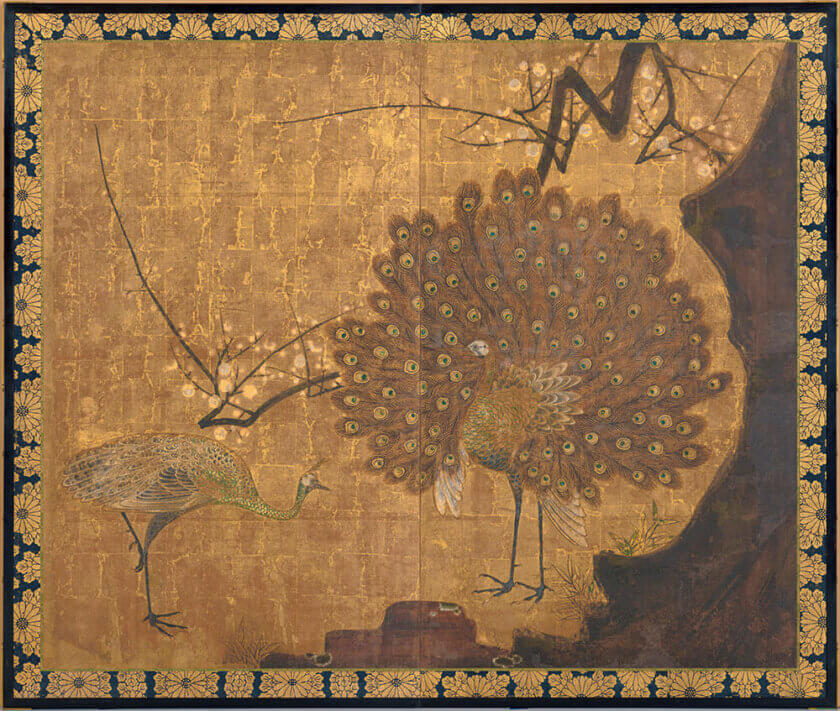
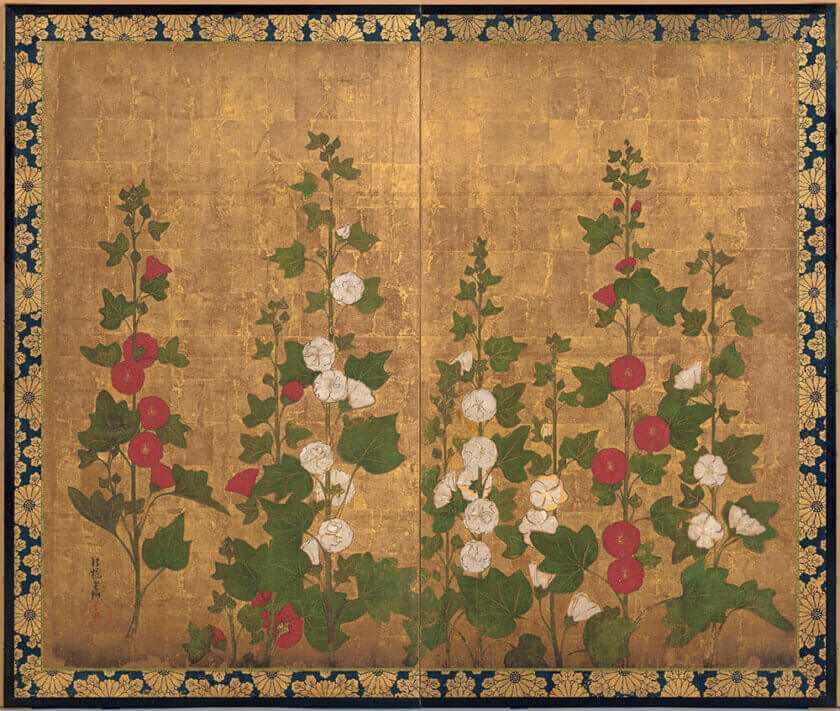
These two screens, originally the front and back of a tsuitate screen, have been converted into the present pair of screens. The renovation was carried out in 1957, according to the official certificate of designation as an important cultural property. Some say it was a byōbu (folding screen) or a fusuma (sliding door) before it became a tsuitate, so we don’t know what it looked like in its original form.
The screen above features a male peacock with his wings spread and his long, thin legs stretched out, and a framed out plum tree trunk surrounding his gorgeous wings. The branch with the white plum blossoms bends towards the female peacock on the left, and the direction in which the female peacock walks leads the eye back to the male peacock, the centre of the picture.
The lower screen is designed with a vertical gaze, just like the upright hollyhock, and the contrast between the red, white, and green colours is striking, in contrast to the finely detailed peacocks on the upper screen.
It is thought to have been produced after Ogata Kōrin’s training in Edo (now Tokyo), and is a masterpiece that combines the experimental style of the peacocks with the typical Rimpa style of the hollyhocks. In recent years they have been included in the collection of the Museum of Artizon in Tokyo, and the public will have more opportunities to see them in the future.