Who Is Hakuin? Exploring His Life and Cute Zen Paintings!
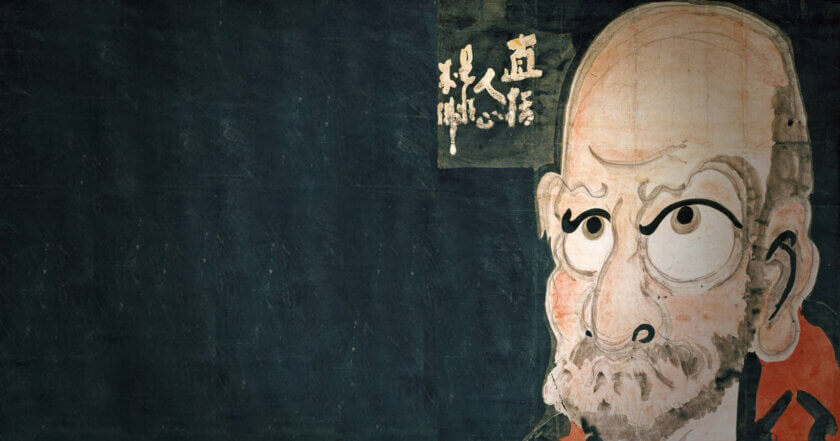
The father of the restoration of the Rinzai sect, Hakuin Ekaku, was a high priest who is said to be one of the few in 500 years. Hakuin, who was born in Suruga, travelled all over Japan before returning to Suruga to teach, was later praised for his achievements as being comparable to those of Mount Fuji: “There are two great things in Suruga: Mt. Fuji and Hakuin. Despite being such a great Zen monk, Hakuin’s “Zen paintings” have an extraordinary power that overturns the image that many people have of Zen!! In this article, we will unravel the mystery of why people are so fascinated by Hakuin’s Zen paintings.
Hakuin’s Life
Hakuin’s Early Life
Hakuin was born in Harajuku, Sunshu ( present Numazu City) in 1685. He was eight or nine years old when he first set foot on the Buddhist path. He was taken to a temple by his mother and was shocked by the monks’ talk about the horrors of hell. In order to break this fear of hell, he asked to be ordained as a Buddhist monk and at the age of 15, he was ordained at the Shōin-ji Temple in Numazu.
Later, he traveled to Shizuoka, Fukui, Ehime, and other places to practice Zen, but for a few years around the age of 20, he questioned his Zen practice and devoted himself to poetry, calligraphy, and painting. However, he later studied under Dōkyō Etan, whose training was so rigorous that it was life or death, and he suffered from neurosis. He visited Hakuyū Hermit, who lived in the mountains of Shirakawa in Kyōto and overcame his illness by meditating with the method of introspection.
Hakuin’s Later Years
On an autumn night at the age of 42, while reading the Lotus Sutra, Hakuin heard the sound of crickets chirping in his garden and finally had the greatest enlightenment experience of his life. From then on, as many as 400 people would flock to listen to his Dharma talks. In his mid-fifties, the number of his paintings increased, and in his seventies, he experimented with different techniques, finally achieving perfection in his eighties.
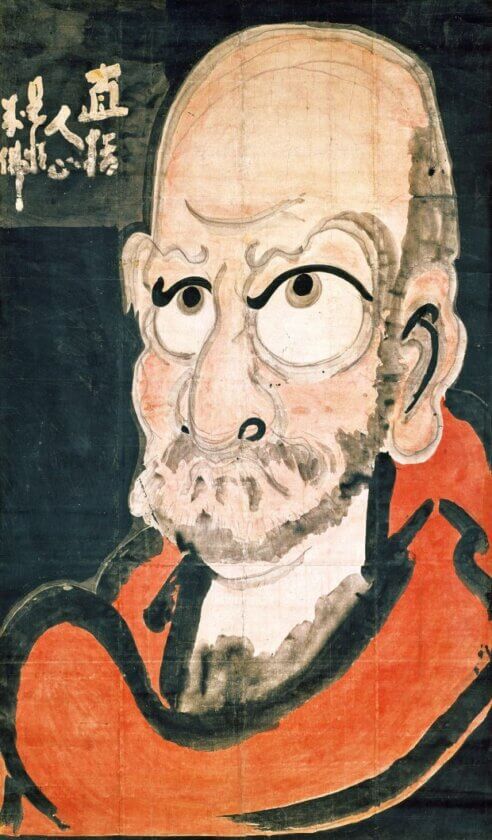
As a Zen monk, Hakuin produced a large number of Zen paintings and calligraphic works. Not a professional painter, Hakuin’s seemingly humorous, simple, and daring paintings and calligraphic works were a catalyst for the eccentric artists of Kyoto.
What is Zen?
Zen was introduced to China from India by Bodhidharma about 1500 years ago. The red doll “Daruma-san” is a deformed version of Bodhidharma sitting in Zen. Zen was later spread by Linji Yixuan, who followed in Bodhidharma’s footsteps, and the history of Zen in Japan began in the Kamakura period (1185-1333) with the arrival of the Rinzai and Ōbaku sects, of which Linji Yixuan was the founder.
The Rinzai sect was supported by the Kamakura shogunate, which held political power at the time, and quickly developed. In the Muromachi period (1333-1573), the Rinzai sect of Buddhism was protected and controlled by the Shogunate, and all the prestigious temples in Kyoto and Kamakura were monopolised by the Rinzai sect, which had a profound influence on the cultural and spiritual formation of the time. Later, in the Edo period, there were changes in the Rinzai school, but with the efforts of Hakuin Ekaku, Zen once again flourished, and has continued to do so to this day.
Hakuin’s Cute Zen Paintings
Hakuin did not study painting, so if you ask us whether he was a good painter or a bad one, he was definitely a bad one. However, his paintings are full of originality, and it is no exaggeration to say that they are unique in the history of Japanese art. Why did Hakuin paint the pictures? It was because he was a Zen monk who wanted to spread Buddhism to as many people as possible.
The subjects of the paintings range from those derived from Buddhism, such as Sakyamuni and Bodhisattvas, to those rooted in folk beliefs, such as the Seven Lucky Gods and Okame, and anthropomorphic animals. Hakuin’s unconventional paintings, which could never have been painted by any professional painters, are full of his characteristic humour, and he is notable in the history of Japanese art for establishing a new genre of Zen paintings in which the meaning of Zen is expressed in layers of pictures and praise.
The Highlights of Hakuin’s Zen Paintings?
Hakuin’s Zen paintings may seem like a joke at first glance, but they all have hidden meanings. The picture shows a kōan (Zen question and answer), with a clue hidden somewhere, but no answer. This is to make the viewers think and come up with their own answers. Hakuin’s Zen paintings are full of questions about the nature of humanity, and the more we explore, the more we learn, the more we enjoy the essence of Hakuin.
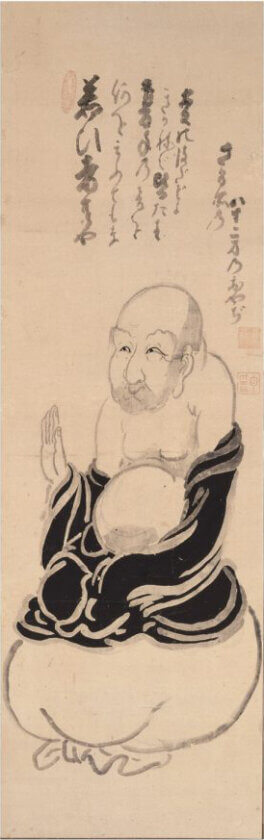
The painting is based on a typical kōan by Hakuin: “If you clap both hands, a sound is made, but what sound is made with one hand? This is very typical of Zen questions, whose heart is not to be stiffened by common sense and naturalness.
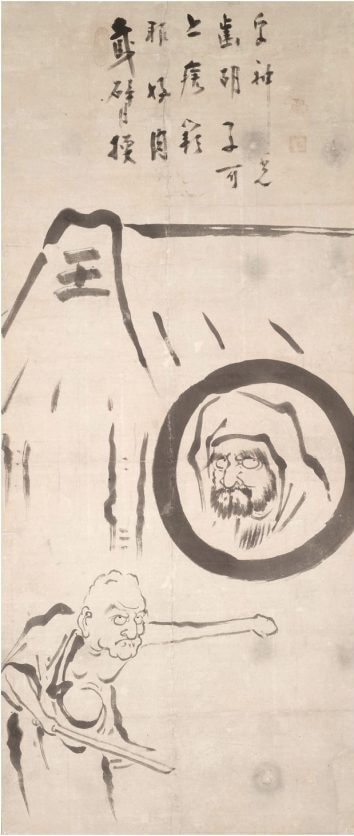
“Eka Danpi-zu” is an important subject in Zen. When Shinkō visited Bodhidharma at the Shaolin Temple, he repeatedly asked to become his disciple, but received no reply. When Bodhidharma explained to him how difficult it was to become a disciple, Shinkō cut off his own left arm and offered it to the master, who responded by allowing him to become a disciple. Shinkō later changed his name to Eka (Dazu Huike) and became the second founder of Bodhidharma. Hakuin symbolically expressed the sublimity of Bodhidharma by depicting him in a circle, and the figure of Shinkō, holding out his left arm with clenched teeth, is realistic.