Zen Masterpiece Showdown! Comparing Sesshū’s and Hakuin’s “Eka Danpi-zu” (Painting of Dazu Huike Offering His Severed Arm to Bodhidharma)
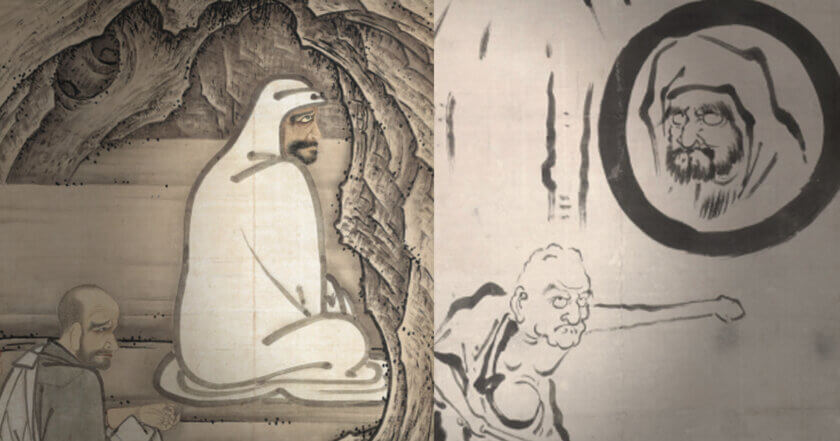
Eka Danpi-zu (Painting of Dazu Huike Offering His Severed Arm to Bodhidharma)
“Eka Danpi-zu” is a picture of Huika’s determination to appeal to Daruma to become his disciple. It has a very deep meaning for Zen.
Shinkō visited Daruma (Bodhidharma) at the Shaolin Temple, where Daruma continued to sit in zen meditation facing the wall and asked to become Daruma’s disciple, but received no reply.
Again and again, Shinkō wished to do so, and the master explained the difficulty of Shinkō’s request, and then Shinkō took out his sword and cut off his own left arm.
In response, Daruma allowed him to become his disciple, and Shinkō changed his name to Huika and succeeded the first founder, Daruma, to become the second founder.
It is a kind of horrific anecdote, but it is also known for its many masterpieces on the subject of painting.
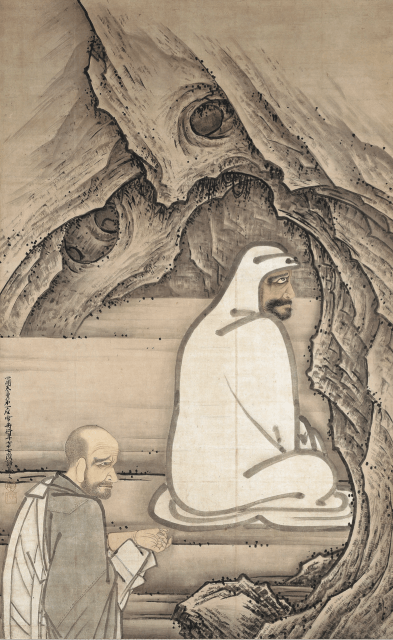
Sesshū Tōyō
The master of ink and wash painting, Sesshū Tōyō created this zen masterpiece at the age of 77.
Sesshū depicted Daruma in his white robes with thick lines, sitting for nine years against a wall in heavy rock.
In spite of the horror of the situation, the powerful portrayal of Daruma, who does not move, does not make us feel the horror of the situation.
It is a masterpiece of tension and sanctity.
Hakuin Ekaku
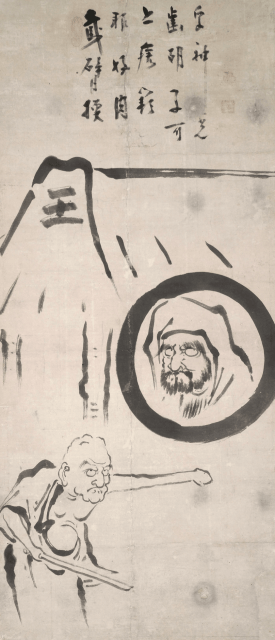
In Hakuin’s “Eka Danpi-zu”, which was done in ink, the sublimity of Daruma was symbolically expressed by drawing him in a circle.
The image of Shinkō gritting his teeth and holding out his left arm is clearly drawn in graphic detail.
By doing this, Hakuin may have explained the situation in a way that is easy to understand for people who are not familiar with Buddhism.