
The Most Powerful Bird Showdown in History! Itō Jakuchū, “The Rising Sun and the Phoenix” VS Soga Shōhaku, “The Eagle”
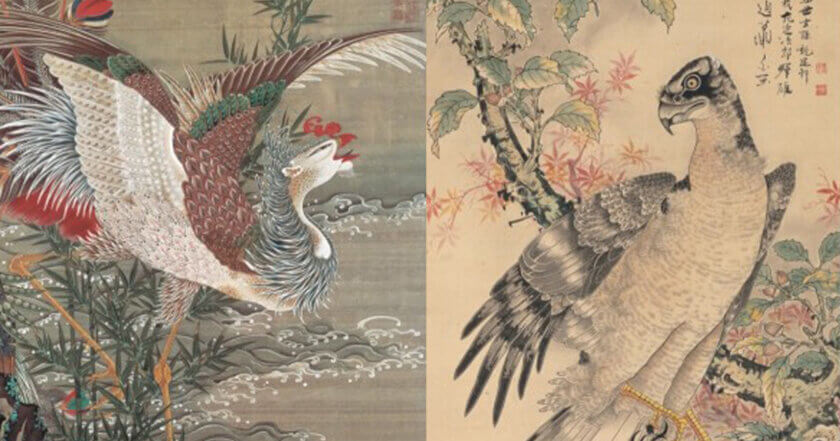
Unprecedented Technical Virtuosity from Two Geniuses

Itō Jakuchū, “The Rising Sun and the Phoenix” VS Soga Shōhaku, “The Eagle”


Like Itō Jakuchū, Soga Shōhaku was born into a merchant family in Kyoto (he was 14 years younger than Itō Jakuchū), but because his family had fallen into ruin, he became a painter in order to earn a living. At the time, there was a widespread Chinese belief in Kyoto that those who possessed an “eccentric” spirit were closer to being “saints” (as symbolised by the Toad Hermit and the Tieguai Hermit). He made a name for himself as a painter who was willing to act out the ‘strange’ and go down the wrong path.

In this sense, too, Shōhaku’s life was a contrast to Jakuchū’s, and the difference in their personalities can be symbolically illustrated by comparing the praise written on these two paintings.
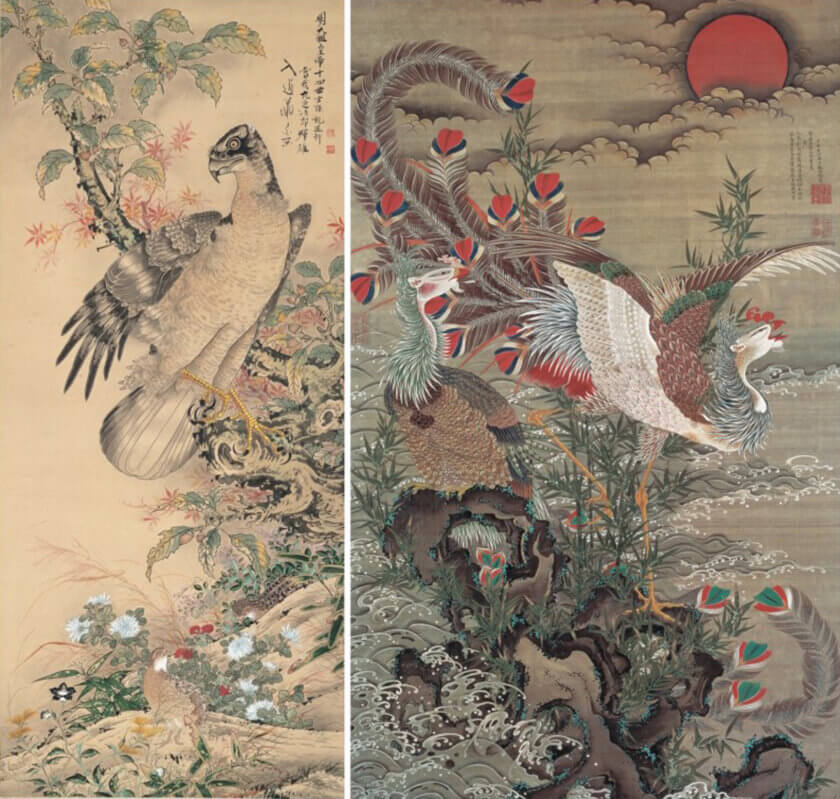
Left: Soga Shōhaku, right: Itō Jakuchū

Shōhaku’s painting prominently states “I am a descendant of the Ming emperor and a direct descendant of Soga Jasoku (a leading Muromachi-era painter of the Soga school)”, loudly asserting his own origins (all of which are self-serving). In contrast, Jakuchū’s painting bears the words “Flowers and birds should be painted after careful observation of the real thing, but the phoenix cannot be seen, so I used other paintings as a reference” in a reserved size. It is as if he is apologising for not being able to paint the real thing, even though it is his duty to do so.

However, even though they are so different in their behaviour, personalities, and circumstances, it is hard not to feel that they are very similar when it comes to the superb artistry that unfolds in their paintings. Did they ever meet each other on the streets of Kyoto? It’s fun to imagine.

Soga Shōhaku, “The Eagle”


A self-proclaimed follower of the Soga school, Shōhaku left many paintings of falcons, a characteristic of the Soga school. Although only three coloured falcon paintings are known to have survived, none of them are as elaborate and varied as this one.
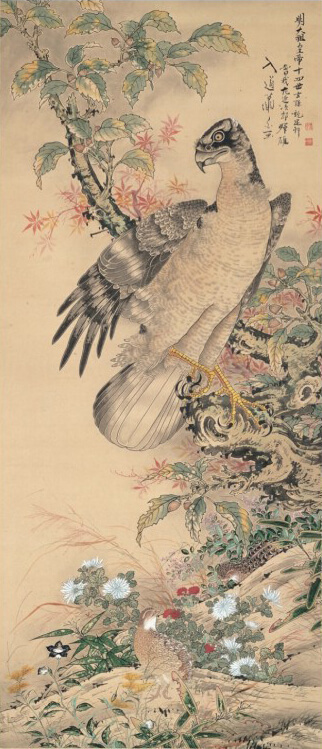
Soga Shōhaku, “The Eagle”

Itō Jakuchū, “The Rising Sun and the Phoenix”


By Jakuchū at the age of 40. This is a great achievement for a painter who has just started to concentrate on his work. The detailed depiction of the feathers of the male and female phoenixes, lined up on the rocks by the waves, and their mysterious and glamorous expressions, show us Jakuchū’s ability.
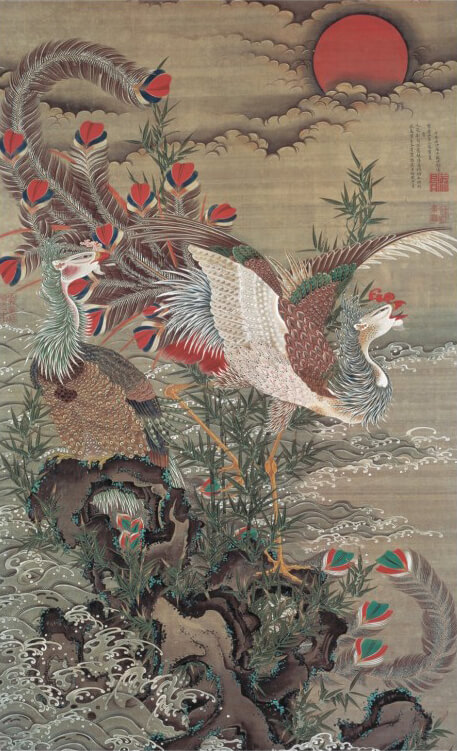
Itō Jakuchū, “The Rising Sun and the Phoenix”

    NameRequired

    SexRequired

    MaleFemale

    CountryRequired

    e-mailRequired

    CommentRequired

    Attached File
    ※Up to 3 MB for each file.


    ← ← "MUST CHECK" / Please confirm the above contents again and check this button.

    Contact Us

    Please fill out the form below and submit for your inquiry.

    ❈FirstName
    ❈LastName
    Country
    ❈E-mail
    (❈Confirm E-mail)
    ❈Inquiry category Question
    Consultation
    Impression
    Request
    Others
    ❈Comment

    is the mark for required item.


    Your privacy is important to us. We are committed to protecting your privacy.

    (or press ESC or click the overlay)

    CEO Message

    Our Feelings For Kakejiku


     The Japanese people have long set a high value on aesthetic senses since ancient times. As a result, the
    peculiar culture which is not seen in other countries blossomed and many aspects of the modern Japanese
    culture come from it. Parts of Japanese culture has been introduced to people in other countries recently,
    so the number of people from other countries who are interested in Japanese culture has been increasing.
    However, the Japanese aesthetic senses, which are the bases of Japanese culture, have been nurtured
    through a long history, intertwining various elements intricately, such as climate, geographical features,
    religion, customs and so on. Therefore, they are very difficult to understand not only for people from other
    countries, but even for the Japanese people. I think the best tool which conveys these difficult senses
    understandably is a “kakejiku.”
     The kakejiku (a hanging scroll; a work of calligraphy or a painting which is mounted and hung in an
    alcove or on a wall) is a traditional Japanese art. It's no exaggeration to say that paintings are what
    express aesthetic senses at all times and places. The kakejiku is an art which expresses the Japanese
    aesthetic senses. The kakejiku has long been used in traditional Japanese events, daily life and so on since
    ancient times. As a result, there are various customs of kakejiku in Japan; kakejiku and the life of the
    Japanese are closely related. We can see Japanese values through kakejiku.
     The kakejiku is a cultural tradition which the Japanese people should be proud of. However, many people
    in other countries don't know much about it because it hasn't been showcased as much. This is why I
    decided to try to introduce it. The kakejiku world is very interesting and beautiful. We want not only the
    Japanese, but also many people from other countries to know and enjoy it. I hope that many people will
    love kakejiku someday.

    (or press ESC or click the overlay)
    Company Profile
    syaoku.jpg(120220 byte)

    Name Art Nomura


    President Tatsuji Nomura


    Founded1973


    Established1992


    Address7-23 Babadori, Tarumi-ku, Kobe city,
    Hyougo Prefecture, 655-0021, Japan


    Capital10 million yen


    URLhttp://nomurakakejiku.com


    Our Business

     Art Nomura is an art dealer which produces kakejiku (hanging scrolls). We mount many paintings and calligraphic works in kakejiku in my factory. Kakejiku are our main product. We also remount and repair old or damaged kakejiku. We share the traditional Japanese art of kakejiku with people all over the world.


    (or press ESC or click the overlay)
    Access Map

    Access Map


     The Japanese people have long set a high value on aesthetic senses since ancient times. As a result, the
    peculiar culture which is not seen in other countries blossomed and many aspects of the modern Japanese
    culture come from it. Parts of Japanese culture has been introduced to people in other countries recently,
    so the number of people from other countries who are interested in Japanese culture has been increasing.
    However, the Japanese aesthetic senses, which are the bases of Japanese culture, have been nurtured
    through a long history, intertwining various elements intricately, such as climate, geographical features,
    religion, customs and so on. Therefore, they are very difficult to understand not only for people from other
    countries, but even for the Japanese people. I think the best tool which conveys these difficult senses
    understandably is a “kakejiku.”
     The kakejiku (a hanging scroll; a work of calligraphy or a painting which is mounted and hung in an
    alcove or on a wall) is a traditional Japanese art. It's no exaggeration to say that paintings are what
    express aesthetic senses at all times and places. The kakejiku is an art which expresses the Japanese
    aesthetic senses. The kakejiku has long been used in traditional Japanese events, daily life and so on since
    ancient times. As a result, there are various customs of kakejiku in Japan; kakejiku and the life of the
    Japanese are closely related. We can see Japanese values through kakejiku.
     The kakejiku is a cultural tradition which the Japanese people should be proud of. However, many people
    in other countries don't know much about it because it hasn't been showcased as much. This is why I
    decided to try to introduce it. The kakejiku world is very interesting and beautiful. We want not only the
    Japanese, but also many people from other countries to know and enjoy it. I hope that many people will
    love kakejiku someday.

    (or press ESC or click the overlay)