
The Mischievous Pranks of Soga Shōhaku: Pang Jushi (Hōkoji) and Ling Zhaonu (Reishōjo) Are Made to Look Like a Kume Hermit and a Woman
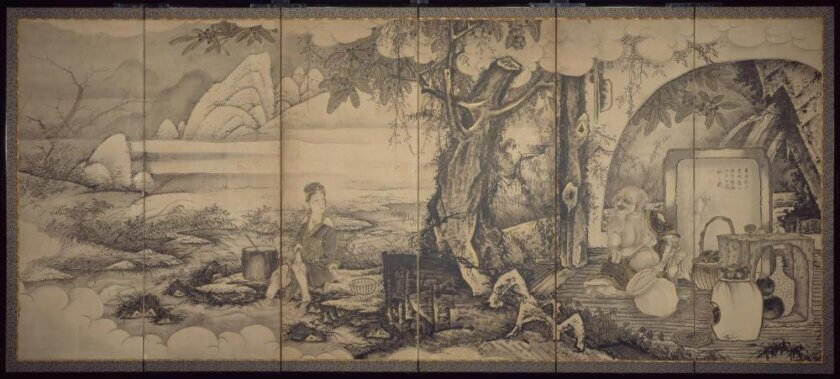
Byōbu Screen by Soga Shōhaku: Pang Jushi (Hōkoji) and Ling Zhaonu (Reishōjo) Are Made to Look Like a Kume Hermit and a Woman

Soga Shōhaku was a painter active mainly in Kyoto during the mid-Edo period.

Known for his eccentric style, he still attracts a lot of attention today.

In this article, we will talk about the oldest known work by Soga Shōhaku, “Pang Jushi (Hōkoji) and Ling Zhaonu (Reishōjo) Are Made to Look Like a Kume Hermit and a Woman” byōbu screen, in the collection of the Museum of Fine Arts, Boston. (1759, at the age of twenty-nine).

Erotic Hermit, Kume Hermit

Kume Sennin was a legendary figure who was believed to be the founder of the Kume Temple (Kume Town, Kashihara, Nara Prefecture). He was mentioned in Buddhist literature as well as in many stories and essays.

He is said to have been born in the village of Katsuragi (present-day Gosho City to Shinjō-chō and Taima-chō, Kitakatsuragi County) during the reign of Emperor Kinmei (reigned 539?-571?). He trained at Mount Ryūmon (the boundary between Uda City and Yoshino-chō, Yoshino County) and acquired the art of divine flight.

He used to enjoy swimming in the air, but one day he saw the calf (some say thigh) of a young woman washing clothes on the banks of the Kume River and fell in lust, losing his divine power and crashing. (What the hell! You’re not a fallen angel, you’re a fallen hermit!)

Later, the Kume hermit became married to the young woman. (Really? Is that what you wanted, woman? He’s just a horny ex-hermit!)

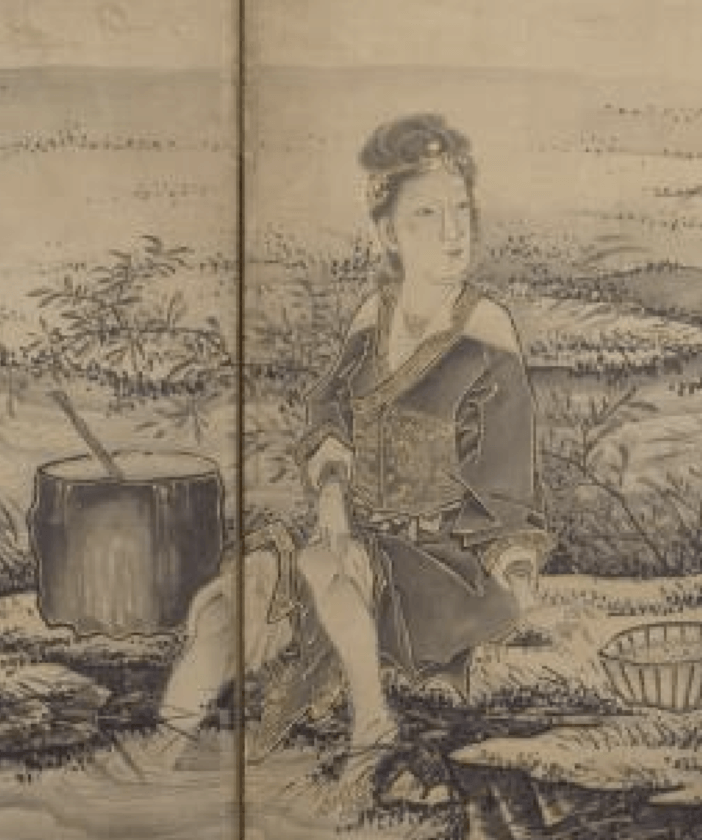
In this painting, Soga Shōhaku depicted Kume Hermit admiring the young woman sitting on the bank of the river with her calves exposed.
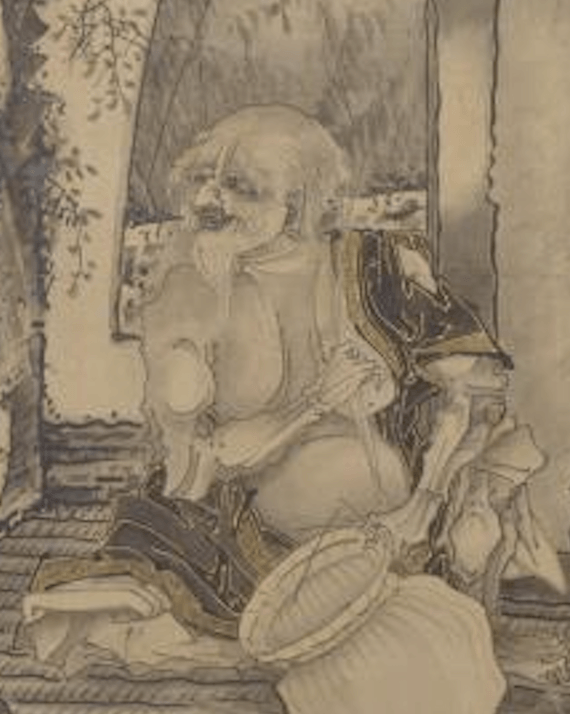
By the way, Kume Hermit later served as a layman when Emperor Shōmu (reigned 724-749) built the Daibutsuden (Great Buddha Hall) at the Tōdai-ji Temple, and was engaged in transporting lumber.

Knowing that people called him a hermit, a government official asked him if he could use his divine powers to carry lumber. After about a week’s training, Kume Hermit regained his divine powers and transported lumber cut from Mt. Yoshino by levitating it into the air and landing it at the proposed construction site.

Thanks to this, the construction of the Daibutsuden was completed quickly, and Emperor Shōmu gave Kume Hermit a piece of land on which he built the Kume Temple. This is the origin of the Kume Temple.

Soga Shōhaku Parodies Pang Jushi and Ling Zhaonu

Pang Jushi was a Chinese Zen master of the Tang dynasty. During his life, he pursued the spirit of Zen without being a priest. The records of his dialogues with Zen priests, in which he maintained his position as a layman, were recorded at an early stage, and have been handed down to the present day, 1300 years later.

Ling Zhaonu, the daughter of Pang Jushi, was a Zen scholar as good as Pang Jushi, but was poor and made her living selling bamboo baskets. Ling Zhaonu, together with Pang Jushi, has long been used as a Zen painting subject, often depicting a young girl with a bamboo basket under her arm.

This is an intense work by Soga Shōhaku parodying Pang Jushi and Ling Zhaonu, depicting a Kume hermit and a beautiful woman.
    NameRequired

    SexRequired

    MaleFemale

    CountryRequired

    e-mailRequired

    CommentRequired

    Attached File
    ※Up to 3 MB for each file.


    ← ← "MUST CHECK" / Please confirm the above contents again and check this button.

    Contact Us

    Please fill out the form below and submit for your inquiry.

    ❈FirstName
    ❈LastName
    Country
    ❈E-mail
    (❈Confirm E-mail)
    ❈Inquiry category Question
    Consultation
    Impression
    Request
    Others
    ❈Comment

    is the mark for required item.


    Your privacy is important to us. We are committed to protecting your privacy.

    (or press ESC or click the overlay)

    CEO Message

    Our Feelings For Kakejiku


     The Japanese people have long set a high value on aesthetic senses since ancient times. As a result, the
    peculiar culture which is not seen in other countries blossomed and many aspects of the modern Japanese
    culture come from it. Parts of Japanese culture has been introduced to people in other countries recently,
    so the number of people from other countries who are interested in Japanese culture has been increasing.
    However, the Japanese aesthetic senses, which are the bases of Japanese culture, have been nurtured
    through a long history, intertwining various elements intricately, such as climate, geographical features,
    religion, customs and so on. Therefore, they are very difficult to understand not only for people from other
    countries, but even for the Japanese people. I think the best tool which conveys these difficult senses
    understandably is a “kakejiku.”
     The kakejiku (a hanging scroll; a work of calligraphy or a painting which is mounted and hung in an
    alcove or on a wall) is a traditional Japanese art. It's no exaggeration to say that paintings are what
    express aesthetic senses at all times and places. The kakejiku is an art which expresses the Japanese
    aesthetic senses. The kakejiku has long been used in traditional Japanese events, daily life and so on since
    ancient times. As a result, there are various customs of kakejiku in Japan; kakejiku and the life of the
    Japanese are closely related. We can see Japanese values through kakejiku.
     The kakejiku is a cultural tradition which the Japanese people should be proud of. However, many people
    in other countries don't know much about it because it hasn't been showcased as much. This is why I
    decided to try to introduce it. The kakejiku world is very interesting and beautiful. We want not only the
    Japanese, but also many people from other countries to know and enjoy it. I hope that many people will
    love kakejiku someday.

    (or press ESC or click the overlay)
    Company Profile
    syaoku.jpg(120220 byte)

    Name Art Nomura


    President Tatsuji Nomura


    Founded1973


    Established1992


    Address7-23 Babadori, Tarumi-ku, Kobe city,
    Hyougo Prefecture, 655-0021, Japan


    Capital10 million yen


    URLhttp://nomurakakejiku.com


    Our Business

     Art Nomura is an art dealer which produces kakejiku (hanging scrolls). We mount many paintings and calligraphic works in kakejiku in my factory. Kakejiku are our main product. We also remount and repair old or damaged kakejiku. We share the traditional Japanese art of kakejiku with people all over the world.


    (or press ESC or click the overlay)
    Access Map

    Access Map


     The Japanese people have long set a high value on aesthetic senses since ancient times. As a result, the
    peculiar culture which is not seen in other countries blossomed and many aspects of the modern Japanese
    culture come from it. Parts of Japanese culture has been introduced to people in other countries recently,
    so the number of people from other countries who are interested in Japanese culture has been increasing.
    However, the Japanese aesthetic senses, which are the bases of Japanese culture, have been nurtured
    through a long history, intertwining various elements intricately, such as climate, geographical features,
    religion, customs and so on. Therefore, they are very difficult to understand not only for people from other
    countries, but even for the Japanese people. I think the best tool which conveys these difficult senses
    understandably is a “kakejiku.”
     The kakejiku (a hanging scroll; a work of calligraphy or a painting which is mounted and hung in an
    alcove or on a wall) is a traditional Japanese art. It's no exaggeration to say that paintings are what
    express aesthetic senses at all times and places. The kakejiku is an art which expresses the Japanese
    aesthetic senses. The kakejiku has long been used in traditional Japanese events, daily life and so on since
    ancient times. As a result, there are various customs of kakejiku in Japan; kakejiku and the life of the
    Japanese are closely related. We can see Japanese values through kakejiku.
     The kakejiku is a cultural tradition which the Japanese people should be proud of. However, many people
    in other countries don't know much about it because it hasn't been showcased as much. This is why I
    decided to try to introduce it. The kakejiku world is very interesting and beautiful. We want not only the
    Japanese, but also many people from other countries to know and enjoy it. I hope that many people will
    love kakejiku someday.

    (or press ESC or click the overlay)