Uemura Shōen: Her Life in Bijinga (Beautiful Woman Paintings)
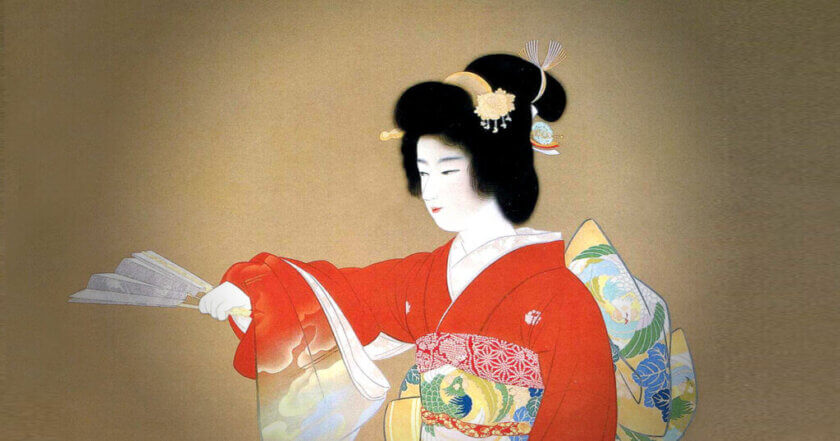
“Bijinga (beautiful woman paintings)” is a genre of Japanese painting based on the ukiyo-e style, which became popular among the general public in the Edo period.
Since then, a large number of master painters of bijinga have emerged and have captivated the hearts of many people.
Among them, the queen of bijinga is Uemura Shōen (1875-1949), one of the most famous female painters in Japan.
It has been said that “there was no painter like Shōen before and after her”.
However, the life of Uemura Shōen, who painted such beautiful and innocent paintings, was one of struggle.
Today, more and more women are working as painters, but in Uemura Shōen’s time, the art world was completely male-dominated.
While women were supposed to get married and take care of the house and children, Uemura Shōen was determined to make a living as a painter and continued to challenge the art world.
She was a painter with a passionate rock spirit, which is hard to imagine from her beautiful paintings.
In this article, we will introduce you to the rock ‘n’ roll artist Uemura Shōen.
1875: Born in Kyoto, as the Second Daughter of a Leaf Tea Shop.
Uemura Shōen’s father had passed away two months before Shōen’s birth, leaving her mother to raise her two daughters while running her own business. Her mother, Nakako, received the following advice from those around her.
“You can’t bring up your daughters on your own, so why don’t you marry again?”
“You can’t run a business and bring up children at the same time.”
But she ignored all such advice.
“I’m going to raise these kids on my own, while I’m still in business!” She shows her passionate rock spirit. (Nakako is awesome!)
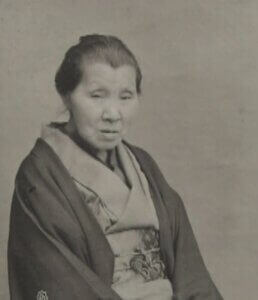
In fact, she raised her two daughters by herself, without whining or relying on relatives. The presence of this reliable mother, Nakako, had a great influence on Shōen’s future painting style.
1887: Entered the Kyoto Prefectural School of Painting; the 1st teacher: Suzuki Shōnen
After graduating from primary school, at the age of 12, she entered the Kyoto Prefectural Art School, the first public art school in Japan. (How quickly she decided to pursue a career in painting!)
At that time, there was a feeling that “a woman should not become a painter…”. Naturally, there was no understanding from the people around her and she faced a lot of opposition, but her mother, Nakako, was the only one who supported her, saying, “It’s the path you love.” (That’s really great! In that sense, her mother Nakako not only brought up Shōen, but also her art.)
Uemura Shōen’s first teacher at the Kyoto Prefectural School of Painting was Suzuki Shōnen.
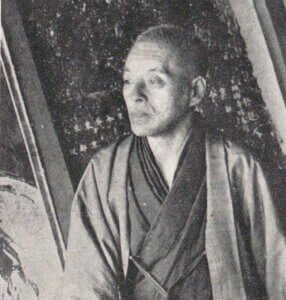
Suzuki Shōnen was the founder of the Suzuki School in Kyoto, which was very influential at the time. He was characterised by his vigorous brushwork and left many paintings of pine trees, sunrises, and Mt. Fuji.
He had a very rough temperament, but he was also very caring and popular with his students and pupils.
Shōen was also a woman with a strong will to be a painter, so it seems that she and Suzuki Shōnen were on the same page.
When Suzuki Shōnen resigned from his position as a teacher at the Kyoto Prefectural School of Painting in 1888, she also left the school and entered the Shōnen School. (You’re leaving school!? Nakako is going to cry ( ノД`))
Uemura Shōen’s painting name “松園 Shōen” was given to him by Suzuki Shōnen, who combined the character for “松 (shō, pine)” in his own name with “園 (en, farm)” which reminds him of a leaf tea shop.
1890: Debut
Uemura Shōen’s debut in the art world came early, when she exhibited “Four Seasonal Beauties” at the 3rd National Industrial Exhibition, a major event held in 1890.
For this, she was awarded the first prize, along with her future teacher, Takeuchi Seihō, and Yamamoto Shunkyo, a leading figure in the Kyoto art world.
His Royal Highness, Prince Connaught of England, who was visiting Japan, bought the work, so she made a spectacular debut at the age of 15. (It was said that the way the relatives changed their attitude quickly was amazing because the newspaper wrote “A girl genius appears!”)
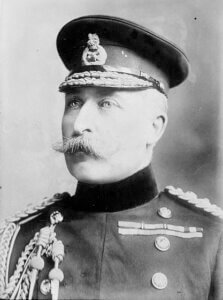
The motif of this “Four Seasonal Beauties” is thought to have been painted by Uemura Shōen in response to various requests, as there are several of the same style in existence.
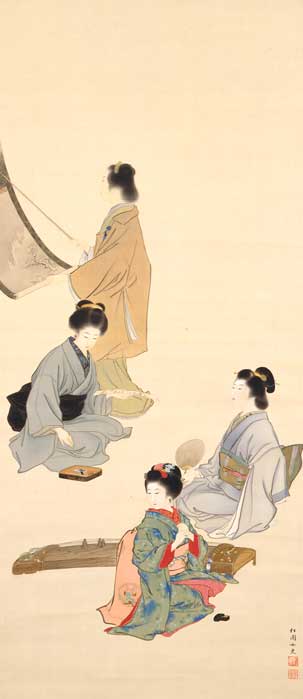
The “Four Seasonal Beauties” depicts four women in spring, summer, autumn, and winter, with each woman dressed for the season, and the age of the women increasing as the seasons progress, starting with spring. In this work, from the bottom of the screen, there is a girl preparing to play the koto (Japanese harp) in the spring, a young woman cooling off with a fan in the summer, a woman with a brush in her hand trying to write a waka poem on a tanzaku (Japanese paper strip) in the autumn, and an older woman looking at a hanging scroll with an ink drawing of a snowy scene in the winter.
1893: The 2nd Master Kōno Bairei
Aiming to reach a higher level, Uemura Shōen received permission from Suzuki Shōnen to study under a new master. That person was Kōno Bairei.
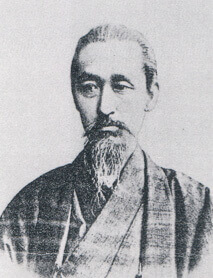
This Kōno Bairei was a painter who made a name for himself as a teacher. Once upon a time, when Kōno Bairei was still young, he had a fortune teller predict his future as a painter.
The result of the divination was as follows.
“You will end up as a second-rate painter, but your students will become first-rate painters, so you should focus on teaching them.
Kōno Bairei was sentenced to a thankful death sentence as a painter. (It’s too painful…)
However, as predicted, many first-rate artists, including Takeuchi Seihō, were born from the Kōno Bairei school.
Such is the case with Kōno Bairei, but it seems that he and Suzuki Shōnen were on bad terms, and their painting styles are also contrasting. If Suzuki Shōnen is described as a painter with a strong style, then Kōno Bairei is a painter with a soft style. (It’s like the relationship between Raoh and Toki in the manga Fist of the North Star.)
In the beginning, Uemura Shōen was puzzled. Even though she tried to learn Kōno Bairei’s style, she couldn’t get rid of Suzuki Shōnen’s style, which she had studied until then, so she ended up with a strange mixture of the two, and ended up producing only half-hearted paintings.
Uemura Shōen, who had fallen into a slump, arrived at the
“I’ll take the best parts of both masters and mix them with my own good points to create an original style!”
It was a very clever idea. (As expected of a rock ‘n’ roller, Shōen. She’s got a strong heart!)
Unfortunately, her second master, Kōno Bairei, passed away around the time she was coming out of her slump. It was a short relationship between master and disciple, only two years after Shōen joined the school.
1895: The 3rd Master: Takeuchi Seihō
After Kōno Bairei passed away, his students were divided into four groups: Kikuchi Hōbun, Taniguchi Kōkyō, Tsuji Kakō, and Takeuchi Seihō, all of whom were known as the “Big Four” under Kōno Bairei.
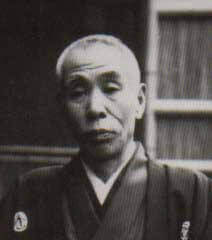
This Takeuchi Seihō was the greatest painter and leader to come out of the pupils of Kōno Bairei. He was known as the “East’s Taikan, West’s Seihō” along with Yokoyama Taikan.
Takeuchi Seihō’s two-part program for his disciples was to “study old paintings” and “explore realism. (In other words, he wanted them to do everything from Yamato-e to Western painting… It’s quite a spartan teaching, isn’t it, Seihō-sensei?)
In this way, Uemura Shōen absorbed the different styles of painting from each of her three masters, and her natural talent blossomed, winning her many awards at various exhibitions.
1902: Birth of the first son, Uemura Shōkō
Uemura Shōen was active in the art world from a young age, but in the male-dominated world of painting, many people were jealous of her talent, and the hardships she endured were unimaginable.
And then there was a scandal…
Shōen had given birth to her first son. This itself is something to be celebrated, but surprisingly the father is unknown and she became a mother without ever having married. (Seriously?)
It sounds like something the media would be happy to write about, but Shōen never talked about the father and continued to paint, ignoring the media. (That’s Ironheart! She rocks!)
Incidentally, her eldest son was the future Uemura Shōkō, who became a painter like his mother, and his child (Shōen’s grandson), Uemura Atsushi, also became a painter. (DNA is amazing.)
1904: “Prostitute Kiyū” Incident
Shōen was a woman of many topics, and she had many enemies and was harassed in various ways.
One of the most notable incidents was an incident involving a work (Prostitute Kiyū) that she exhibited at an exhibition in 1904.
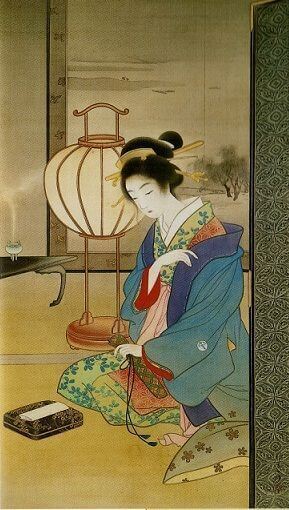
In the late Edo period (1603-1868), when Japan’s samurai were forced to bow down to foreigners after the opening of the country to the outside world, Kiyū, a prostitute in Yokohama, refused to take a foreign customer and committed suicide to show her Japanese spirit.
This work was based on this story. It is a work that expresses the strength of Kiyū as a woman, who stands by her own will and is unaffected by the opportunistic attitude of men.
This work by Shōen, which depicts a dignified figure of a proud woman facing adversity, was graffitied by someone while it was on display, without the security guards noticing.
And the person from the bureau came to Shōen and said…
“Come back in the morning and fix it because it’s a disgrace to leave it like that.”
There was no apology.
The rocky Shōen was furious.
“I’m sure the culprit was jealous of me, but it’s not fair to scribble on my work. If he had a problem with me, he could have just inked my face. I’m not going to fix it and cry myself to sleep as if nothing happened. Let’s just leave it as it is and let them see what happens.”
She took a hard-line stance. (As expected of Rock Shōen.)
The person from the bureau was in a panic and apologized for the lack of management, so Shōen calmed down, but in the end, the graffiti was still on display. (The culprit was never identified.)
This work depicted a proud rock ‘n’ roll woman Kiyū, so I guess Shōen did not want to bend her mind.
Shōen later described this time in his life as follows.
“I don’t know how many times I’ve had to grit my teeth in tears and say, ‘I’ll make you pay for it.’”
Shōen seems to have gone through quite a few pandemonium.
By the way, this work was wanted by a picky person after the exhibition, and the dirt was wiped clean. (I’m glad to hear that.)
1912: The Tide of the Taishō Era
The year 1912 marked the start of the Taishō era. From the opening of the country in the Edo period to the Meiji period, Japan, which had always felt inferior to the Western powers, regained its confidence by winning the Sino-Japanese and Russo-Japanese wars.
Such confidence influenced the arts, and a trend of “respecting individuality and freedom” was born.
In these times, criticism of Shōen’s paintings of beautiful women began to emerge, including the following
“Uemura Shōen’s paintings of beautiful women are indeed beautiful, but they are like dolls. They don’t have any blood in them, and they don’t depict the emotions of women.”
In response to this criticism, Shōen was troubled and went through a trial and error process. (Shōen was not someone who was quiet when she was being dissed, was she?)
1914: Learning Noh from Kongō Iwao
In 1914, Uemura Shōen began studying chanting with Noh actor Kongō Iwao in an attempt to explore new frontiers.
The result was “Hanagatami” and “Flame,” two works that are unique among Uemura Shōen’s series.
1915: “Hanagatami”
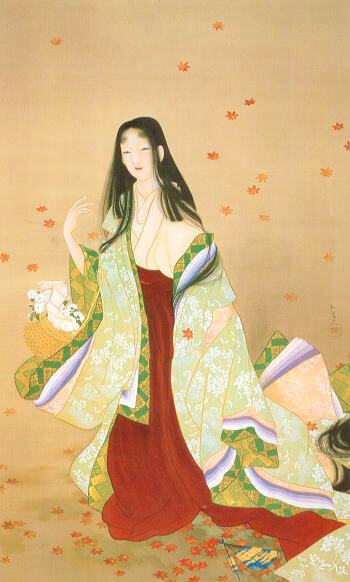
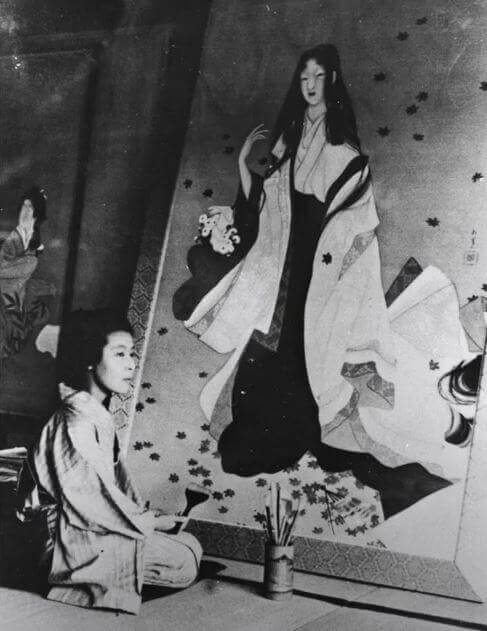
This work is based on the chant “Hanagami”. A woman (Teruhinomae) is in a state of desperation after a sudden breakup with her lover.
The beauty of the details in this work is as one would expect from Shōen, but what is most noteworthy is the deranged face of Teruhinomae in the painting. It is said that Shōen went to a mental hospital in Kyoto and sketched a woman in a state of delirium in order to paint this expression. (Wow, that painter’s spirit! I think this kind of craftsmanship dwells in the details of Shōen’s art.)
She also referred to the facial expressions of Noh masks used in chanting with advice from Kongō Iwao.
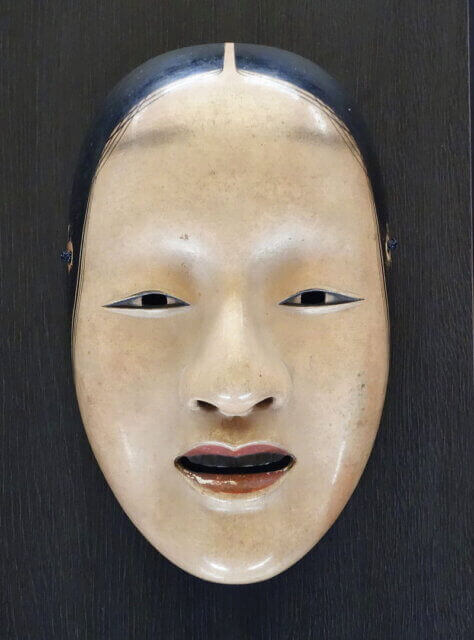
And here is the completed expression. I see, the influence of the Noh mask can certainly be seen.
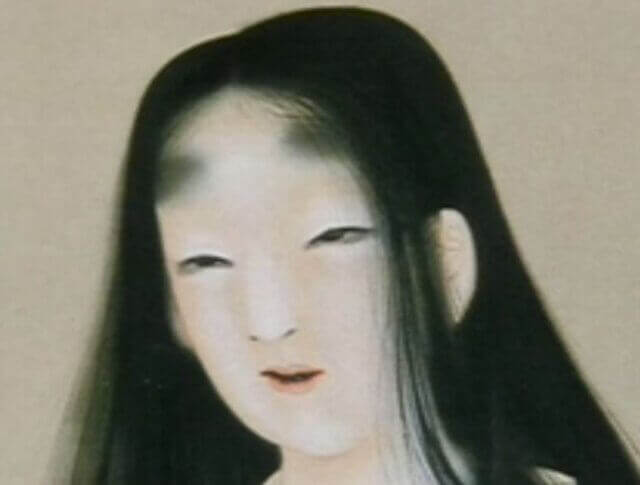
It’s hard to tell from the photo, but this is a very large piece, and I recommend seeing it in person to get a sense of the realism of the face.
1918: “Flame”
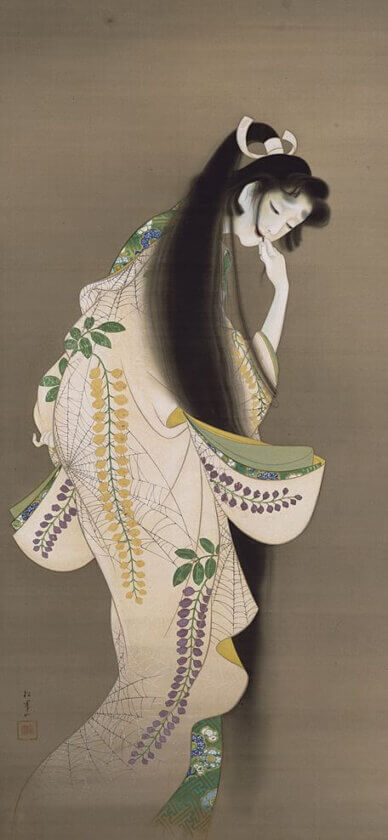
This work is based on the chant “Aoi-no-ue”. Rokujō-no-miyasundokoro, an early lover of Hikaru Genji, went mad with jealousy and became a living spirit to curse and kill her love rival. This work is unique among Shōen’s works, and it conveys a horrifying sense of dread. (The pattern of the kimono is a spider’s net… it’s horror!)
Shōen was also wondering how to depict the face in this piece, but Kongō Iwao advised her again. He said that in chanting, a special Noh mask is used to represent this horrible living spirit ver. It is called a “deigan (mud eye)” mask with the whites of the eyes and teeth painted in gold. (It’s like Gokū transformed into a Super Saiyan after Frieza killed Krillin in the Dragon Ball anime.)
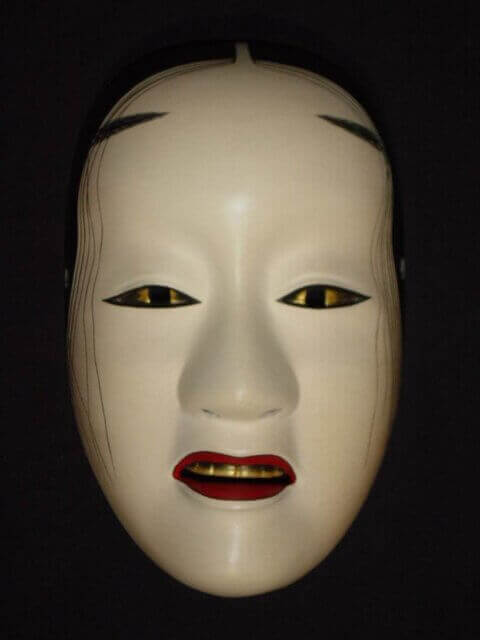
Taking a hint from this, Shōen actually painted the white part of the eyes of Rokujō-no-miyasundokoro in gold from the back of the work. (She didn’t paint it from the front, as expected…The fact that she expressed it with just a hint of concealment is what Kyoto painters are known for. But this picture has enough punch.)
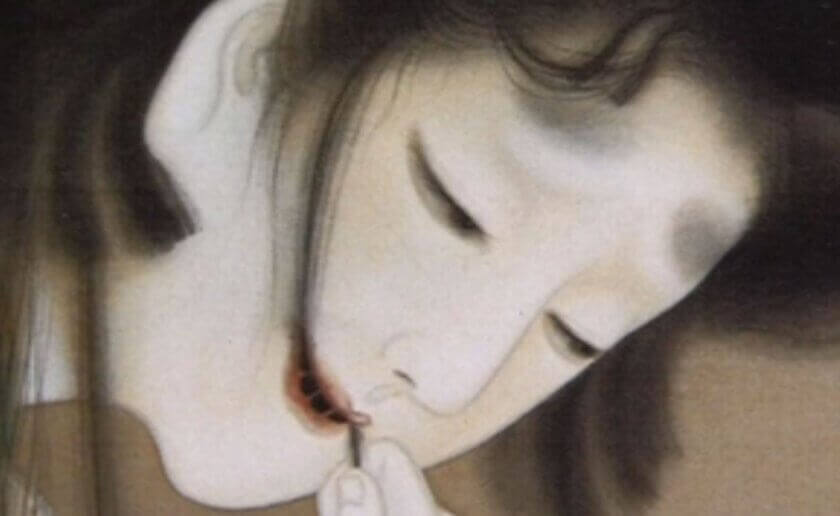
I think it’s a slightly hidden flavor that you probably can’t feel unless you see it up close.
By the way, this work is also very large, so you will be overwhelmed when you see the real thing.
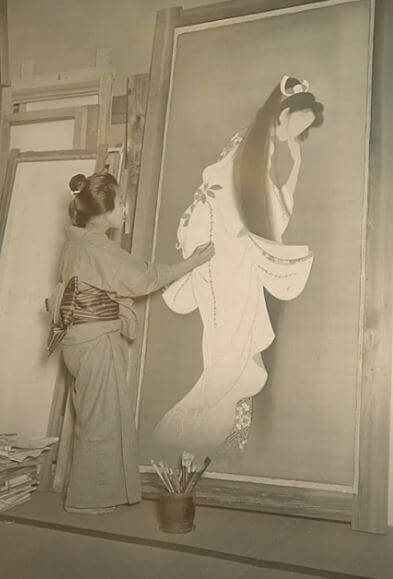
Shōen painted the shocking “Hanagatami” and “Flame,” but after these two works, she returned to her traditional style of painting.
In the Taishō era, she took on a new challenge and created wonderful works of art, but she realized that it was not the art she was aiming for and returned to her roots.
However, she refined her painting skills as she tried a new style of painting. As a result, even when she painted in the same style as before, the details of her works became more powerful.
1934: Death of Nakako
When Shōen was 59 years old, her beloved mother, Nakako, passed away.
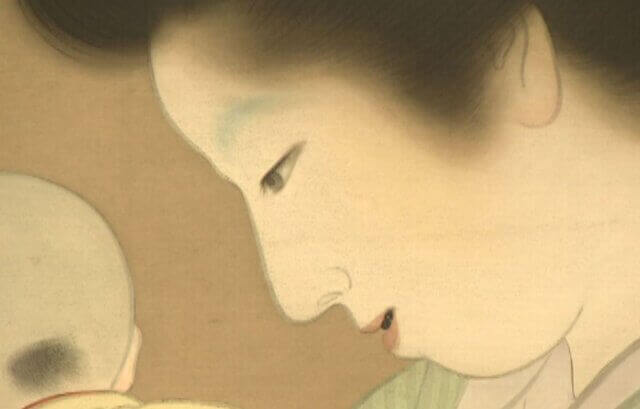
Shōen painted “Mother and Child” in remembrance of her mother, who was the person who understood Shōen the most.
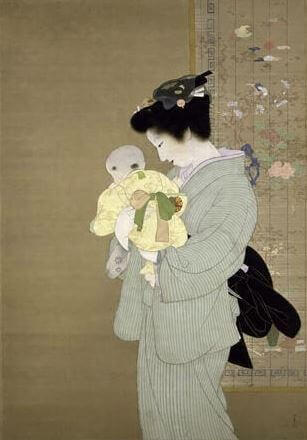
Shōen had previously depicted a mother and child in “Mother and Child” in 1899 and “Seeing the Rainbow” in 1932, but this is a new subject for a beauty painting.
The love expressed by Shōen from mother to child has a mystical divinity similar to that of Kano Hōgai’s masterpiece, Kannon (Goddess of Mercy), painted in the early Meiji period.
1936: “Jo-no-mai” (The Introductory Dance)
Two years after the death of her mother, Nakako, a masterpiece representing Uemura Shōen was born.
That is the “Jo-no-mai” (The Introductory Dance).
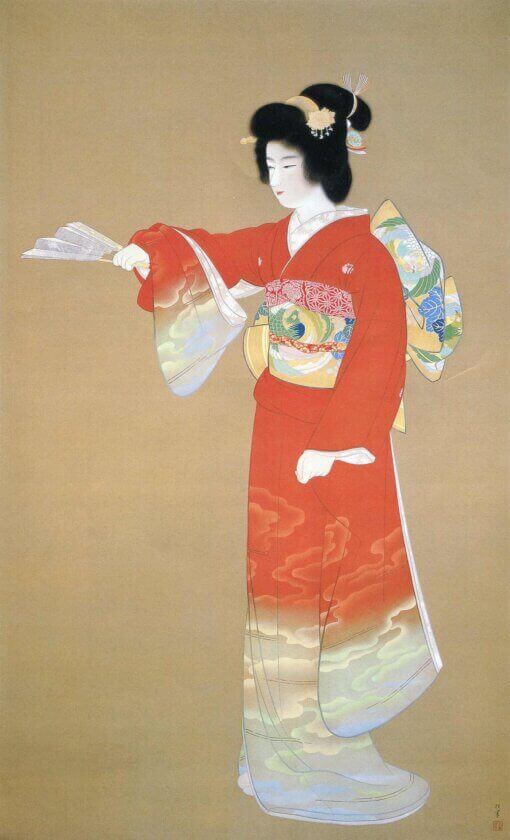
“Jo-no-mai” is the name of a Noh dance. Shōen spent a great deal of time preparing her son’s wife as a model for this work.
It is a very large work that she painted with great care, re-drawing the sketches over and over again, and it beautifully expresses the outpouring of tension in the expression of a beautiful woman dancing in the silence.
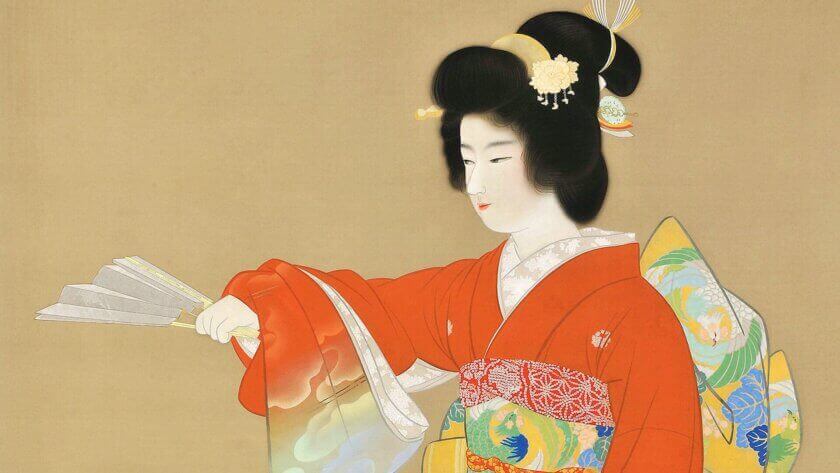
Shōen herself said of this work.
“This picture is the best of my ideal woman, I like it myself. In this painting, I wanted to express the strong will of a woman that is hidden within her and cannot be defeated by anything. I believe I have succeeded in portraying the classical, graceful and resolute spirit of the woman.”
Shōen herself, as a woman, jumped into the world of painting, which is a male-dominated society, and went through a lot of hardships. She even described her situation as if she was fighting on a battlefield…
It is because of her that she was able to portray the beauty of a woman’s inner resolve, pride, and dignity in this work.
This work is a tribute to the life of her mother, whom she admired, and it may also be an expression of the culmination of her painting career and her determination to move into a new field of painting.
1941: Member of the Imperial Academy of Fine Arts, 1944: Imperial Household Artist
After the release of “Jo-no-mai,” Shōen began to produce works vigorously as if she had been blown away.
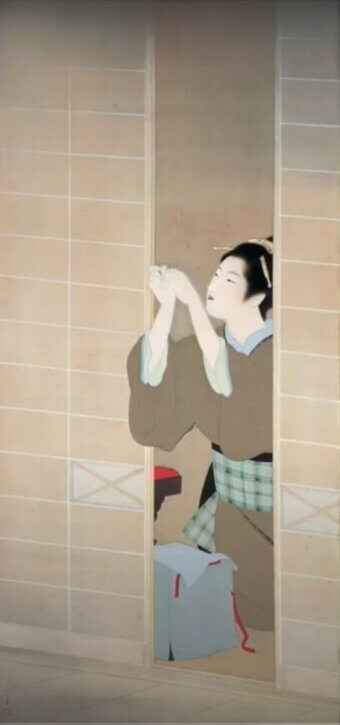
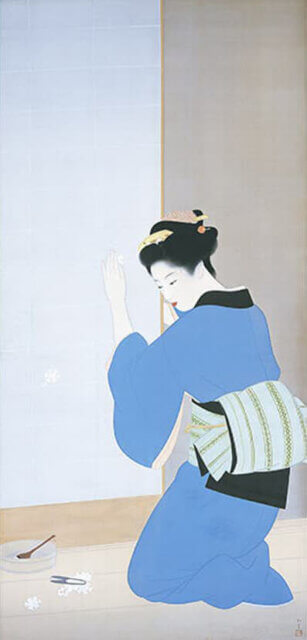
Uemura Shōen chose the theme of “working women” in light of the wartime situation. The paintings “Dusk” and “Late Autumn” were new aspects of Shōen’s art in which she found beauty in women working diligently in their daily lives.
1948: Awarded the Order of Culture
In 1948, Shōen became the first woman to be awarded the Order of Cultural Merit.
1949: Died
She ended her life at the age of 74, a year after receiving the Order of Cultural Merit.
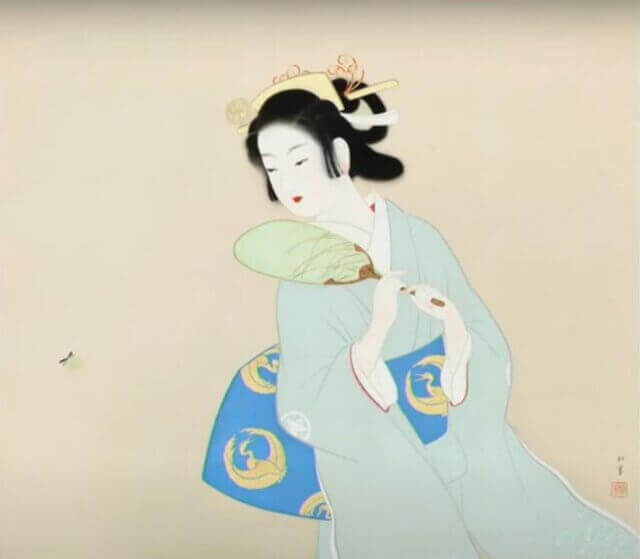
Her last painting was “Evening in Early Summer” in 1949. It is clear that she continued to work vigorously until the end.
Lastly
We have introduced the life of Uemura Shōen, and she left us these words.
“I have never painted a woman just to be beautiful. My dream painting is like a fragrant pearl, clear and pure without a trace of vulgarity.”
Perhaps her ideal art was to depict not only the outer beauty of a beautiful woman but also the noble and proud inner beauty of a woman.