Only Kawanabe Kyōsai Can Depict the Otherworldly and Still be Somewhat Mischievous!
Even the Spectres Are Creepy-Cute!
Kawanabe Kyōsai’s brush was at its best when he painted ghosts and monsters that do not exist in this world. Although he placed a great deal of emphasis on sketching, it was his studious nature that came in handy when painting the unseen spectres. Kawanabe Kyōsai obtained works from various schools in the past and studied their styles thoroughly. Hyakkiyakō-zu-byōbu” is also based on the same theme that has been drawn by many painters in the past. However, the characters in this work are humorous in a way that only Kyōsai could draw. He drew on the work of his predecessors but also incorporated the creative forms he had acquired through his own work with animals, to create his own unique style of ‘creepy-cute’ spectres.
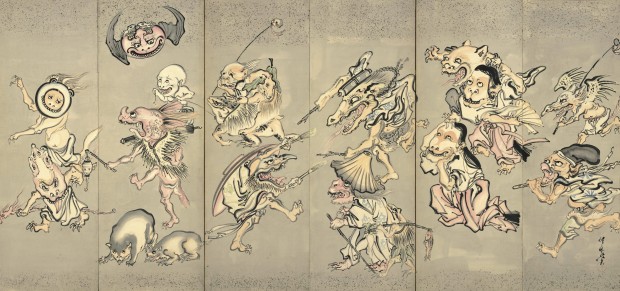
The term ‘Hyakkiyakō’ refers to the nighttime procession of ghosts and goblins, and appears in a Heian period tale. This work was no doubt inspired by the famous Muromachi-period painting Hyakkiyakō Emaki (The Night Parade of One Hundred Demons Painting Scroll), owned by the Daitokuji Temple Shinju-an. However, there are no other examples of specters with such a humorous appearance. Kawanabe Kyōsai, the man to be respected!
Even the Boldest Composition Is Creepy-Cute!
When talking about the work of Kawanabe Kyōsai, it is notable for the variety of his works and the eccentricity of his ideas. He is a multi-talented artist who has worked in a wide range of genres, including Buddhist and beautiful woman paintings in the style of the Kanō school, caricatures, ghost paintings, illustrations, and preparatory drawings for crafts. His paintings are not limited to caricatures, which are his quintessence. This is demonstrated in the series of thirty-five paintings entitled “Jigoku Gokuraku Megurizu (A Tour of Hell and Pure Land)”. There have been many depictions of the Pure Land in the history of Japanese art, but who else but Kyōsai could have depicted a steam locomotive just before it was to be used? This is a masterpiece that shows a genius that is more than just “creepy-cute”.
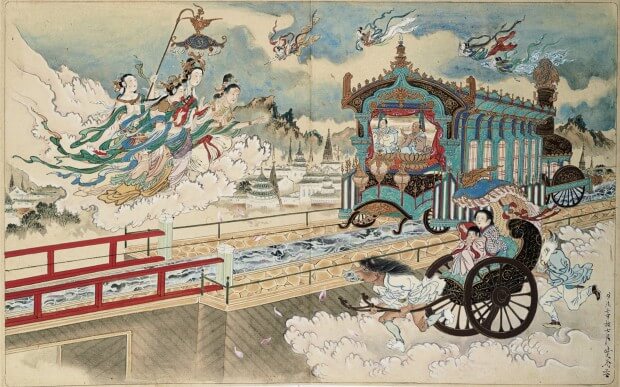
A series of paintings commissioned by Gohei on the occasion of the untimely death of Tatsu, a daughter of Katsuta Gohei, a wealthy shopkeeper in Nihonbashi who was a patron of Kyōsai.The work depicts the daughter’s visit to the underworld with Amida Nyorai and then to the pure land of paradise. However, the scene is depicted in a cheerful and lively manner, without the gloominess of the afterlife, as if to express Kyōsai’s deep sympathy for Gohei, who has lost his beloved daughter.