
Animals Painted by Kawanabe Kyōsai Are Creepy Cute!?

Lovable Animals Drawn by Masterful Brushwork

Kawanabe Kyōsai’s paintings of animals are characterized by their remarkable use of anthropomorphism and their ability to look remarkably realistic and natural, despite their bizarre angles and improbable appearance. Kawanabe Kyōsai was dedicated to the practice of sketching, and he was able to capture in his mind every gesture and momentary expression of the animals. It was for this reason that he was able to depict animals in all their impossible forms, with a sense of humor that was both endearing and funny. This is the result of his keen powers of observation, backed up by his unique sensitivity, and the overwhelming power of his painting skills, which only Kyōsai could have mastered. All of Gyosai’s “creepy-cute” paintings can be found in his animal paintings.

Kawanabe Kyōsai’s Humor Is no less than the Source of Caricatures, the “Chōjū-jinbutsu-giga, Animal-person Caricatures”.


The national treasure of the Heian period, the “Chōjū-jinbutsu-giga, Animal-person Caricatures”, is a supreme picture scroll and the starting point of manga. As some painters of the Kanō school practiced copying this masterpiece (such as Kanō Tan-yū), it is possible that Kyōsai, who briefly belonged to the Kanō school, also learned the basics of animal painting from this painting. Kawanabe Kyōsai’s ‘Animal-person Caricatures’ are filled with a keen eye and a sense of humor that makes them inexplicably funny.
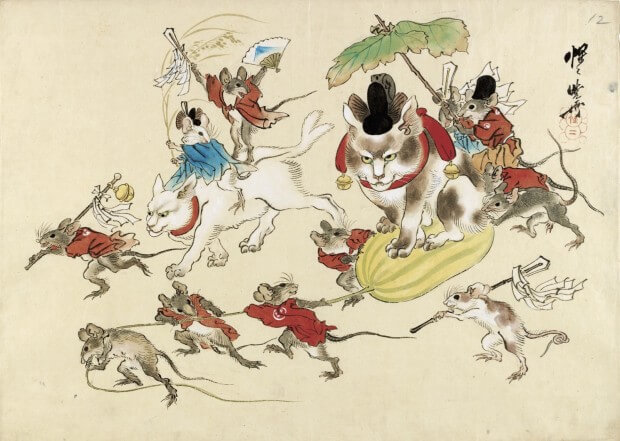
A Cat Rides a Gourd Pulled by Mice

His Impromptu Ink Drawings Are Also Full of Witty Humor.


This work is said to be one of a collection of about 50 paintings, Kyōsai’s art book. They were likely painted extemporaneously at a banquet in response to requests from guests. This is evidenced by the marks of tatami mats around the elephant’s neck. A big elephant is playing with a small raccoon, and it is a very funny picture.
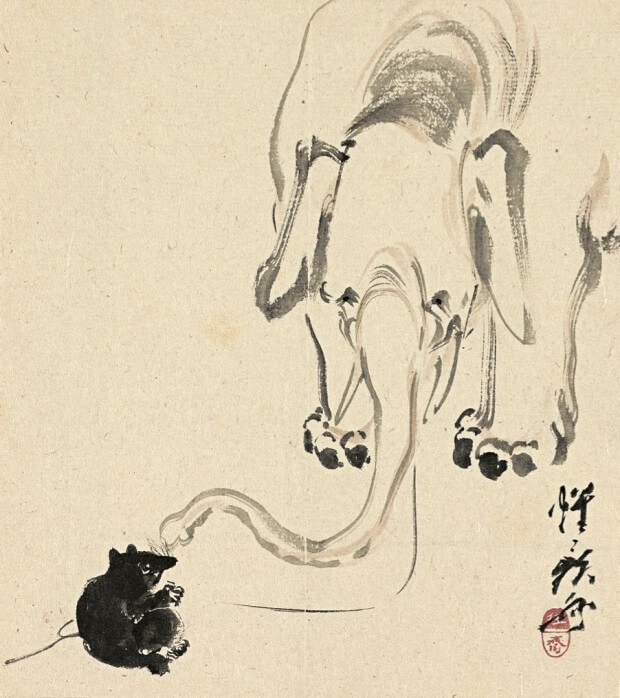
Elephant and raccoon by Kawanabe Kyōsai

Make Frogs Pull Rickshaws! He’s also a Genius at Thinking out of the Box!


The frog, blowing a cigarette on a rickshaw made of lotus leaves, is splendidly lounging on the car. This work is the quintessence of Kawanabe Kyōsai’s attempt to depict a kind of microcosm of human society by anthropomorphizing animals. It is also interesting to note that the telephone poll has been transformed into a lotus stem and flower.
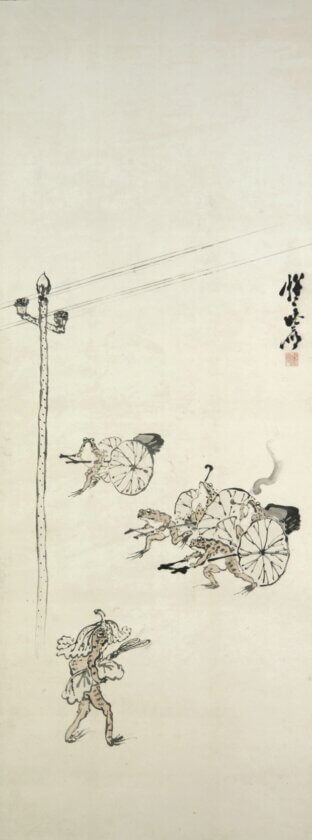
Frogs in town by Kawanabe Kyōsai

    NameRequired

    SexRequired

    MaleFemale

    CountryRequired

    e-mailRequired

    CommentRequired

    Attached File
    ※Up to 3 MB for each file.


    ← ← "MUST CHECK" / Please confirm the above contents again and check this button.

    Contact Us

    Please fill out the form below and submit for your inquiry.

    ❈FirstName
    ❈LastName
    Country
    ❈E-mail
    (❈Confirm E-mail)
    ❈Inquiry category Question
    Consultation
    Impression
    Request
    Others
    ❈Comment

    is the mark for required item.


    Your privacy is important to us. We are committed to protecting your privacy.

    (or press ESC or click the overlay)

    CEO Message

    Our Feelings For Kakejiku


     The Japanese people have long set a high value on aesthetic senses since ancient times. As a result, the
    peculiar culture which is not seen in other countries blossomed and many aspects of the modern Japanese
    culture come from it. Parts of Japanese culture has been introduced to people in other countries recently,
    so the number of people from other countries who are interested in Japanese culture has been increasing.
    However, the Japanese aesthetic senses, which are the bases of Japanese culture, have been nurtured
    through a long history, intertwining various elements intricately, such as climate, geographical features,
    religion, customs and so on. Therefore, they are very difficult to understand not only for people from other
    countries, but even for the Japanese people. I think the best tool which conveys these difficult senses
    understandably is a “kakejiku.”
     The kakejiku (a hanging scroll; a work of calligraphy or a painting which is mounted and hung in an
    alcove or on a wall) is a traditional Japanese art. It's no exaggeration to say that paintings are what
    express aesthetic senses at all times and places. The kakejiku is an art which expresses the Japanese
    aesthetic senses. The kakejiku has long been used in traditional Japanese events, daily life and so on since
    ancient times. As a result, there are various customs of kakejiku in Japan; kakejiku and the life of the
    Japanese are closely related. We can see Japanese values through kakejiku.
     The kakejiku is a cultural tradition which the Japanese people should be proud of. However, many people
    in other countries don't know much about it because it hasn't been showcased as much. This is why I
    decided to try to introduce it. The kakejiku world is very interesting and beautiful. We want not only the
    Japanese, but also many people from other countries to know and enjoy it. I hope that many people will
    love kakejiku someday.

    (or press ESC or click the overlay)
    Company Profile
    syaoku.jpg(120220 byte)

    Name Art Nomura


    President Tatsuji Nomura


    Founded1973


    Established1992


    Address7-23 Babadori, Tarumi-ku, Kobe city,
    Hyougo Prefecture, 655-0021, Japan


    Capital10 million yen


    URLhttp://nomurakakejiku.com


    Our Business

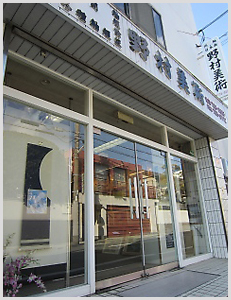
     Art Nomura is an art dealer which produces kakejiku (hanging scrolls). We mount many paintings and calligraphic works in kakejiku in my factory. Kakejiku are our main product. We also remount and repair old or damaged kakejiku. We share the traditional Japanese art of kakejiku with people all over the world.


    (or press ESC or click the overlay)
    Access Map

    Access Map


     The Japanese people have long set a high value on aesthetic senses since ancient times. As a result, the
    peculiar culture which is not seen in other countries blossomed and many aspects of the modern Japanese
    culture come from it. Parts of Japanese culture has been introduced to people in other countries recently,
    so the number of people from other countries who are interested in Japanese culture has been increasing.
    However, the Japanese aesthetic senses, which are the bases of Japanese culture, have been nurtured
    through a long history, intertwining various elements intricately, such as climate, geographical features,
    religion, customs and so on. Therefore, they are very difficult to understand not only for people from other
    countries, but even for the Japanese people. I think the best tool which conveys these difficult senses
    understandably is a “kakejiku.”
     The kakejiku (a hanging scroll; a work of calligraphy or a painting which is mounted and hung in an
    alcove or on a wall) is a traditional Japanese art. It's no exaggeration to say that paintings are what
    express aesthetic senses at all times and places. The kakejiku is an art which expresses the Japanese
    aesthetic senses. The kakejiku has long been used in traditional Japanese events, daily life and so on since
    ancient times. As a result, there are various customs of kakejiku in Japan; kakejiku and the life of the
    Japanese are closely related. We can see Japanese values through kakejiku.
     The kakejiku is a cultural tradition which the Japanese people should be proud of. However, many people
    in other countries don't know much about it because it hasn't been showcased as much. This is why I
    decided to try to introduce it. The kakejiku world is very interesting and beautiful. We want not only the
    Japanese, but also many people from other countries to know and enjoy it. I hope that many people will
    love kakejiku someday.

    (or press ESC or click the overlay)