
Kitazawa Eigetsu: The Nihonga Painter Who Pursued Female Beauty
Kitazawa Eigetsu was a person who established her status in the art scene with portrait paintings, and more specifically, female portraits. With gentle lines and calmly harmonic color tones, she painted fictional women, and as displayed in ‘Deep in Thought (Higuchi Ichiyō,)’ women from real life as well, capturing the varying beauties that lie in their kindness, relentlessness, and compassion in a style that can only be realized through the eyes of a woman.
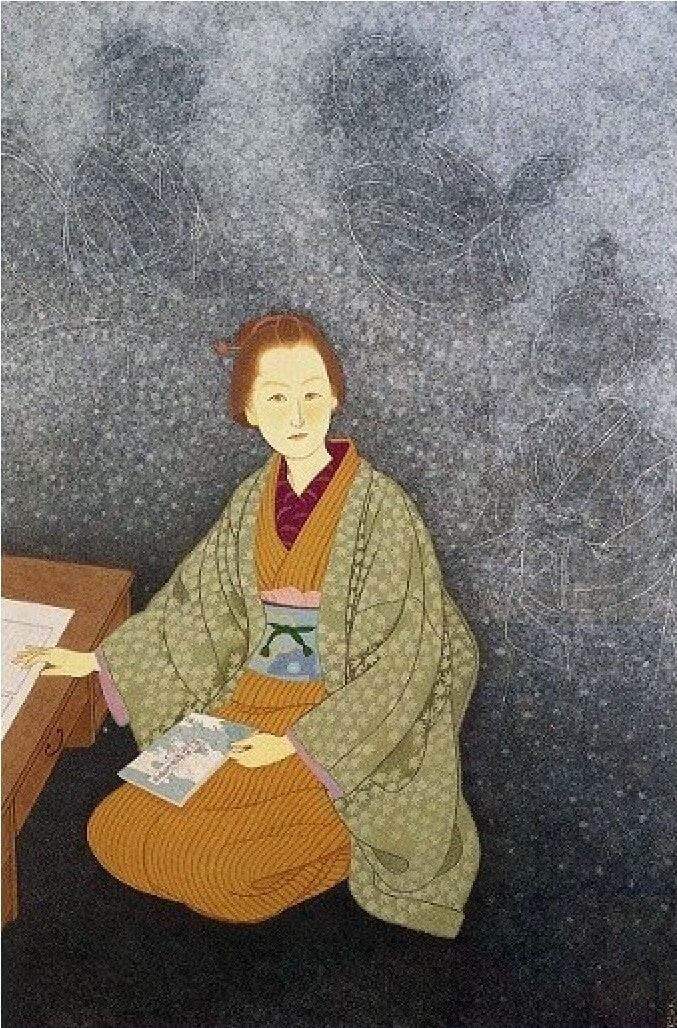
Deep in Thought (Higuchi Ichiyō) by Kitazawa Eigetsu

Eigetsu exhibited a portrait painting of two women at the 65th Inten exhibition in 1980 as well, in which she was widely acknowledged for her magnificently accomplished style of expression, and was awarded the Minister of Education Award for the painting.

Kitazawa Eigetsu was born in Kyoto in 1907. She lost her father when she was in sixth grade. Despite being in a situation that could have discouraged her from pursuing the arts, she became an apprentice to Uemura Shōen. She was only 16 years old at the time, and this was when she learned the basics of portrait painting. She later joined the art academy of Tsuchida Bakusen in 1932, at 25 years old. Although Eigetsu’s work was selected to be exhibited at the Teiten for the first time in the eighth exhibition in 1927, in the same year, she experienced the death of her master, Tsuchida Bakusen, whom she was largely influenced by. She started to exhibit her works at the Nihon Bijutsu-in exhibitions from the following year, and was nominated as one of Inten’s administrative members as early as in 1941. Kitazawa Eigetsu’s shift from Teiten to Inten nurtured the quality of her paintings, and led to her later success. Her works from this time period such as ‘Cleaning Cloths (Meisho)’ (1940), which portrays two women in Japanese clothing spreading out kimonos, display her efforts to incorporate features of neoclassicist paintings, developed by her seniors in the Inten, including Kobayashi Kokei. Although her work is accomplished to a certain degree, here, it is not yet in its distinctive form.
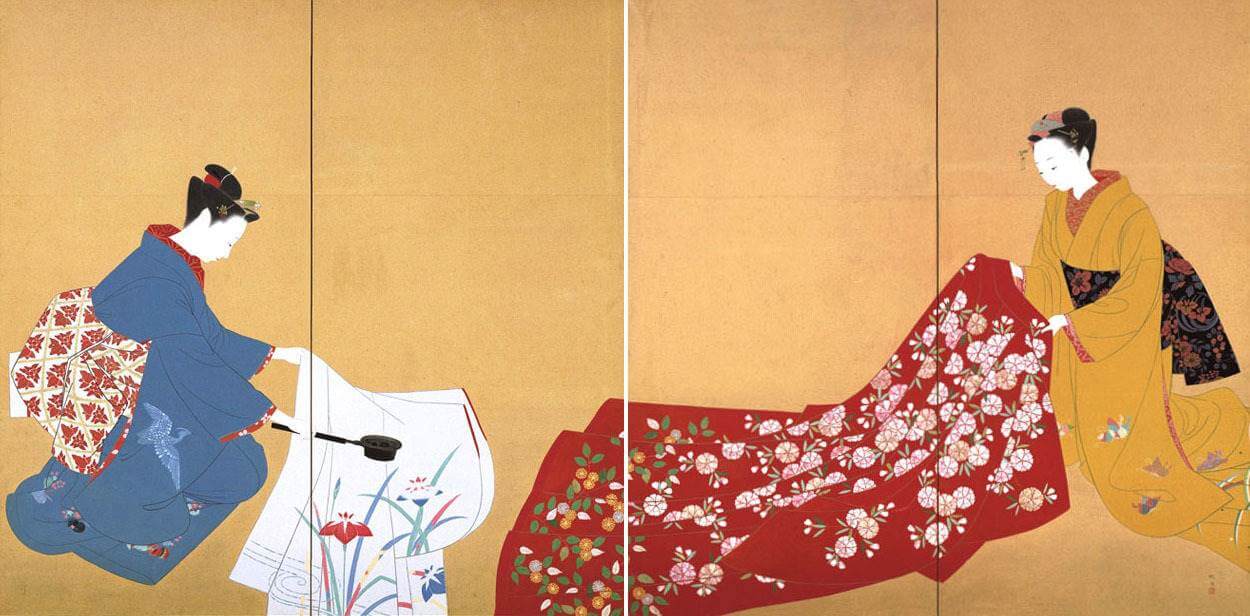
‘Cleaning Cloths (Meisho)’ by Kitazawa Eigetsu

Nevertheless, the work shows the start of Kitazawa Eigetsu’s progression towards portraying the underlying beauty of women. It was after she moved to Tokyo in 1960 that this specific painting style of hers gained further depth. It is as if her aesthetical sensibility, which was cultivated by Kyoto’s culture, paradoxically started to shine on its own as she found herself in Kantō, an environment that was alien to her. Some of her commonly known works include ‘Yasue-san on One Day (Aruhi no Yasue-san)’ (1967) and ‘Nene and Chacha (Nene to Chacha)’ (1970).
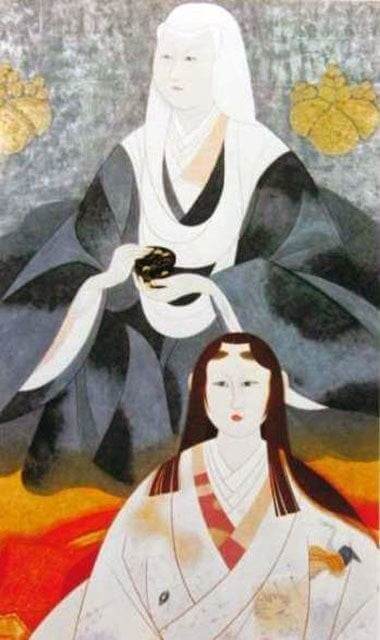
Nene and Chacha (Nene to Chacha) by Kitazawa Eigetsu

There may be several more pieces that are considered to be representative of her artistry, however, it is in these works that her stylistic traits, which consist of balanced silhouettes drawn in gentle lines, the harmony of mellow color tones, and her beautiful gaze that captures the uniqueness of every woman, are pieced together. Sometimes strict, at times kind, and at times bewitching, their expressions are brought to life with their eyes. What is created in her works, is a world of female beauty that differs from that of her first master, Uemura Shōen.

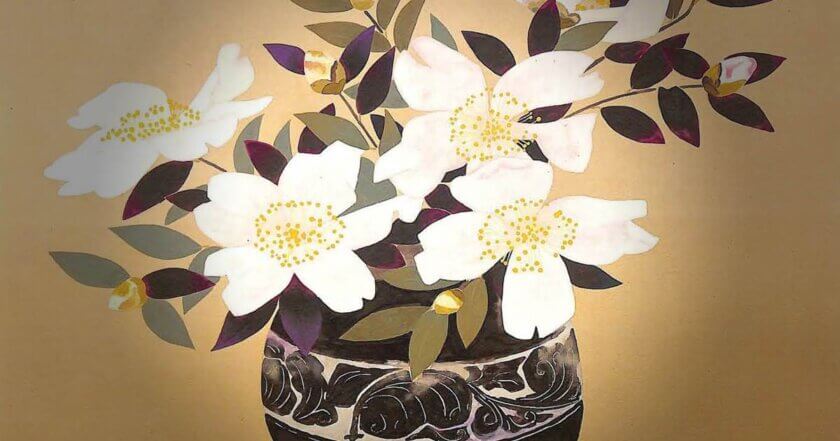
‘Camellia Sasanqua (Sazanka)’
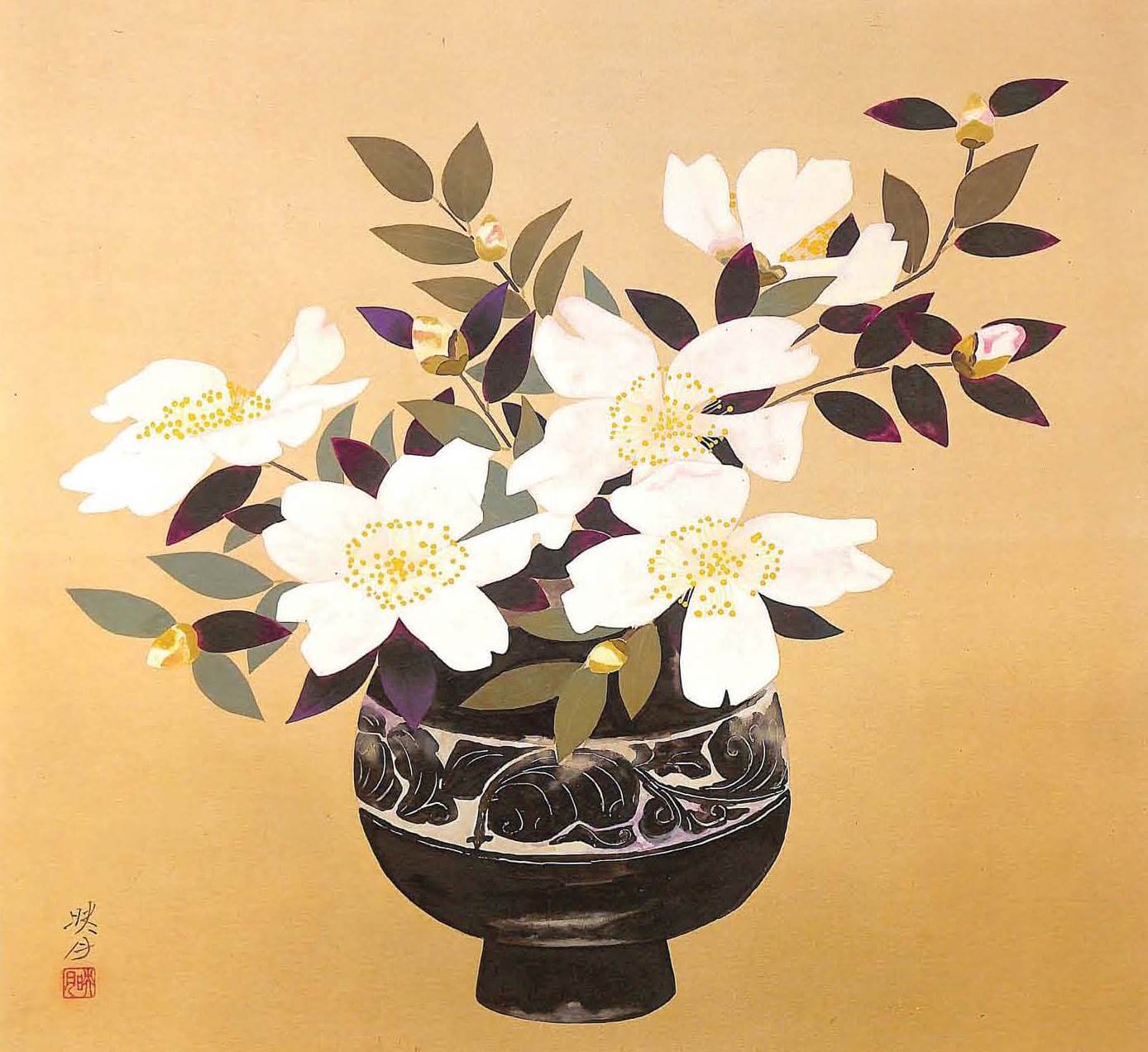
‘Camellia Sasanqua (Sazanka)’ by Kitazawa Eigetsu

‘Camellia Sasanqua (Sazanka)’ is a piece from 1958. This, perhaps, is from when she still lived in Kyoto. The painting’s tone is clear and shows no lack of order. The piece seems to be quietly settled in a manner that is neither bright nor dark. One will notice that, from looking at it, the whiteness of the bloomed camellia sasanqua flowers will start to float out of the canvas. Similar to her works that portray women, in this painting, she depicts a world of profound beauty that gently finds its way into people’s hearts.
    NameRequired

    SexRequired

    MaleFemale

    CountryRequired

    e-mailRequired

    CommentRequired

    Attached File
    ※Up to 3 MB for each file.


    ← ← "MUST CHECK" / Please confirm the above contents again and check this button.

    Contact Us

    Please fill out the form below and submit for your inquiry.

    ❈FirstName
    ❈LastName
    Country
    ❈E-mail
    (❈Confirm E-mail)
    ❈Inquiry category Question
    Consultation
    Impression
    Request
    Others
    ❈Comment

    is the mark for required item.


    Your privacy is important to us. We are committed to protecting your privacy.

    (or press ESC or click the overlay)

    CEO Message

    Our Feelings For Kakejiku


     The Japanese people have long set a high value on aesthetic senses since ancient times. As a result, the
    peculiar culture which is not seen in other countries blossomed and many aspects of the modern Japanese
    culture come from it. Parts of Japanese culture has been introduced to people in other countries recently,
    so the number of people from other countries who are interested in Japanese culture has been increasing.
    However, the Japanese aesthetic senses, which are the bases of Japanese culture, have been nurtured
    through a long history, intertwining various elements intricately, such as climate, geographical features,
    religion, customs and so on. Therefore, they are very difficult to understand not only for people from other
    countries, but even for the Japanese people. I think the best tool which conveys these difficult senses
    understandably is a “kakejiku.”
     The kakejiku (a hanging scroll; a work of calligraphy or a painting which is mounted and hung in an
    alcove or on a wall) is a traditional Japanese art. It's no exaggeration to say that paintings are what
    express aesthetic senses at all times and places. The kakejiku is an art which expresses the Japanese
    aesthetic senses. The kakejiku has long been used in traditional Japanese events, daily life and so on since
    ancient times. As a result, there are various customs of kakejiku in Japan; kakejiku and the life of the
    Japanese are closely related. We can see Japanese values through kakejiku.
     The kakejiku is a cultural tradition which the Japanese people should be proud of. However, many people
    in other countries don't know much about it because it hasn't been showcased as much. This is why I
    decided to try to introduce it. The kakejiku world is very interesting and beautiful. We want not only the
    Japanese, but also many people from other countries to know and enjoy it. I hope that many people will
    love kakejiku someday.

    (or press ESC or click the overlay)
    Company Profile
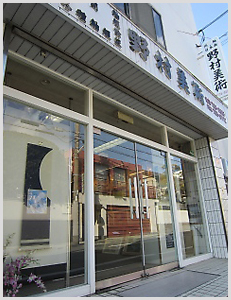
    syaoku.jpg(120220 byte)

    Name Art Nomura


    President Tatsuji Nomura


    Founded1973


    Established1992


    Address7-23 Babadori, Tarumi-ku, Kobe city,
    Hyougo Prefecture, 655-0021, Japan


    Capital10 million yen


    URLhttp://nomurakakejiku.com


    Our Business

     Art Nomura is an art dealer which produces kakejiku (hanging scrolls). We mount many paintings and calligraphic works in kakejiku in my factory. Kakejiku are our main product. We also remount and repair old or damaged kakejiku. We share the traditional Japanese art of kakejiku with people all over the world.


    (or press ESC or click the overlay)
    Access Map

    Access Map


     The Japanese people have long set a high value on aesthetic senses since ancient times. As a result, the
    peculiar culture which is not seen in other countries blossomed and many aspects of the modern Japanese
    culture come from it. Parts of Japanese culture has been introduced to people in other countries recently,
    so the number of people from other countries who are interested in Japanese culture has been increasing.
    However, the Japanese aesthetic senses, which are the bases of Japanese culture, have been nurtured
    through a long history, intertwining various elements intricately, such as climate, geographical features,
    religion, customs and so on. Therefore, they are very difficult to understand not only for people from other
    countries, but even for the Japanese people. I think the best tool which conveys these difficult senses
    understandably is a “kakejiku.”
     The kakejiku (a hanging scroll; a work of calligraphy or a painting which is mounted and hung in an
    alcove or on a wall) is a traditional Japanese art. It's no exaggeration to say that paintings are what
    express aesthetic senses at all times and places. The kakejiku is an art which expresses the Japanese
    aesthetic senses. The kakejiku has long been used in traditional Japanese events, daily life and so on since
    ancient times. As a result, there are various customs of kakejiku in Japan; kakejiku and the life of the
    Japanese are closely related. We can see Japanese values through kakejiku.
     The kakejiku is a cultural tradition which the Japanese people should be proud of. However, many people
    in other countries don't know much about it because it hasn't been showcased as much. This is why I
    decided to try to introduce it. The kakejiku world is very interesting and beautiful. We want not only the
    Japanese, but also many people from other countries to know and enjoy it. I hope that many people will
    love kakejiku someday.

    (or press ESC or click the overlay)