
Yamaguchi Hōshun: Japanese Painter Who Developed an Original Style of Paintings by Incorporating Western Painting Expressions into Yamato-e

Sunny During Rainy Season by Yamaguchi Hōshun
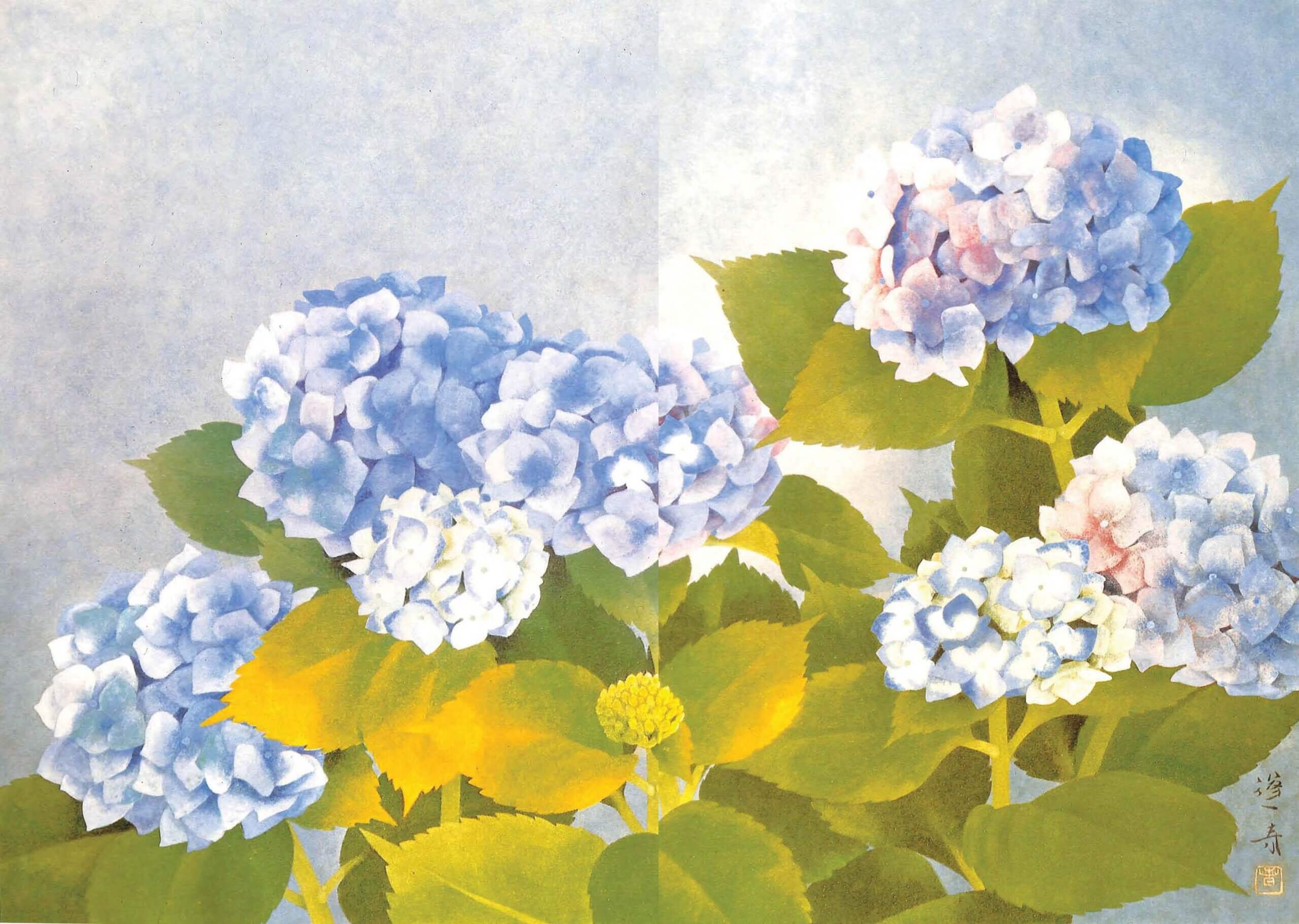
Sunny During Rainy Season by Yamaguchi Hōshun

Yamaguchi Hōshun had shown outstanding skills as a Western-style painter, winning two awards at the Nikakai exhibition while he was still a student at the Tokyo School of Fine Arts, but his professor at the time, Nagahara Kōtarō (a Western-style painter), who was trying to find a way to transform Western paintings into Japanese paintings, evaluated his painting style, saying that it resembled Yamato-e scroll, and Hōshun wanted to try Japanese-style paintings, so he switched courses and became a pupil of Matsuoka Eikyū. Hōshun had a such unique career. At the time, Matsuoka Eikyū had just started the new Yamato-e movement, and Yamaguchi Hōshun naturally participated in this movement and painted landscapes using Yamato-e techniques. The peak of his career was “Nachi Mountain in Mikumano.”
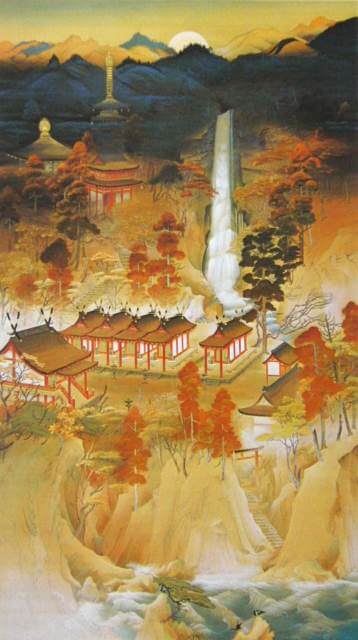
Nachi Mountain in Mikumano” by Yamaguchi Hōshun

This work, which was exhibited at the 7th Teiten exhibition in 1926, won a special prize of the Teiten exhibition and the Fine Arts Prize of Imperial Academy, and was purchased by the Imperial Household, made his spectacular debut in the art world. However, Hōshun who dreamed to create a new Japanese painting, parted from Eikyū, left the Teiten, and in 1930 formed the Rikuchōkai with Fukuda Heihachirō, Nakamura Gakuryō, Kimura Shōhachi, Nakagawa Kigen, Makino Torao, Yokokawa Kiichirō, Togari Kenshō, and others. Through interchange with other artists from different schools, including Japanese-style painters, Western-style painters, and art critics, he expanded his own painting fields. After the war, he attempted to develop a more abstract style of Yamato-e paintings, but eventually returned to more sketchy pursuit.

This painting, “Sunny During Rainy Season,” is from that period and captures the refreshing atmosphere of hydrangeas changing into seven different colors, washed by the rain. The tones of blue and pink are beautiful, and the painting of the leaves is particularly brilliant.

Chrysanthemum
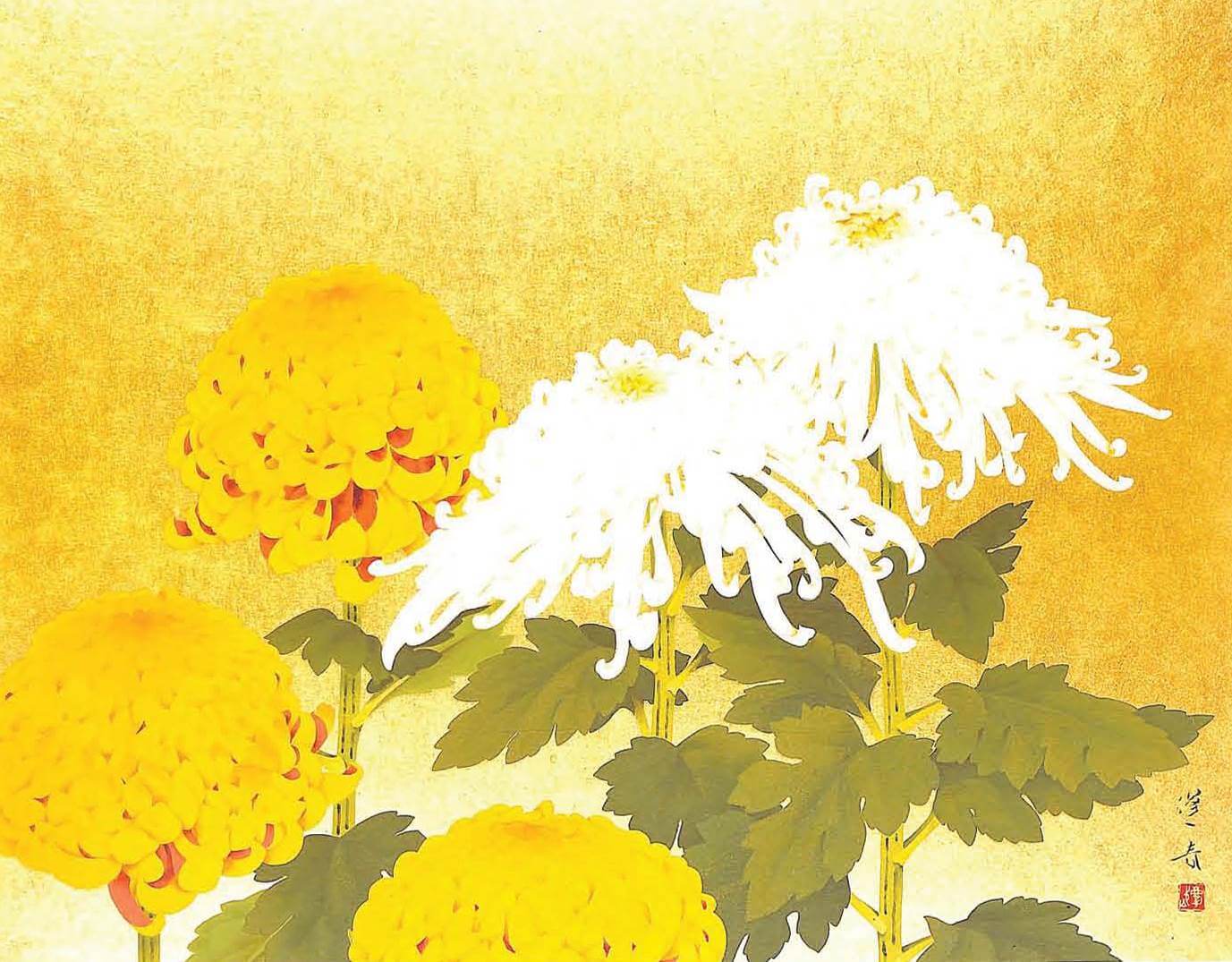
Chrysanthemum by Yamaguchi Hōshun

He painted yellow chrysanthemums and white chrysanthemums. This work was also done after passing through the period of Yamaguchi Hōshun’s attempt at abstract Yamato-e, which was mentioned earlier, and shows thick and rich chrysanthemum petals. Of course, it goes without saying that this work is based on a sketch without getting water, but even so, it is struck by the sense of life that seems to be moving through it. The leaves and trunks are also drawn in a simplified manner, but their characters are accurately captured, and as for the green of the leaves, by skillfully coloring, which makes us even feel its stain, it reminds us of “Colorist Hōshun.”

Early Summer
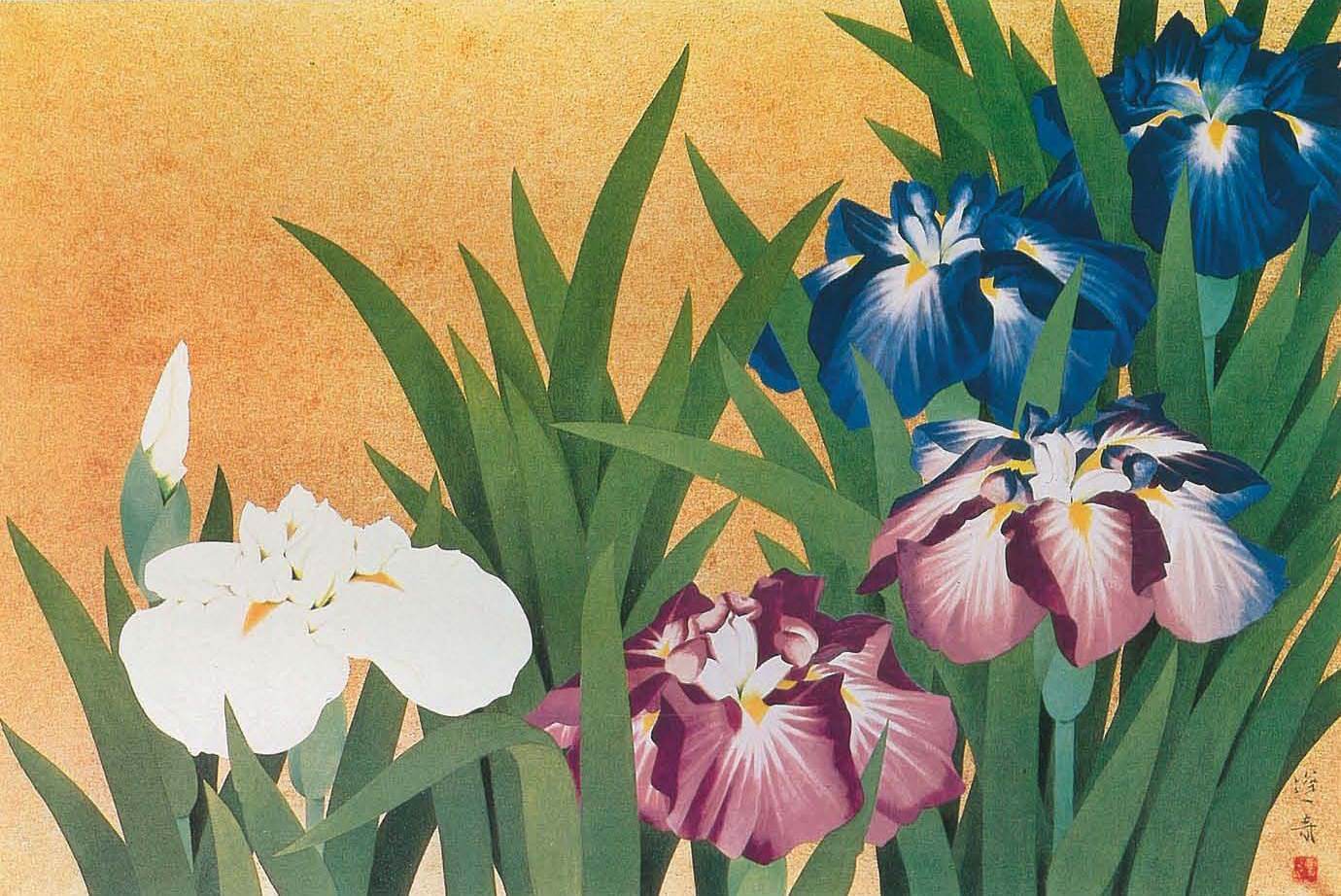
Early Summer by Yamaguchi Hōshun

Blue, purple, and white irises are lined up diagonally from upper right to lower left, with white buds forming a period. The subtle changes in the colors of the irises accurately express the softness and volume of the petals. The overlapping petals, which may have been struck by an evening shower, are particularly tasteful. The leaves are sharp and vigorous, like the shape of a sword. Since such color intensity is inevitably hard to apply to the entire screen, a breather is taken in the upper left space.
    NameRequired

    SexRequired

    MaleFemale

    CountryRequired

    e-mailRequired

    CommentRequired

    Attached File
    ※Up to 3 MB for each file.


    ← ← "MUST CHECK" / Please confirm the above contents again and check this button.

    Contact Us

    Please fill out the form below and submit for your inquiry.

    ❈FirstName
    ❈LastName
    Country
    ❈E-mail
    (❈Confirm E-mail)
    ❈Inquiry category Question
    Consultation
    Impression
    Request
    Others
    ❈Comment

    is the mark for required item.


    Your privacy is important to us. We are committed to protecting your privacy.

    (or press ESC or click the overlay)

    CEO Message

    Our Feelings For Kakejiku


     The Japanese people have long set a high value on aesthetic senses since ancient times. As a result, the
    peculiar culture which is not seen in other countries blossomed and many aspects of the modern Japanese
    culture come from it. Parts of Japanese culture has been introduced to people in other countries recently,
    so the number of people from other countries who are interested in Japanese culture has been increasing.
    However, the Japanese aesthetic senses, which are the bases of Japanese culture, have been nurtured
    through a long history, intertwining various elements intricately, such as climate, geographical features,
    religion, customs and so on. Therefore, they are very difficult to understand not only for people from other
    countries, but even for the Japanese people. I think the best tool which conveys these difficult senses
    understandably is a “kakejiku.”
     The kakejiku (a hanging scroll; a work of calligraphy or a painting which is mounted and hung in an
    alcove or on a wall) is a traditional Japanese art. It's no exaggeration to say that paintings are what
    express aesthetic senses at all times and places. The kakejiku is an art which expresses the Japanese
    aesthetic senses. The kakejiku has long been used in traditional Japanese events, daily life and so on since
    ancient times. As a result, there are various customs of kakejiku in Japan; kakejiku and the life of the
    Japanese are closely related. We can see Japanese values through kakejiku.
     The kakejiku is a cultural tradition which the Japanese people should be proud of. However, many people
    in other countries don't know much about it because it hasn't been showcased as much. This is why I
    decided to try to introduce it. The kakejiku world is very interesting and beautiful. We want not only the
    Japanese, but also many people from other countries to know and enjoy it. I hope that many people will
    love kakejiku someday.

    (or press ESC or click the overlay)
    Company Profile
    syaoku.jpg(120220 byte)

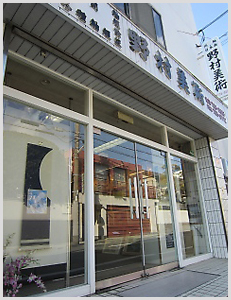
    Name Art Nomura


    President Tatsuji Nomura


    Founded1973


    Established1992


    Address7-23 Babadori, Tarumi-ku, Kobe city,
    Hyougo Prefecture, 655-0021, Japan


    Capital10 million yen


    URLhttp://nomurakakejiku.com


    Our Business

     Art Nomura is an art dealer which produces kakejiku (hanging scrolls). We mount many paintings and calligraphic works in kakejiku in my factory. Kakejiku are our main product. We also remount and repair old or damaged kakejiku. We share the traditional Japanese art of kakejiku with people all over the world.


    (or press ESC or click the overlay)
    Access Map

    Access Map


     The Japanese people have long set a high value on aesthetic senses since ancient times. As a result, the
    peculiar culture which is not seen in other countries blossomed and many aspects of the modern Japanese
    culture come from it. Parts of Japanese culture has been introduced to people in other countries recently,
    so the number of people from other countries who are interested in Japanese culture has been increasing.
    However, the Japanese aesthetic senses, which are the bases of Japanese culture, have been nurtured
    through a long history, intertwining various elements intricately, such as climate, geographical features,
    religion, customs and so on. Therefore, they are very difficult to understand not only for people from other
    countries, but even for the Japanese people. I think the best tool which conveys these difficult senses
    understandably is a “kakejiku.”
     The kakejiku (a hanging scroll; a work of calligraphy or a painting which is mounted and hung in an
    alcove or on a wall) is a traditional Japanese art. It's no exaggeration to say that paintings are what
    express aesthetic senses at all times and places. The kakejiku is an art which expresses the Japanese
    aesthetic senses. The kakejiku has long been used in traditional Japanese events, daily life and so on since
    ancient times. As a result, there are various customs of kakejiku in Japan; kakejiku and the life of the
    Japanese are closely related. We can see Japanese values through kakejiku.
     The kakejiku is a cultural tradition which the Japanese people should be proud of. However, many people
    in other countries don't know much about it because it hasn't been showcased as much. This is why I
    decided to try to introduce it. The kakejiku world is very interesting and beautiful. We want not only the
    Japanese, but also many people from other countries to know and enjoy it. I hope that many people will
    love kakejiku someday.

    (or press ESC or click the overlay)