
Matsunaga Kōgyoku: The Shōwa Period Painter Who Continued to Draw Traditional Japanese Painting

Tsuru no Mai (The Dance of Cranes)
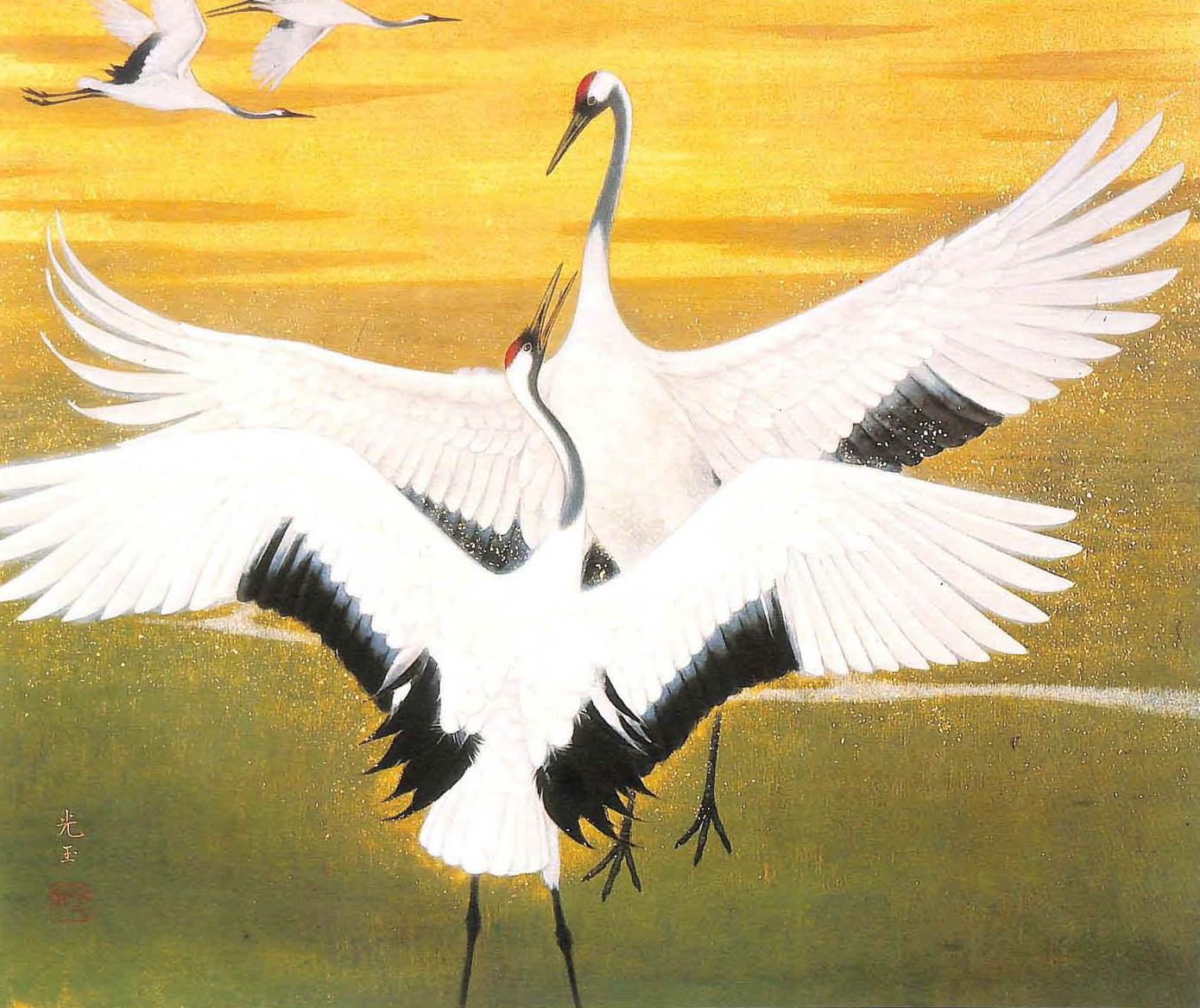
Tsuru no Mai (The Dance of Cranes) by Matsunaga Kōgyoku

The appearance of the two cranes is dramatic. It looks as if the love scene of a young beautiful couple was drawn in cranes. Since cranes are noble, the scene is finished in a much more magnificent stage than drawing the performance of human beings.

White feathers cover the painting, and it’s a drastic composition. It quickly captures the moment of movement. Although the painting is not so big, it is a work that mysteriously feels spacious. He did not handle the gold gorgeously, but it is a great supporting role for cranes. The painter’s solid brush strokes can be fully seen.

Shirokujaku (White Peacocks)
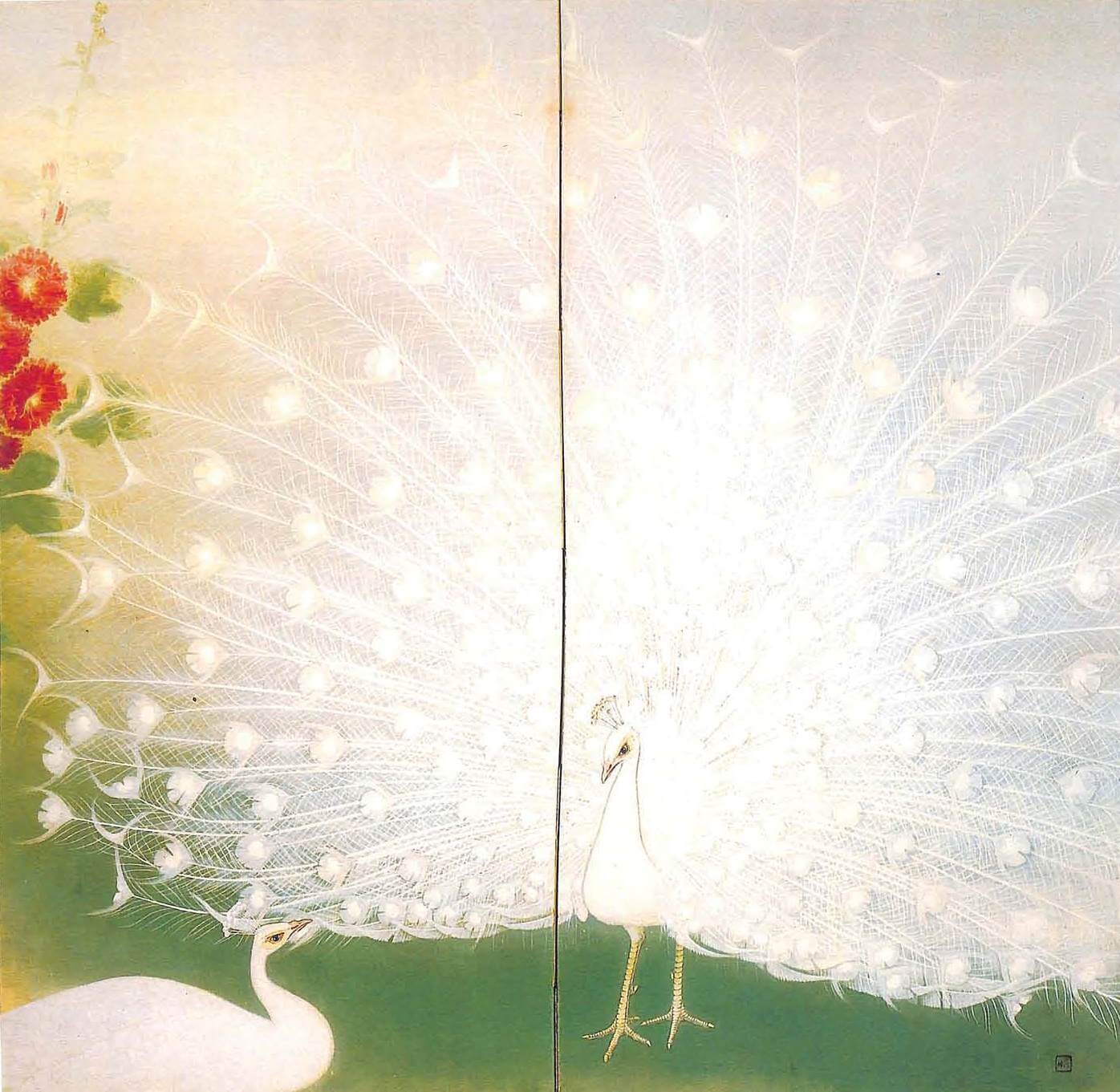
Shirokujaku (White Peacocks) by Matsunaga Kōgyoku

The painting fully conveys the noble appearance of the white peacock. The painter expresses the wings spread out in full screen size with delicate brush strokes. It seems that the tips of the feathers are smooth, and even the soft touch of the feather can be felt by the viewer. A female peacock, fascinated by her stunning bravery, sends her enthusiastic gaze to her courtesan. The faces and arrangement of the two peacocks are more than just a Kachō-ga (painting of flowers and birds), and they are likely to become a drama. The white and green color scheme is also elegant. And the color tone of the hollyhock, which looks like a little red on the left edge of the painting, adds flowers to this drama.

The painter, Matsunaga Kōgyoku, was born in 1902 in Shizuoka Prefecture. He moved to Tōkyō in 1922 and studied under Ikegami Shūho. After that, he exhibited at the Shinkō Bijutsuin, was recommended as a member of the Shinkō Bijutsuin in 1951, left the institute in 1959, and the following year he formed Shinsei Bijutsukai with his comrades. He worked energetically until his later years with an expression method that steadily focused on the basics and traditions of Japanese painting. He died in 1987 at the age of 85.

Rusō (The Flow of the River)
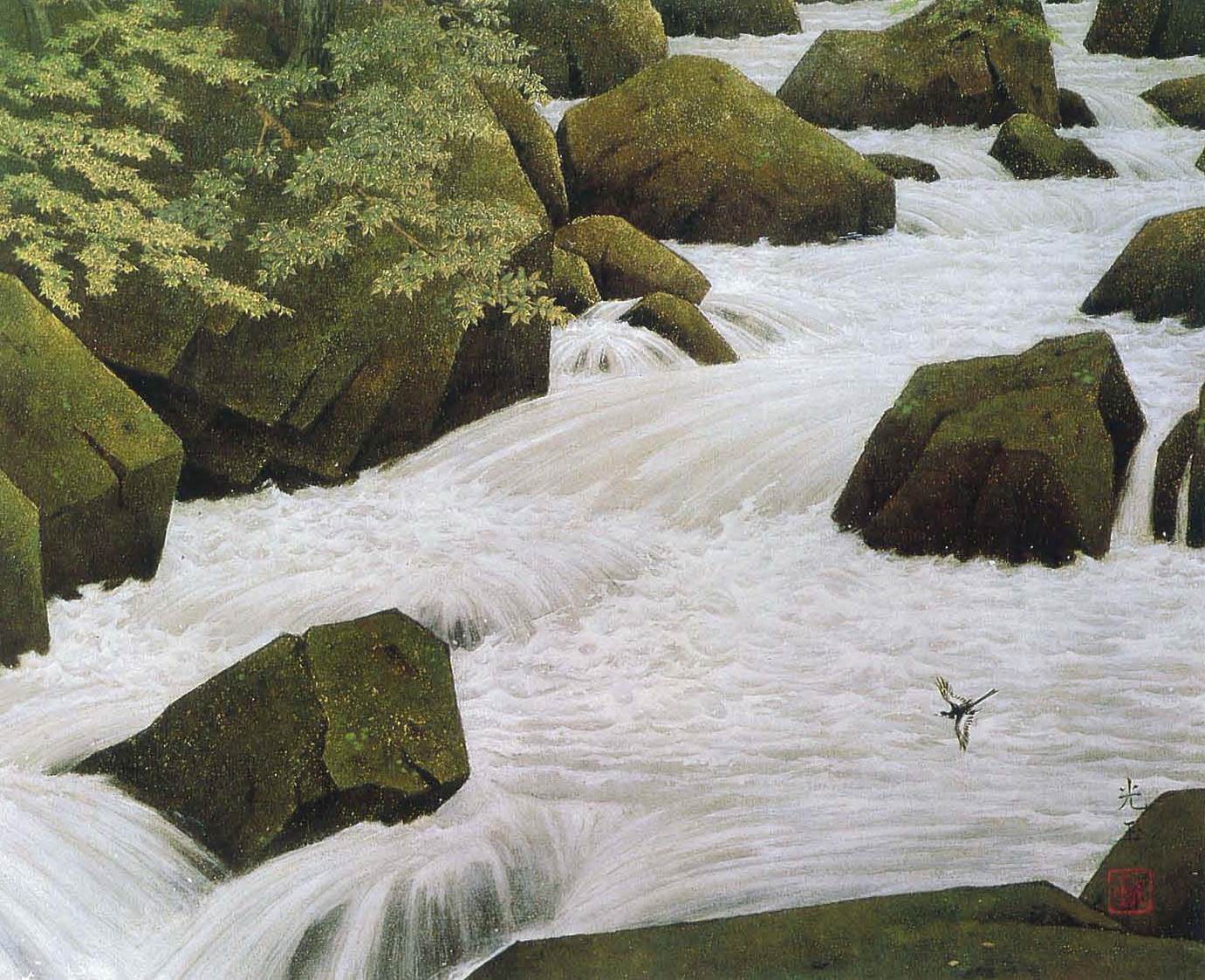
Rusō (The Flow of the River) by Matsunaga Kōgyoku

Matsunaga  Kōgyoku liked Oirase (Mountain Stream in Aomori Prefecture) and produced numerous works with the motif of the mountain streams. He says, “I felt in this mountain stream the immutability of various acts that are close to how life changes without stopping.” This painting is also one of them, and it seems that you can hear the sound of a clear stream flowing vigorously from the painting. Passing between rocks, sometimes shaving rocks, sometimes merging, water runs freely like a living thing. Nature’s activities since ancient times will continue endlessly in the future. The painter captured the moment of nature on the painting. However, the flow of water does not stop even inside the painting, and the water that flows from the back of the screen flows through the screen, then out of the painting. The tone of the two colors of white and green is refreshing again.
    NameRequired

    SexRequired

    MaleFemale

    CountryRequired

    e-mailRequired

    CommentRequired

    Attached File
    ※Up to 3 MB for each file.


    ← ← "MUST CHECK" / Please confirm the above contents again and check this button.

    Contact Us

    Please fill out the form below and submit for your inquiry.

    ❈FirstName
    ❈LastName
    Country
    ❈E-mail
    (❈Confirm E-mail)
    ❈Inquiry category Question
    Consultation
    Impression
    Request
    Others
    ❈Comment

    is the mark for required item.


    Your privacy is important to us. We are committed to protecting your privacy.

    (or press ESC or click the overlay)

    CEO Message

    Our Feelings For Kakejiku


     The Japanese people have long set a high value on aesthetic senses since ancient times. As a result, the
    peculiar culture which is not seen in other countries blossomed and many aspects of the modern Japanese
    culture come from it. Parts of Japanese culture has been introduced to people in other countries recently,
    so the number of people from other countries who are interested in Japanese culture has been increasing.
    However, the Japanese aesthetic senses, which are the bases of Japanese culture, have been nurtured
    through a long history, intertwining various elements intricately, such as climate, geographical features,
    religion, customs and so on. Therefore, they are very difficult to understand not only for people from other
    countries, but even for the Japanese people. I think the best tool which conveys these difficult senses
    understandably is a “kakejiku.”
     The kakejiku (a hanging scroll; a work of calligraphy or a painting which is mounted and hung in an
    alcove or on a wall) is a traditional Japanese art. It's no exaggeration to say that paintings are what
    express aesthetic senses at all times and places. The kakejiku is an art which expresses the Japanese
    aesthetic senses. The kakejiku has long been used in traditional Japanese events, daily life and so on since
    ancient times. As a result, there are various customs of kakejiku in Japan; kakejiku and the life of the
    Japanese are closely related. We can see Japanese values through kakejiku.
     The kakejiku is a cultural tradition which the Japanese people should be proud of. However, many people
    in other countries don't know much about it because it hasn't been showcased as much. This is why I
    decided to try to introduce it. The kakejiku world is very interesting and beautiful. We want not only the
    Japanese, but also many people from other countries to know and enjoy it. I hope that many people will
    love kakejiku someday.

    (or press ESC or click the overlay)
    Company Profile
    syaoku.jpg(120220 byte)

    Name Art Nomura


    President Tatsuji Nomura


    Founded1973


    Established1992


    Address7-23 Babadori, Tarumi-ku, Kobe city,
    Hyougo Prefecture, 655-0021, Japan


    Capital10 million yen


    URLhttp://nomurakakejiku.com


    Our Business

     Art Nomura is an art dealer which produces kakejiku (hanging scrolls). We mount many paintings and calligraphic works in kakejiku in my factory. Kakejiku are our main product. We also remount and repair old or damaged kakejiku. We share the traditional Japanese art of kakejiku with people all over the world.


    (or press ESC or click the overlay)
    Access Map

    Access Map


     The Japanese people have long set a high value on aesthetic senses since ancient times. As a result, the
    peculiar culture which is not seen in other countries blossomed and many aspects of the modern Japanese
    culture come from it. Parts of Japanese culture has been introduced to people in other countries recently,
    so the number of people from other countries who are interested in Japanese culture has been increasing.
    However, the Japanese aesthetic senses, which are the bases of Japanese culture, have been nurtured
    through a long history, intertwining various elements intricately, such as climate, geographical features,
    religion, customs and so on. Therefore, they are very difficult to understand not only for people from other
    countries, but even for the Japanese people. I think the best tool which conveys these difficult senses
    understandably is a “kakejiku.”
     The kakejiku (a hanging scroll; a work of calligraphy or a painting which is mounted and hung in an
    alcove or on a wall) is a traditional Japanese art. It's no exaggeration to say that paintings are what
    express aesthetic senses at all times and places. The kakejiku is an art which expresses the Japanese
    aesthetic senses. The kakejiku has long been used in traditional Japanese events, daily life and so on since
    ancient times. As a result, there are various customs of kakejiku in Japan; kakejiku and the life of the
    Japanese are closely related. We can see Japanese values through kakejiku.
     The kakejiku is a cultural tradition which the Japanese people should be proud of. However, many people
    in other countries don't know much about it because it hasn't been showcased as much. This is why I
    decided to try to introduce it. The kakejiku world is very interesting and beautiful. We want not only the
    Japanese, but also many people from other countries to know and enjoy it. I hope that many people will
    love kakejiku someday.

    (or press ESC or click the overlay)