
Tonouchi Mishō: A Japanese-Style Painter Who Gave New Sensation to the World of Yamato-e.

Frost
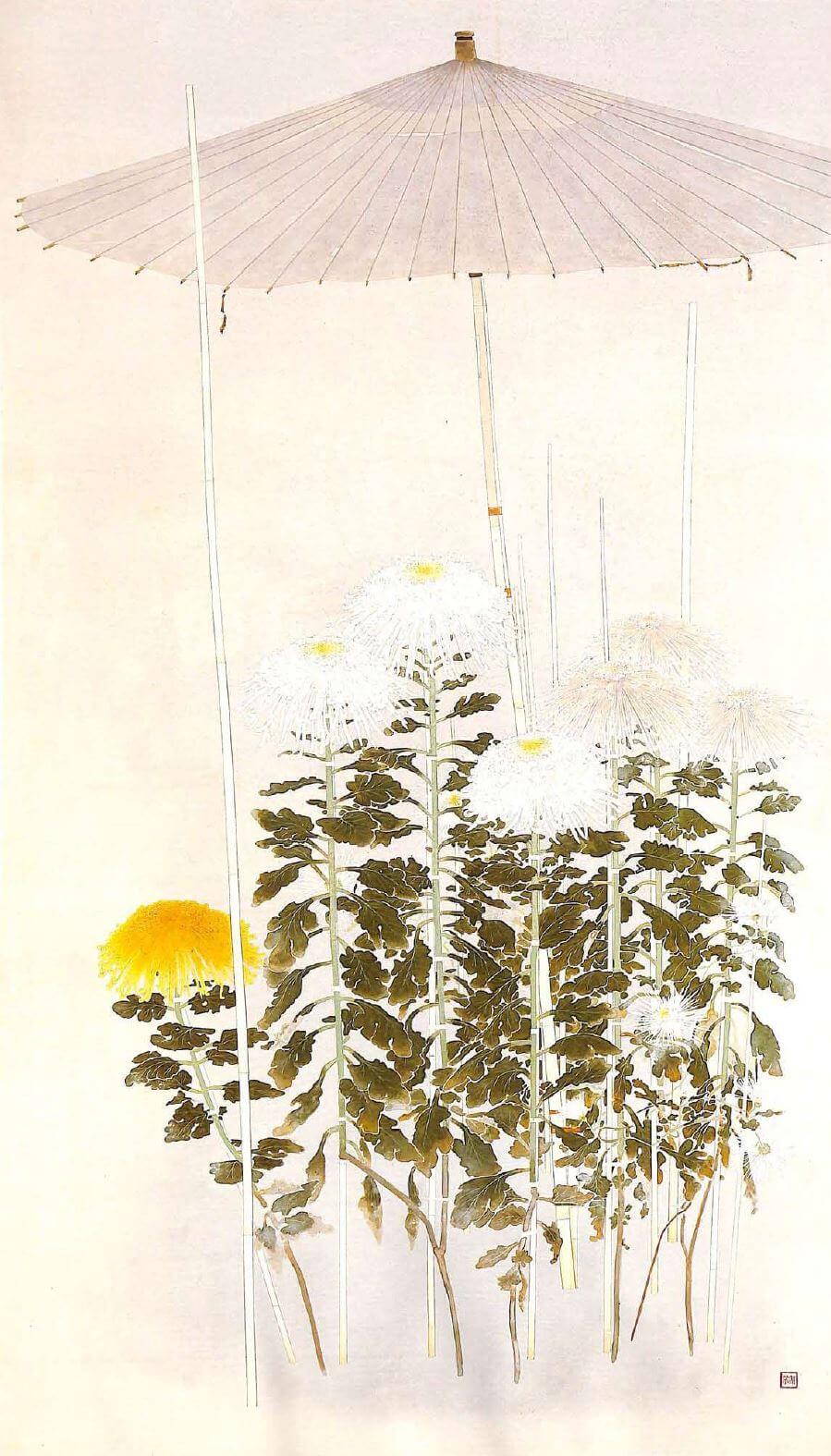
Frost by Tonouchi Mishō

Tonouchi Mishō was a painter who adored the world of Yamato-e and tried to revive its traditional methods and classical world. Mishō was born in Kanda, Tokyo in 1891. When he first started learning painting, he took lessons from Terasaki Kōgyō in Tokyo. Later on, he moved up to Kyoto to enter Kyoto City Specialist School of Painting (the predecessor of Kyoto University of the Arts) and learned painting under Kikuchi Keigetsu there. He was awarded his first prize at the 2nd Teiten Exhibition in 1920 and won the special commendation at the 6th Teiten Exhibition in the year he graduated from the painting school (1925). He was awarded the special commendation again for his work titled “Tounomine Shunsetsu (Spring snow-covered Mt. Tounomine and Its Temples and Shrines)” at the 8th Teiten Exhibition in 1927. He was chosen as a judge at the 10th Teiten Exhibition in 1929. “Tounomine Shunsetsu (Spring snow-covered Mt. Tounomine and Its Temples and Shrines)” is the work for which Mishō won his second special commendation. It is said to be his best work that faithfully presents the world of classical Yamayo-e, depicting slightly snow-covered Mt. Tounomine and the sanctuary of Tanzan shrine. Those places have a sacred atmosphere.
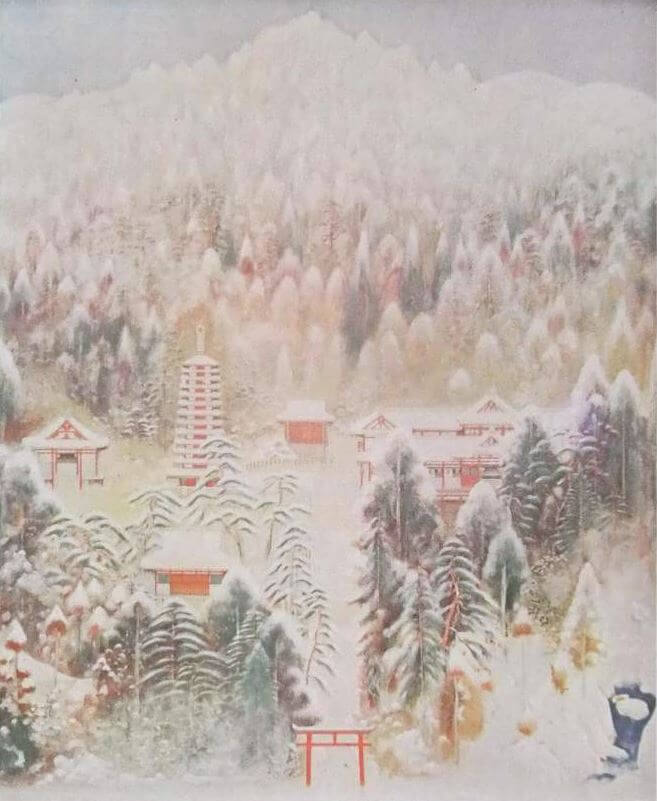
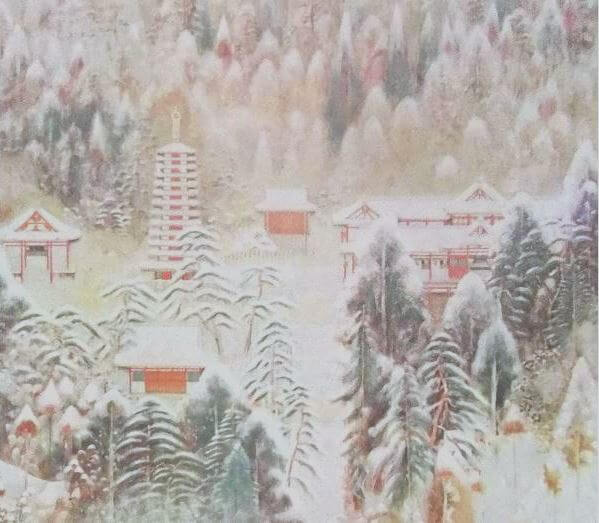
Tōnomine Shunsetsu (Spring snowed Tōnomine Temples)” by Tonouchi Mishō

Mishō was qualified for exemption of examination when displaying artworks at the Shin Bunten exhibition for years, and he became a contracted artist of the Nitten after World War II. He passed away in 1964 at the age of 73.

“Frost” featured herein was released in 1937 when Mishō was 55 years old. There stand 7 or 8 large chrysanthemums that have gold and white petals. They bloom dignifiedly on a vertically long screen. Lean over bangasa (coarse oilpaper umbrella) is placed above large chrysanthemums, possibly to avoid frost damage. A combination of soft lyricism and distinctive sharp drawing line he learned from his master, Kikuchi Keigetsu, produces a relaxed ambiance in this bird and flower painting. Especially, the interaction between the linear composition of the bangasa and supporting bamboo sticks, and curved lines of the large petals, branches, and leaves, has an effect of creating rich and poetic sentiment in the painting, without lacking tension. This beautiful flower painting bears grace and emotional leeway. It is hard to believe it was created during turmoil and despair after the defeat of Japan in World War II.
    NameRequired

    SexRequired

    MaleFemale

    CountryRequired

    e-mailRequired

    CommentRequired

    Attached File
    ※Up to 3 MB for each file.


    ← ← "MUST CHECK" / Please confirm the above contents again and check this button.

    Contact Us

    Please fill out the form below and submit for your inquiry.

    ❈FirstName
    ❈LastName
    Country
    ❈E-mail
    (❈Confirm E-mail)
    ❈Inquiry category Question
    Consultation
    Impression
    Request
    Others
    ❈Comment

    is the mark for required item.


    Your privacy is important to us. We are committed to protecting your privacy.

    (or press ESC or click the overlay)

    CEO Message

    Our Feelings For Kakejiku


     The Japanese people have long set a high value on aesthetic senses since ancient times. As a result, the
    peculiar culture which is not seen in other countries blossomed and many aspects of the modern Japanese
    culture come from it. Parts of Japanese culture has been introduced to people in other countries recently,
    so the number of people from other countries who are interested in Japanese culture has been increasing.
    However, the Japanese aesthetic senses, which are the bases of Japanese culture, have been nurtured
    through a long history, intertwining various elements intricately, such as climate, geographical features,
    religion, customs and so on. Therefore, they are very difficult to understand not only for people from other
    countries, but even for the Japanese people. I think the best tool which conveys these difficult senses
    understandably is a “kakejiku.”
     The kakejiku (a hanging scroll; a work of calligraphy or a painting which is mounted and hung in an
    alcove or on a wall) is a traditional Japanese art. It's no exaggeration to say that paintings are what
    express aesthetic senses at all times and places. The kakejiku is an art which expresses the Japanese
    aesthetic senses. The kakejiku has long been used in traditional Japanese events, daily life and so on since
    ancient times. As a result, there are various customs of kakejiku in Japan; kakejiku and the life of the
    Japanese are closely related. We can see Japanese values through kakejiku.
     The kakejiku is a cultural tradition which the Japanese people should be proud of. However, many people
    in other countries don't know much about it because it hasn't been showcased as much. This is why I
    decided to try to introduce it. The kakejiku world is very interesting and beautiful. We want not only the
    Japanese, but also many people from other countries to know and enjoy it. I hope that many people will
    love kakejiku someday.

    (or press ESC or click the overlay)
    Company Profile
    syaoku.jpg(120220 byte)

    Name Art Nomura


    President Tatsuji Nomura


    Founded1973


    Established1992


    Address7-23 Babadori, Tarumi-ku, Kobe city,
    Hyougo Prefecture, 655-0021, Japan


    Capital10 million yen


    URLhttp://nomurakakejiku.com


    Our Business

     Art Nomura is an art dealer which produces kakejiku (hanging scrolls). We mount many paintings and calligraphic works in kakejiku in my factory. Kakejiku are our main product. We also remount and repair old or damaged kakejiku. We share the traditional Japanese art of kakejiku with people all over the world.


    (or press ESC or click the overlay)
    Access Map

    Access Map


     The Japanese people have long set a high value on aesthetic senses since ancient times. As a result, the
    peculiar culture which is not seen in other countries blossomed and many aspects of the modern Japanese
    culture come from it. Parts of Japanese culture has been introduced to people in other countries recently,
    so the number of people from other countries who are interested in Japanese culture has been increasing.
    However, the Japanese aesthetic senses, which are the bases of Japanese culture, have been nurtured
    through a long history, intertwining various elements intricately, such as climate, geographical features,
    religion, customs and so on. Therefore, they are very difficult to understand not only for people from other
    countries, but even for the Japanese people. I think the best tool which conveys these difficult senses
    understandably is a “kakejiku.”
     The kakejiku (a hanging scroll; a work of calligraphy or a painting which is mounted and hung in an
    alcove or on a wall) is a traditional Japanese art. It's no exaggeration to say that paintings are what
    express aesthetic senses at all times and places. The kakejiku is an art which expresses the Japanese
    aesthetic senses. The kakejiku has long been used in traditional Japanese events, daily life and so on since
    ancient times. As a result, there are various customs of kakejiku in Japan; kakejiku and the life of the
    Japanese are closely related. We can see Japanese values through kakejiku.
     The kakejiku is a cultural tradition which the Japanese people should be proud of. However, many people
    in other countries don't know much about it because it hasn't been showcased as much. This is why I
    decided to try to introduce it. The kakejiku world is very interesting and beautiful. We want not only the
    Japanese, but also many people from other countries to know and enjoy it. I hope that many people will
    love kakejiku someday.

    (or press ESC or click the overlay)