
Fukuda Suikō: Shijō School Painter Who Takes the Nickname of “Hawk’s Suikō”

White Egrets
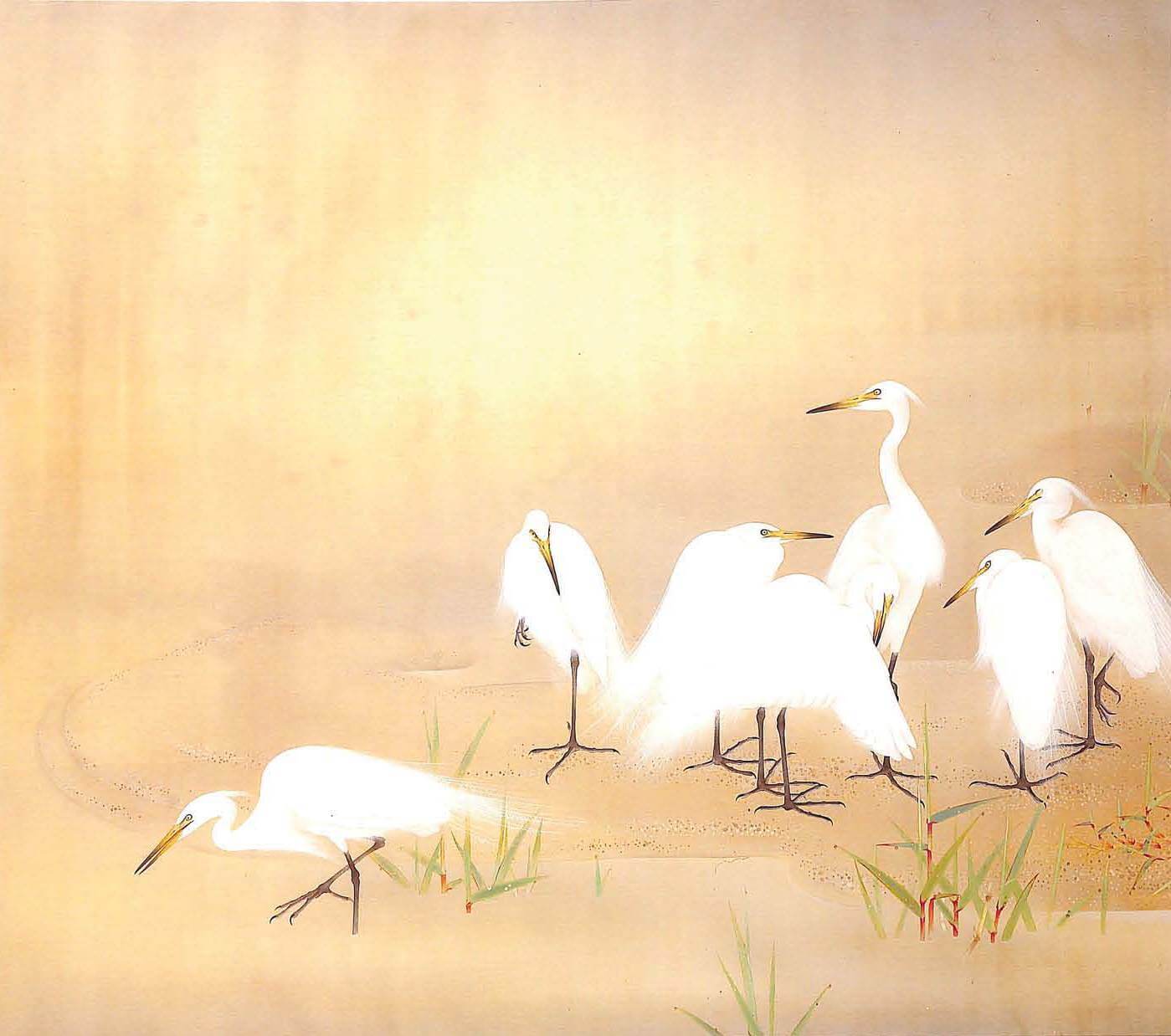
White Egrets by Fukuda Suikō

Fukuda Suikō was born in Kyōto in 1895. After graduating from the Kyōto Municipal School of Arts and Crafts in 1913, he worked in the art department of Takashimaya but became determined to be a painter. Suiko’s career as a painter began in earnest in 1925, when he joined “Shōkōsha,” a painting school of Nishiyama Suishō. In 1926, his painting “The Hawk” was selected for the 7th Teiten exhibition. In 1931, he was awarded a special prize at the Teiten, and in 1932, he became without inspection, and Suikō’s prewar presentation activities were centered around the Teiten exhibition, Nitten exhibition, and Shōkōsha exhibition. After the war, he continued to exhibit his works at the Nitten exhibition, and at the same time, he continued to produce works vigorously and held many solo exhibitions.

After the death of his master Nishiyama Suishō in 1958, he studied under Tokuoka Shinsen, which was a significant step in the development of Suikō’s painting career. After that, Suikō’s works became more poetic. In 1961, he became a member of the judge of the Nitten exhibition and established a solid position in the art world, which was probably the peak of Suikō’s artistic activities. Around 1965, at the age of seventy, he began to experience physical problems, and in 1972 he developed heart and kidney disease. He died unfortunately in 1973 due to heart failure.

Suikō inherited the tradition of the Shijō School from Takeuchi Seihō to Nishiyama Suishō and seems to have pursued a rigorous approach to realism. In order to achieve realistic expression, the first priority was to master the technique, and it can be said that Suikō mastered this technique enough. Suikō’s works sometimes give the impression of craftsmanship, it may be due to the brilliance of his technique. The expression of the egrets in this work is also without fail, and we feel the rigor of not neglecting even a single line. The painting must have been based on many sketches.

Hawk and Falcon
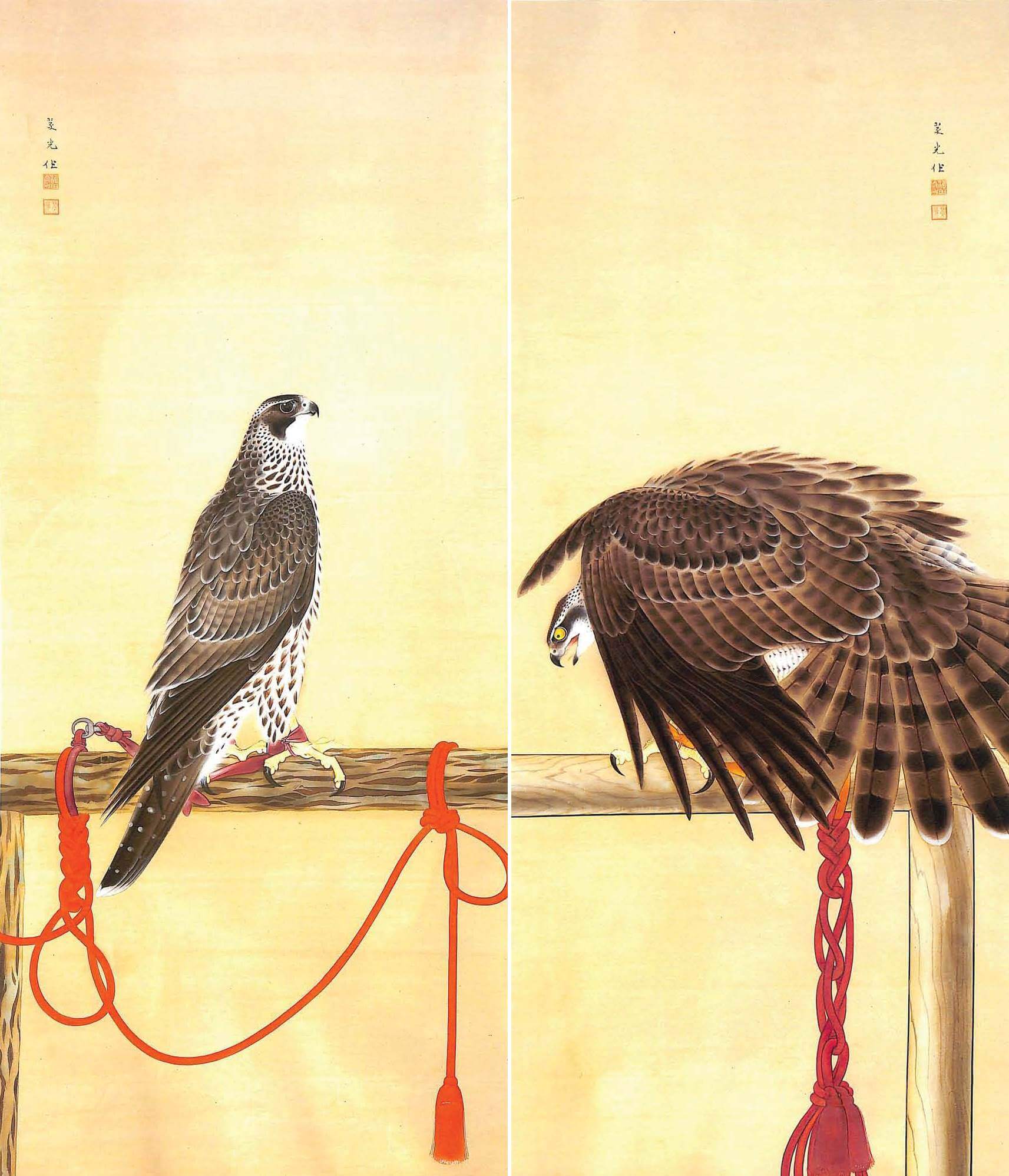
Hawk and Falcon by Fukuda Suikō

Fukuda Suikō was known as “Hawk’s Suikō.” His first work to be selected for the Teiten was a hawk, and the work that won a special prize at the Teiten was also a painting of a hawk. If the 1931 exhibition was his first solo exhibition, Suikō‘s solo exhibitions began with ten falcon paintings and ended with the exhibition of ten falcon paintings in 1967. Suikō continued to paint falcons from his early days as a painter to his later years. Thus, the hawk was a memorable theme for Suikō and was a theme he liked. Suikō wrote himself that he was attracted to the falcon because of its “dignified, majestic, and graceful” appearance, and despite the changes in his painting style after studying under Tokuoka Shinsen, his perception of the falcon did not seem to change much. This may be because the poetic sentiment of the paintings, which became more outstanding after his style changed, was not appropriate for expression of this falcon.

This work depicts a falconry hawk. The right side of the painting is a goshawk and the left side is a falcon, both of which have been used for falconry since ancient times. This work was exhibited at the first Shin-Bunten exhibition in 1962.

White Geese
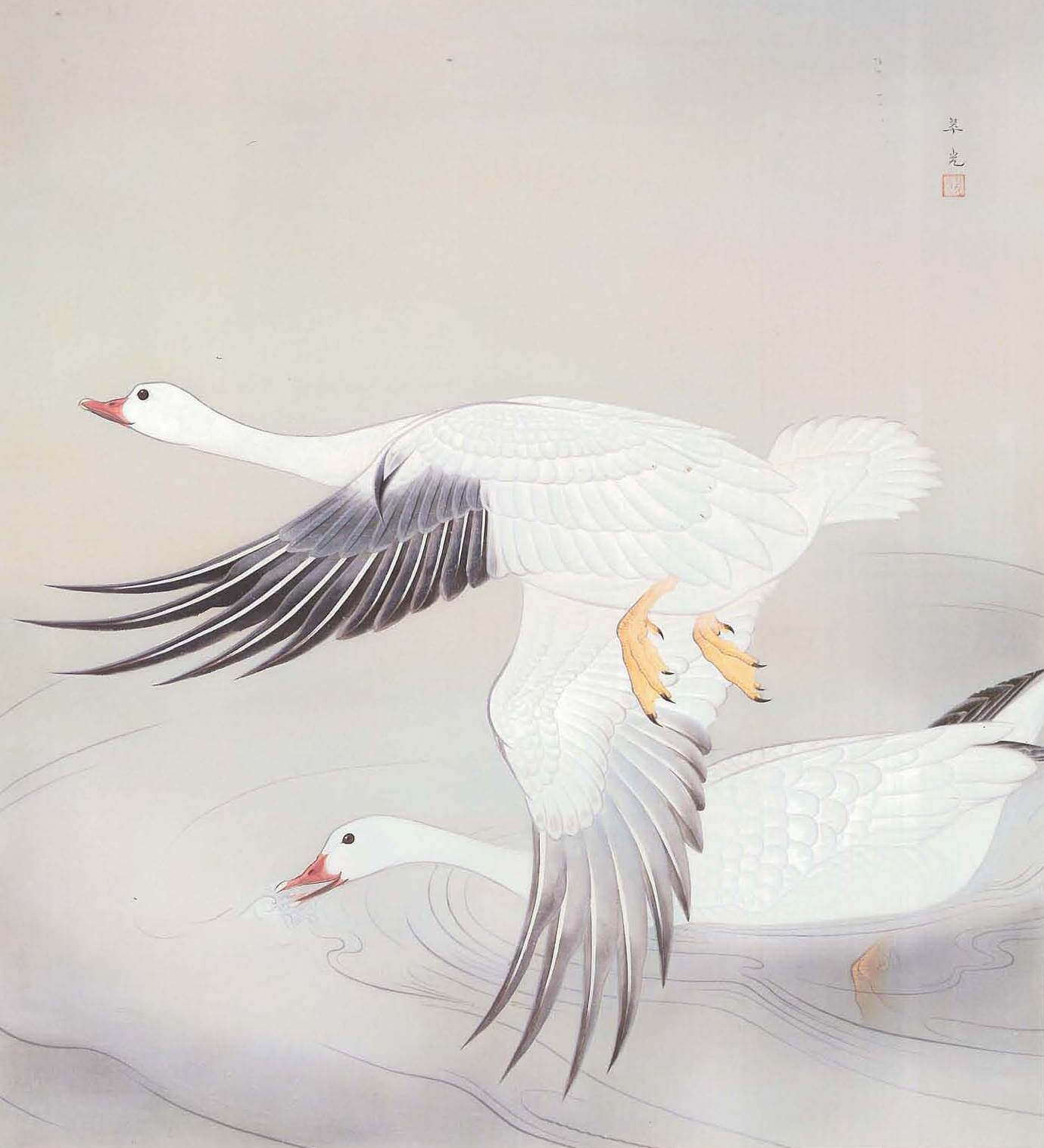
White Geese by Fukuda Suikō

“White Goose” is a work that focuses on realism, the tradition of the Shijō School, from Takeuchi Seihō to Nishiyama Suishō. Each feather is carefully drawn, and the screen with suppressed colors is clean, showing the earnest painting style of Suikō. Although the painting depicts white geese in flight, a sense of tranquility pervades the entire work, and only the slight surface of the water, which the beak of the swimming white goose probes, causes a stir, further reinforcing the overall tranquility.

Snow White Swan
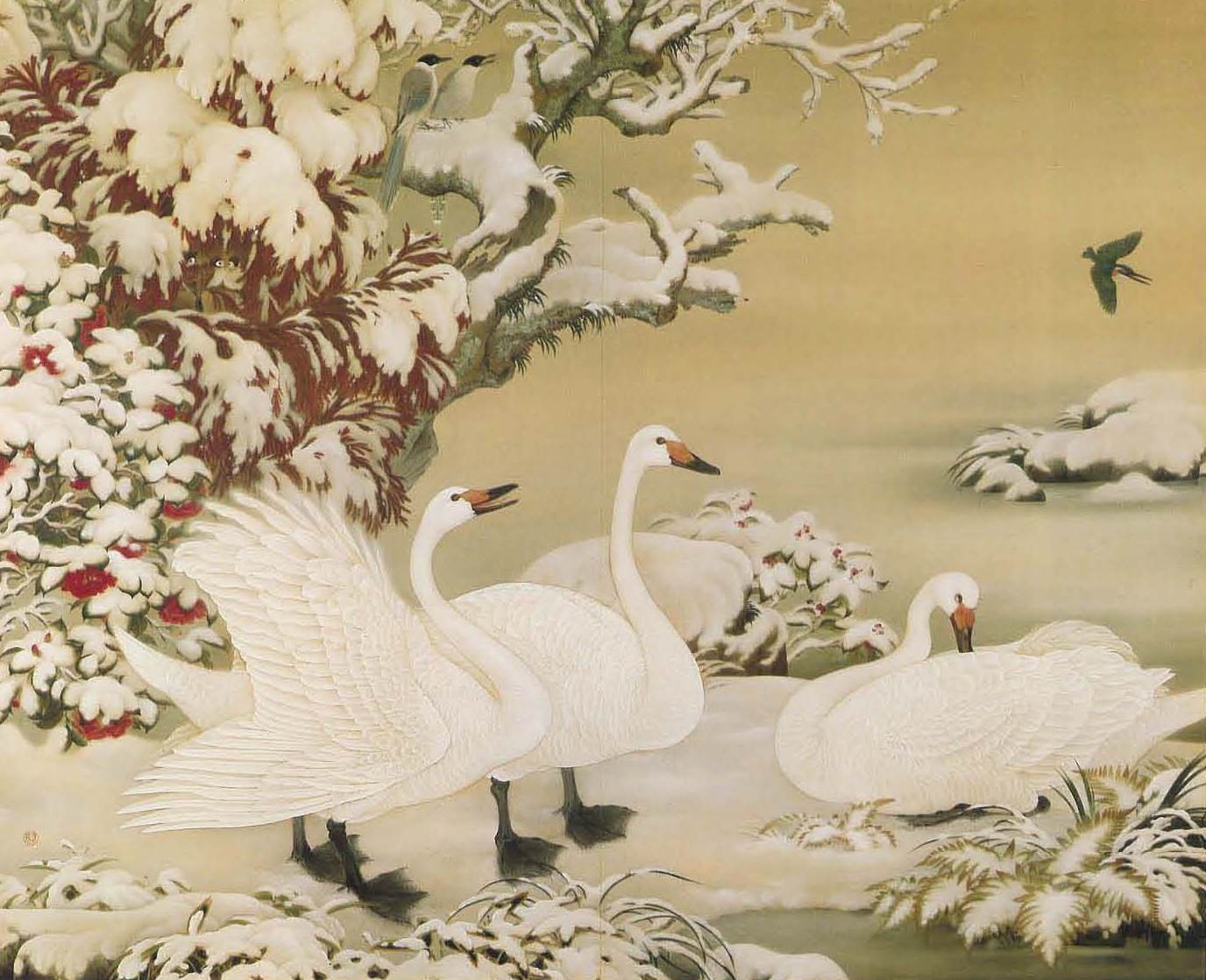
Snow White Swan by Fukuda Suikō

In the same way that Kishi Chikudō of the Kishi School, a prominent figure in the Kyōto art world and one of the great masters of the Meiji era, resembled a tiger, Fukuda Suikō, also known as “Hawk’s Suikō,” is said to have had an appearance reminiscent of a hawk. After the death of his master Nishiyama Suishō, he studied under Tokuoka Shinsen and began to move away from his traditional focus on realism towards a more inner world of paintings. However, in the summer of 1965, he began to suffer from high blood pressure, which made it difficult for him to make progress in his work. So, he has not exhibited his works at the Nitten exhibition after 1970 due to his health issues. After that, his condition worsened, and he died in 1973. He was 77 years old at the time.

“Snow White Swan” has a fairytale-like romantic lyricism and symbolizes the early realism of Suikō, which makes us feel a tranquil elegance. This work was exhibited at the 9th Teiten exhibition in 1928 at the age of 33.

The Japanese art world in Kyōto has a tradition of excellent sketching of nature in the four seasons since the Maruyama and Shijō schools of the Edo period, and in this painting, with the theme of swans, from kingfisher, long-tailed bird, sparrow bird to snow on the old plum tree, cedar, camellia, Aucuba japonica, bear bamboo grass, lepisorus thunbergii, and fern, the detailed and defined brushstroke of Suikō’s sketch is active. In his brushwork and coloring, the spirit of traditional Oriental flower-and-bird paintings is alive through Suikō ‘s emotions. It seems that his talent for shape and composition is not the only gifted that circulates the viewer’s glances and draws them into the painting.
    NameRequired

    SexRequired

    MaleFemale

    CountryRequired

    e-mailRequired

    CommentRequired

    Attached File
    ※Up to 3 MB for each file.


    ← ← "MUST CHECK" / Please confirm the above contents again and check this button.

    Contact Us

    Please fill out the form below and submit for your inquiry.

    ❈FirstName
    ❈LastName
    Country
    ❈E-mail
    (❈Confirm E-mail)
    ❈Inquiry category Question
    Consultation
    Impression
    Request
    Others
    ❈Comment

    is the mark for required item.


    Your privacy is important to us. We are committed to protecting your privacy.

    (or press ESC or click the overlay)

    CEO Message

    Our Feelings For Kakejiku


     The Japanese people have long set a high value on aesthetic senses since ancient times. As a result, the
    peculiar culture which is not seen in other countries blossomed and many aspects of the modern Japanese
    culture come from it. Parts of Japanese culture has been introduced to people in other countries recently,
    so the number of people from other countries who are interested in Japanese culture has been increasing.
    However, the Japanese aesthetic senses, which are the bases of Japanese culture, have been nurtured
    through a long history, intertwining various elements intricately, such as climate, geographical features,
    religion, customs and so on. Therefore, they are very difficult to understand not only for people from other
    countries, but even for the Japanese people. I think the best tool which conveys these difficult senses
    understandably is a “kakejiku.”
     The kakejiku (a hanging scroll; a work of calligraphy or a painting which is mounted and hung in an
    alcove or on a wall) is a traditional Japanese art. It's no exaggeration to say that paintings are what
    express aesthetic senses at all times and places. The kakejiku is an art which expresses the Japanese
    aesthetic senses. The kakejiku has long been used in traditional Japanese events, daily life and so on since
    ancient times. As a result, there are various customs of kakejiku in Japan; kakejiku and the life of the
    Japanese are closely related. We can see Japanese values through kakejiku.
     The kakejiku is a cultural tradition which the Japanese people should be proud of. However, many people
    in other countries don't know much about it because it hasn't been showcased as much. This is why I
    decided to try to introduce it. The kakejiku world is very interesting and beautiful. We want not only the
    Japanese, but also many people from other countries to know and enjoy it. I hope that many people will
    love kakejiku someday.

    (or press ESC or click the overlay)
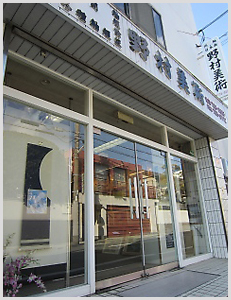
    Company Profile
    syaoku.jpg(120220 byte)

    Name Art Nomura


    President Tatsuji Nomura


    Founded1973


    Established1992


    Address7-23 Babadori, Tarumi-ku, Kobe city,
    Hyougo Prefecture, 655-0021, Japan


    Capital10 million yen


    URLhttp://nomurakakejiku.com


    Our Business

     Art Nomura is an art dealer which produces kakejiku (hanging scrolls). We mount many paintings and calligraphic works in kakejiku in my factory. Kakejiku are our main product. We also remount and repair old or damaged kakejiku. We share the traditional Japanese art of kakejiku with people all over the world.


    (or press ESC or click the overlay)
    Access Map

    Access Map


     The Japanese people have long set a high value on aesthetic senses since ancient times. As a result, the
    peculiar culture which is not seen in other countries blossomed and many aspects of the modern Japanese
    culture come from it. Parts of Japanese culture has been introduced to people in other countries recently,
    so the number of people from other countries who are interested in Japanese culture has been increasing.
    However, the Japanese aesthetic senses, which are the bases of Japanese culture, have been nurtured
    through a long history, intertwining various elements intricately, such as climate, geographical features,
    religion, customs and so on. Therefore, they are very difficult to understand not only for people from other
    countries, but even for the Japanese people. I think the best tool which conveys these difficult senses
    understandably is a “kakejiku.”
     The kakejiku (a hanging scroll; a work of calligraphy or a painting which is mounted and hung in an
    alcove or on a wall) is a traditional Japanese art. It's no exaggeration to say that paintings are what
    express aesthetic senses at all times and places. The kakejiku is an art which expresses the Japanese
    aesthetic senses. The kakejiku has long been used in traditional Japanese events, daily life and so on since
    ancient times. As a result, there are various customs of kakejiku in Japan; kakejiku and the life of the
    Japanese are closely related. We can see Japanese values through kakejiku.
     The kakejiku is a cultural tradition which the Japanese people should be proud of. However, many people
    in other countries don't know much about it because it hasn't been showcased as much. This is why I
    decided to try to introduce it. The kakejiku world is very interesting and beautiful. We want not only the
    Japanese, but also many people from other countries to know and enjoy it. I hope that many people will
    love kakejiku someday.

    (or press ESC or click the overlay)