
Kanashima Keika: A Master of Paintings in the Flower-and-Bird Genre Who Showed His Talent at the Bunten, the Teiten and the Nitten Exhibitions.
Peony Flowers in a Basket
In 1892, Kanashima Keika was born in Hiroshima Prefecture. At the age of 14, Keika moved to Ōsaka and there learned Japanese painting. And at the age of 19, he entered the school of Takeuchi Seihō. In 1918, Keika got his painting accepted for the first time for the 12th Bunten exhibition. Thereafter, he exhibited his works at the Teiten exhibitions, the Shin Bunten exhibitions, and the Nitten exhibitions. In 1925, he exhibited his work “Poppy” at the 6th Teiten exhibition, followed by “Kyūkō-ni naku (this phrase means: “A wise man may go into hiding, but his fame will be widely known to the world”)” at the 8th Teiten exhibition held in 1927, and “Peony” at the 9th Teiten exhibition in 1928. And for all these three works, he was awarded a special prize. After the World War Two, Keika was awarded the Minister of Education Prize for his work, “Carp”, at the 8th Nitten exhibition in 1952, and the Japan Art Academy Prize for another piece, “Winter Rice Field”, at the 9th Nitten exhibition in 1953. In 1964, he became a member of the Japan Art Academy. Keika also served as a judge for the Teiten, Shin Bunten, and Nitten exhibitions, and also as a member of the Nitten board of directors. He presided over a painting school, Kinugasa-kai, and died in 1974 at the age of 82.
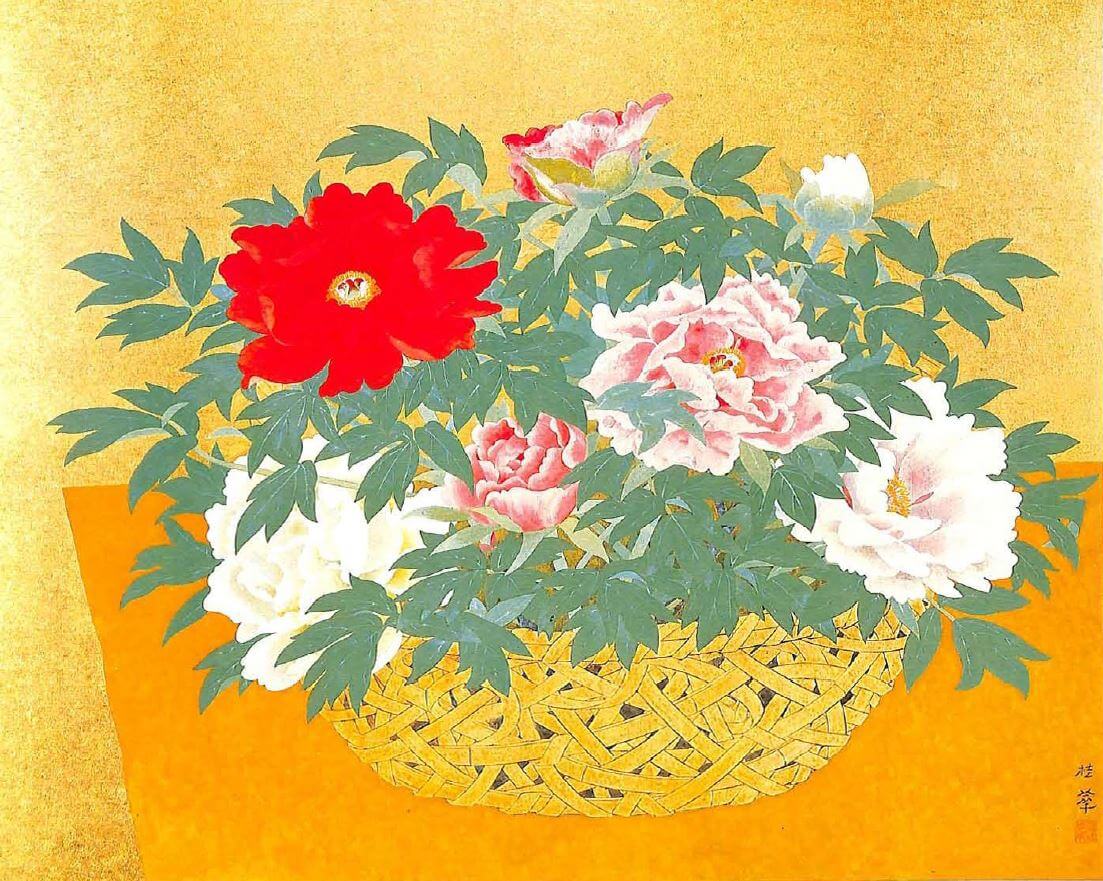
Keika’s work “Peonies Flowers in a Basket” fully expresses the exquisite grace and beauty of the peony which is also known as “king of flowers”. Crimson, pure white, and pale pink peonies in a bamboo basket were quietly smiling. The peony flowers are depicted so realistically that the viewers can even feel the smooth texture of the petals. The leaves, on the other hand, are depicted two-dimensionally in a greenish-blue color, which, together with the gold background, accentuates the gorgeous and strong peonies. It is a work created with a keen observation to see through the essence of the subject through which one can truly feel the breath of the peonies.
Peony Flowers
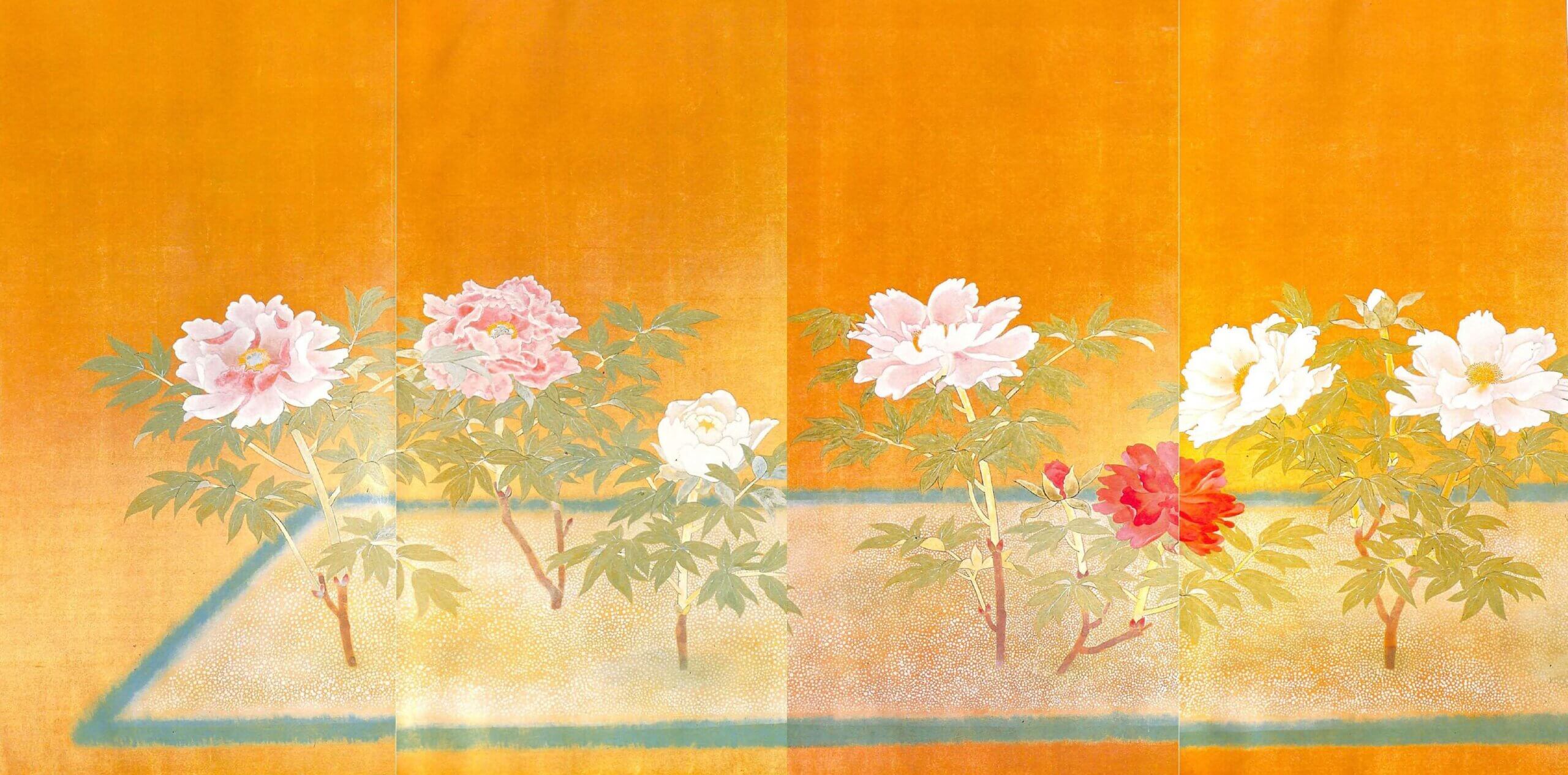
This painting depicts seven peony flowers in white, red, and pale pink blooming on six young trees planted in an open field. With his rigorous depiction and his use of fresh colors, based on a straightforward sketching method, Keika captured a moment of life of the delicate and gorgeous peonies that sway in the slightest breeze. In particular, its concise and static composition is creative. Keika gilded the background in the upper part of the canvas and thus created a wide space while positioning the flowers and enclosure of the flowerbed almost horizontally. Being created based on the study of masterpieces of ancient painting, in dignity, this work matches the paintings of Imperial Court Academy of the Song and Yuan dynasties in China while depicting beautiful peonies.
A Wild Goose
One of his works, “Flying Toward the Moon,” which was exhibited at the Nitten exhibition in 1967, depicts a large full moon in the azure sky and two geese in flight. This is a representative work of his later years, measuring 2 meters in width, and was his last work to be exhibited at the Nitten exhibition at the age of 75, after having diligently exhibited his works at the Bunten, Teiten, and the Nitten exhibitions since the age of 26. From then, until his death at the age of 82, Keika painted only small works and pastels. It is said that this vivid work, which depicts the beak, eyes, legs, and feathers of wild geese in the night sky, is a painting that visualized, in the clear and cloudless night sky, the mental and emotional scenery of Keika in his later years. In this piece, he depicted himself about to leave the front line as a flying goose.
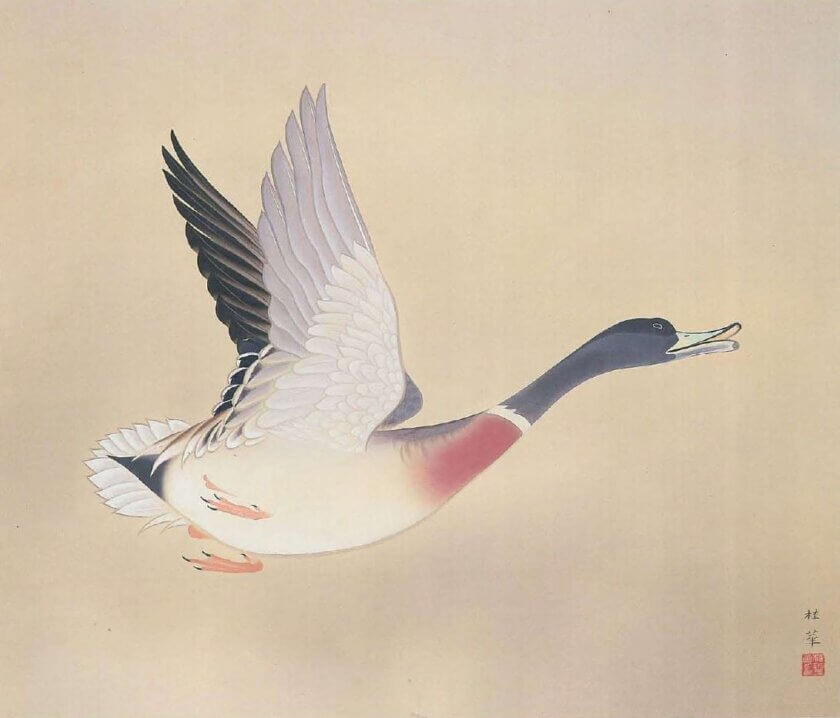
In this work, “A Wild Goose,” the goose, soaring leisurely through the sky, bears a striking resemblance to one of the two geese depicted in “Flying Toward the Moon,” and the former is probably the latter’s later work. The goose, portrayed in “A Wild Goose,” is painted from a slightly lower perspective than the goose depicted in the upper part of “Flying Toward the Moon,” and the pale gray color scheme applied to the goose in the former painting expresses a deeper state of tranquility than those in “Flying Toward the Moon.” The smooth streamline that leads from the goose’s beak to its neck and to the body, and the powerful depiction of the tips of its wings, are as exquisite as expected. Its gray blank space gives the impression of a desolate emptiness. It is a work of high dignity that shows the state of tranquility reached by a painter who continued to follow the orthodox style of Japanese painting based on austere sketching.
A Small Bird
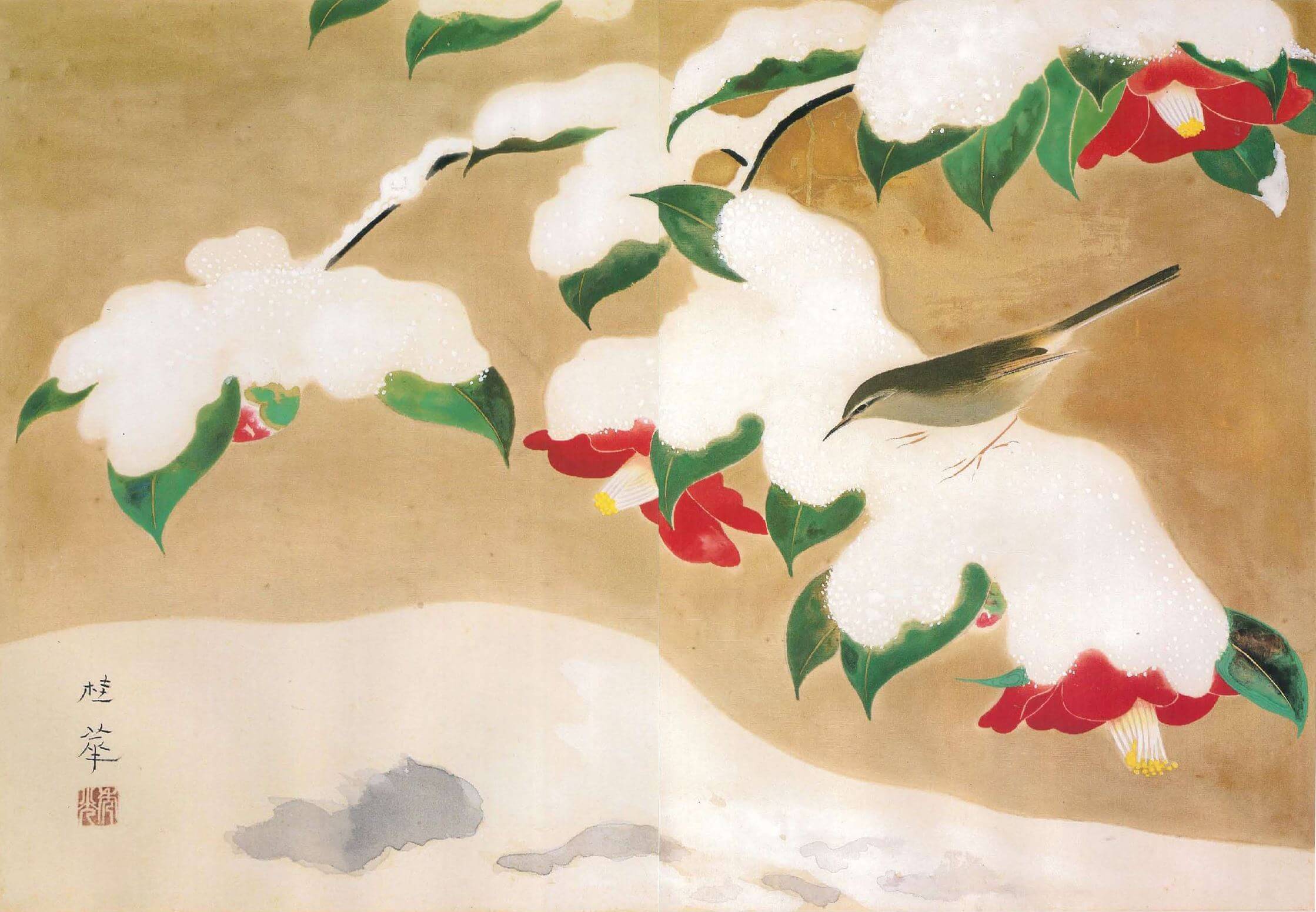
This piece depicts a small bird fluttered down on a camellia tree covered with snow. Both the camellias, sagging under the weight of the snow, and the white snow, which seemed to contain moisture, had a sense of heaviness. On the contrary, the slender little bird with its sharp beak seems light and cute. The small bird is probably a Japanese bush warbler that comes down to the plains in winter. The portrayal of the snow on the ground shaded in with a light touch and of the heavy camellia flowers and leaves are very much decorative. Contrarily, the Japanese bush warbler is painted realistically. This elegant work with a clean and fresh atmosphere shows the characteristic of the Japanese traditional flower-and-bird painting which gives endless poetic sentiment in the unexpected scene found in a corner of a garden.
Red Plum Blossoms
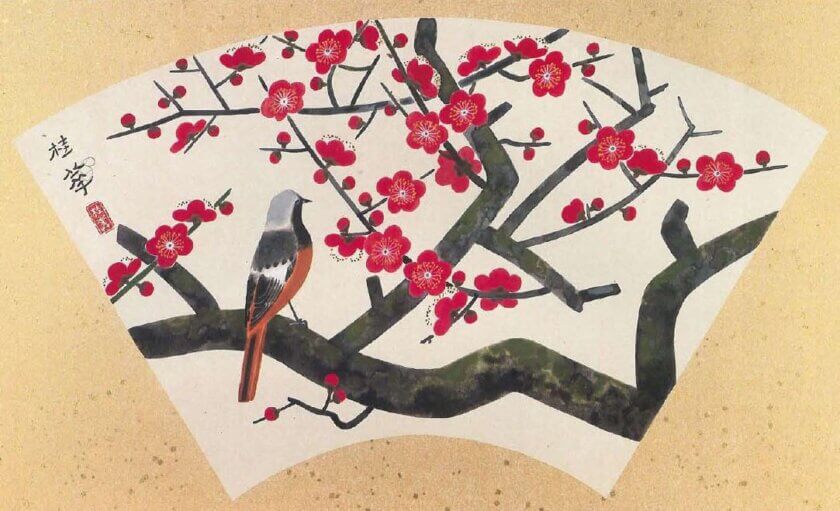
This piece, “Red Plum Blossoms” depicts plum blossoms on the entire fan surface, with a single daurian redstartin on the trunk. Daurian redstartin belongs to the same family as dusky thrush and is a winter bird that can often be seen in gardens of human habitations and parks. The thick, moss-covered, and zigzagged trunks of old plum trees are arranged across the lower part of the picture, and the red plum blossoms are scattered upward like a pattern. While the plum blossoms are depicted in a flat, decorative manner with no shading, the trunk and branches are shaded using tarashikomi technique and are very realistic. In his major pieces, Kanashima Keika has always done an impeccable and rigorous work. This piece, however, leaves a hint of a relaxed mood, as if he was taking it easy with his brush. In addition, the faint scent of red plum blossoms in full bloom can be felt in the crisp air of early spring. Although being small, it is a pleasant piece.