
Abe Shunpō : The Master of Kachō-ga Who Was Active in the Bunten and Teiten Exihibitions

Secchū Suikin(Waterfowls in the Snow)
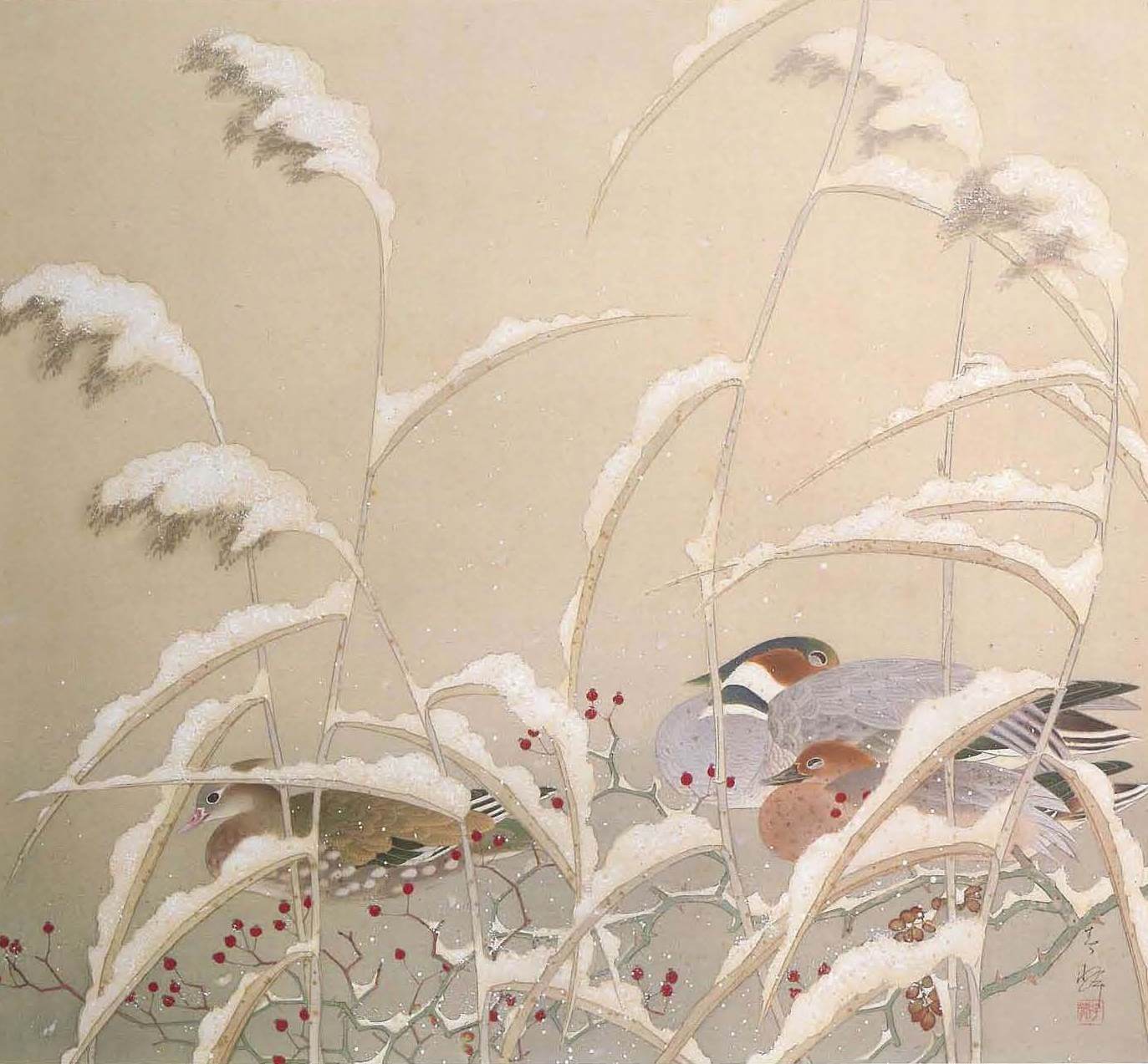
Secchū Suikin (Waterfowls in the Snow) by Abe Shunpō

Abe Shunpō was born in Fukuoka Prefecture in 1877. He went out to Kyōto and studied the techniques of drawing bird-and-flower in the Shijō style under Fukada Chokujō first. Then, he worked even harder to master it under his second master, Kikuchi Hōbun. He exhibited splendid bird-and-flower paintings at art exhibitions hosted by the government and left many of these paintings on the sliding doors of temples. He temporarily returned to his hometown Fukuoka, but after the Second World War, he returned to Kyōto. He died in 1956 at the age of 78 years old.

“Secchū Suikin-Zu (Waterfowls in the Snow)” was a work made in 1942 when Shunpō was 65 years old and it was a dedication painting to the military. The society was in the midst of wartime turmoil, and many of the subjects in Japanese paintings were intended to heighten the war spirit, but Shunpō painted a tranquil scene of waterfowl, a mandarin duck couple, and a single duck in the snow.

Snow settles on dry plants and leaves of the reeds by the water. The water is cold, and in this white world, the flamboyant mandarin ducks and the small red fruits of the multiflora rose are impressively depicted.

Still, we can say, the mandarin ducks are depicted in a restrained manner. Shunpō chose the theme: the bird-and-flower painting for his dedication artwork to the military, probably because that was what he was best at. The figure of waterfowl in the snow likely reflects Shunpō’s thoughts during the harsh wartime period. Depending on how you look at it, deep snow and thorny multiflora roses seem to express a social condition that is becoming more and more absorbed in a military-controlled society day by day. The painting captures waterfowl floating in the water, which Shunpō was accustomed to depicting. In front, there are dry reeds covered with snow. The composition skillfully produces subtle movements in the quiet painting since the viewers feel as if they peer into the waterfowl in the water through reeds. The male mandarin duck is dozing with half-open eyes, while the female mandarin duck has her eyes open and seems to look for something. We can read a slight movement here too.

Although the work lacks the decorativeness unique to bird-and-flower paintings, it is a work that we can see through the experienced technique of Shunpō, who has devoted his life to this kind of painting.
    NameRequired

    SexRequired

    MaleFemale

    CountryRequired

    e-mailRequired

    CommentRequired

    Attached File
    ※Up to 3 MB for each file.


    ← ← "MUST CHECK" / Please confirm the above contents again and check this button.

    Contact Us

    Please fill out the form below and submit for your inquiry.

    ❈FirstName
    ❈LastName
    Country
    ❈E-mail
    (❈Confirm E-mail)
    ❈Inquiry category Question
    Consultation
    Impression
    Request
    Others
    ❈Comment

    is the mark for required item.


    Your privacy is important to us. We are committed to protecting your privacy.

    (or press ESC or click the overlay)

    CEO Message

    Our Feelings For Kakejiku


     The Japanese people have long set a high value on aesthetic senses since ancient times. As a result, the
    peculiar culture which is not seen in other countries blossomed and many aspects of the modern Japanese
    culture come from it. Parts of Japanese culture has been introduced to people in other countries recently,
    so the number of people from other countries who are interested in Japanese culture has been increasing.
    However, the Japanese aesthetic senses, which are the bases of Japanese culture, have been nurtured
    through a long history, intertwining various elements intricately, such as climate, geographical features,
    religion, customs and so on. Therefore, they are very difficult to understand not only for people from other
    countries, but even for the Japanese people. I think the best tool which conveys these difficult senses
    understandably is a “kakejiku.”
     The kakejiku (a hanging scroll; a work of calligraphy or a painting which is mounted and hung in an
    alcove or on a wall) is a traditional Japanese art. It's no exaggeration to say that paintings are what
    express aesthetic senses at all times and places. The kakejiku is an art which expresses the Japanese
    aesthetic senses. The kakejiku has long been used in traditional Japanese events, daily life and so on since
    ancient times. As a result, there are various customs of kakejiku in Japan; kakejiku and the life of the
    Japanese are closely related. We can see Japanese values through kakejiku.
     The kakejiku is a cultural tradition which the Japanese people should be proud of. However, many people
    in other countries don't know much about it because it hasn't been showcased as much. This is why I
    decided to try to introduce it. The kakejiku world is very interesting and beautiful. We want not only the
    Japanese, but also many people from other countries to know and enjoy it. I hope that many people will
    love kakejiku someday.

    (or press ESC or click the overlay)
    Company Profile
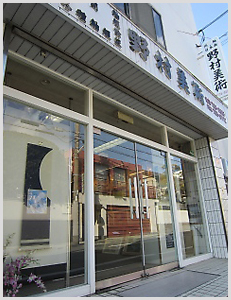
    syaoku.jpg(120220 byte)

    Name Art Nomura


    President Tatsuji Nomura


    Founded1973


    Established1992


    Address7-23 Babadori, Tarumi-ku, Kobe city,
    Hyougo Prefecture, 655-0021, Japan


    Capital10 million yen


    URLhttp://nomurakakejiku.com


    Our Business

     Art Nomura is an art dealer which produces kakejiku (hanging scrolls). We mount many paintings and calligraphic works in kakejiku in my factory. Kakejiku are our main product. We also remount and repair old or damaged kakejiku. We share the traditional Japanese art of kakejiku with people all over the world.


    (or press ESC or click the overlay)
    Access Map

    Access Map


     The Japanese people have long set a high value on aesthetic senses since ancient times. As a result, the
    peculiar culture which is not seen in other countries blossomed and many aspects of the modern Japanese
    culture come from it. Parts of Japanese culture has been introduced to people in other countries recently,
    so the number of people from other countries who are interested in Japanese culture has been increasing.
    However, the Japanese aesthetic senses, which are the bases of Japanese culture, have been nurtured
    through a long history, intertwining various elements intricately, such as climate, geographical features,
    religion, customs and so on. Therefore, they are very difficult to understand not only for people from other
    countries, but even for the Japanese people. I think the best tool which conveys these difficult senses
    understandably is a “kakejiku.”
     The kakejiku (a hanging scroll; a work of calligraphy or a painting which is mounted and hung in an
    alcove or on a wall) is a traditional Japanese art. It's no exaggeration to say that paintings are what
    express aesthetic senses at all times and places. The kakejiku is an art which expresses the Japanese
    aesthetic senses. The kakejiku has long been used in traditional Japanese events, daily life and so on since
    ancient times. As a result, there are various customs of kakejiku in Japan; kakejiku and the life of the
    Japanese are closely related. We can see Japanese values through kakejiku.
     The kakejiku is a cultural tradition which the Japanese people should be proud of. However, many people
    in other countries don't know much about it because it hasn't been showcased as much. This is why I
    decided to try to introduce it. The kakejiku world is very interesting and beautiful. We want not only the
    Japanese, but also many people from other countries to know and enjoy it. I hope that many people will
    love kakejiku someday.

    (or press ESC or click the overlay)