Murakami Kagaku: A Japanese-style Painter, Having Kept on Exploring the Path for the ‘Real Artist’, Overwhelmingly Acclaimed by the Art Experts
Peonies with Frolicking Butterflies
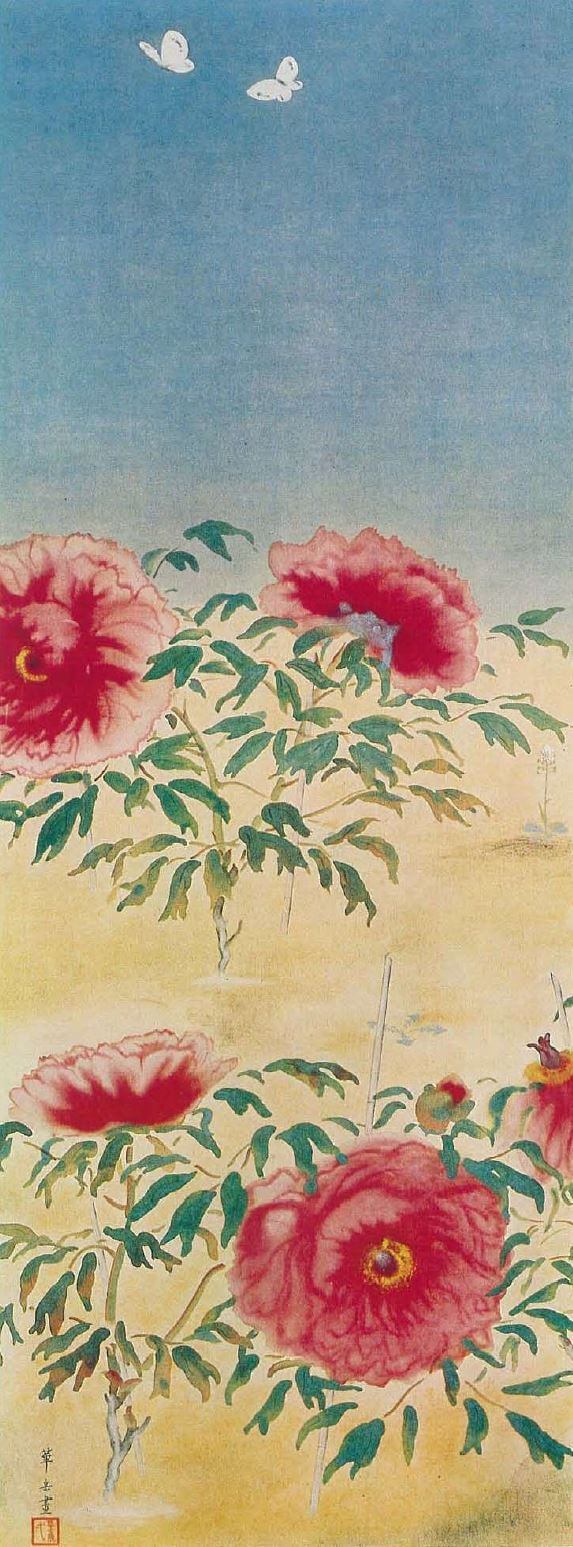
Around the time when Murakami Kagaku drew this work ‘Peonies with Frolicking Butterflies’, he also had often depicted in his works the image of ‘maiko’ or geiko apprentice. (Geiko is a professional entertainer who attends guests during meals, banquets, and other occasions.) Peonies in this work somewhat remind us of the appearance of maiko which Kagaku had drawn: To our closed eyes appear the lovely maikos dressed in the gorgeous clothing, being completely absorbed in dancing, who still possess a delicate fragility and are somehow in common with the transient beauty of peonies in full bloom.
In the work ‘Peonies with Frolicking Butterflies’, though the peony trees themselves are short, the large flowers of peonies are blooming, seemingly mysteriously overreaching themselves as if maikos make up and decorate themselves each as a lady instead of a girl. The fascinating beauty of the large deep red flowers overwhelms the screen, with their red color recalling the smell of the powder or lipstick on maiko’s face rather than just the natural color blessed with the sunshine, with the vivid green color of leaves likewise reminding us of some artificial atmosphere. The soft, comfortable, and rhythmic brush lines are creating the touch of an enticing spring, with butterflies frolicking in the blue sky, seemingly half in a dream attracted by the bewitching peony flowers, as if the butterflies are refined people wandering in the street of red-light district.
Kagaku drew peonies in his last work, too, which was a sumi-e, unfolding a world of just one color, the sumi ink, without any dazzling coloring. The painter, Kagaku, had concentrated the magnificent and gorgeous peony flowers into the black world, reviving them once again as brilliant flowers on his own. The peonies depicted in the work ‘Peonies with Frolicking Butterflies’ as well as in his last work exceedingly show us the psychological path that the painter had pursued.
Murakami Kagaku was born in 1888 to the family of Takeda in Ōsaka and was accepted for some reasons by the family into which his aunt had married. Upon his father’s death, he was adopted as heir to the aunt’s family, changing his surname to Murakami, was separated from his own mother at his young age, which caused him irreparable pain in his childish mind. His unfortunate and complex background must have some connection with the fact that a kind of dark shadow is looming in his works. He moved to Kyōto in 1903 and enrolled in the Kyōto City Technical School of Arts, attended secondly the Kyōto City Specialist School of Painting (the present Kyōto City University of Arts), then went further onto the graduate course of the Specialist School. Together with four other young Japanese-style painters, Tsuchida
Bakusen, Sakakibara Shihō, Ono Chikkyō, Nonagase Banka, who were all colleagues at the Kyōto City Specialist School of Painting, Kagaku cofounded the ‘Kokugasōsakukyōkai’ in 1918, to which those five painters had sent their highly committed works one after another. Soon after Kagaku sent his work to the 5th Kokugasōsakukyōkai exhibition in 1926, he moved to the house of his adoptive father in Hanakuma, Kōbe city, and had devoted himself to just drawing works without sending them to any of exhibitions, living his life like a hermit, which kind of life had continued until right before his death.
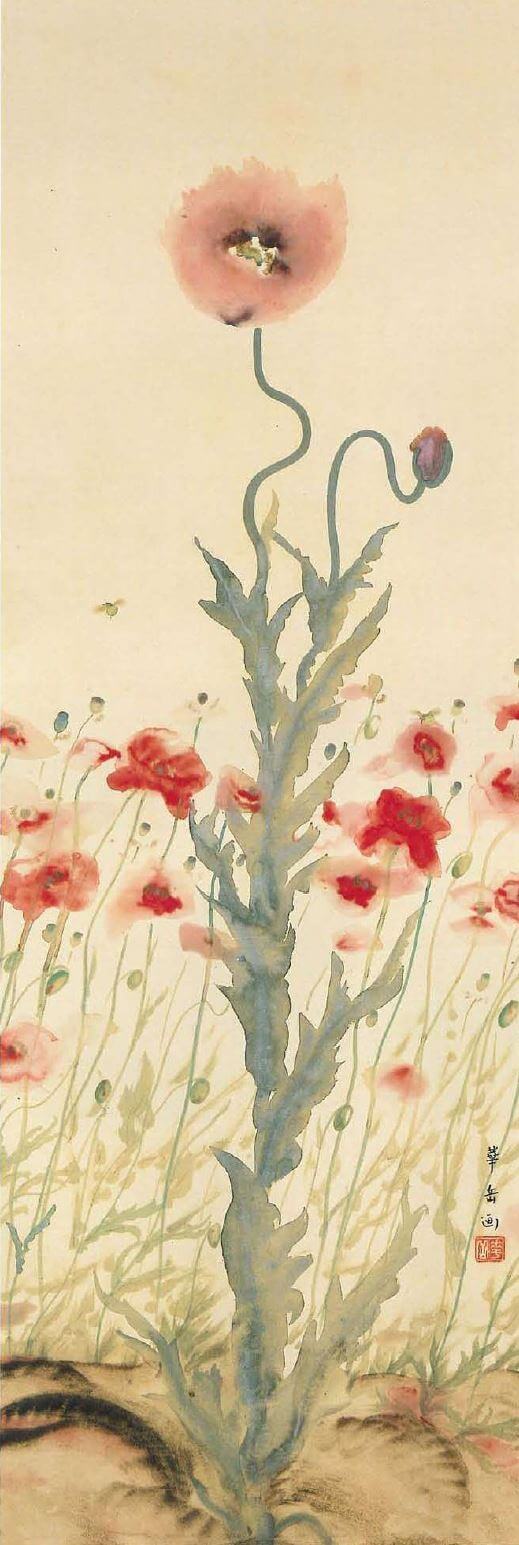
Gubijinsō (Field Poppies)
In as short as 52 years of Murakami Kagaku’s life, seemingly a bit too hurried one, his painting works are equipped with sincerity that somehow touches people’s heart. His history as a painter started from the enrollment in the Kyōto City Technical School of Arts in 1903 and the graduation from the school in 1907. He was born and raised in Ōsaka, learned painting techniques in Kyōto, was sending his works mainly to the Kokugasōsakukyōkai exhibition, then moved to Kōbe. Some speculate that the sprout of Kagaku’s art world in later years had already started to come out in his boyhood by the time he came to Kyōto, which would be anybody’s guess. Except for the two works drawn in the early time of his painting life, ‘Around the Time of February’ and ‘Around the time of Rice Transplanting’(Those were sent to the 5th and 6th Bunten exhibition respectively), what is clear, however, is that Murakami Kagaku’s lifelong theme hidden in Murakami Kagaku’s mind cannot be expressed only by one simple thought or just the words of a few lines long, such as ‘his longing for the female image who is still humane psychologically as well as physically, but transcends somehow the framework of humankind’, or ‘the embodiment of the ideological existence abstracted essentially from the humane things’ and so on. Kagaku for sure had drawn various subjects in his works at each stage of his painter’s life such as the ‘development’, the ‘transition’, and the ‘completion/maturity’ stage – those stages, by the way, had been just categorized by art experts in later years. His works at each stage eventually had converged on the world of the Buddhist paintings and of sceneries as his mental images in the later years of his painter’s life. His way of life hidden behind such a painting world is also just a matter of speculation unless Kagaku talks about himself. It is, nonetheless, true that the works Kagaku drew have made many art experts comment on him in later years, which had told much more than Kagaku himself. Therefore, Kagaku has been regarded as an unparalleled person that the modern Japanese-style painting had brought forth, though he had drawn few masterpieces.
The plant ‘gubijinsō’ depicted in this work is also known as ‘field poppy’. The field poppy drawn in the center of the screen is clearly personified, which is nothing, but the image of a woman symbolized by the poppy. In 1915 two years before this work was drawn, he got married at the age of 28, having a baby as his first beloved son in 1918. The taste of the beautiful poppy in this work ‘Gubijinsō’ have unmistakably led to one of his masterpieces, ‘Naked Lady’, sent to the 3rd Kokugasōsakukyōkai exhibition in 1920, though the work ‘Gubijinsō’ of course may not appear to be directly connected with the work ‘Naked Lady’ depicting the person as his ‘eternal lady’. The aspiration for the eternal beauty shown in ‘Naked Lady’ has something in common with the poppy in ‘Gubijinsō’ which conveys the feminine loveliness as well as beauty far more than typical Ukiyo-e paintings of beautiful women.
White Plum
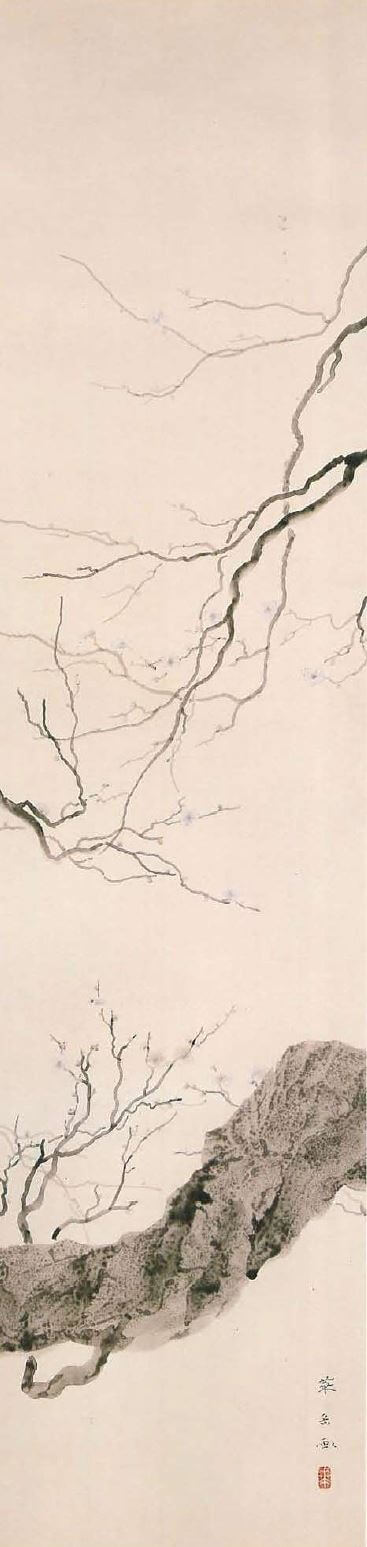
In the year 1927 when this work was drawn, Kagaku moved to Kobe. Though he, as a member of the Kokugasōsakukyōkai established in 1918, enthusiastically continued his painting work based on the founding principle of the association, he had started to feel that his own artworks were turning into the ones, totally different in taste from the works generally sent to the exhibitions. Kagaku started to have such a feeling, as the characteristics of the Kokugasōsakukyōkai exhibition had changed from the one for the association’s members into the different one in its nature, expanding greatly to the extent that was characterized as the exhibition for publicly chosen pieces. He had the desire to translate what he heard as spiritual voices from the inner deep world into his painting works, putting his emphasis persistently on something spiritual and religiously sublime. He just after all wanted to flee from the secular concerns. He did not send his work to the Kokugasōsakukyōkai exhibition that year. In the next year of 1928, the first section of the association for Japanese-style paintings was regrettably resolved. (The second section for Western-style paintings has continued up to the present under the new name of the ‘Kokugakai’ while succeeding the name commonly known as the ‘Kokuten’ exhibition.) Kagaku had afterward distanced himself from any of art circles, just for the sake of his paintings.
While he, like a hermit, had struggled to establish his own art world in the street of the red-light district of Hanakuma, Kōbe city, on one hand, he had indulged in the joy of drawing works on the other. Drawing works for him was equal to be religious as well as seeking for spiritual truth. Since he always had drawn whatever small pieces of work in real earnest, like fighting for his pride, there were no Kagaku’s works which were said to be carelessly drawn or cutting corners. ‘White Plum’, not a mighty work, but still conveying the painter’s spirit, splendidly depicts the dignity of the plum, with the thick trunk, thin twigs, and pretty flowers being powerful, elegant, and graceful, effectively utilizing the beauty of the sumi ink’s thin coloring. The painter must have heard the spiritual voice of the flower- the plum is not the real flower, but the flower of truth: the ideal form of plum hidden deep in the inner part of Kagaku. The reason why we are attracted to Kagaku’s works is that he had been searching for the real essence of the painting subjects, thereby depicting their true nature rest in the deep inner world.