Katayama Nanpū: A Core Painter, Recognized by Yokoyama Taikan, Leading the Japanese Art World in the Taishō through the Shōwa Period
Cherry Blossoms
Katayama Nanpū was born in Kumamoto city in 1887. Though he was born in the family of a wealthy merchant, his life had been always overwhelmed by misfortunes. Nanpū’s mother, reputed to be beautiful, was snatched away by a sudden death when Nanpū had not yet reached 1 year old. His father also died when Nanpū was 7 years old. With his father’s death triggering the wane of his family’s fortune, he finally had to quit school and work to help with the family budget at the age of 14 years old while being raised by his grandfather. He had two elder brothers and one younger brother. His family under the extreme poverty due to being in debt, could not help but give up their house, which was followed by the death of his grandfather and his eldest brother when Nanpū was 20 years old. Even after he could stand on his own as a painter, he lost his younger brother at the age of 32 and his second oldest brother at 41. He was destined to have a thin relationship with his immediate family. As for his artwork, he had devoted himself to painting works while earning money for his family under the extreme poverty. It was 1909 when he came to Tōkyō with his senior associates at the age of 23 that his long-time desire of betting his life on a painter in Tokyo finally came true. It was considerably a late starting at the time of the Meiji period when many would-be painters had started to learn at painting schools as early as the age of 10 years old. Okumura Togyū, for example, had already received the ‘santō-shō’ prize in the ‘Tatsumigakai’ exhibition in 1909 when Nanpū just came to Tokyō. At any rate, Katayama Nanpū’s life as a painter had started under such a severe circumstance.
A well-known masterpiece in the early time of his life as a painter is ‘Around the Time of Shimotsuki (November)’, which was sent to the 7th Bunten exhibition in 1913. Though he had been already awarded a prize at the Tatsumigakai exhibition even under tough circumstances after he came to Tōkyō, until ‘Around the Time of Shimotsuki’ was awarded a prize in the Bunten exhibition for the first time (He won the ‘Nitō-shō’ prize, the highest prize in effect since there were no appropriate works to be awarded the highest ‘Ittō-shō’ prize.), his work had been rejected four times in the former Bunten exhibitions. His work ‘Around the Time of Shimotsuki’ could receive the prize in the Bunten exhibition due to the recommendation by Yokoyama Taikan, one of the judges for the exhibition at that time. The winning of the prize must have been fateful for Nanpū as well as the present Inten exhibition since it had given Nanpū the direct opportunity for him to model himself on Taikan and to involve himself in the Nihon Bijutsuin’s operation in later years.
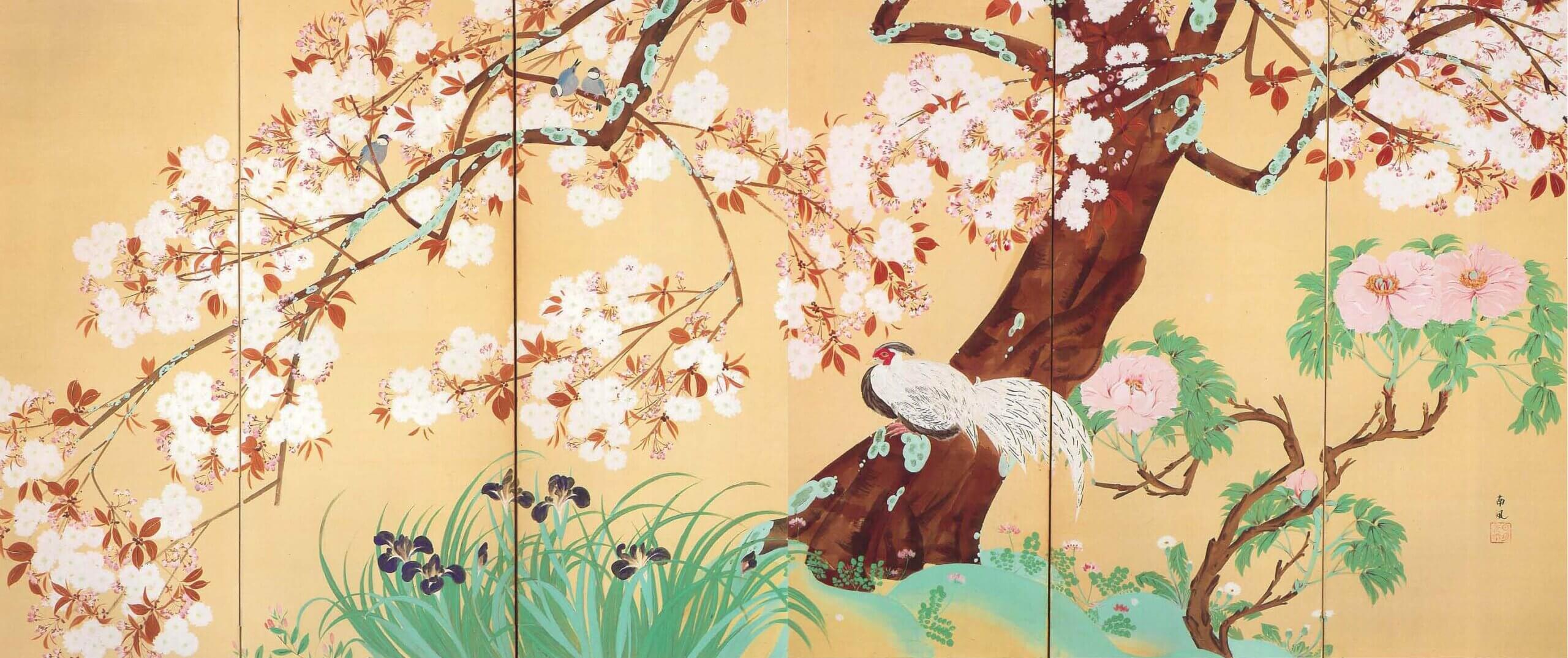
The work ‘Cherry Blossoms’ shown here was drawn in 1921 when Nanpū was 35 years old. This depicts cherry blossoms predominantly covering the space of the one six-panel folding screen, a silver pheasant (a kind of pheasant) standing on the thick trunk and playing java sparrows on the twigs. This work was one of those drawn at the earliest stage of his painter’s life. Although his work ‘Around the Time of Shimotsuki’ attracted people’s attention due to his excellent achievement in the Bunten exhibition, he had been somewhat at a loss what to draw, painting as a result a broad range of works from the Ukiyo-e paintings of beautiful women, the Buddhist paintings even to such a work as ‘The Evening in the Tropical Country’ in which Nanpū depicted what he had experienced during his trip to India. In the same year when the ‘Cherry Blossoms’ was drawn, Nanpū completed the work ‘The morning in the Snow’, a work depicting a beautiful woman in the snow with the painting style like that of Yamato-e. The work ‘Cherry Blossoms’ shows the aspect of relaxed and still dynamic composition as if reflecting the feeling of Nanpū at that time: while drawing the work such as ‘The morning in the Snow’ on one hand, he had in fact started to be attracted to the subject of bird-and-flower paintings on the other. ‘Cherry Blossoms’ with each depiction of peony flowers, cherry blossom flowers, a silver pheasant is a valuable one in terms of being allusive to the future unfolding of the Nanpū’s bird-and-flower painting world.
‘Yayoi (March)’
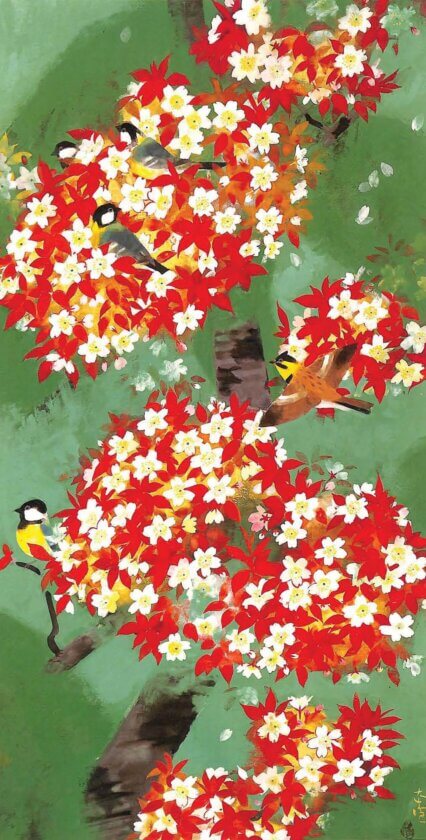
‘Yayoi (March)’ was sent to the Nihon Bijutsuin Shunkiten exhibition in 1965. It depicts wild cherry blossoms, with the green background recalling the deep in the mountains, as well as several yellow-throated buntings. This colorful bird-and-flower-painting is one of typical works representing Nanpū’s painting style with a rich sense of color. His painting style, however, had already made various transformations by around this time from the post-war period. Though he had mainly drawn bird-and-flower paintings around the time when he was nominated for one of the Nihon Bijutsuin’s steering Committee member in 1924, a series of works depicting fishes drawn around the early Showa period was full of dynamism making good use of the screen composition of the rhythmic movement of fishes and their graceful appearances, widening the painting world expressed by Katayama Nanpū. In the post-war period, he had drawn many works depicting human characteristics centering around the subject of the static world or figure, which remarkably contrasted with the dynamic world of fishes. Since around 1957 when he became a member of the Japan Art Academy, he had unfolded his diversified painting world ranging from still-life, figure to bird-and-flower paintings. Looking ‘Yayoi’ with this kind of Nanpū’s background of his diversified world in mind enables us to feel relaxed and profound taste of the work, which resulted from his unceasing inquiry.