
Mochizuki Unsō: A Disciple of Tsubaki Chinzan in Enshū Region and an Expert of Bird-and-Flower Painting.

Mokuren Botan (Magnolia and Peonies)
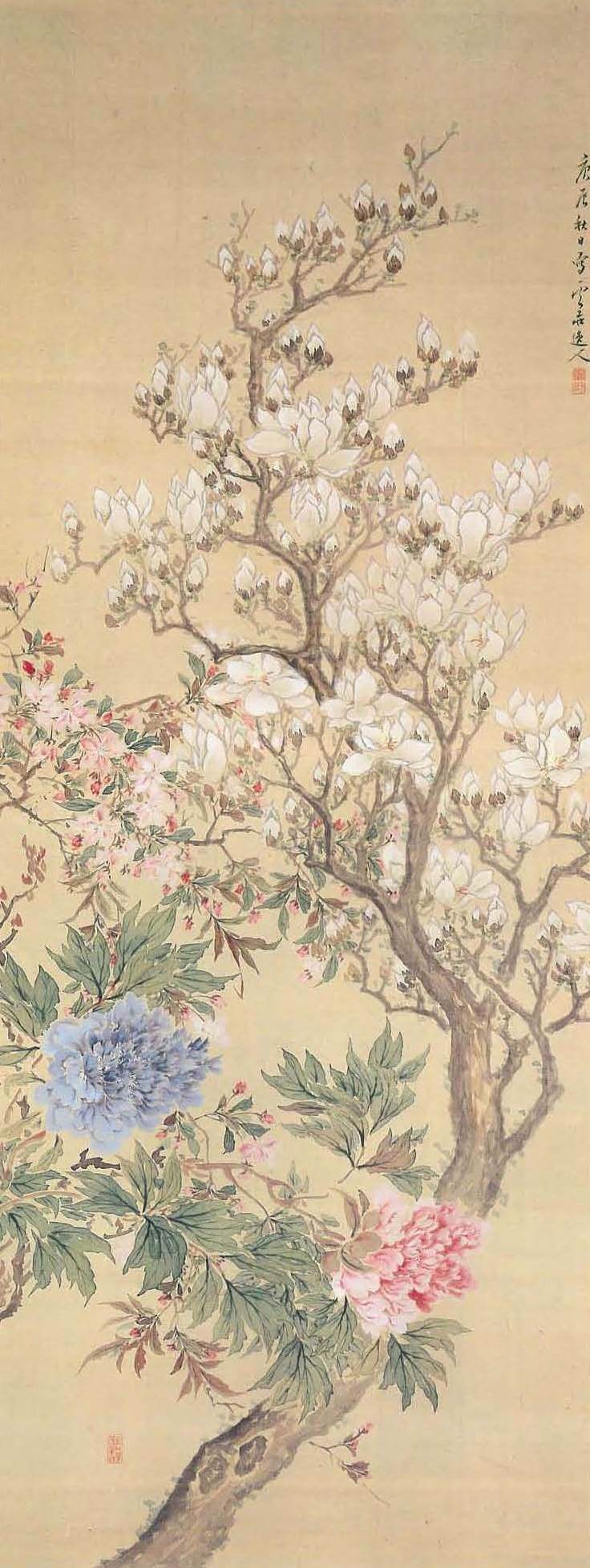
Mokuren Botan (Magnolia and Peonies) by Mochizuki Unsō

Mochizuki Unsō was born in Edo in 1832. He was a disciple of Tsubaki Chinzan and senior to Watanabe Shōka and Tsubaki Kakoku (the eldest son of Tsubaki Chinzan). He was one of the painters who experienced the turbulent times of the early Meiji period. Chinzan was born into a samurai family, so he only took disciples from the samurai class. Unsō was a former shogunate retainer, so he was allowed to study under Chinzan, and his natural talent for coloring was admired by Chinzan. It is said that when Chinzan was busy, he asked Unsō to teach his disciples (more than 30), including Watanabe Shōka and Tsubaki Kakoku.

The painting of magnolia, a hall crabapple and peony is called “Gyokudō-Fuki-Zu (a painting of wealth and fame)” and the painting combines all three, with a large white flowering magnolia at the top and white-red, and purple peonies swaying in the wind at the bottom. Peony was a specialty of the artists in the Kazan Watanabe and Tsubaki Chinzan families, and this painting is no exception. The mokkotsu technique, which he probably learned from Chinzan, is particularly effective on peony flowers and leaves. The beauty of the coloring is also fully demonstrated in the peonies and the red-tinted hall crabapples. The reason why there are so few remaining works by Unsō, who excelled in paintings of flowers and birds, may be that he suffered a hard time in his life as a samurai and a painter before and after the Meiji Restoration. In each of his works, there are faint traces of his study of Tsubaki Chinzan. Unsō died in Tokyo in 1896.


  • Mokkotsu: A technique where the object is expressed by the shading of sumi ink or color rather than by using outlines (koppō.) It is widely known as a technique for kachō-ga (paintings of flowers and birds).

Naten Suisen (Nandina Domestica and Daffodil)
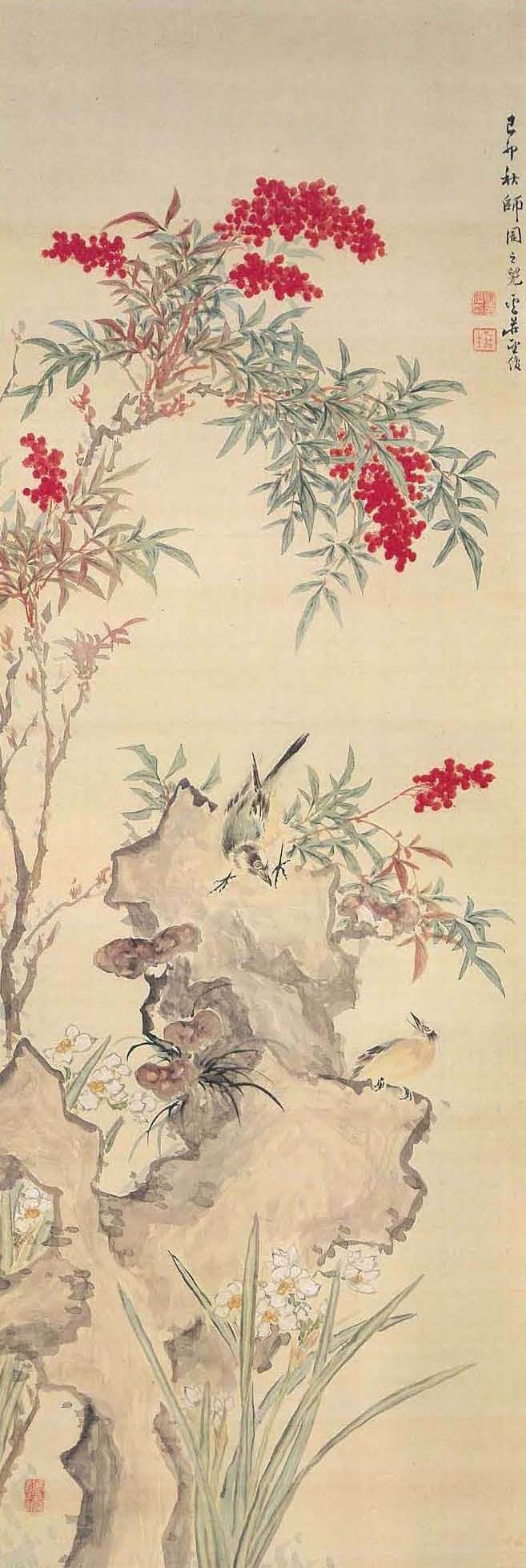
Naten Suisen (Nandina Domestica and Daffodil) by Mochizuki Unsō

This work was created in the autumn of 1888 and depicts nandina domestica with abundant clusters of round red berries covering the upper part of the painting. Two small birds with whiteheads are chirping on the rocks, which looks like Taihu stones or dead trees, creating a lively atmosphere. The red of the nandina domestica is so vivid that it catches the viewer’s eye.
The painting also depicts reddish-brown Reishi mushrooms and white-flowered daffodils around the rocks. The painting gives us a harmonious and gentle feeling like when we see the artwork of Tsubaki Chinzan, probably because it is mainly created on the mokkotsu technique. A method of applying a ground or primer on a screen has been passed down from Unsō to Yamashita Seijō. From the Meiji 10s to the 20s, Nanga painting was at its peak. Unsō left Tokyo under these circumstances and became an outstanding painter who supported the rise of Nanga in the provinces. Much about Unsō’s life remained unclear, and it is only recently that his year of birth and death have been discovered.
    NameRequired

    SexRequired

    MaleFemale

    CountryRequired

    e-mailRequired

    CommentRequired

    Attached File
    ※Up to 3 MB for each file.


    ← ← "MUST CHECK" / Please confirm the above contents again and check this button.

    Contact Us

    Please fill out the form below and submit for your inquiry.

    ❈FirstName
    ❈LastName
    Country
    ❈E-mail
    (❈Confirm E-mail)
    ❈Inquiry category Question
    Consultation
    Impression
    Request
    Others
    ❈Comment

    is the mark for required item.


    Your privacy is important to us. We are committed to protecting your privacy.

    (or press ESC or click the overlay)

    CEO Message

    Our Feelings For Kakejiku


     The Japanese people have long set a high value on aesthetic senses since ancient times. As a result, the
    peculiar culture which is not seen in other countries blossomed and many aspects of the modern Japanese
    culture come from it. Parts of Japanese culture has been introduced to people in other countries recently,
    so the number of people from other countries who are interested in Japanese culture has been increasing.
    However, the Japanese aesthetic senses, which are the bases of Japanese culture, have been nurtured
    through a long history, intertwining various elements intricately, such as climate, geographical features,
    religion, customs and so on. Therefore, they are very difficult to understand not only for people from other
    countries, but even for the Japanese people. I think the best tool which conveys these difficult senses
    understandably is a “kakejiku.”
     The kakejiku (a hanging scroll; a work of calligraphy or a painting which is mounted and hung in an
    alcove or on a wall) is a traditional Japanese art. It's no exaggeration to say that paintings are what
    express aesthetic senses at all times and places. The kakejiku is an art which expresses the Japanese
    aesthetic senses. The kakejiku has long been used in traditional Japanese events, daily life and so on since
    ancient times. As a result, there are various customs of kakejiku in Japan; kakejiku and the life of the
    Japanese are closely related. We can see Japanese values through kakejiku.
     The kakejiku is a cultural tradition which the Japanese people should be proud of. However, many people
    in other countries don't know much about it because it hasn't been showcased as much. This is why I
    decided to try to introduce it. The kakejiku world is very interesting and beautiful. We want not only the
    Japanese, but also many people from other countries to know and enjoy it. I hope that many people will
    love kakejiku someday.

    (or press ESC or click the overlay)
    Company Profile
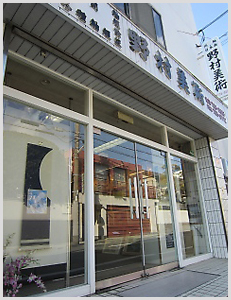
    syaoku.jpg(120220 byte)

    Name Art Nomura


    President Tatsuji Nomura


    Founded1973


    Established1992


    Address7-23 Babadori, Tarumi-ku, Kobe city,
    Hyougo Prefecture, 655-0021, Japan


    Capital10 million yen


    URLhttp://nomurakakejiku.com


    Our Business

     Art Nomura is an art dealer which produces kakejiku (hanging scrolls). We mount many paintings and calligraphic works in kakejiku in my factory. Kakejiku are our main product. We also remount and repair old or damaged kakejiku. We share the traditional Japanese art of kakejiku with people all over the world.


    (or press ESC or click the overlay)
    Access Map

    Access Map


     The Japanese people have long set a high value on aesthetic senses since ancient times. As a result, the
    peculiar culture which is not seen in other countries blossomed and many aspects of the modern Japanese
    culture come from it. Parts of Japanese culture has been introduced to people in other countries recently,
    so the number of people from other countries who are interested in Japanese culture has been increasing.
    However, the Japanese aesthetic senses, which are the bases of Japanese culture, have been nurtured
    through a long history, intertwining various elements intricately, such as climate, geographical features,
    religion, customs and so on. Therefore, they are very difficult to understand not only for people from other
    countries, but even for the Japanese people. I think the best tool which conveys these difficult senses
    understandably is a “kakejiku.”
     The kakejiku (a hanging scroll; a work of calligraphy or a painting which is mounted and hung in an
    alcove or on a wall) is a traditional Japanese art. It's no exaggeration to say that paintings are what
    express aesthetic senses at all times and places. The kakejiku is an art which expresses the Japanese
    aesthetic senses. The kakejiku has long been used in traditional Japanese events, daily life and so on since
    ancient times. As a result, there are various customs of kakejiku in Japan; kakejiku and the life of the
    Japanese are closely related. We can see Japanese values through kakejiku.
     The kakejiku is a cultural tradition which the Japanese people should be proud of. However, many people
    in other countries don't know much about it because it hasn't been showcased as much. This is why I
    decided to try to introduce it. The kakejiku world is very interesting and beautiful. We want not only the
    Japanese, but also many people from other countries to know and enjoy it. I hope that many people will
    love kakejiku someday.

    (or press ESC or click the overlay)