
Mizukami Taisei: A Master of Bird-and-Flower Painting Who Loved the Peaceful Four Seasons

Chrysanthemum Flowers on a Woven Fence
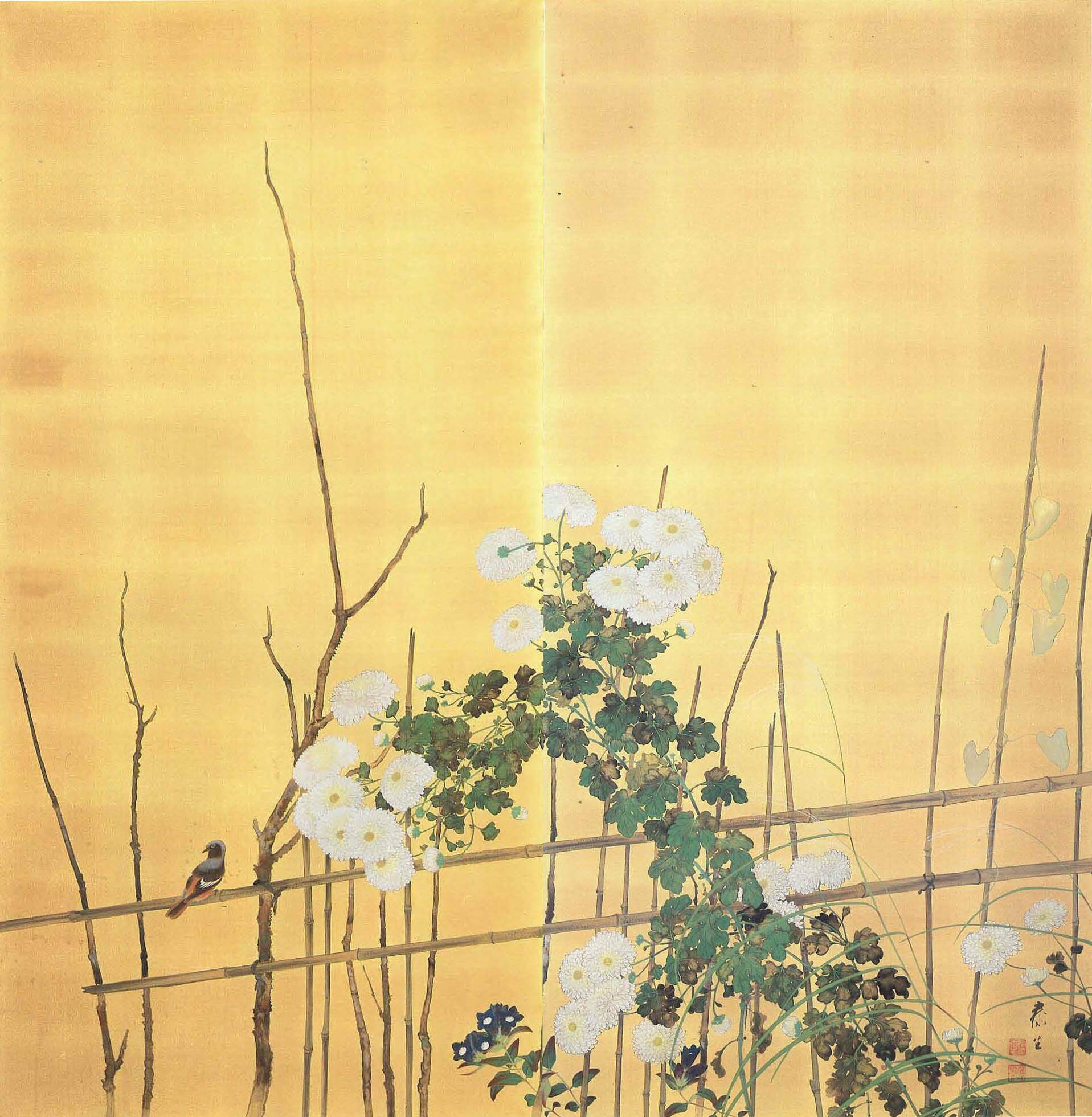
Chrysanthemum Flowers on a Woven Fence by Mizukami Taisei

Mizukami Taisei was born in 1882 in Fukuoka prefecture. After graduating from the Tokyo Fine Arts School’s program of Japanese Painting, he studied under Terasaki Kogyō and aspired to exhibit his works at Bunten exhibitions. His first work to be selected was ‘Kiri (Paulownia)’ at the seventh Bunten exhibition, held in 1913. Despite following his master’s style, the artwork was a tour de force with its bold lines and the elegant presence of paulownia flowers and the petals on the ground, demonstrating his cunning artistic talent. Although ‘Ryukyū no Hana (The Flowers of Ryukyū,)’ exhibited at the eighth Bunten exhibition, also drew inspiration from his master, the painting powerfully captures the patterns of tropical and colorful flowers as if to embody Mizukami Taisei’s vibrant passion as a young man. His flamboyant style was further defined in his 1915 piece, ‘Karafuto (Sakhalin.)’ This bird-and-flower painting includes various types of flowers and trees, giving it a decorative and splendid style with a charm similar to that of the Rinpa school paintings. Taisei won the second prize for this painting. As he went on to exhibit another work from Sakhalin the following year, it is almost certain that he traveled to Hokkaidō and Sakhalin around this time. He did not exhibit his works at the Bunten and Teiten exhibitions for a period of time, but presented a highly realistic bird-and-flower painting titled ‘Tsuyuake no Koro (Around the End of the Rainy Season)’ at Teiten’s fourth exhibition in 1922, and was granted the right to exhibit his works without undergoing the selection procedure in 1928. His expression of birds and flowers became dominated by gentle and sentimental touches in the Shōwa period as his passion from his early years calmed, and it seems that Taisei’s expressions never exceeded his previously adopted decorative style. It is likely that the highly militant climate of that time-limited the society’s capacity to create space for Mizukami Taisei, a bird-and-flower painter. Moreover, perhaps as a man who loved the peaceful four seasons, he did not wish to change his themes according to the trend. Without much participation in the art scene after the war, he died in 1951.

This artwork is painted as if to make the audience feel the deep autumn through its overflow of blooming chrysanthemum flowers on the gold folding screen. A Daurian redstart, a bird representative of the autumn season, is seen resting its wings. Below the center of the screen, Japanese gentian flowers can be seen in a vibrant shade of bluish purple. The painting successfully conveys Mizukami Taisei’s aptitude for painting as an artist who specialized in bird-and-flower painting. As he would walk outside while sketching his subjects, it is possible that these chrysanthemum flowers blooming by the fences are based on impressions of the things he saw.

Mizukami Taisei was recommended as a committee member of Teiten in 1926. The world of bird-and-flower paintings, having captured the raw excitement that is felt from the nature of the four seasons in detail throughout time, is suggestive of a style that is representative of Nihon-ga paintings from the Taishō and Shōwa period.
    NameRequired

    SexRequired

    MaleFemale

    CountryRequired

    e-mailRequired

    CommentRequired

    Attached File
    ※Up to 3 MB for each file.


    ← ← "MUST CHECK" / Please confirm the above contents again and check this button.

    Contact Us

    Please fill out the form below and submit for your inquiry.

    ❈FirstName
    ❈LastName
    Country
    ❈E-mail
    (❈Confirm E-mail)
    ❈Inquiry category Question
    Consultation
    Impression
    Request
    Others
    ❈Comment

    is the mark for required item.


    Your privacy is important to us. We are committed to protecting your privacy.

    (or press ESC or click the overlay)

    CEO Message

    Our Feelings For Kakejiku


     The Japanese people have long set a high value on aesthetic senses since ancient times. As a result, the
    peculiar culture which is not seen in other countries blossomed and many aspects of the modern Japanese
    culture come from it. Parts of Japanese culture has been introduced to people in other countries recently,
    so the number of people from other countries who are interested in Japanese culture has been increasing.
    However, the Japanese aesthetic senses, which are the bases of Japanese culture, have been nurtured
    through a long history, intertwining various elements intricately, such as climate, geographical features,
    religion, customs and so on. Therefore, they are very difficult to understand not only for people from other
    countries, but even for the Japanese people. I think the best tool which conveys these difficult senses
    understandably is a “kakejiku.”
     The kakejiku (a hanging scroll; a work of calligraphy or a painting which is mounted and hung in an
    alcove or on a wall) is a traditional Japanese art. It's no exaggeration to say that paintings are what
    express aesthetic senses at all times and places. The kakejiku is an art which expresses the Japanese
    aesthetic senses. The kakejiku has long been used in traditional Japanese events, daily life and so on since
    ancient times. As a result, there are various customs of kakejiku in Japan; kakejiku and the life of the
    Japanese are closely related. We can see Japanese values through kakejiku.
     The kakejiku is a cultural tradition which the Japanese people should be proud of. However, many people
    in other countries don't know much about it because it hasn't been showcased as much. This is why I
    decided to try to introduce it. The kakejiku world is very interesting and beautiful. We want not only the
    Japanese, but also many people from other countries to know and enjoy it. I hope that many people will
    love kakejiku someday.

    (or press ESC or click the overlay)
    Company Profile
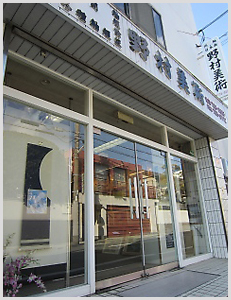
    syaoku.jpg(120220 byte)

    Name Art Nomura


    President Tatsuji Nomura


    Founded1973


    Established1992


    Address7-23 Babadori, Tarumi-ku, Kobe city,
    Hyougo Prefecture, 655-0021, Japan


    Capital10 million yen


    URLhttp://nomurakakejiku.com


    Our Business

     Art Nomura is an art dealer which produces kakejiku (hanging scrolls). We mount many paintings and calligraphic works in kakejiku in my factory. Kakejiku are our main product. We also remount and repair old or damaged kakejiku. We share the traditional Japanese art of kakejiku with people all over the world.


    (or press ESC or click the overlay)
    Access Map

    Access Map


     The Japanese people have long set a high value on aesthetic senses since ancient times. As a result, the
    peculiar culture which is not seen in other countries blossomed and many aspects of the modern Japanese
    culture come from it. Parts of Japanese culture has been introduced to people in other countries recently,
    so the number of people from other countries who are interested in Japanese culture has been increasing.
    However, the Japanese aesthetic senses, which are the bases of Japanese culture, have been nurtured
    through a long history, intertwining various elements intricately, such as climate, geographical features,
    religion, customs and so on. Therefore, they are very difficult to understand not only for people from other
    countries, but even for the Japanese people. I think the best tool which conveys these difficult senses
    understandably is a “kakejiku.”
     The kakejiku (a hanging scroll; a work of calligraphy or a painting which is mounted and hung in an
    alcove or on a wall) is a traditional Japanese art. It's no exaggeration to say that paintings are what
    express aesthetic senses at all times and places. The kakejiku is an art which expresses the Japanese
    aesthetic senses. The kakejiku has long been used in traditional Japanese events, daily life and so on since
    ancient times. As a result, there are various customs of kakejiku in Japan; kakejiku and the life of the
    Japanese are closely related. We can see Japanese values through kakejiku.
     The kakejiku is a cultural tradition which the Japanese people should be proud of. However, many people
    in other countries don't know much about it because it hasn't been showcased as much. This is why I
    decided to try to introduce it. The kakejiku world is very interesting and beautiful. We want not only the
    Japanese, but also many people from other countries to know and enjoy it. I hope that many people will
    love kakejiku someday.

    (or press ESC or click the overlay)