
Tazaki Sōun: A Nanga Painter Overcame Struggles to Become a Renowned Artist in the Meiji Era.

Shūtō Hōbin/Gika Inko/Shunka Kōrō (Autumn and Winter Flowers in Vessels/Psittacidae/Fragrance of Spring and Summer)
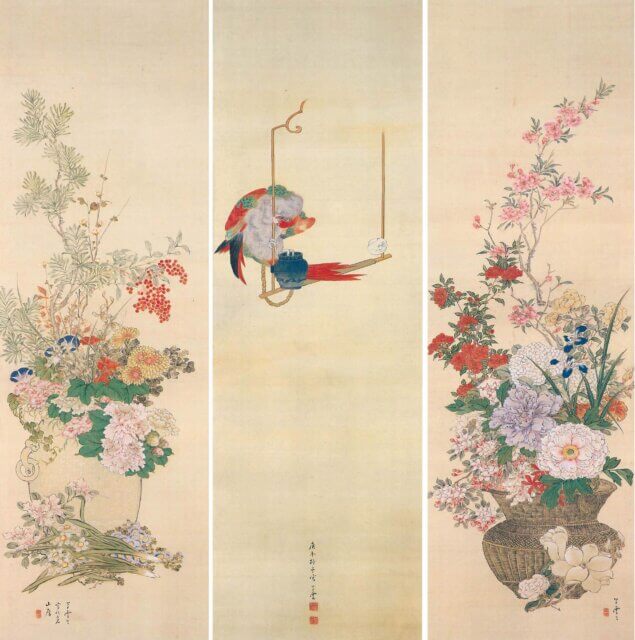
Shūtō HōbinGika InkoShunka Kōrō (Autumn and Winter Flowers in Vessels Psittacidae Fragrance of Spring and Summer) by Tazaki Sōun

Tazaki Sōun was born in 1815, as the eldest son of a family who had been serving as a foot soldier (Ashigaru) of the Ashikaga domain for generations. Since Ashigaru was a lower-ranking soldier, the family could not avoid poverty due to low salaries. From a young age, Sōun had started learning martial arts and painting. His master of painting was Kanai Ujū. Soun’s father also had a talent for painting and learned it from Kanai Ujū. That’s why Sōun learned painting from Ujū. Later, he learned under Tani Bunchō. Tani Bunchō, however, already got renowned as a painter and was in the prime of his life. Considering he had hundreds of disciples at that time, it’s unlikely Sōun could learn painting directly from him.

Sōun transferred the headship of his family to his younger brother around 20 years old. From here, he lived an unfulfilling and financially disadvantaged life until his later years. His devoted wife got sick and passed away in desperate poverty. His child committed suicide.

As you see, Sōun went through a series of hardships in the first half of his life.

The situation was becoming better for Sōun after the Meiji era started since literati painting was getting trendy. However, he had already retreated to his hometown, Ashikaga then. (Ashikaga city, Tochigi Prefecture) He received the silver prize at the 1st Naikoku Kaiga Kyōshinkai exhibition in 1882 and won the silver medal at the 1st exhibition of Nihon Bijutsu Kyokai (The Japan Art Association) in 1891. He was chosen as an Imperial Household Artist in the previous year, 1890. As these awards suggest, he was treated as a great master in his later years and passed away at the old age of 84 in 1898.

Although Sōun started his artist career with literati painting of Tani Bunchō’s style, he had been mostly self-taught. He studied Chinese painters such as Qiú Yīng and Liu Songnian. His wide-ranging interests also included sketching, Yamato-e, Rinpa school, and many others. He drew many things such as landscape, figures, and bird-and-flowers. Among them, he showed his true potential when drawing landscapes. We would say the splendid bird-and-flower painting (a set of three) as shown above was rather rare. Looking at a parakeet in the middle and flowers on both sides, it is obvious that Sōun was heavily influenced by Yanagisawa Kien at the time. Also, he put what he has learned from the painting style of Shen Quan into the artwork.

Tōka Nyūkyūzu (Pigeon Perching on Peach Blossom)
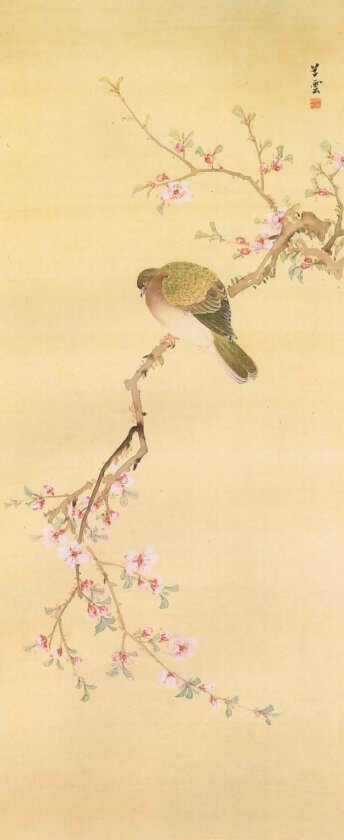
Tōka Nyūkyūzu (Pigeon Perching on Peach Blossom) by Tazaki Sōun

Regarding a style of painting, Tazaki Sōun succeeded the style of Tani Bunchō and was a self-taught artist of Chinese paintings, Yamato-e, Rinpa school, and Shasei (sketching) school. Over time, he developed his style. Sōun created the work named Tōka Nyūkūzu (Pigeon Perching on Peach blossom) under the influence of Nanpin school.

Famous painters like Tani Bunchō, Watanabe Kazan (a disciple of Bunchō), Yanagisawa Kien, and Tsubaki Chinzan all studied artworks done by Shen Quan. They copied the works of Shen Quan to understand his overall approach to art. This helped them get both the ideas of motifs and a feel for how Shen Quan worked, then broaden their range of painting to strive for better artists. Sōun was no exception. He has been heavily influenced by Nanpin school through Tani Bunchō and Yanagisawa Kien. He also learned the painting style of Sō Shiseki who was an important transmitter of Nanpin school in Edo and surrounding areas.

The painting depicts a puffed-up pigeon perching on a peach tree branch that hangs down from the top right. The composition is similar to Sō Shiseki’s bird-and-flower paintings.

Artists from Nanpin school including Sō Shiseki produced glamorous bird-and-flower paintings using slightly rich colors. On the contrary, those paintings done by literati painters were simple as they should be, even when the artists adopted the style of Nanpin school.

The same applies to “Pigeon Perching on Peach blossom” by Sōun. While being influenced by Sō Shiseki, Sōun displayed the world of bird-and-flower painting neatly and simply, which are the prominent characteristics of literati painting. Sōun toned branches, leaves, and peach blossoms down to avoid the painting becomes too loud but to fully bring out a quaint atmosphere.
    NameRequired

    SexRequired

    MaleFemale

    CountryRequired

    e-mailRequired

    CommentRequired

    Attached File
    ※Up to 3 MB for each file.


    ← ← "MUST CHECK" / Please confirm the above contents again and check this button.

    Contact Us

    Please fill out the form below and submit for your inquiry.

    ❈FirstName
    ❈LastName
    Country
    ❈E-mail
    (❈Confirm E-mail)
    ❈Inquiry category Question
    Consultation
    Impression
    Request
    Others
    ❈Comment

    is the mark for required item.


    Your privacy is important to us. We are committed to protecting your privacy.

    (or press ESC or click the overlay)

    CEO Message

    Our Feelings For Kakejiku


     The Japanese people have long set a high value on aesthetic senses since ancient times. As a result, the
    peculiar culture which is not seen in other countries blossomed and many aspects of the modern Japanese
    culture come from it. Parts of Japanese culture has been introduced to people in other countries recently,
    so the number of people from other countries who are interested in Japanese culture has been increasing.
    However, the Japanese aesthetic senses, which are the bases of Japanese culture, have been nurtured
    through a long history, intertwining various elements intricately, such as climate, geographical features,
    religion, customs and so on. Therefore, they are very difficult to understand not only for people from other
    countries, but even for the Japanese people. I think the best tool which conveys these difficult senses
    understandably is a “kakejiku.”
     The kakejiku (a hanging scroll; a work of calligraphy or a painting which is mounted and hung in an
    alcove or on a wall) is a traditional Japanese art. It's no exaggeration to say that paintings are what
    express aesthetic senses at all times and places. The kakejiku is an art which expresses the Japanese
    aesthetic senses. The kakejiku has long been used in traditional Japanese events, daily life and so on since
    ancient times. As a result, there are various customs of kakejiku in Japan; kakejiku and the life of the
    Japanese are closely related. We can see Japanese values through kakejiku.
     The kakejiku is a cultural tradition which the Japanese people should be proud of. However, many people
    in other countries don't know much about it because it hasn't been showcased as much. This is why I
    decided to try to introduce it. The kakejiku world is very interesting and beautiful. We want not only the
    Japanese, but also many people from other countries to know and enjoy it. I hope that many people will
    love kakejiku someday.

    (or press ESC or click the overlay)
    Company Profile
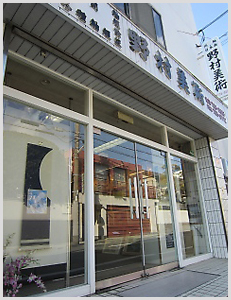
    syaoku.jpg(120220 byte)

    Name Art Nomura


    President Tatsuji Nomura


    Founded1973


    Established1992


    Address7-23 Babadori, Tarumi-ku, Kobe city,
    Hyougo Prefecture, 655-0021, Japan


    Capital10 million yen


    URLhttp://nomurakakejiku.com


    Our Business

     Art Nomura is an art dealer which produces kakejiku (hanging scrolls). We mount many paintings and calligraphic works in kakejiku in my factory. Kakejiku are our main product. We also remount and repair old or damaged kakejiku. We share the traditional Japanese art of kakejiku with people all over the world.


    (or press ESC or click the overlay)
    Access Map

    Access Map


     The Japanese people have long set a high value on aesthetic senses since ancient times. As a result, the
    peculiar culture which is not seen in other countries blossomed and many aspects of the modern Japanese
    culture come from it. Parts of Japanese culture has been introduced to people in other countries recently,
    so the number of people from other countries who are interested in Japanese culture has been increasing.
    However, the Japanese aesthetic senses, which are the bases of Japanese culture, have been nurtured
    through a long history, intertwining various elements intricately, such as climate, geographical features,
    religion, customs and so on. Therefore, they are very difficult to understand not only for people from other
    countries, but even for the Japanese people. I think the best tool which conveys these difficult senses
    understandably is a “kakejiku.”
     The kakejiku (a hanging scroll; a work of calligraphy or a painting which is mounted and hung in an
    alcove or on a wall) is a traditional Japanese art. It's no exaggeration to say that paintings are what
    express aesthetic senses at all times and places. The kakejiku is an art which expresses the Japanese
    aesthetic senses. The kakejiku has long been used in traditional Japanese events, daily life and so on since
    ancient times. As a result, there are various customs of kakejiku in Japan; kakejiku and the life of the
    Japanese are closely related. We can see Japanese values through kakejiku.
     The kakejiku is a cultural tradition which the Japanese people should be proud of. However, many people
    in other countries don't know much about it because it hasn't been showcased as much. This is why I
    decided to try to introduce it. The kakejiku world is very interesting and beautiful. We want not only the
    Japanese, but also many people from other countries to know and enjoy it. I hope that many people will
    love kakejiku someday.

    (or press ESC or click the overlay)