
Watanabe Shōka: A Painter Who Succeeded the Painting Style of Watanabe Kazan and Tsubaki Chinzan

Meika Jūyū
Watanabe Shōka was born in 1835 in the Edo clan’s residence as the second child of Watanabe Kazan. It is said that Watanabe Shōka was a strong looking man similar to Kazan. In 1841, Kazan committed suicide, but he endured the sadness with his wise grandmother and gentle mother’s help. In 1844, Shōka went to Edo and became a disciple of Tsubaki Chinzan. Shōka, who had been improving his painting skills under Chinzan for more than ten years, became the head of his family in 1856. He went to Toyohashi, Aichi Prefecture in 1874, then moved to Hyakkaen in 1877, and had a painting room there until 1882. In 1877, he got Kamonshō prize at the 1st Naikoku Kangyō Hakurankai exhibition, which was held at Ueno Park. This era was called Shōka’s era of Hyakkaen, because many flowers were planted in front of his garden and he enjoyed the flowers of the four seasons.

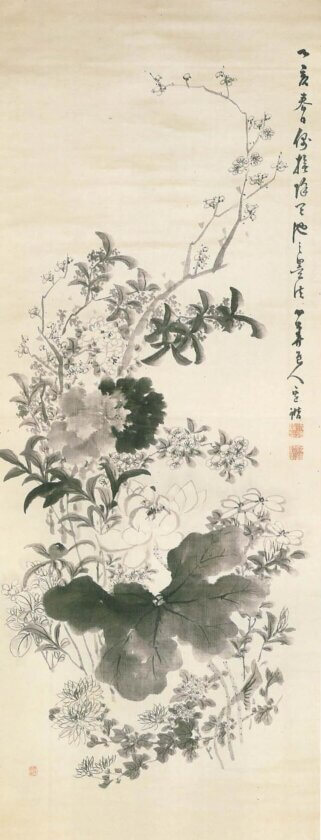
This work, which used sumi ink skillfully, was made before Shōka went to Hyakukaen, but the reason why this work is a Meika Jūyū-zu of ink painting is because it was based on the sketches of familiar flowers.
Meika Jūyū are the 10 frineds anthropromorphized from 10 kinds of famous flowers chosen by a Chinese poet. This work expresses those flowers with exquisite brush strokes, and the painting that was painted with the full use of the tsuketate technique (one of the typical techniques of Japanese painting that does not draw the outlines but do with one brushwork containing light and shade, two types of Sumi inks or paints simultaneously at once so that the result can express the shade and the stereoscopic effect, which can be often seen in Maruyama and Shijō schools) creates a kind of refreshing feeling. This painting is something that can only be created by ink painting.

which can be often seen in Maruyama and Shijō schools) creates a kind of refreshing feeling. This painting is something that can only be created by ink painting.

Ryūu
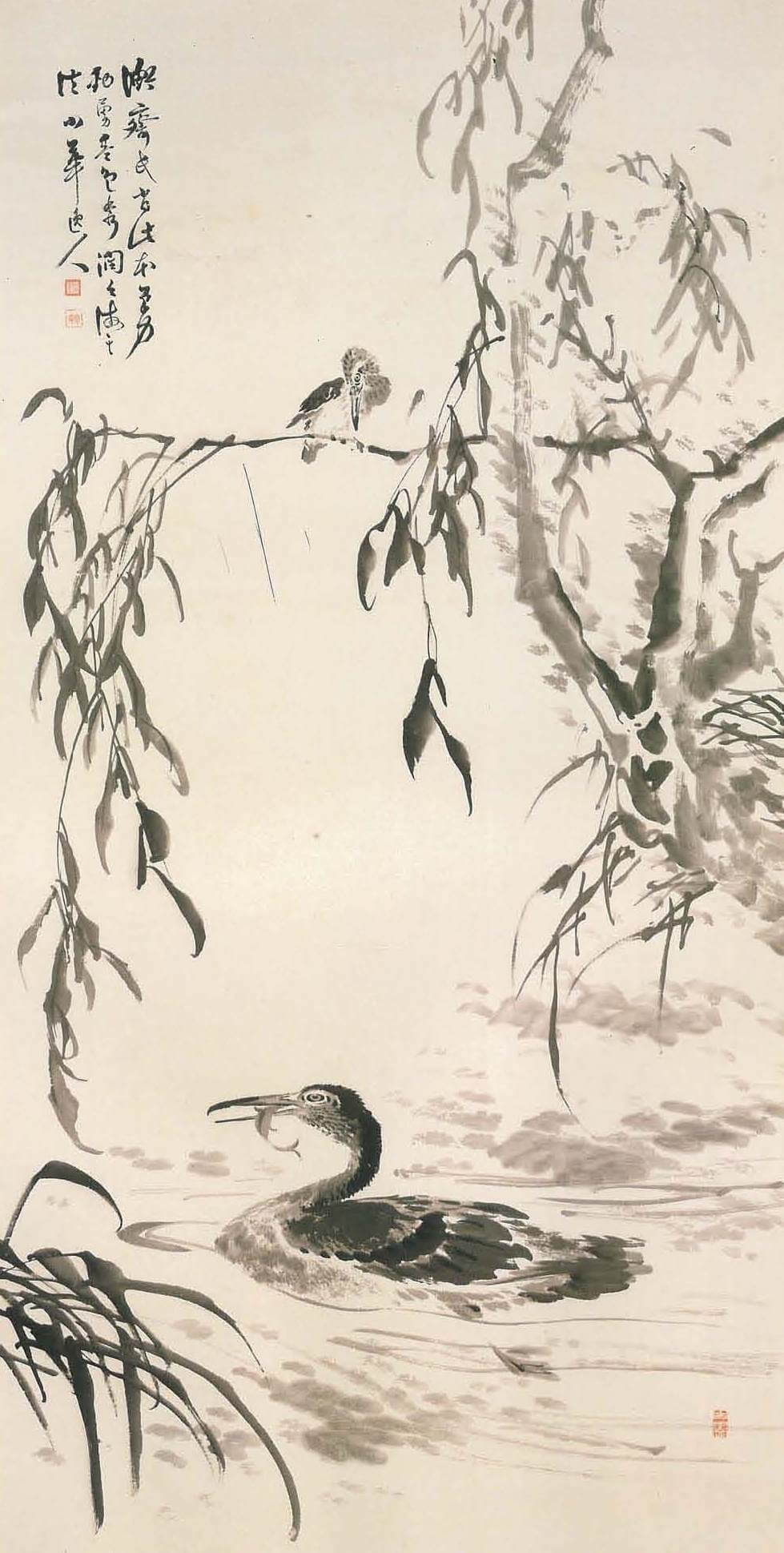
It is said that Watanabe Shōka was excellent in Kachō-ga (painting of flowers and birds), and there are works with gorgeous coloring such as 1887’s Meiji Kyūden Sugito-e painting in the Imperial Palace, but when you look at many of his ink paintings, you would notice that his true characters are shown rather in the ink paintings. It is not known when this work was made, but it is one of the masterpieces of ink painting in his later years. A large cormorant is moving its legs powerfully under willow leaves. It has a sweetfish in its mouth that was just caught. A kingfisher is enviously looking down from willow branch. It might be thinking about getting a sweetfish from the cormorant if there is a chance. The fun of this painting is that one scene is a drama. Although it is a large painting, there is no looseness in the composition, and the ink lines such as willow and indigo are drawn nicely and makes you feel calm maybe because the lines were drawn with plenty of water. Compared to Watanabe Kazan’s work, maybe because it was drawn on a paper, but the mild drawing method of water surface came from Tsubaki Chinzan’s influence.

Meika Jūyū
When his brother died in 1856, Watanabe Shōka served the Tahara domain as a reign of the family. It was the third year since Tsubaki Chinzan’s death. Until then, Shōka was entrusted to Chinzan by his father Kazan, and Chinzan was teaching him to bring out the talent of Shōka. It was said that he was clumsy compared to Noguchi Yūkoku who studied under Chinzan together, but he continued to study hard.

Shōka left for Toyohashi, Aichi Prefecture in 1874, and in 1877 moved to Hyakkaen, which is connected to the precincts of Yoshida Shrine, and had a painting room there. Many literary guests and ink painters had visited there respecting Shōka.

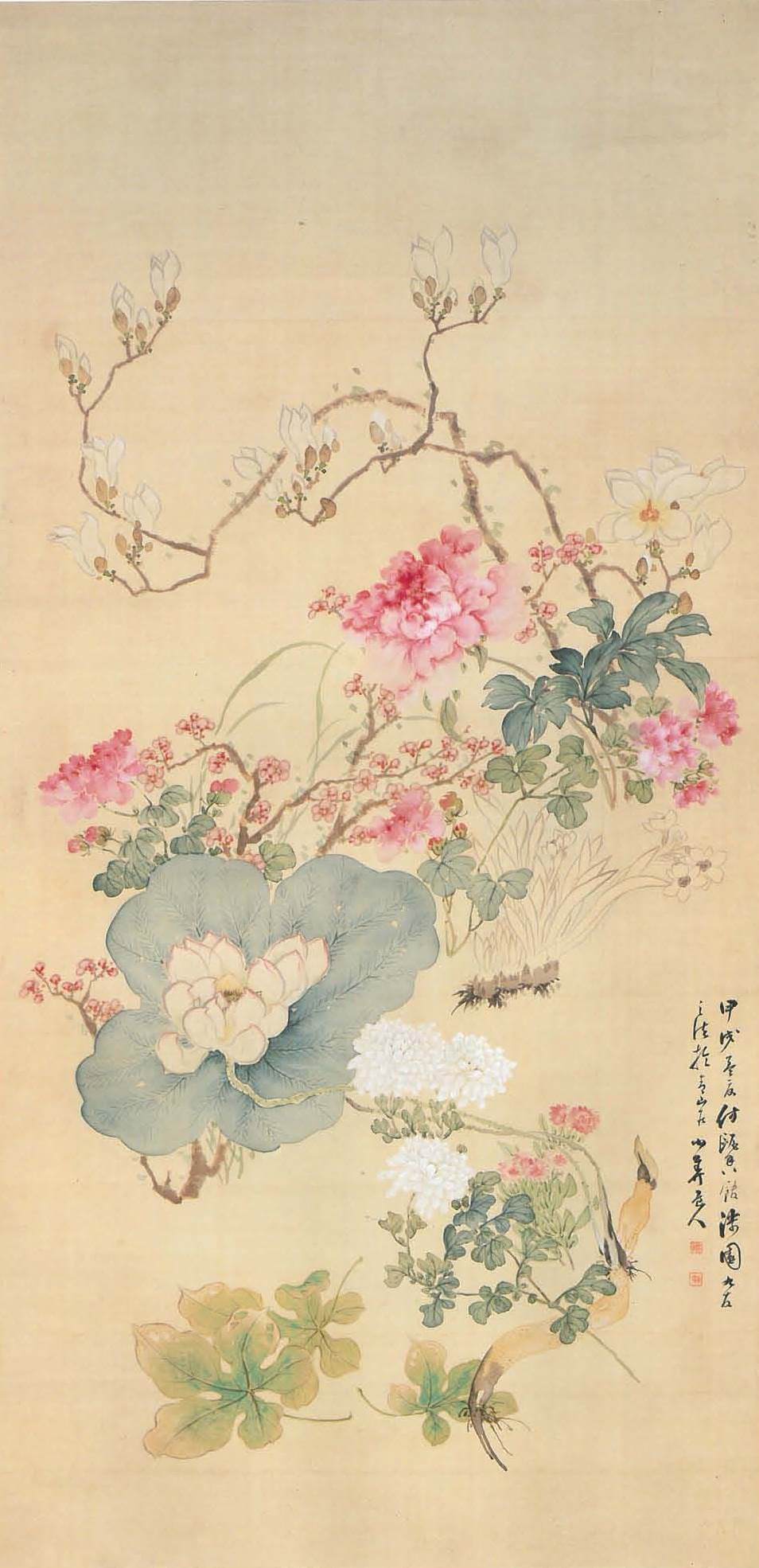
This work was made when he went to Toyohashi, and he drew sweet osmanthus, peony, sea urchin, lotus, chrysanthemum, etc. of the Meika Jūyū, and in addition, a new taste is added with three leaves of paulownia leaves. The soft painting style is seen because he was influenced by Chinzan’s teachings.

In 1882, Shōka exhibited at the 1st Naikoku Kaiga Kyōshinkai exhibition, sponsored by the Ministry of Agriculture and Commerce, which was held in Ueno Park, and received a bronze prize. Since then, he went to Tōkyō to be a part of central painting circle and stayed in Hamachō. In 1887, while traveling in Chiba Prefecture, he suffered from intestinal typhoid and died at his home in Hamachō, after he returned to his house riding on a palanquin since he couldn’t find a good doctor in Chiba. He was 53 years old.
    NameRequired

    SexRequired

    MaleFemale

    CountryRequired

    e-mailRequired

    CommentRequired

    Attached File
    ※Up to 3 MB for each file.


    ← ← "MUST CHECK" / Please confirm the above contents again and check this button.

    Contact Us

    Please fill out the form below and submit for your inquiry.

    ❈FirstName
    ❈LastName
    Country
    ❈E-mail
    (❈Confirm E-mail)
    ❈Inquiry category Question
    Consultation
    Impression
    Request
    Others
    ❈Comment

    is the mark for required item.


    Your privacy is important to us. We are committed to protecting your privacy.

    (or press ESC or click the overlay)

    CEO Message

    Our Feelings For Kakejiku


     The Japanese people have long set a high value on aesthetic senses since ancient times. As a result, the
    peculiar culture which is not seen in other countries blossomed and many aspects of the modern Japanese
    culture come from it. Parts of Japanese culture has been introduced to people in other countries recently,
    so the number of people from other countries who are interested in Japanese culture has been increasing.
    However, the Japanese aesthetic senses, which are the bases of Japanese culture, have been nurtured
    through a long history, intertwining various elements intricately, such as climate, geographical features,
    religion, customs and so on. Therefore, they are very difficult to understand not only for people from other
    countries, but even for the Japanese people. I think the best tool which conveys these difficult senses
    understandably is a “kakejiku.”
     The kakejiku (a hanging scroll; a work of calligraphy or a painting which is mounted and hung in an
    alcove or on a wall) is a traditional Japanese art. It's no exaggeration to say that paintings are what
    express aesthetic senses at all times and places. The kakejiku is an art which expresses the Japanese
    aesthetic senses. The kakejiku has long been used in traditional Japanese events, daily life and so on since
    ancient times. As a result, there are various customs of kakejiku in Japan; kakejiku and the life of the
    Japanese are closely related. We can see Japanese values through kakejiku.
     The kakejiku is a cultural tradition which the Japanese people should be proud of. However, many people
    in other countries don't know much about it because it hasn't been showcased as much. This is why I
    decided to try to introduce it. The kakejiku world is very interesting and beautiful. We want not only the
    Japanese, but also many people from other countries to know and enjoy it. I hope that many people will
    love kakejiku someday.

    (or press ESC or click the overlay)
    Company Profile
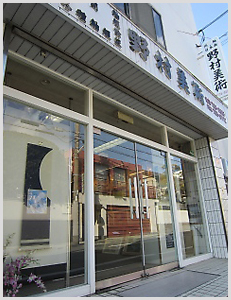
    syaoku.jpg(120220 byte)

    Name Art Nomura


    President Tatsuji Nomura


    Founded1973


    Established1992


    Address7-23 Babadori, Tarumi-ku, Kobe city,
    Hyougo Prefecture, 655-0021, Japan


    Capital10 million yen


    URLhttp://nomurakakejiku.com


    Our Business

     Art Nomura is an art dealer which produces kakejiku (hanging scrolls). We mount many paintings and calligraphic works in kakejiku in my factory. Kakejiku are our main product. We also remount and repair old or damaged kakejiku. We share the traditional Japanese art of kakejiku with people all over the world.


    (or press ESC or click the overlay)
    Access Map

    Access Map


     The Japanese people have long set a high value on aesthetic senses since ancient times. As a result, the
    peculiar culture which is not seen in other countries blossomed and many aspects of the modern Japanese
    culture come from it. Parts of Japanese culture has been introduced to people in other countries recently,
    so the number of people from other countries who are interested in Japanese culture has been increasing.
    However, the Japanese aesthetic senses, which are the bases of Japanese culture, have been nurtured
    through a long history, intertwining various elements intricately, such as climate, geographical features,
    religion, customs and so on. Therefore, they are very difficult to understand not only for people from other
    countries, but even for the Japanese people. I think the best tool which conveys these difficult senses
    understandably is a “kakejiku.”
     The kakejiku (a hanging scroll; a work of calligraphy or a painting which is mounted and hung in an
    alcove or on a wall) is a traditional Japanese art. It's no exaggeration to say that paintings are what
    express aesthetic senses at all times and places. The kakejiku is an art which expresses the Japanese
    aesthetic senses. The kakejiku has long been used in traditional Japanese events, daily life and so on since
    ancient times. As a result, there are various customs of kakejiku in Japan; kakejiku and the life of the
    Japanese are closely related. We can see Japanese values through kakejiku.
     The kakejiku is a cultural tradition which the Japanese people should be proud of. However, many people
    in other countries don't know much about it because it hasn't been showcased as much. This is why I
    decided to try to introduce it. The kakejiku world is very interesting and beautiful. We want not only the
    Japanese, but also many people from other countries to know and enjoy it. I hope that many people will
    love kakejiku someday.

    (or press ESC or click the overlay)