
Shikoku Pilgrimage Temple: No. 32: Hachiyō-zan Gumonji-in Zenjibu-ji
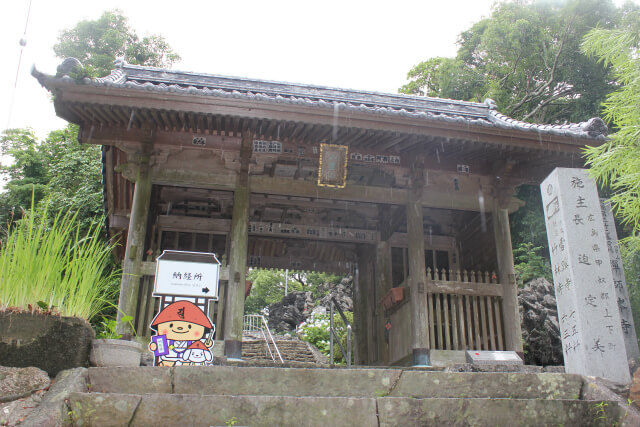
No. 32: Hachiyō-zan Gumonji-in Zenjibu-ji

The Funatama Kannon (Boat Spirit Kannon) for Safety at Sea

  • Name: Hachiyō-zan Gumonji-in Zenjibu-ji
  • Principal Image: Jūichimen Kanzeon Bosatsu (Eleven-Faced Bodhisattva Avalokiteshvara)
  • Goeika (Pilgrimage Song):
  • Tranquil is my source at Zenjibu-ji;
  • my floating heart is a swift boat of the Dharma.

Access From Temple No. 31, Chikurin-ji

  • On foot: Descend the mountain path and head east along the path by the Shimodagawa River. Cross Zuizan Bridge and follow the signs. Approx. 6 km, 1 hour 20 minutes.
  •  
  • By Car: Almost the same route as walking, but the mountain road descending from Chikurin-ji and the road just before Zenjibu-ji are slight detours. Approx. 6.5 km, 15 minutes.
  •  
  • Public Transport: From the Chikurin-ji-mae bus stop, take the Tosaden Kōtsū MY-Yū Bus bound for Katsurahama for 12 minutes, get off at Ikedōri Gijutsu Gakkō-mae, and walk 35 minutes.

An Ancient Mountaintop Temple Designated as a Kannon Sacred Site by Kōbō Daishi

Zenjibu-ji is located on the summit of Mt. Mine overlooking Tosa Bay, and is affectionately known by locals as “Minedera” (also pronounced Minenji or Mineji). The temple’s origins date back to the Nara period; it is said to have begun when Gyōki, by imperial decree of Emperor Shōmu, built a hall to pray for the safety of ships sailing off the coast of Tosa.

This is the place where Kōbō Daishi performed an ascetic practice called Kokūzō Gumonji-hō, aimed at acquiring infinite memory. At this time, the Daishi is said to have designated it a Kannon sacred site, stating, “The shape of this mountain resembles the eight-petaled lotus seat (the pedestal on which Buddhas ride) said to be located on Mt. Fudaraku (Potalaka), the pure land of Kannon.” The mountain name (sangō) “Hachiyō-zan” and the temple name (ingō) “Gumonji-in” originate from this. Incidentally, “Zenji” refers to a practicing monk.

The Kannon Welcoming You at the Parking Lot

The principal image of Zenjibu-ji is an Eleven-Faced Kannon (Jūichimen Kannon) said to have been carved by Kōbō Daishi. Ascending the slope from the Minedera-dōri bus stop leads to the Zenjibu-ji parking lot. An Eleven-Faced Kannon statue stands beside it, welcoming pilgrims. Note that walking pilgrims take a different route that comes out in front of the Niō-mon Gate, so they will not come face-to-face with the Kannon at the parking lot.

Climbing the stone steps from the parking lot, you will find the Niō-mon Gate, which is compact yet has a dignified atmosphere. Previously, Important Cultural Property Kongō Rikishi (Niō) statues—said to be the work of the Kamakura-period Buddhist sculptor Jōmyō—were placed here, but they are currently kept in a repository.
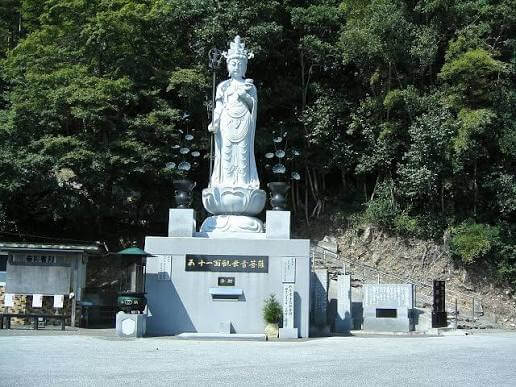
Strange Rocks and Bizarre Stones Create a Mystical Atmosphere

Climb further up the stone steps from the Niō-mon. The stone steps are laid with natural stones and are rugged and rough. Beside the Niō-mon is the Minedera Fudō Myōō, set against a strangely shaped rock called Byōbu-iwa (Folding Screen Rock). The shape of Byōbu-iwa is impressive, as it resembles the flames of Fudō Myōō.
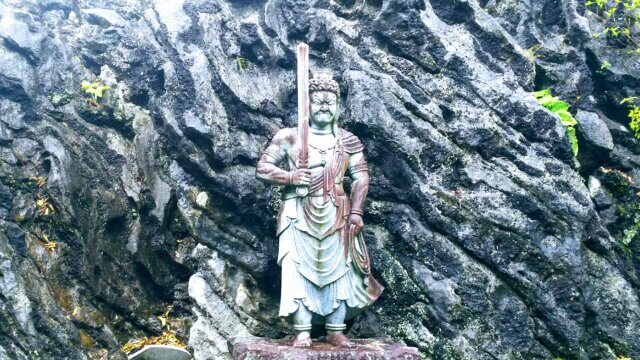
As you ascend the stone steps, the Hondō (Main Hall) comes into view, with the Daishi-dō on the left, and the Jizō-dō and Amida-dō further back. Due to being a mountaintop temple, the halls are lined up in a limited space. In front of the Hondō, there are also strange rocks and bizarre stones that could be called the beauty of natural molding, adding a mystical charm to the scattered Mizuko Jizō and Kōbō Daishi statues.

A Kannon Deeply Worshipped by Seafarers

The principal image, the Eleven-Faced Kannon, is also a Funatama Kannon (boat spirit Kannon) for safety at sea, carved by Kōbō Daishi to pray for the safe voyage of ships traveling the seas of Tosa. It is said that during the Edo period, successive lords of the Tosa domain, the Yamauchi clan, when departing by ship from Urado Bay for sankin kōtai (alternate attendance), always visited this temple upon departure to pray for a safe sea voyage.

This mountaintop temple is highly visible from ships passing on the sea, and in ancient times it also played the role of a lighthouse. It must have been a truly reassuring presence for seafarers. Although the Kannon statue carved by Kōbō Daishi cannot be viewed, the doors of the Hondō are open, and one can pray to the Omaedachi (standing in front) Kannon statue, which wears a quiet smile.

DATA

Address: 3084 Tōchi, Nankoku City, Kōchi Prefecture
Phone: 088-865-8430
Access: A 10-minute walk from JR Kōchi Station on the Dosan Line brings you to the Harimayabashi bus stop. Take the Tosaden Kōtsū Bus bound for Maehama Shako for 25 minutes, get off at Midorigaoka 3-chome, and walk 30 minutes.
Parking: Available (Free)
Lodging: None

Your Pilgrimage, Your Art

Completing the Shikoku Pilgrimage is a once-in-a-lifetime journey—but what if you could preserve it in a form that lasts forever?

Many pilgrims collect red stamps and calligraphy from each temple on a special silk scroll called a nōkyōjiku.

This sacred record of your path can be transformed into a kakejiku—a traditional Japanese hanging scroll—not only preserving the memories, but turning them into a work of cultural and spiritual art.

It’s more than a souvenir—it’s a way to honor your journey, your prayers, and your growth.

To learn more about how a nōkyōjiku becomes a kakejiku, and what makes this transformation so meaningful, please refer the below link.
 

    NameRequired

    SexRequired

    MaleFemale

    CountryRequired

    e-mailRequired

    CommentRequired

    Attached File
    ※Up to 3 MB for each file.


    ← ← "MUST CHECK" / Please confirm the above contents again and check this button.

    Contact Us

    Please fill out the form below and submit for your inquiry.

    ❈FirstName
    ❈LastName
    Country
    ❈E-mail
    (❈Confirm E-mail)
    ❈Inquiry category Question
    Consultation
    Impression
    Request
    Others
    ❈Comment

    is the mark for required item.


    Your privacy is important to us. We are committed to protecting your privacy.

    (or press ESC or click the overlay)

    CEO Message

    Our Feelings For Kakejiku


     The Japanese people have long set a high value on aesthetic senses since ancient times. As a result, the
    peculiar culture which is not seen in other countries blossomed and many aspects of the modern Japanese
    culture come from it. Parts of Japanese culture has been introduced to people in other countries recently,
    so the number of people from other countries who are interested in Japanese culture has been increasing.
    However, the Japanese aesthetic senses, which are the bases of Japanese culture, have been nurtured
    through a long history, intertwining various elements intricately, such as climate, geographical features,
    religion, customs and so on. Therefore, they are very difficult to understand not only for people from other
    countries, but even for the Japanese people. I think the best tool which conveys these difficult senses
    understandably is a “kakejiku.”
     The kakejiku (a hanging scroll; a work of calligraphy or a painting which is mounted and hung in an
    alcove or on a wall) is a traditional Japanese art. It's no exaggeration to say that paintings are what
    express aesthetic senses at all times and places. The kakejiku is an art which expresses the Japanese
    aesthetic senses. The kakejiku has long been used in traditional Japanese events, daily life and so on since
    ancient times. As a result, there are various customs of kakejiku in Japan; kakejiku and the life of the
    Japanese are closely related. We can see Japanese values through kakejiku.
     The kakejiku is a cultural tradition which the Japanese people should be proud of. However, many people
    in other countries don't know much about it because it hasn't been showcased as much. This is why I
    decided to try to introduce it. The kakejiku world is very interesting and beautiful. We want not only the
    Japanese, but also many people from other countries to know and enjoy it. I hope that many people will
    love kakejiku someday.

    (or press ESC or click the overlay)
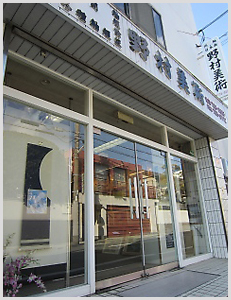
    Company Profile
    syaoku.jpg(120220 byte)

    Name Art Nomura


    President Tatsuji Nomura


    Founded1973


    Established1992


    Address7-23 Babadori, Tarumi-ku, Kobe city,
    Hyougo Prefecture, 655-0021, Japan


    Capital10 million yen


    URLhttp://nomurakakejiku.com


    Our Business

     Art Nomura is an art dealer which produces kakejiku (hanging scrolls). We mount many paintings and calligraphic works in kakejiku in my factory. Kakejiku are our main product. We also remount and repair old or damaged kakejiku. We share the traditional Japanese art of kakejiku with people all over the world.


    (or press ESC or click the overlay)
    Access Map

    Access Map


     The Japanese people have long set a high value on aesthetic senses since ancient times. As a result, the
    peculiar culture which is not seen in other countries blossomed and many aspects of the modern Japanese
    culture come from it. Parts of Japanese culture has been introduced to people in other countries recently,
    so the number of people from other countries who are interested in Japanese culture has been increasing.
    However, the Japanese aesthetic senses, which are the bases of Japanese culture, have been nurtured
    through a long history, intertwining various elements intricately, such as climate, geographical features,
    religion, customs and so on. Therefore, they are very difficult to understand not only for people from other
    countries, but even for the Japanese people. I think the best tool which conveys these difficult senses
    understandably is a “kakejiku.”
     The kakejiku (a hanging scroll; a work of calligraphy or a painting which is mounted and hung in an
    alcove or on a wall) is a traditional Japanese art. It's no exaggeration to say that paintings are what
    express aesthetic senses at all times and places. The kakejiku is an art which expresses the Japanese
    aesthetic senses. The kakejiku has long been used in traditional Japanese events, daily life and so on since
    ancient times. As a result, there are various customs of kakejiku in Japan; kakejiku and the life of the
    Japanese are closely related. We can see Japanese values through kakejiku.
     The kakejiku is a cultural tradition which the Japanese people should be proud of. However, many people
    in other countries don't know much about it because it hasn't been showcased as much. This is why I
    decided to try to introduce it. The kakejiku world is very interesting and beautiful. We want not only the
    Japanese, but also many people from other countries to know and enjoy it. I hope that many people will
    love kakejiku someday.

    (or press ESC or click the overlay)