
Noguchi Shōhin: Representative Modern Female Naga Painter

Fuyō Natsugamo ( Confederate Roses and Spot‐Billed Duck)
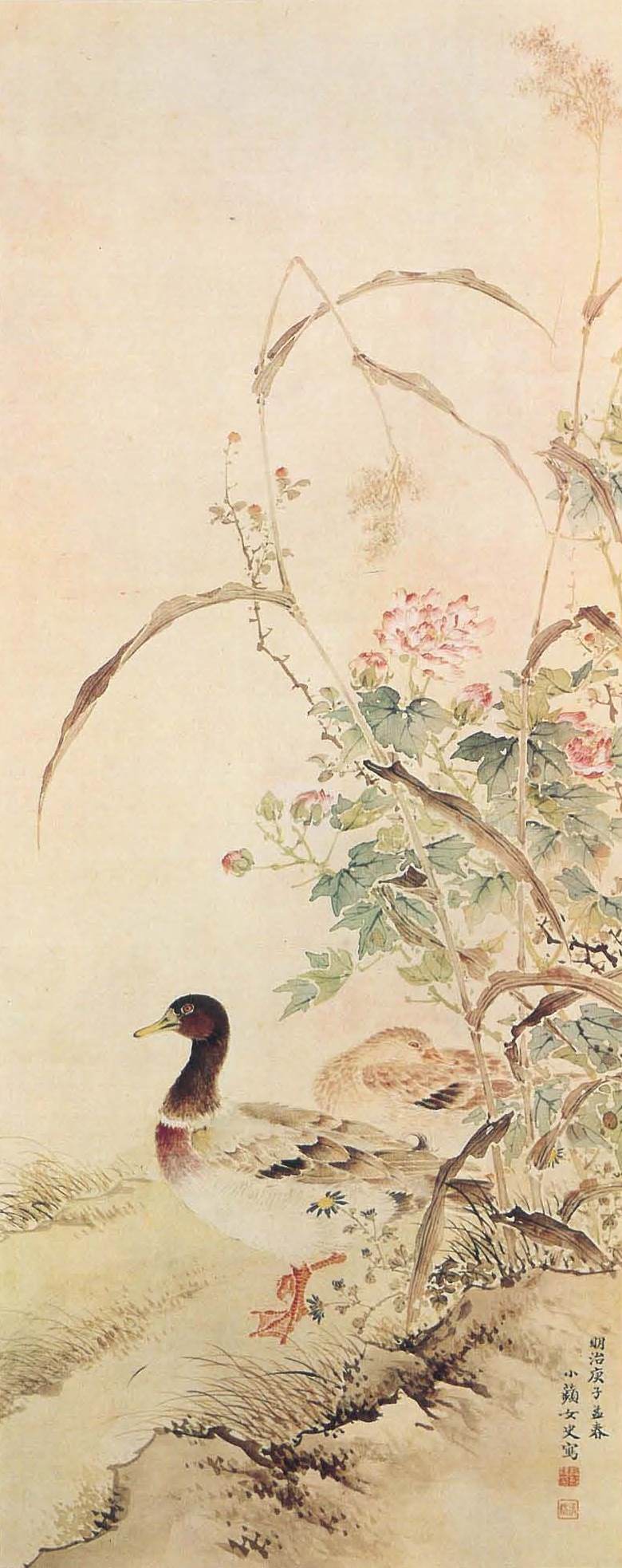
Fuyō Natsugamo ( Confederate Roses and Spot‐Billed Duck) by Noguchi Shohin

Noguchi Shōhin was born in Osaka in 1847. She loved painting since she was a child and traveled to the Hokuriku Tokai region with her parents, but she lost his father at the age of 16 and later went to Kyōto to become a disciple of Hine Taizan in 1867. It is said that she worked hard to learn the painting, and was good at Kachō-ga (painting of birds and flowers) and Sansui-ga (landscape painting). At the age of 24, Shōhin, who lost his mother and had no family, moved to Tōkyo in 1871. In 1873, he drew Kakiya-zu (flower painting) on the shoji (sliding paper door) and byōbu (folding screen) of the imperial palace’s bedroom and became famous. In 1877, she married Noguchi Masaaki and moved to Shiga Prefecture, but in 1882 she returned to Tōkyo and lived there permanently. She received the Bronze Award at the Tōyō Kaiga Kyōshinkai exhibition in 1886, and after the establishment of the Nihon Bijutsu Kyōkai, she was active mainly in the exhibition of the association, and in 1901 she received a gold medal. Besides, she was appointed as a part-time professor at the Kazoku Jogakko in 1889. Since she made many paintings for the government and frequently taught the imperial family the painting, she had a deep relationship with the imperial family and became the first woman Teishitsu Gigei-in (government’s artist) in 1904. In 1915, she produced a byōbu painting for the throne of Emperor Taishō. She was the head of the Meiji period Nanga painting world together with Okuhara Seiko, and while inheriting the techniques of her teacher Taizan, she had a feminine, warm and elegant character, and shows a solemn and detailed style that contrasts with Seiko’s lavishness. She died in 1917 at the age of 71 years old, and she had a Nanga painter Noguchi Shōkei as her oldest daughter.

This work was made in 1900 when Shōhin was at her best. She drew a pair of mallards resting on the edge of the water, carrizo, fuyō, wild chrysanthemum, and dead wild roses that had fruit born. All of them are drawn in detail with soft brush strokes and modest coloring, and a gentle autumn atmosphere is created. You can see Shōhin’s style with a fusion of sketching and Shai (expressing the painter’s heart or the nature of the object in Eastern-style paintings) in flowers and grasses which Shōhin was good at the most, such as the chrysanthemums that bloomed adorably beside fuyō, the broken carrizo with its ears hanging, or the vines of wild roses that entwined with those, etc.

Peonies, Cranes and Japanese Emperor Oak / Chrysanthemum, Chicken and Pine
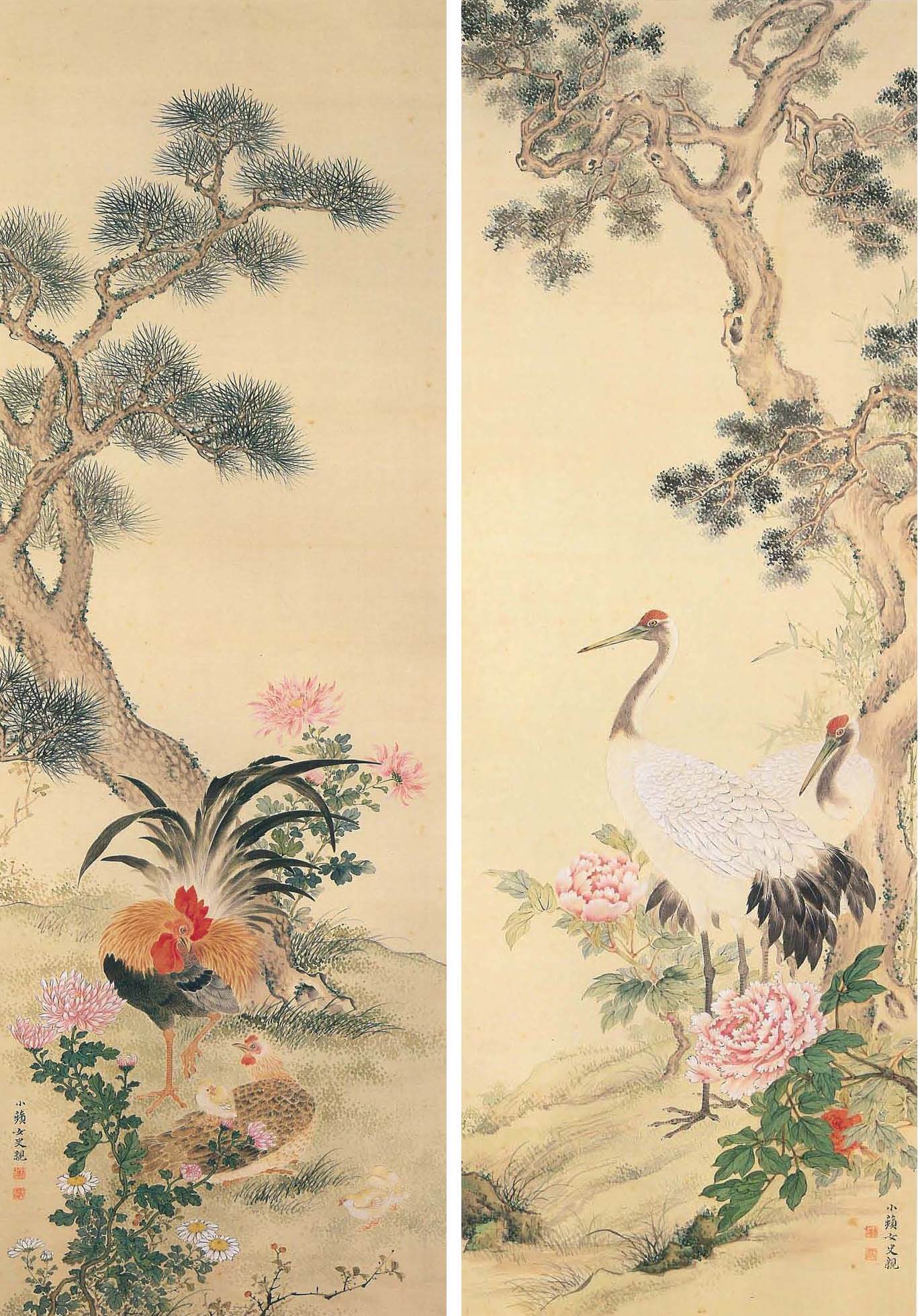
Peonies, Cranes and Japanese Emperor Oak Chrysanthemum, Chicken and Pine by Noguchi Shohin

Noguchi Shōhin was a head Meiji period painter who often was treated in contrast to Okuhara Seiko. An art critic Umezawa Waken said, ” Seiko is single, and Shōhin has a husband, Seiko is unrelenting, the Shōhin is obedient, Seiko is living in the countryside secretly, and the other is an imperial artist. It is the distinctiveness of the Meiji period Nanga world that both of them are opposed to each other.” It is said that Seiko had a men’s hairstyle and dressed like a man, and had legendary episodes that no men have, but Shōhin kept being a good wife and wise mother. However, she also working hard on painting, and the recollection of his eldest daughter, Noguchi Shōkei, tells an anecdote that Shōhin promised to draw a thousand Seki-ga in a day and night when he was young, and kept that promise. Such a personality is clearly shown in Shōhin’s paintings. The work of Okuhara Seiko refuses to distinguish it from the work of a male painter. Shōhin’s delicate brush strokes and the soft and warm atmosphere are certainly feminine features.

This work is a pair of hanging scroll works that show the spring view depicting cranes and Japanese emperor oak, peony, etc., and the autumn view with a chicken and pine trees, various chrysanthemums, and dead wild roses. It depicts the world of flowers and birds with full of emotion using strict and meticulous techniques but without hardening. Especially, you can feel a rich emotional feeling in the chicken family depicted in the work on the left. Chrysanthemums and peonies beautifully depict the ecology of flowers from buds to full bloom. As with other works by Noguchi Shōhin, she drew chrysanthemums and peony into three flowers, which are buds, flowers beginning to bloom, and flowers in full bloom. Being more than being faithful to the basics, she breathed life into the flowers and adds time to the work. You can feel the detailed consideration of Noguchi Shōhin towards her work.
    NameRequired

    SexRequired

    MaleFemale

    CountryRequired

    e-mailRequired

    CommentRequired

    Attached File
    ※Up to 3 MB for each file.


    ← ← "MUST CHECK" / Please confirm the above contents again and check this button.

    Contact Us

    Please fill out the form below and submit for your inquiry.

    ❈FirstName
    ❈LastName
    Country
    ❈E-mail
    (❈Confirm E-mail)
    ❈Inquiry category Question
    Consultation
    Impression
    Request
    Others
    ❈Comment

    is the mark for required item.


    Your privacy is important to us. We are committed to protecting your privacy.

    (or press ESC or click the overlay)

    CEO Message

    Our Feelings For Kakejiku


     The Japanese people have long set a high value on aesthetic senses since ancient times. As a result, the
    peculiar culture which is not seen in other countries blossomed and many aspects of the modern Japanese
    culture come from it. Parts of Japanese culture has been introduced to people in other countries recently,
    so the number of people from other countries who are interested in Japanese culture has been increasing.
    However, the Japanese aesthetic senses, which are the bases of Japanese culture, have been nurtured
    through a long history, intertwining various elements intricately, such as climate, geographical features,
    religion, customs and so on. Therefore, they are very difficult to understand not only for people from other
    countries, but even for the Japanese people. I think the best tool which conveys these difficult senses
    understandably is a “kakejiku.”
     The kakejiku (a hanging scroll; a work of calligraphy or a painting which is mounted and hung in an
    alcove or on a wall) is a traditional Japanese art. It's no exaggeration to say that paintings are what
    express aesthetic senses at all times and places. The kakejiku is an art which expresses the Japanese
    aesthetic senses. The kakejiku has long been used in traditional Japanese events, daily life and so on since
    ancient times. As a result, there are various customs of kakejiku in Japan; kakejiku and the life of the
    Japanese are closely related. We can see Japanese values through kakejiku.
     The kakejiku is a cultural tradition which the Japanese people should be proud of. However, many people
    in other countries don't know much about it because it hasn't been showcased as much. This is why I
    decided to try to introduce it. The kakejiku world is very interesting and beautiful. We want not only the
    Japanese, but also many people from other countries to know and enjoy it. I hope that many people will
    love kakejiku someday.

    (or press ESC or click the overlay)
    Company Profile
    syaoku.jpg(120220 byte)

    Name Art Nomura


    President Tatsuji Nomura


    Founded1973


    Established1992


    Address7-23 Babadori, Tarumi-ku, Kobe city,
    Hyougo Prefecture, 655-0021, Japan


    Capital10 million yen


    URLhttp://nomurakakejiku.com


    Our Business

     Art Nomura is an art dealer which produces kakejiku (hanging scrolls). We mount many paintings and calligraphic works in kakejiku in my factory. Kakejiku are our main product. We also remount and repair old or damaged kakejiku. We share the traditional Japanese art of kakejiku with people all over the world.


    (or press ESC or click the overlay)
    Access Map

    Access Map


     The Japanese people have long set a high value on aesthetic senses since ancient times. As a result, the
    peculiar culture which is not seen in other countries blossomed and many aspects of the modern Japanese
    culture come from it. Parts of Japanese culture has been introduced to people in other countries recently,
    so the number of people from other countries who are interested in Japanese culture has been increasing.
    However, the Japanese aesthetic senses, which are the bases of Japanese culture, have been nurtured
    through a long history, intertwining various elements intricately, such as climate, geographical features,
    religion, customs and so on. Therefore, they are very difficult to understand not only for people from other
    countries, but even for the Japanese people. I think the best tool which conveys these difficult senses
    understandably is a “kakejiku.”
     The kakejiku (a hanging scroll; a work of calligraphy or a painting which is mounted and hung in an
    alcove or on a wall) is a traditional Japanese art. It's no exaggeration to say that paintings are what
    express aesthetic senses at all times and places. The kakejiku is an art which expresses the Japanese
    aesthetic senses. The kakejiku has long been used in traditional Japanese events, daily life and so on since
    ancient times. As a result, there are various customs of kakejiku in Japan; kakejiku and the life of the
    Japanese are closely related. We can see Japanese values through kakejiku.
     The kakejiku is a cultural tradition which the Japanese people should be proud of. However, many people
    in other countries don't know much about it because it hasn't been showcased as much. This is why I
    decided to try to introduce it. The kakejiku world is very interesting and beautiful. We want not only the
    Japanese, but also many people from other countries to know and enjoy it. I hope that many people will
    love kakejiku someday.

    (or press ESC or click the overlay)