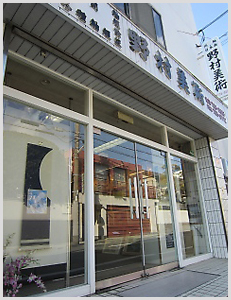
Purchasing Kakejiku in Japan|Choosing a Hanging Scroll That Matches the Customer’s Taste
Japan has four distinct seasons, and each season has its own atmosphere, beauty, and special highlights.
Hanging scrolls that depict the charm of each season and are mounted so they can be displayed are called seasonal kakejiku.
Seasonal hanging scrolls featuring flowers, birds, plants, trees, and seasonal events have long been loved in Japanese life and culture.
In this article, we would like to introduce an episode with a customer who carefully selected her favorite kakejiku from among many seasonal hanging scrolls.
It was a very memorable time for us as well, as the customer compared many hanging scrolls in person and gradually chose the scrolls that truly matched her taste.
A Request to Display Calligraphy and a Flower Hanging Scroll Together
The customer who visited us this time was a German customer living in Spain.

During her trip to Japan, she visited ART NOMURA hoping to purchase two hanging scrolls: one calligraphy scroll and one flower scroll.
For the calligraphy scroll, she was looking for a shorter size.
For the flower scroll, she was looking for a traditional vertical format, assuming that it would be displayed together with the calligraphy scroll.
We decided to first help her choose the calligraphy scroll, and then move on to selecting a flower scroll that would go well with it.
The First Scroll Chosen Was the Calligraphy “Yume”
The first items we introduced were calligraphy hanging scrolls.
We showed her several calligraphy scrolls, including works featuring the Japanese characters “Yume” (Dream) and “Wa” (Harmony).
At first glance, one might think that a calligraphy hanging scroll is chosen simply by the meaning of the character.
However, the impression of a calligraphy scroll changes greatly depending on the gradation of the ink, the movement of the brush, the dynamism of the character, the use of blank space, and the harmony with the mounting.
The customer carefully looked not only at the calligraphy itself, but also at the overall atmosphere of each hanging scroll.
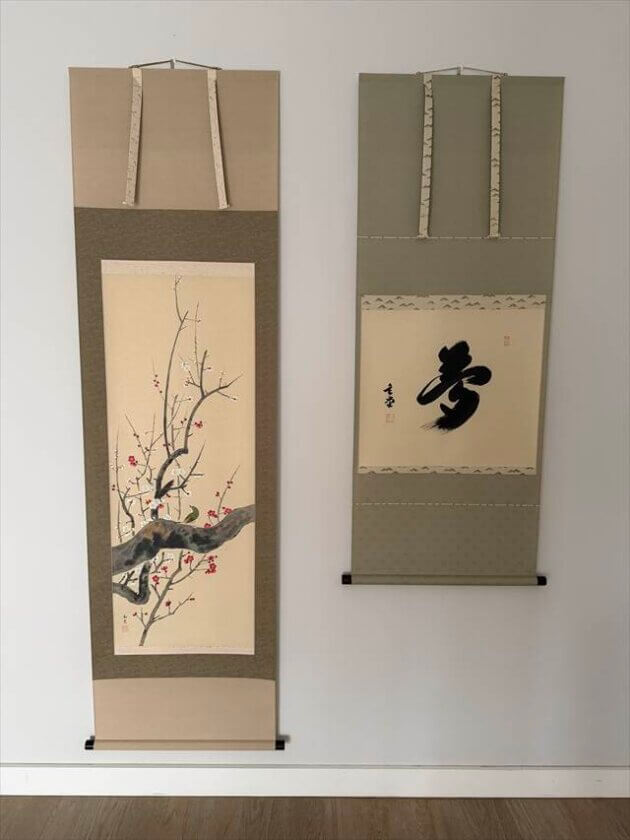
In the end, she chose this hanging scroll of “Yume,” meaning “Dream.”
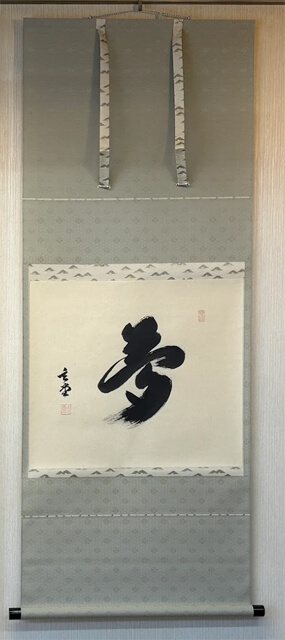
We felt that the graceful feeling of the calligraphy and the color balance of the mounting matched the customer’s taste very well.
The Meaning Behind the Mounting: “Climbing the Mountain to Reach a Dream”
During the conversation, the customer asked us about the ichimonji fabric.
Ichimonji refers to the narrow fabric sections placed above and below the main artwork.
It is an important element that tightens and refines the overall impression of the hanging scroll.
For this “Yume” hanging scroll, we had chosen an ichimonji fabric with a mountain pattern.
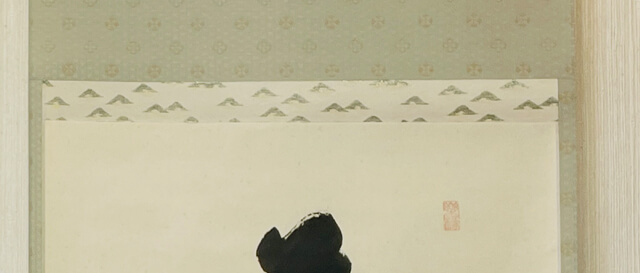
When the customer asked why the mountain pattern had been used, we explained that we selected it with the image of effort toward achieving a dream being like climbing a mountain.
Step by step, one continues the climb, and at the summit, the goal is reached and the dream comes true.
Rather than simply choosing a beautiful fabric, we try to create a natural connection between the meaning of the calligraphy and the design of the mounting.
This is one of the areas where the sensibility of a hyōgushi, a traditional Japanese mounting artisan, appears.
After hearing the explanation, the customer seemed to understand and appreciate the meaning very deeply.
Searching for a Flower Scroll to Match the Calligraphy
After the calligraphy hanging scroll had been decided, we moved on to choosing the flower scroll.
Since the customer was not particular about a specific season, we introduced many different hanging scrolls with flowers, birds, and plants.
These included peony, flowers of the four seasons, cosmos, Japanese snake gourd, cherry blossoms, camellia, chrysanthemum, nandina, red-and-white plum blossoms, and the Four Gentlemen—a traditional East Asian motif featuring plum blossom, orchid, bamboo, and chrysanthemum, each symbolizing the virtues of a cultivated scholar.
The customer’s preference was not completely clear from the beginning.
However, as she looked at many scrolls one by one, the direction of her taste gradually became clearer.
What was especially memorable was that she preferred works that valued blank space, rather than paintings where the background was fully covered with pigment.
She also preferred calm, soft, and simple works, rather than vivid or strongly colored ones.
How the Camellia Scroll Helped Reveal the Customer’s Taste
The customer liked the composition and atmosphere of the camellia hanging scroll very much.
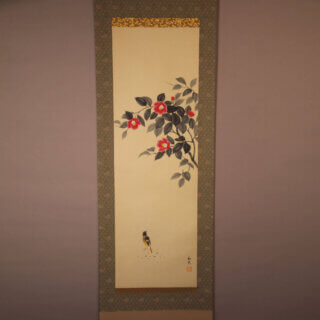
However, the red color made a slightly strong impression, and it seemed a little too vivid for her taste.
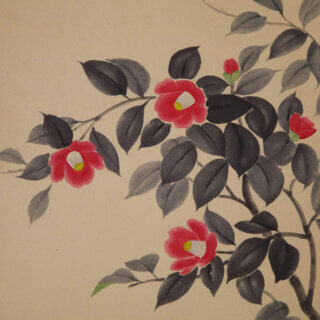
“The composition is beautiful, but it would be nice if the color were a little softer.”
From this reaction, we began to understand that the customer was not looking for a flashy hanging scroll that simply caught the eye.
Instead, she was looking for a scroll with blank space, gentle color, and a quiet atmosphere that would naturally blend into the room.
The time spent choosing a hanging scroll is not only time spent looking at artworks.
It is also time for the customer to put their own taste into words.
At ART NOMURA, we listen carefully to these small reactions and search for works that come close to the customer’s sensibility.
Narrowing the Candidates Down to Two Scrolls
When choosing a hanging scroll, it is important to look at many pieces.
However, if too many scrolls remain displayed until the end, it can actually make the decision more difficult.
This time as well, after the customer had compared several scrolls, her candidates gradually narrowed down to two.
At that point, we put away all the other hanging scrolls that had been displayed and left only the final two candidates side by side.
This was to help the customer concentrate.
In the final stage, it is better to compare only the scrolls that truly matter.
That way, the emotional response becomes much clearer.
When choosing a hanging scroll, knowledge alone is not enough.
The atmosphere felt in front of the piece, and the feeling one imagines when displaying it at home, are also very important.
For that reason, it is sometimes necessary to reduce the number of candidates and create a quiet moment for comparison.
The Final Choice: A Hanging Scroll Depicting Red and White Plum Blossoms with a Japanese Bush Warbler (Uguisu)
The customer finally chose a hanging scroll depicting red and white plum blossoms with a Japanese bush warbler (uguisu).
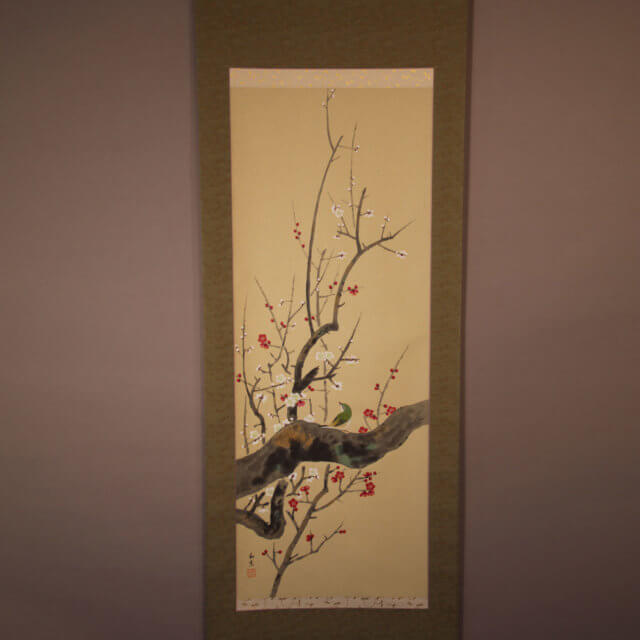
We felt that the deciding points were its beautifully open composition, its modest elegance, and the charming presence of the small bird.
In Japanese art, plum blossoms and the Japanese bush warbler (uguisu) are a classic combination that symbolizes the arrival of spring.
Although red and white plum blossoms can appear quite decorative as a subject, this particular scroll was not overly showy.
The balance between the blossoms, the bird, and the surrounding blank space was very refined.
The small uguisu also gave the entire work a gentle and delightful feeling.
The customer’s smile when she noticed the bird was especially memorable.
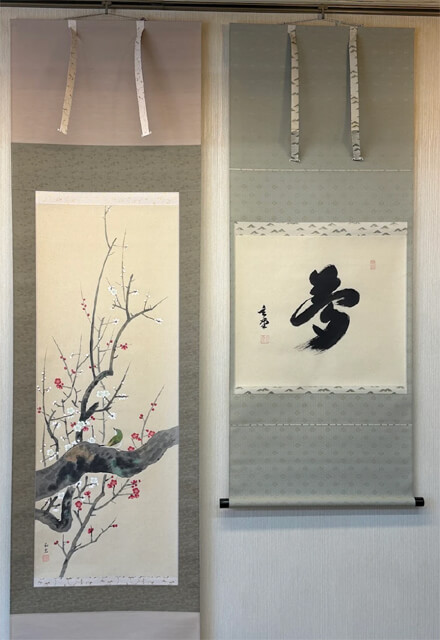
When displayed together with the calligraphy “Yume,” the flower scroll does not compete for attention.
Instead, it adds a quiet brightness to the space, creating a very harmonious combination.
Exploring the Customer’s Taste Is Part of Professional Service
During this visit, the customer saw quite a large number of hanging scrolls.
Because our display space is limited, scrolls that were no longer candidates were rolled up again, and new scrolls were shown in their place.
Because of this, the customer apologized several times, seeming to feel sorry that we were taking out so many scrolls.
However, for us, searching through a large stock of hanging scrolls to find one that matches the customer’s taste is part of our normal service.
In fact, when customers tell us honestly, “This color is a little strong,” “I like this atmosphere,” or “I would prefer something softer,” the outline of their taste becomes clearer.
That is why it is important for us to listen carefully to the customer’s preferences and take time to narrow down the candidates.
We told the customer, “This is our normal service, so please do not worry.”
In the end, it seemed that she enjoyed the process of seeing so many hanging scrolls, which made us very happy.
The Difficulty of Explaining Japanese Plants and Seasonal Atmosphere in English
During this visit, there were many moments when we explained Japanese plant names in English.
Some plants, such as kiku, karasu-uri, and hagi, can be a little difficult to explain in English.
For Japanese people, these subjects may naturally evoke a seasonal atmosphere.
However, for customers from overseas, the charm may not fully come across unless the names and meanings are explained.
The plants depicted on hanging scrolls are not merely decorative elements.
They contain a sense of season, auspicious meaning, the beauty of blank space, and the enjoyment of the subject matter itself.
Even if our English is not perfect, by doing our best to convey these meanings, we feel that overseas customers can enjoy Japanese hanging scrolls more deeply.
Explaining How to Carry, Display, and Store the Hanging Scrolls
In the end, the customer chose two scrolls: the calligraphy hanging scroll of “Yume” and a flower-and-bird hanging scroll depicting red and white plum blossoms with a Japanese bush warbler (uguisu).
After the purchase, we explained how to display and store the hanging scrolls, and we also provided an instruction sheet.
With kakejiku, not only the way they are displayed but also the way they are rolled and stored is important.
This is especially important when a customer takes them overseas, because the scrolls need to be protected during travel.
This time, the customer was taking them home by airplane, so we packed the two hanging scrolls in a way that would make them easier to carry.
We want hanging scrolls purchased during a trip to be displayed properly and enjoyed for many years in the customer’s daily life.
We believe that this is also an important part of our work.
Google Review
After the visit, the customer kindly wrote a Google review.
The original review was written in German.
Ich wurde exzellent beraten und über zwei Stunden lang von dem Landeninhaber und zwei Angestellen betreut – bis wir genau die zwei Kakejiku fanden, die ich mir vorgestellt hatte. Der Inhaber sprach gut Englisch und ich bin sehr dankbar für die Zeit und weiß dieses besondere Geschäft sehr zu schätzen. Ich werde sicherlich wiederkommen. Vielen Dank.
I received excellent advice and was assisted for more than two hours by the shop owner and two staff members, until we found exactly the two kakejiku I had imagined. The owner spoke good English, and I am very grateful for the time. I truly appreciate this special shop. I will certainly come again. Thank you very much.
Receiving such kind words was a great honor for us.
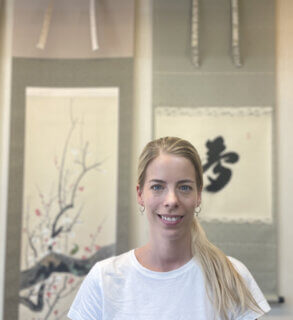
Here is a photo of the scrolls actually displayed in the her room after returning home.
Choosing a Hanging Scroll Is a Time to Discover the Customer’s Taste Together
This visit did not begin with a clear answer already decided.
First, the customer chose the calligraphy hanging scroll. Then, while searching for a flower scroll to display with it, her taste gradually became clearer.
The camellia scroll had a beautiful composition, but the red color was a little strong.
She preferred something with blank space, soft colors, and a calm atmosphere.
And finally, she chose the hanging scroll depicting red and white plum blossoms with a Japanese bush warbler.
In this way, comparing actual hanging scrolls in person and gradually discovering one’s own taste is one of the great pleasures of choosing a hanging scroll at our shop.
If the encounter with a single hanging scroll becomes a good memory of a trip to Japan, and if that scroll continues to bring joy in the customer’s daily life afterward, nothing would make us happier.
If you are looking for a hanging scroll in Kōbe, or if you are visiting Japan from overseas and would like to see Japanese kakejiku in person, please feel free to contact us.
At ART NOMURA, we will listen carefully to your taste and help you find a hanging scroll that you truly love from among our large stock.