Reproducing a Kakejiku|Creating a Reproduction of a Master’s Calligraphy That Could No Longer Be Displayed
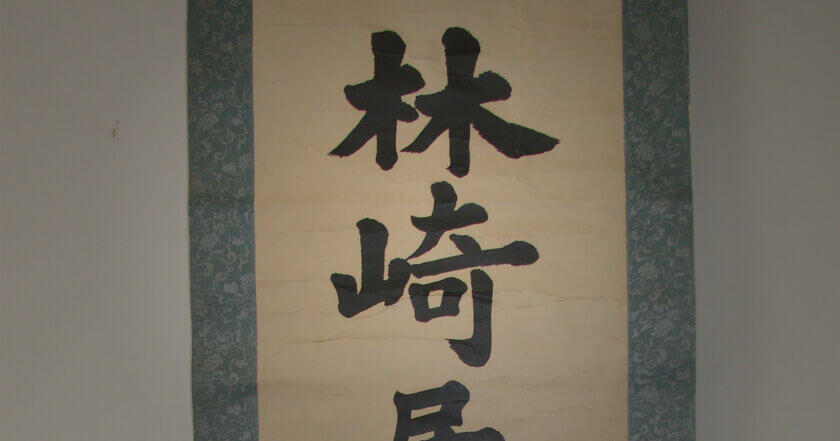
When a kakejiku has become badly damaged, many people naturally consider having it restored.
Of course, we also believe that restoring a kakejiku and bringing it back to a condition where it can be displayed again is a very meaningful choice.
However, such restoration work requires delicate specialist techniques, many years of experience, and a tremendous amount of time. For that reason, the cost can often become quite high.
The option we would like to introduce in this article is not “restoration,” but “reproduction of a kakejiku.”
Even if you wish to make a badly damaged kakejiku displayable again, depending on the condition of the original, creating a reproduction may sometimes be a better fit for your budget and purpose than restoring the original itself.
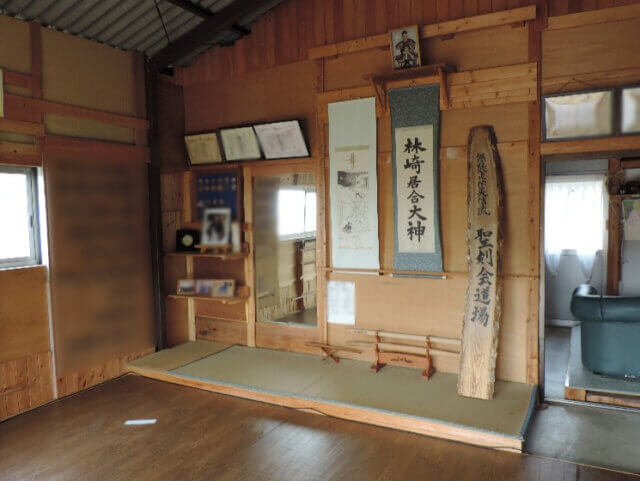
This time, we would like to introduce a reproduction kakejiku project requested by a customer from Akashi City, Hyōgo Prefecture, Japan who wanted to display the scroll once again at a dōjō (martial arts training hall).
Background of the Consultation
A customer from Akashi City contacted us with a request to make a kakejiku bearing a sacred calligraphic inscription displayable again at a dōjō.
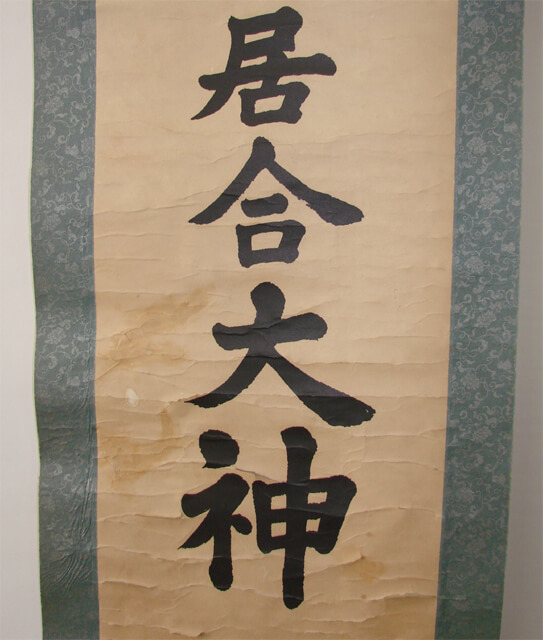
The original kakejiku was an important calligraphy work written by the customer’s master. However, over many years, the scroll had become badly damaged, with tears and other deterioration, making it difficult to display.
The customer had tried to repair it personally by attaching fusuma paper and other materials, hoping to somehow improve the condition. However, because kakejiku have their own structure and material characteristics, self-repair can sometimes make the condition worse rather than better.
As a result, the condition became even more difficult, and the customer decided to consult us in order to have it handled properly.
This consultation came to us through an introduction from a temple priest whose temple had previously used our services. The customer was one of the temple’s parishioners.
We could feel the customer’s desire to entrust this important piece to someone reliable, and we approached the project with a strong sense of responsibility.
The Customer’s Request and the Condition of the Original Scroll
The customer’s request had two main points.
The first was that the kakejiku should be displayable again at the dōjō.
The second was that the finished size and overall mounting atmosphere should be as close as possible to the original.
The original scroll had noticeable tears and losses, and the effects of the previous self-repair were also present.
If we had tried to restore the original scroll itself to a condition where it could be displayed again, the cost would have become quite high.
This was the key point in deciding the best direction for the project.
When Reproduction Is More Practical Than Restoration
There are, of course, cases where the most important goal is to repair and preserve the original itself.
However, in this case, the purpose was to display the scroll at the dōjō again in a condition that everyone could look at comfortably.
In such a situation, instead of forcing a heavily damaged original back into display condition, it may be more practical and economical to create a reproduction kakejiku based on the original calligraphy and finish it as a new scroll that can be displayed.
This project was exactly such a case.
However, expectation-setting is very important.
Reproduction is convenient, but because of the nature of scanning and printing on washi paper, the density of the ink, gradation, and color may differ from the original. It is not a process intended to create a reproduction so perfect that it cannot be distinguished from the original.
Although it did not apply in this case, we also explained that gold, silver, and special pigments can only be reproduced approximately in print.
The customer understood these points, and we proceeded with the project as a kakejiku reproduction.
Our Proposal|Not Printing the Damaged Condition as It Was
This was the part that the customer was especially pleased with.
When a badly damaged original is scanned, the tears, losses, and damaged areas naturally appear in the digital data as they are.
However, considering that the purpose was to display the scroll again at a dōjō, we felt that faithfully reproducing the damaged condition would not be the best solution.
Instead, we believed that correcting the damaged areas in the scanned data as much as possible and printing it in a cleaner, more presentable condition would lead to a better result for the customer.
Therefore, we proposed correcting the tears and damaged areas digitally before printing, so that the final piece would look visually balanced and appropriate for display.
The customer agreed, saying that this approach would be preferable, and we proceeded in that direction.
We also adjusted the overall balance so that the finished dimensions and mounting atmosphere would remain as close as possible to the original scroll.
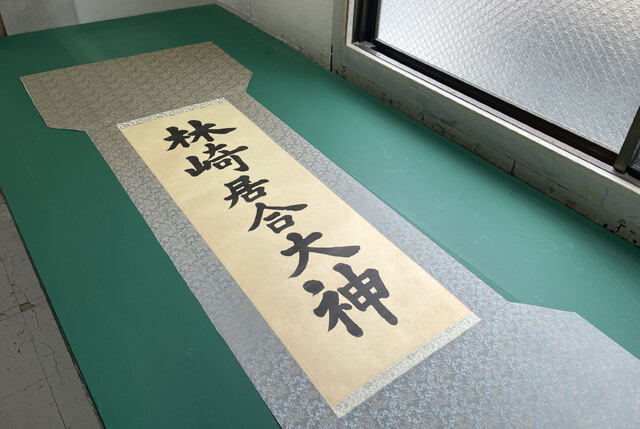
The Finished Reproduction Kakejiku
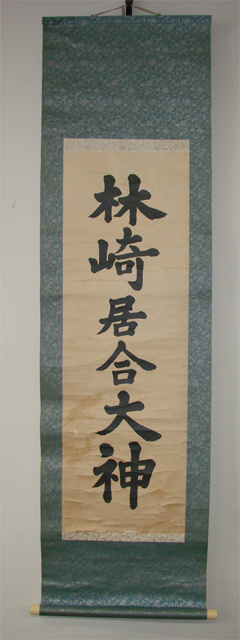
Here is the reproduction kakejiku made by printing the scanned and corrected image and mounting it as a hanging scroll.
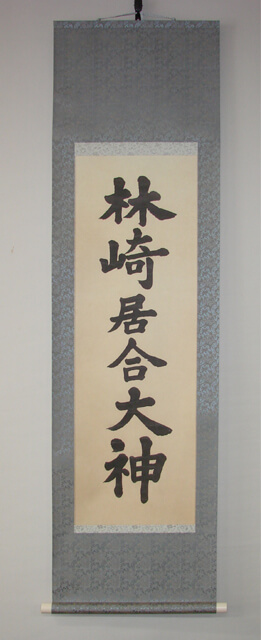
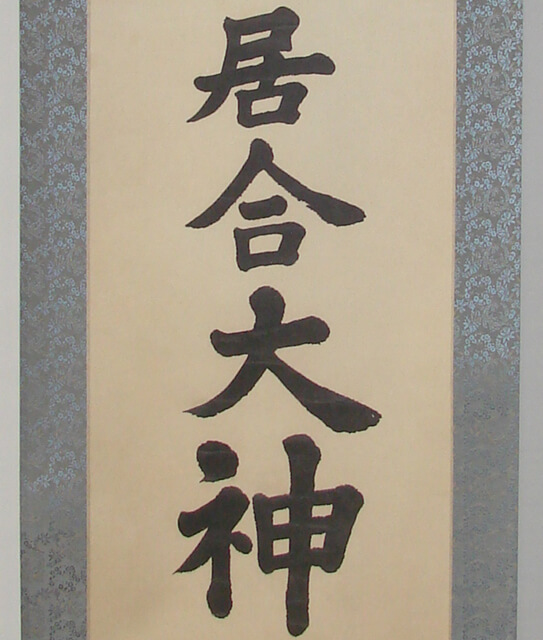
After completion, the appearance was greatly improved, and the scroll became suitable for display once again at the dōjō.
Rather than displaying a restored original that would still carry visible tears and damage, we brought the piece closer to a condition that would feel natural and comfortable to display.
As a result, we feel that the scroll regained its presence as a sacred calligraphic kakejiku for the dōjō.
Customer Feedback
The customer was very pleased with the finished piece, and we were told that the members of the dōjō were also happy with it.
We sincerely hope that this reproduction kakejiku will become a natural part of their daily training space.
Nothing would make us happier than knowing that the scroll can once again support the atmosphere of the dōjō.
Conclusion|Reproduction as an Option for Kakejiku
When a kakejiku has become badly damaged, restoring the original is not always the only best solution.
If the purpose is to display it again, and the condition of the original is severe, creating a reproduction kakejiku may be a more practical option in terms of cost and overall satisfaction.
Self-repair of mounting works is often difficult, and in some cases it can make the condition worse.
That is why it is important to first consider the current condition and the purpose of the piece, and then decide which method is the most natural and reasonable.
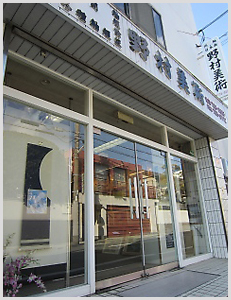
At ART NOMURA, we examine the actual item and propose the most appropriate solution within a realistic and careful range.
If you are wondering whether it is possible to create a reproduction of a kakejiku, please feel free to contact us.