
Noguchi Yūkoku: Nanga Painter Who Was Good at Drawing Elegant Kachō-ga

Kankōnozu (Early Spring)
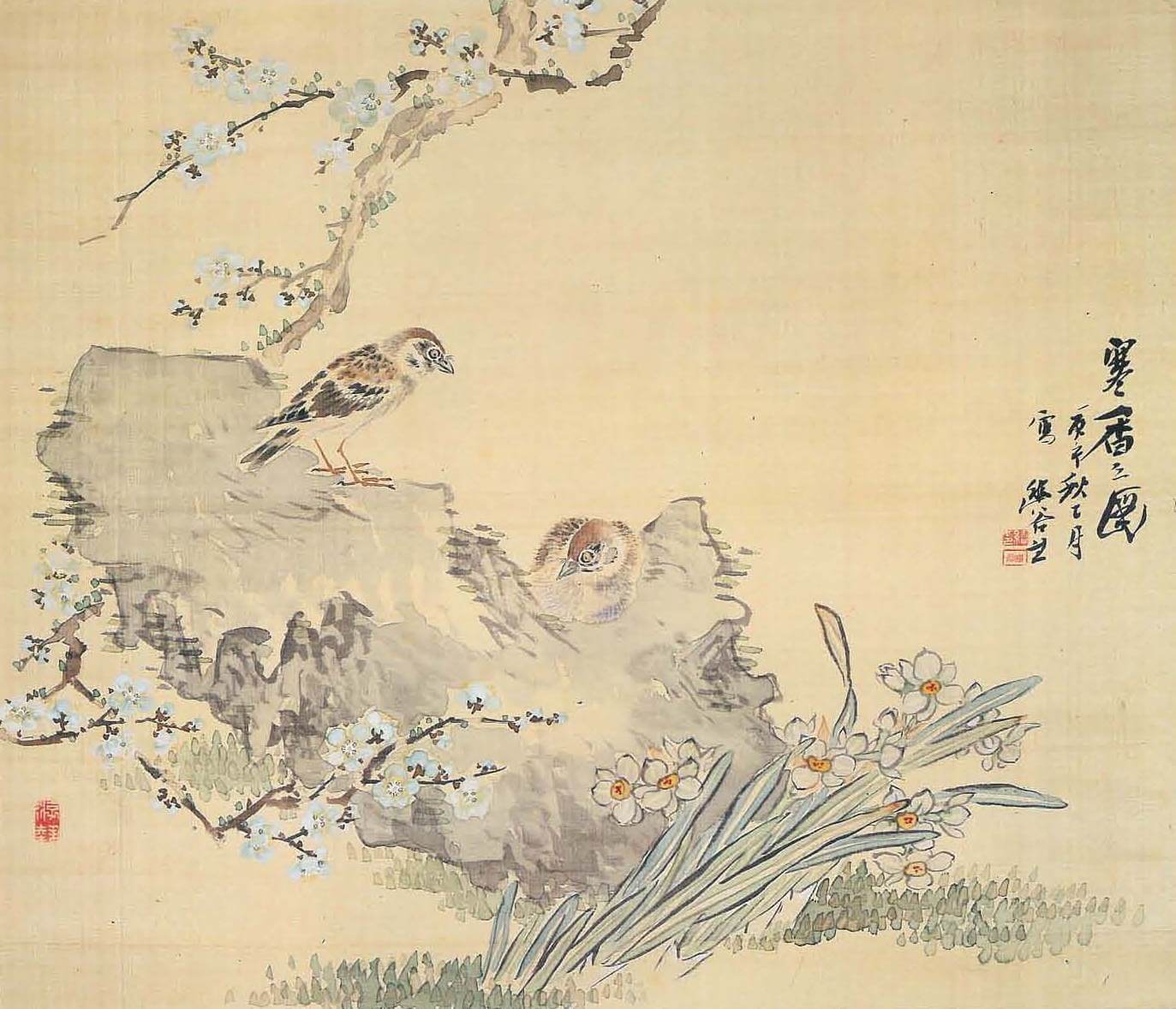
Kankōnozu (Early Spring) by Noguchi Yūkoku

Noguchi Yūkoku was born in 1825 in Edo as the son of a carpenter. Since he had a serious illness when he was a child, he became a Miya-carpenter (a carpenter who builds temples, shrines, etc.) thinking that he could just draw the blueprint, but he realized that he needed to study painting to draw the blueprint of a sculpture. He met with some Shijō school painters at first, but then became a disciple of Tsubaki Chinzan. Chinzan was skillful in all of the Jinbutsu-ga (figure painting), Sansui-ga (landscape painting), Kaki-ga (painting of plants), Kachō-ga(painting of flowers and birds), Chōjū-ga (painting of birds and beasts), but he was particularly good at Kachō-ga. Yūkoku started his training in painting in earnest under Chinzan, but he worked as a carpenter in the daytime to earn money and spent his time learning painting and calligraphy exclusively at night. Chinzan died four years after Yūkoku became a disciple. After that, he opened a calligraphy terakoya (school) to earn money and to work harder on painting. The painting name Yūkoku was given when Chinzan was still alive. When he told his master that he wanted to draw a picture with the intention that his heart was in a valley deep in nature, even though he was living in the dust of the streets, the master who was impressed by the disciple allowed the name of Yūkoku (幽谷, means “mountain glens”). After the death of Chinzan, he studied paintings by Yuan and Ming painters and Watanabe Kazan and refined his painting skills. After the Meiji period, he was active as a painter by exhibiting at Hakurankai and Kyōshinkai exhibitions inside and outside Japan and became a Teishitsu Gigei-in (imperial artist) in 1893. He died in 1898 at the age of 72.

The “Kankōnozu (Early Spring)” has a trace of enjoying poetry when completing the work. Although it is still early in spring, the painting is full of fragrances such as plum blossoms and daffodils that herald spring. Unknown grasses are sprouting from the ground, and sparrows resting on the rocks seem to enjoy the warmth of spring. A kachō-ga expressing the full spring is good, but prior to that, the kachō-ga telling the arrival of spring is also good.

Kikkazu (Chrysanthemums)
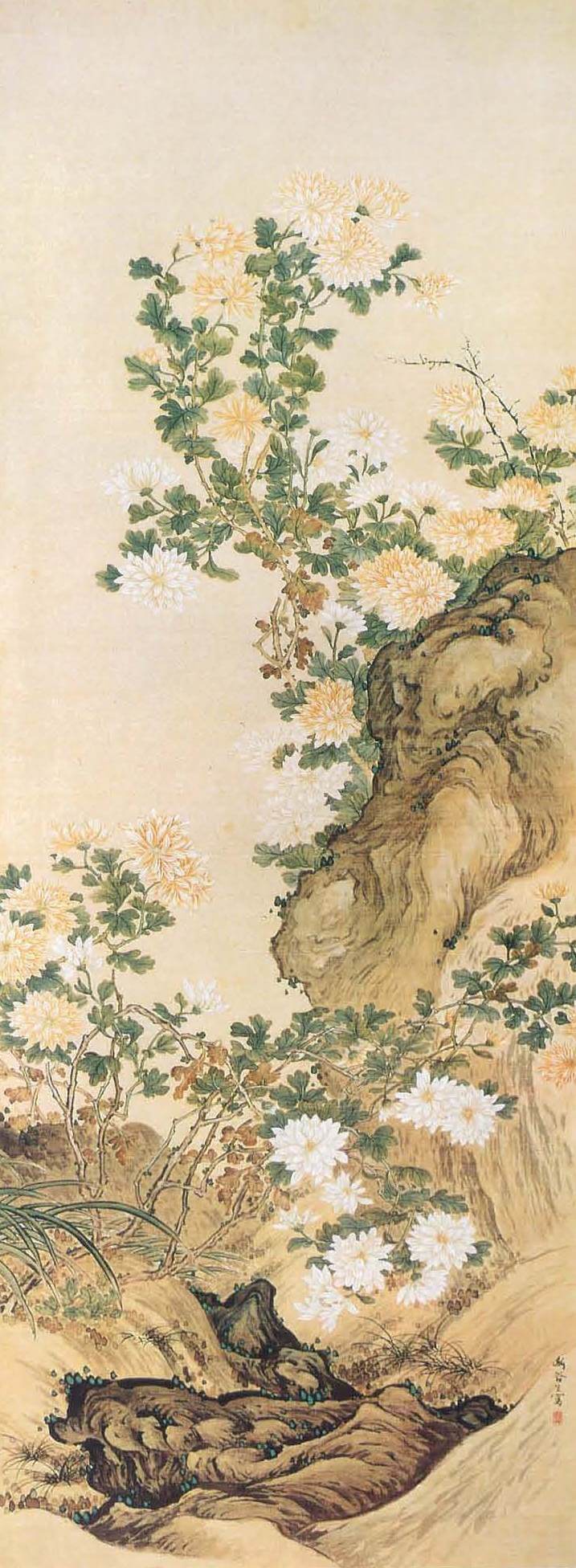
Kikkazu (Chrysanthemums) by Noguchi Yūkoku

“Kikkazu (Chrysanthemums)” is a painting exhibited at the 1st Naikoku Kaiga Kyōshinkai exhibition in 1882, as a judge. Yūkoku had received a silver award for this work. It depicts the chrysanthemum flowers that Yūkoku liked the most. His teacher, Chinzan, died four years after Yūkoku became his disciple. Therefore, he worked on his painting by imitating the paintings of Watanabe Kazan, who was the teacher of Chinzan, and the painter of Yuan and Ming. In particular, he was enthusiastically trying to learn the mokkotsu technique [“Mokkotsu” is a technique where the object is expressed by the shading of “sumi” ink or color rather than by using outlines (“koppō”.)  It is widely known as a technique for Kachō-ga (paintings of flowers and birds)] of Yun Shouping’s Kachō-ga, which Kazan liked, as an extension of his teacher, Chinzan. “Kikkazu” is a masterpiece of Yūkoku with a style of Yun Shouping’s Kachō-ga. Many nanga painters were born from the end of the Edo period to the Meiji period, but few painters surpass Yūkoku in the spiritual depth and dexterity. With the mokkotsu technique, he drew the painting similar to sketching, but he drew the painting with higher aspirations. This work is a refreshing picture befitting the name Yūkoku (幽谷, means mountain glens) as if he drew it in a valley deep in nature.
    NameRequired

    SexRequired

    MaleFemale

    CountryRequired

    e-mailRequired

    CommentRequired

    Attached File
    ※Up to 3 MB for each file.


    ← ← "MUST CHECK" / Please confirm the above contents again and check this button.

    Contact Us

    Please fill out the form below and submit for your inquiry.

    ❈FirstName
    ❈LastName
    Country
    ❈E-mail
    (❈Confirm E-mail)
    ❈Inquiry category Question
    Consultation
    Impression
    Request
    Others
    ❈Comment

    is the mark for required item.


    Your privacy is important to us. We are committed to protecting your privacy.

    (or press ESC or click the overlay)

    CEO Message

    Our Feelings For Kakejiku


     The Japanese people have long set a high value on aesthetic senses since ancient times. As a result, the
    peculiar culture which is not seen in other countries blossomed and many aspects of the modern Japanese
    culture come from it. Parts of Japanese culture has been introduced to people in other countries recently,
    so the number of people from other countries who are interested in Japanese culture has been increasing.
    However, the Japanese aesthetic senses, which are the bases of Japanese culture, have been nurtured
    through a long history, intertwining various elements intricately, such as climate, geographical features,
    religion, customs and so on. Therefore, they are very difficult to understand not only for people from other
    countries, but even for the Japanese people. I think the best tool which conveys these difficult senses
    understandably is a “kakejiku.”
     The kakejiku (a hanging scroll; a work of calligraphy or a painting which is mounted and hung in an
    alcove or on a wall) is a traditional Japanese art. It's no exaggeration to say that paintings are what
    express aesthetic senses at all times and places. The kakejiku is an art which expresses the Japanese
    aesthetic senses. The kakejiku has long been used in traditional Japanese events, daily life and so on since
    ancient times. As a result, there are various customs of kakejiku in Japan; kakejiku and the life of the
    Japanese are closely related. We can see Japanese values through kakejiku.
     The kakejiku is a cultural tradition which the Japanese people should be proud of. However, many people
    in other countries don't know much about it because it hasn't been showcased as much. This is why I
    decided to try to introduce it. The kakejiku world is very interesting and beautiful. We want not only the
    Japanese, but also many people from other countries to know and enjoy it. I hope that many people will
    love kakejiku someday.

    (or press ESC or click the overlay)
    Company Profile
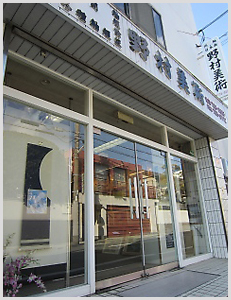
    syaoku.jpg(120220 byte)

    Name Art Nomura


    President Tatsuji Nomura


    Founded1973


    Established1992


    Address7-23 Babadori, Tarumi-ku, Kobe city,
    Hyougo Prefecture, 655-0021, Japan


    Capital10 million yen


    URLhttp://nomurakakejiku.com


    Our Business

     Art Nomura is an art dealer which produces kakejiku (hanging scrolls). We mount many paintings and calligraphic works in kakejiku in my factory. Kakejiku are our main product. We also remount and repair old or damaged kakejiku. We share the traditional Japanese art of kakejiku with people all over the world.


    (or press ESC or click the overlay)
    Access Map

    Access Map


     The Japanese people have long set a high value on aesthetic senses since ancient times. As a result, the
    peculiar culture which is not seen in other countries blossomed and many aspects of the modern Japanese
    culture come from it. Parts of Japanese culture has been introduced to people in other countries recently,
    so the number of people from other countries who are interested in Japanese culture has been increasing.
    However, the Japanese aesthetic senses, which are the bases of Japanese culture, have been nurtured
    through a long history, intertwining various elements intricately, such as climate, geographical features,
    religion, customs and so on. Therefore, they are very difficult to understand not only for people from other
    countries, but even for the Japanese people. I think the best tool which conveys these difficult senses
    understandably is a “kakejiku.”
     The kakejiku (a hanging scroll; a work of calligraphy or a painting which is mounted and hung in an
    alcove or on a wall) is a traditional Japanese art. It's no exaggeration to say that paintings are what
    express aesthetic senses at all times and places. The kakejiku is an art which expresses the Japanese
    aesthetic senses. The kakejiku has long been used in traditional Japanese events, daily life and so on since
    ancient times. As a result, there are various customs of kakejiku in Japan; kakejiku and the life of the
    Japanese are closely related. We can see Japanese values through kakejiku.
     The kakejiku is a cultural tradition which the Japanese people should be proud of. However, many people
    in other countries don't know much about it because it hasn't been showcased as much. This is why I
    decided to try to introduce it. The kakejiku world is very interesting and beautiful. We want not only the
    Japanese, but also many people from other countries to know and enjoy it. I hope that many people will
    love kakejiku someday.

    (or press ESC or click the overlay)