
Kodama Katei: A Literati Painter Who Loved Nagano

Kaki Reimō Gyokudōfuki Sōhaku Heiankyō (Two Meadow Buntings Praying for Peace with Peonies, Magnolias, and Crabapple Trees)
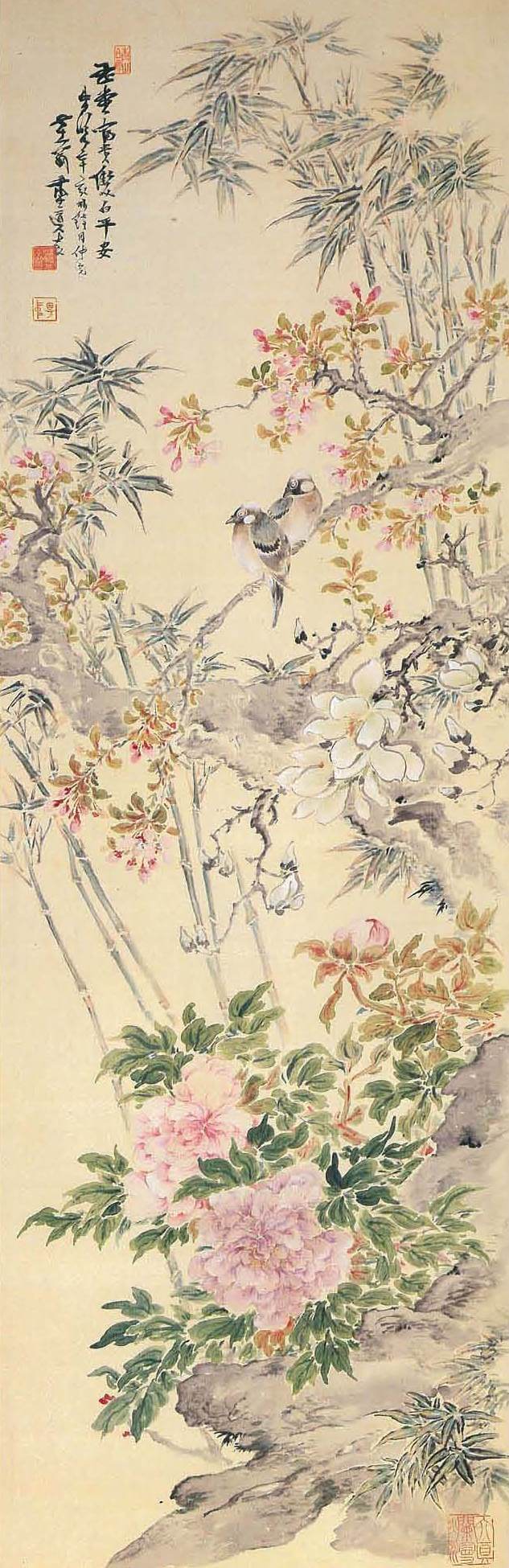
Kaki Reimō Gyokudōfuki Sōhaku Heiankyō (Two Meadow Buntings Praying for Peace with Peonies, Magnolias, and Crabapple Trees) by Kodama Katei

Kodama Katei was born in Nagano prefecture in 1841. Losing his father at the age of 12, he studied under Sakuma Unsō, a painter from the Nanpin school, and also learned Zen from Azegami Baisen. When his house was burned down by a fire in his village, Katei was left with no other option but to leave the prefecture to wander around various places. During this time, he reunited with Baisen in Odawara and then headed for Tokyo, where he studied under Tanomura Chokunyū. In 1889, when he was 40 years old, he returned to his hometown and entered a life of indulging in painting. Hereafter, he never once left the place for the remaining 33 years of his life. He exhibited a masterpiece at the first Tōyō Kaiga Kyōshinkai Exhibition in 1886, where he was awarded a silver prize, but despite his rise to fame, Katei remained indifferent to it and refused any endorsements to be recommended as an Imperial Household Artist. He lost his home once again due to a landslide in 1896, and despite struggling from extreme poverty, continued to focus on his creations. He died in 1913, at the age of 73. His painting style consists of a combination of styles from various schools, notably the style of Ming-Qing paintings. In this way, Katei opened up his own distinctive approach to the Meiji period’s Nanga paintings, and his works are highly regarded for their virtuous and refreshing qualities.

This painting is from 1911, when Katei was 71 years old. ‘Gyokudōfuki’ is a common art motif in nanga paintings along with the ‘Three Friends of Winter (comprised of pine, bamboo, and plum.)’  ‘Fuki’ is another word for peonies, ‘gyoku’ is for magnolias, and ‘dō’ is for crabapple trees — the art motif consists of portraying the three flowers in one painting. Katei furthermore places bamboos, plants that never break no matter how strong the wind, with the peonies, and therefore adds another art motif, ‘Fūki Heian,’ meaning ‘prosperity and peace.’ The painting also includes two little birds that are most likely meadow buntings. Katei was perhaps fond of this motif as there are other works similar to this style. In any case, this spring garden in which the little birds play in, painted with Katei’s skilled brushstrokes and fresh colors, seems as if it is a utopia that was only manifested by Katei, who was a painter that separated himself from the turbulent world and lived high in the mountains.
    NameRequired

    SexRequired

    MaleFemale

    CountryRequired

    e-mailRequired

    CommentRequired

    Attached File
    ※Up to 3 MB for each file.


    ← ← "MUST CHECK" / Please confirm the above contents again and check this button.

    Contact Us

    Please fill out the form below and submit for your inquiry.

    ❈FirstName
    ❈LastName
    Country
    ❈E-mail
    (❈Confirm E-mail)
    ❈Inquiry category Question
    Consultation
    Impression
    Request
    Others
    ❈Comment

    is the mark for required item.


    Your privacy is important to us. We are committed to protecting your privacy.

    (or press ESC or click the overlay)

    CEO Message

    Our Feelings For Kakejiku


     The Japanese people have long set a high value on aesthetic senses since ancient times. As a result, the
    peculiar culture which is not seen in other countries blossomed and many aspects of the modern Japanese
    culture come from it. Parts of Japanese culture has been introduced to people in other countries recently,
    so the number of people from other countries who are interested in Japanese culture has been increasing.
    However, the Japanese aesthetic senses, which are the bases of Japanese culture, have been nurtured
    through a long history, intertwining various elements intricately, such as climate, geographical features,
    religion, customs and so on. Therefore, they are very difficult to understand not only for people from other
    countries, but even for the Japanese people. I think the best tool which conveys these difficult senses
    understandably is a “kakejiku.”
     The kakejiku (a hanging scroll; a work of calligraphy or a painting which is mounted and hung in an
    alcove or on a wall) is a traditional Japanese art. It's no exaggeration to say that paintings are what
    express aesthetic senses at all times and places. The kakejiku is an art which expresses the Japanese
    aesthetic senses. The kakejiku has long been used in traditional Japanese events, daily life and so on since
    ancient times. As a result, there are various customs of kakejiku in Japan; kakejiku and the life of the
    Japanese are closely related. We can see Japanese values through kakejiku.
     The kakejiku is a cultural tradition which the Japanese people should be proud of. However, many people
    in other countries don't know much about it because it hasn't been showcased as much. This is why I
    decided to try to introduce it. The kakejiku world is very interesting and beautiful. We want not only the
    Japanese, but also many people from other countries to know and enjoy it. I hope that many people will
    love kakejiku someday.

    (or press ESC or click the overlay)
    Company Profile
    syaoku.jpg(120220 byte)

    Name Art Nomura


    President Tatsuji Nomura


    Founded1973


    Established1992


    Address7-23 Babadori, Tarumi-ku, Kobe city,
    Hyougo Prefecture, 655-0021, Japan


    Capital10 million yen


    URLhttp://nomurakakejiku.com


    Our Business

     Art Nomura is an art dealer which produces kakejiku (hanging scrolls). We mount many paintings and calligraphic works in kakejiku in my factory. Kakejiku are our main product. We also remount and repair old or damaged kakejiku. We share the traditional Japanese art of kakejiku with people all over the world.


    (or press ESC or click the overlay)
    Access Map

    Access Map


     The Japanese people have long set a high value on aesthetic senses since ancient times. As a result, the
    peculiar culture which is not seen in other countries blossomed and many aspects of the modern Japanese
    culture come from it. Parts of Japanese culture has been introduced to people in other countries recently,
    so the number of people from other countries who are interested in Japanese culture has been increasing.
    However, the Japanese aesthetic senses, which are the bases of Japanese culture, have been nurtured
    through a long history, intertwining various elements intricately, such as climate, geographical features,
    religion, customs and so on. Therefore, they are very difficult to understand not only for people from other
    countries, but even for the Japanese people. I think the best tool which conveys these difficult senses
    understandably is a “kakejiku.”
     The kakejiku (a hanging scroll; a work of calligraphy or a painting which is mounted and hung in an
    alcove or on a wall) is a traditional Japanese art. It's no exaggeration to say that paintings are what
    express aesthetic senses at all times and places. The kakejiku is an art which expresses the Japanese
    aesthetic senses. The kakejiku has long been used in traditional Japanese events, daily life and so on since
    ancient times. As a result, there are various customs of kakejiku in Japan; kakejiku and the life of the
    Japanese are closely related. We can see Japanese values through kakejiku.
     The kakejiku is a cultural tradition which the Japanese people should be proud of. However, many people
    in other countries don't know much about it because it hasn't been showcased as much. This is why I
    decided to try to introduce it. The kakejiku world is very interesting and beautiful. We want not only the
    Japanese, but also many people from other countries to know and enjoy it. I hope that many people will
    love kakejiku someday.

    (or press ESC or click the overlay)